
Compounded yearly is a fundamental concept in personal finance, investing, and the broader world of economics, describing how interest is calculated and added to an initial principal once every twelve months. This seemingly simple phrase underpins the growth of investments, the cost of loans, and the long-term accumulation of wealth. Understanding its mechanics is crucial for anyone navigating savings, debt, or financial planning.
The Core Concept of Compounding
At its heart, “compounded yearly” refers to a specific frequency of applying compound interest. To truly grasp its significance, it’s essential to first differentiate it from its simpler counterpart.
Simple Interest vs. Compound Interest
Simple interest is calculated solely on the original principal amount. If you invest $1,000 at a 5% simple interest rate, you would earn $50 each year ($1,000 * 0.05). After five years, you would have earned $250 in interest, bringing your total to $1,250. The principal never changes for the interest calculation.
Compound interest, famously dubbed “the eighth wonder of the world” by Albert Einstein, is interest calculated on the initial principal and also on all the accumulated interest from previous periods. This “interest on interest” effect creates an accelerating growth trajectory for investments and, conversely, an accelerating cost for debt. When interest is compounded, it means the interest earned (or charged) is added back to the principal, forming a new, larger principal for the next calculation period.
The Mechanics of Yearly Compounding
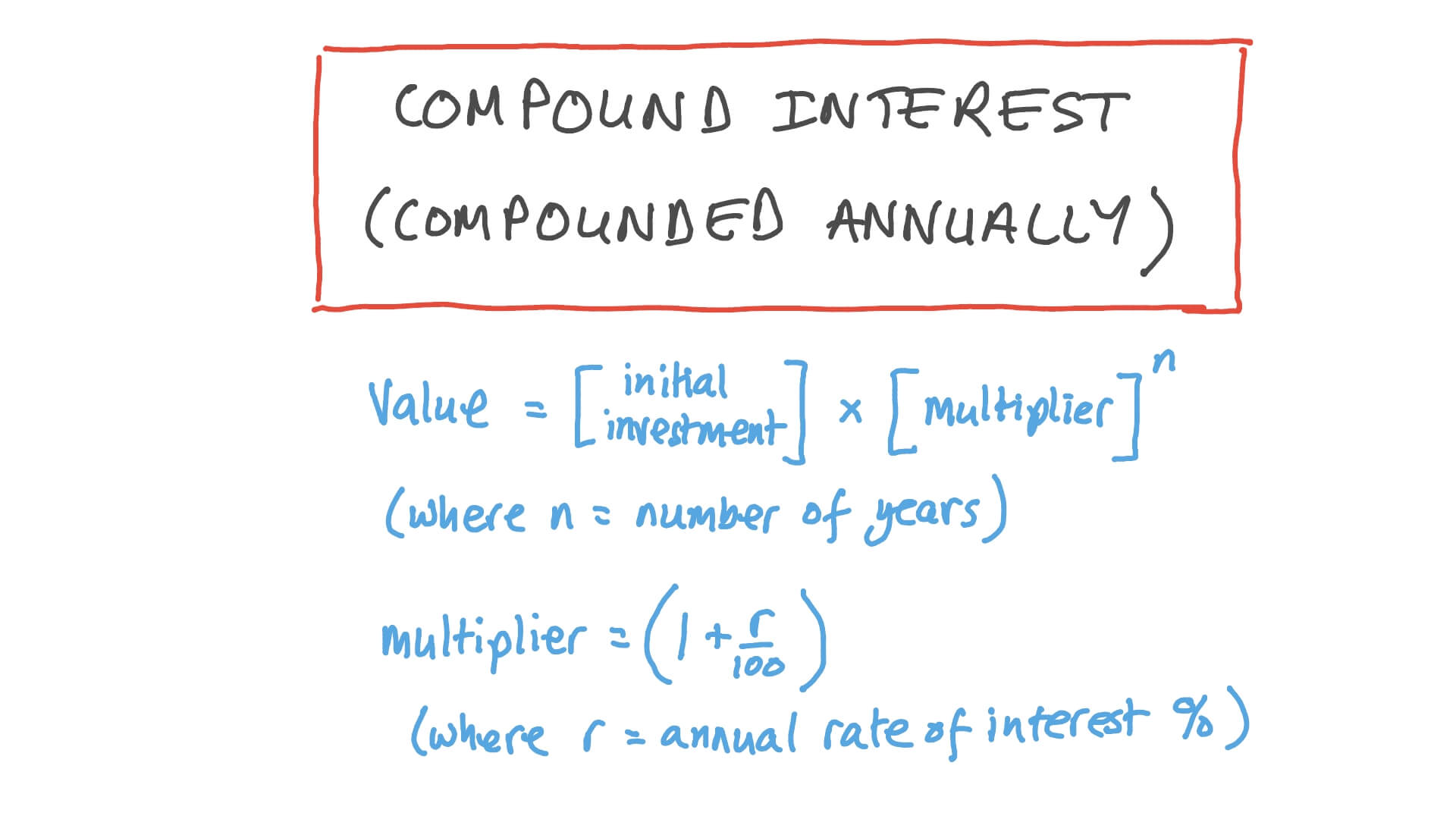
When interest is “compounded yearly,” this process occurs once every year. Let’s consider a practical example:
Imagine you deposit $10,000 into a savings account that offers a 5% annual interest rate, compounded yearly.
-
Year 1:
-
Initial Principal: $10,000
-
Interest Earned: $10,000 * 0.05 = $500
-
New Balance at End of Year 1: $10,000 + $500 = $10,500
-
-
Year 2:
-
Initial Principal for Year 2: $10,500 (the original principal plus the interest from Year 1)
-
Interest Earned: $10,500 * 0.05 = $525
-
New Balance at End of Year 2: $10,500 + $525 = $11,025
-
-
Year 3:
-
Initial Principal for Year 3: $11,025
-
Interest Earned: $11,025 * 0.05 = $551.25
-
New Balance at End of Year 3: $11,025 + $551.25 = $11,576.25
-
Notice how the interest earned increases each year ($500, then $525, then $551.25), even though the interest rate remains constant. This is the power of compounding: your money starts working harder for you, generating returns not just on your initial investment but also on the returns it has already produced.
Unpacking the “Yearly” Frequency
The term “yearly” specifies the frequency at which the compounding calculation takes place. While yearly compounding is straightforward, it’s important to understand it in the context of other potential compounding frequencies.
The Impact of Compounding Frequency
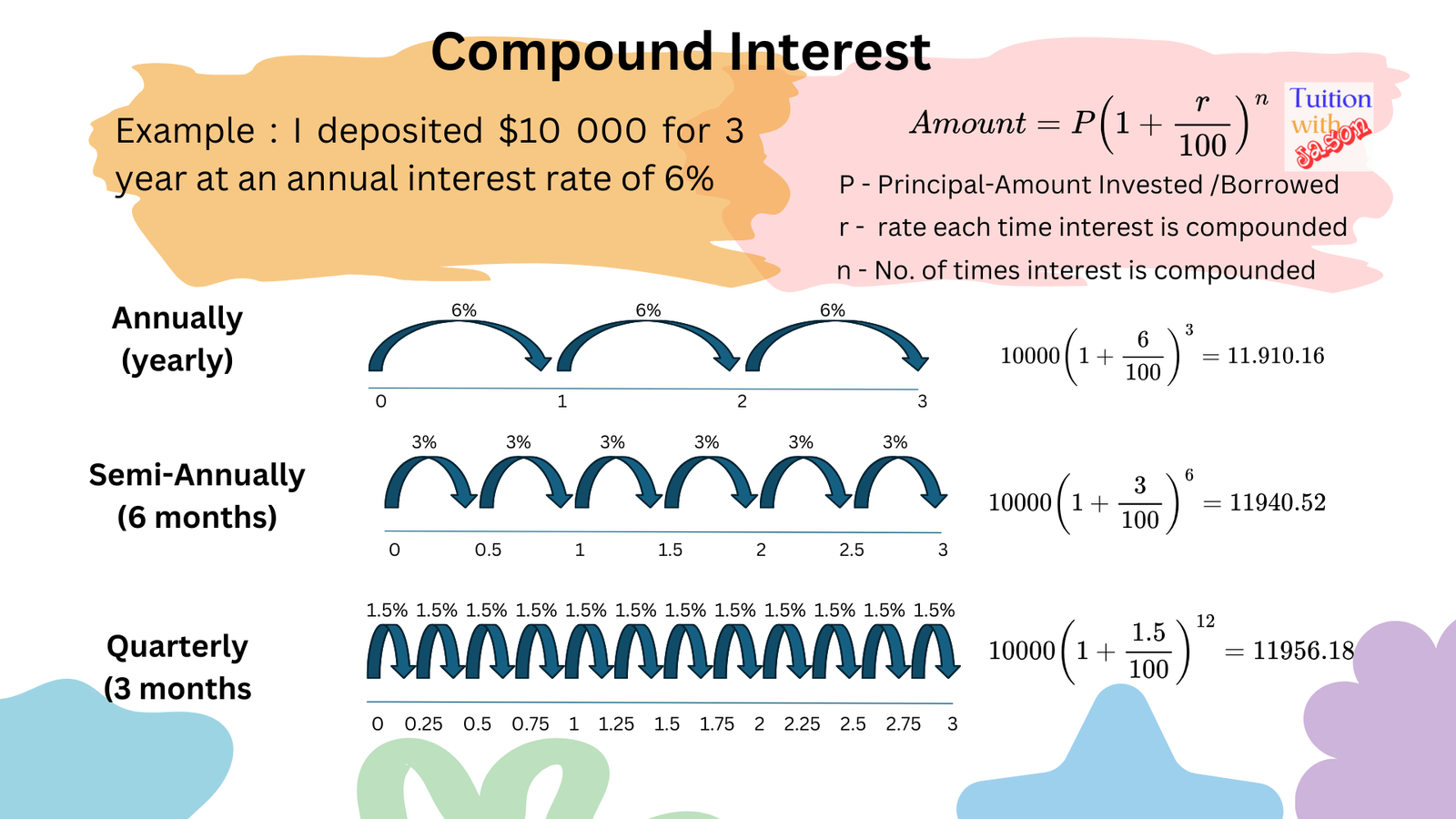
Interest can be compounded at various intervals: daily, monthly, quarterly, semi-annually, or annually (yearly). The more frequently interest is compounded, the faster your money grows (or your debt accumulates), assuming the same nominal annual interest rate. This is because the interest starts earning its own interest sooner.
For example, if the 5% interest in our previous example was compounded semi-annually (twice a year), it would be calculated as 2.5% every six months. If it were compounded monthly, it would be calculated as 5%/12 each month.
-
Daily compounding: Interest is calculated and added every day.
-
Monthly compounding: Interest is calculated and added every month.
-
Quarterly compounding: Interest is calculated and added every three months.
-
Semi-annual compounding: Interest is calculated and added every six months.
-
Yearly (Annual) compounding: Interest is calculated and added once a year.
While the difference between yearly and daily compounding might seem small over a single year, it becomes significant over long periods. More frequent compounding leads to a higher Annual Percentage Yield (APY) or Annual Equivalent Rate (AER), which is the effective rate you actually earn after factoring in the compounding.
Real-World Scenarios with Yearly Compounding
Yearly compounding is common in several financial products and calculations:
-
Bonds: Many bonds pay out interest (coupons) annually. If these coupon payments are reinvested, they effectively compound yearly.
-
Some Savings Certificates or Term Deposits: Certain fixed-term deposits or certificates of deposit (CDs) might specify interest compounded annually, with the full amount payable at maturity.
-
Retirement Account Projections: When modeling long-term growth for retirement accounts like IRAs or 401(k)s, a simple annual compounding rate is often used for illustrative purposes, even though the underlying investments might compound more frequently. This provides a conservative yet realistic long-term growth estimate.
-
Specific Loan Products: While most consumer loans (mortgages, car loans, credit cards) compound more frequently (often daily or monthly), some specialized or older loan agreements might feature yearly compounding.
The Power of Time: The Eighth Wonder of the World
The true magic of “compounded yearly” reveals itself over extended periods. The longer your money has to grow, the more pronounced the compounding effect becomes.
Illustrative Examples of Long-Term Growth
Let’s continue with our $10,000 investment at 5% compounded yearly, but now extend the timeline:

-
After 1 year: $10,500.00
-
After 5 years: $12,762.82
-
After 10 years: $16,288.95
-
After 20 years: $26,532.98
-
After 30 years: $43,219.42
Notice the acceleration:
-
In the first 10 years, the investment grew by approximately $6,289.
-
In the next 10 years (years 11-20), it grew by approximately $10,244.
-
In the following 10 years (years 21-30), it grew by approximately $16,686.
This exponential growth underscores why starting early with investments, even with modest amounts, can lead to substantial wealth accumulation over a lifetime. Time allows the interest to earn interest, which then earns more interest, creating a powerful snowball effect.
The Rule of 72 and Yearly Compounding
The Rule of 72 is a handy mental math shortcut to estimate how long it will take for an investment to double in value, given a fixed annual rate of return compounded yearly.
The formula is simple: Years to Double = 72 / Annual Interest Rate (as a whole number).
Using our 5% example:
- Years to Double = 72 / 5 = 14.4 years.
This means an investment earning 5% compounded yearly will approximately double every 14.4 years. This rule provides a quick way to gauge the long-term impact of different interest rates on your investments.
Practical Applications and Considerations
Understanding “compounded yearly” is not just theoretical; it has significant practical implications across your financial life.
Investing for Retirement and Long-Term Goals
For long-term goals like retirement, a child’s education, or buying a home, the power of yearly compounding (or more frequent compounding in actual investment vehicles) is your greatest ally. Contributions made to retirement accounts such as 401(k)s, IRAs, and Roth IRAs benefit immensely from this effect. Even if your investment returns compound quarterly or monthly, understanding the yearly equivalent rate helps you project future wealth. The earlier you start contributing and investing, the more time your money has to compound and grow substantially.
Loans and Debt: The Reverse Effect
While compounding is a boon for investors, it can be a significant burden for borrowers. When you take out a loan, interest is typically compounded, meaning you pay interest not only on the original principal but also on any unpaid accumulated interest. While most consumer loans (mortgages, auto loans, credit cards) compound more frequently than yearly, the principle remains the same: the longer debt remains unpaid, the more significantly the compounding effect increases the total amount owed. High-interest debt, such as credit card balances, often compounds daily, which can quickly spiral out of control.
Key Metrics: APR vs. APY (AER)
When comparing financial products, it’s vital to distinguish between Annual Percentage Rate (APR) and Annual Percentage Yield (APY), also known as Annual Equivalent Rate (AER) in some regions.
-
APR is the nominal annual rate of interest, often used for loans. It represents the simple interest rate for a year and does not always account for the effects of compounding frequency or additional fees. For example, a loan with an 8% APR compounded monthly will cost more than a loan with an 8% APR compounded yearly.
-
APY (or AER), on the other hand, reflects the effective annual rate of return after factoring in the compounding frequency. It represents the actual amount of interest earned or paid over a year, taking into account how often interest is added to the principal. When comparing savings accounts or investment products, always look for the APY/AER as it gives you the truest measure of what you’ll earn. If a savings account offers 2% compounded monthly, its APY will be slightly higher than 2%. If it’s 2% compounded yearly, its APY will be exactly 2%.
Maximizing the Benefits of Yearly Compounding
To harness the full potential of compounded yearly growth, several strategies are key:
Consistent Contributions
Regularly adding new money to your investments amplifies the compounding effect. Each new contribution becomes part of the principal base, allowing more interest to be earned on an ever-growing sum. This strategy, known as dollar-cost averaging when applied to investments, can lead to significant wealth over time.
Reinvestment
Ensure that any interest, dividends, or other returns generated by your investments are reinvested back into the original principal. This allows those earnings to start compounding themselves, rather than being taken out and spent, which would diminish the long-term growth potential.
Patience and Discipline
Compounding is a long game. The most substantial gains often occur in the later years of an investment’s life. Maintaining a long-term perspective and avoiding impulsive withdrawals or changes to your investment strategy allows compounding to work its magic fully.
Understanding the Terms
Always scrutinize the terms and conditions of any financial product. Know the stated interest rate, but more importantly, identify the compounding frequency and the resulting APY or AER. This information is critical for making informed decisions, whether you’re saving, investing, or borrowing.
In summary, “compounded yearly” signifies that interest is calculated on both the initial principal and accumulated interest once every year. While it’s just one frequency among many, understanding it reveals the extraordinary power of compound interest, transforming modest beginnings into substantial financial outcomes over time for those who grasp its mechanics and leverage it wisely.
aViewFromTheCave is a participant in the Amazon Services LLC Associates Program, an affiliate advertising program designed to provide a means for sites to earn advertising fees by advertising and linking to Amazon.com. Amazon, the Amazon logo, AmazonSupply, and the AmazonSupply logo are trademarks of Amazon.com, Inc. or its affiliates. As an Amazon Associate we earn affiliate commissions from qualifying purchases.