
Understanding percentages is not merely an academic exercise; it is a fundamental skill that underpins almost every aspect of personal and business finance. From evaluating investment returns and managing debt to deciphering discounts and budgeting effectively, percentages are the universal language of financial comparison and analysis. Mastering this basic mathematical concept empowers individuals to make informed decisions, optimize their spending, grow their wealth, and navigate the complex financial landscape with confidence.
The Financial Imperative: Why Percentages Are Your Money’s Best Friend
In the realm of money, percentages provide context, allow for standardized comparisons, and clarify the impact of various financial decisions. Without them, deciphering the true cost of a loan, the real return on an investment, or the actual value of a discount would be incredibly challenging.

Consider these everyday financial scenarios where percentages play a pivotal role:
-
Budgeting: Allocating a percentage of your income to housing, food, savings, and entertainment.
-
Savings and Debt: Understanding annual percentage rates (APR) on loans, calculating interest earned on savings accounts, or assessing the impact of credit card interest.
-
Investing: Gauging the return on investment (ROI) for stocks, bonds, or real estate, and diversifying a portfolio by allocating percentages to different asset classes.
-
Shopping: Figuring out the actual savings from a “20% off” sale or calculating the sales tax on a purchase.
-
Business & Side Hustles: Determining profit margins, calculating commissions, or analyzing growth rates.
A solid grasp of percentage calculation transforms raw numbers into actionable insights, enabling you to take control of your financial destiny rather than being passively swayed by figures you don’t fully comprehend.
Demystifying the Core Formula: Part, Whole, and the Power of 100
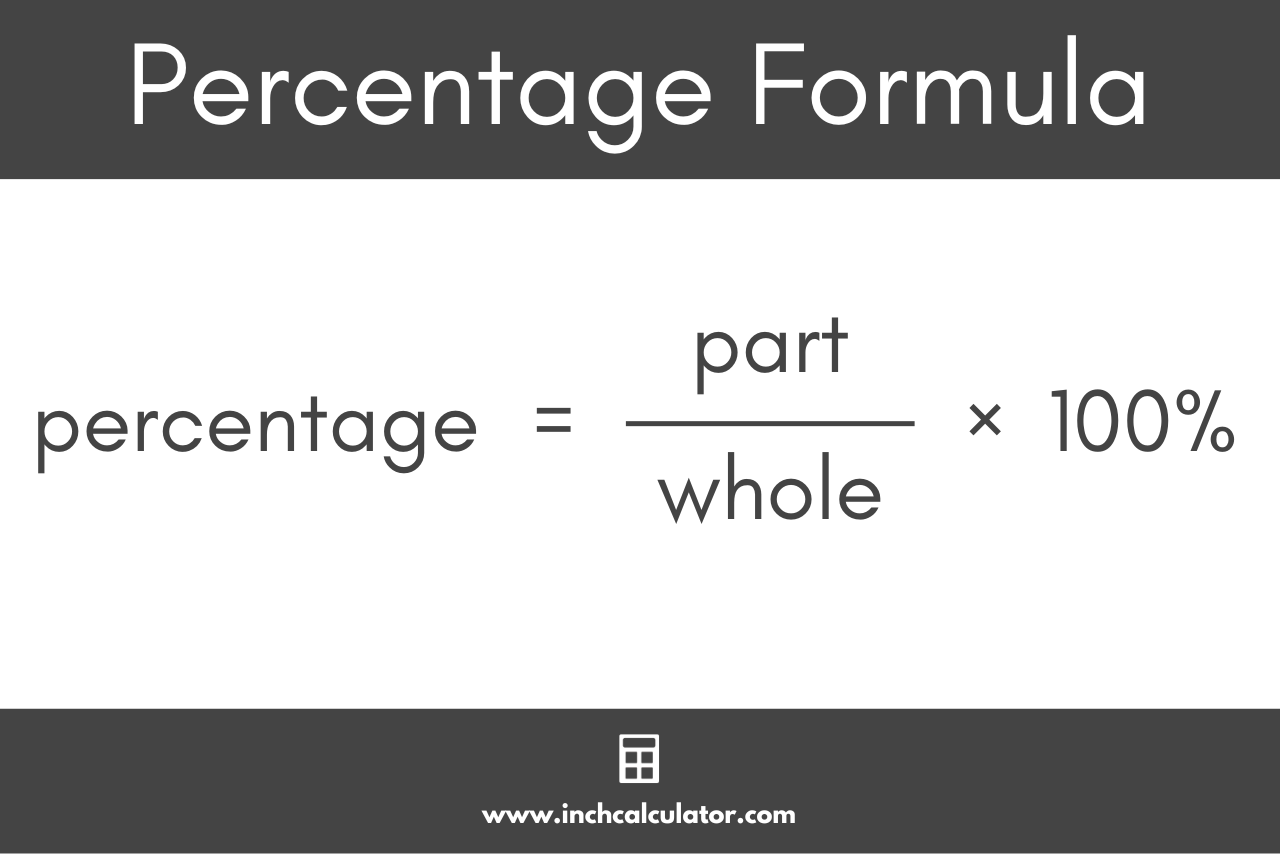
At its heart, a percentage represents a portion of a whole, expressed as a fraction of 100. The term “percent” literally means “per hundred.” All percentage calculations revolve around three core components: the part, the whole, and the percentage itself.
The Basic Calculation: (Part / Whole) x 100 = Percentage
To calculate what percentage a part is of a whole number, you use the following formula:
Percentage = (Part ÷ Whole) × 100
Let’s break this down with financial examples:
Example 1: Calculating a Discount Rate
You find a jacket originally priced at $200, but it’s on sale for $160. You want to know what percentage discount you’re receiving.
-
Identify the “Whole”: The original price, $200.
-
Identify the “Part”: The amount saved, which is $200 – $160 = $40.
-
Apply the formula: ($40 ÷ $200) × 100
-
$40 ÷ $200 = 0.20
-
0.20 × 100 = 20%
-
Result: You received a 20% discount.
-
Example 2: Determining the Percentage of Income Saved
If your monthly take-home pay (whole) is $4,000, and you save $800 (part), what percentage of your income are you saving?
-
Identify the “Whole”: $4,000 (total income).
-
Identify the “Part”: $800 (amount saved).
-
Apply the formula: ($800 ÷ $4,000) × 100
-
$800 ÷ $4,000 = 0.20
-
0.20 × 100 = 20%
-
Result: You are saving 20% of your income.
-
Calculating the “Part” When You Know the Percentage
Often, you’ll know the whole number and the percentage, and you’ll need to find the specific part that percentage represents. This is common when calculating sales tax, tips, or specific budget allocations.
The formula can be rearranged:
Part = (Percentage ÷ 100) × Whole
Example 3: Calculating Sales Tax
You’re buying an item for $50, and the sales tax rate is 7%. How much sales tax will you pay?
-
Identify the “Whole”: The item’s price, $50.
-
Identify the “Percentage”: 7%.
-
Apply the formula: (7 ÷ 100) × $50
-
7 ÷ 100 = 0.07
-
0.07 × $50 = $3.50
-
Result: The sales tax will be $3.50.
-
Example 4: Calculating a Tip
You had a great meal that cost $65, and you want to leave a 15% tip. How much should the tip be?
-
Identify the “Whole”: The meal cost, $65.
-
Identify the “Percentage”: 15%.
-
Apply the formula: (15 ÷ 100) × $65
-
15 ÷ 100 = 0.15
-
0.15 × $65 = $9.75
-
Result: You should leave a $9.75 tip.
-
Real-World Money Applications: Putting Percentages to Work
The ability to calculate percentages translates directly into better financial management and decision-making across numerous categories.
Budgeting and Savings Allocation
Budgeting is fundamentally about allocating percentages of your income. Many financial experts recommend frameworks like the 50/30/20 rule (50% for needs, 30% for wants, 20% for savings and debt repayment).
-
If your monthly take-home income is $5,000:
-
Needs (50%): 0.50 × $5,000 = $2,500
-
Wants (30%): 0.30 × $5,000 = $1,500
-
Savings/Debt (20%): 0.20 × $5,000 = $1,000
-
Knowing these numerical targets makes tracking and adhering to your budget much simpler.
Understanding Interest Rates and Debt Management
Interest rates, whether on savings accounts or loans, are almost always expressed as percentages.
-
Earning Interest: If you have $1,000 in a savings account with a 0.5% annual interest rate, you’d earn (0.5 ÷ 100) × $1,000 = $5 in interest for that year (simplistic calculation, ignoring compounding for a moment).
-
Paying Interest: A credit card with a 20% APR (Annual Percentage Rate) means that if you carry an average daily balance of $1,000, you could accrue approximately (20 ÷ 100) × $1,000 = $200 in interest over a year. Understanding this helps you prioritize paying off high-interest debt.

Evaluating Investments and Returns
Percentages are the bedrock of investment analysis.
-
Return on Investment (ROI): This is perhaps the most common percentage in investing. If you bought a stock for $1,000 and sold it for $1,250, your profit is $250.
- ROI = ($250 profit ÷ $1,000 initial investment) × 100 = 25%.
-
Portfolio Diversification: Financial advisors often recommend allocating specific percentages of your portfolio to different asset classes (e.g., 60% stocks, 30% bonds, 10% cash) to manage risk.
Discounts, Taxes, and Everyday Transactions
Beyond the examples already provided:
-
Multiple Discounts: If an item is 20% off, and then an additional 10% is taken off the sale price, you don’t simply add the percentages.
-
Original price: $100
-
20% off: 0.20 × $100 = $20. Sale price = $100 – $20 = $80.
-
Additional 10% off the sale price: 0.10 × $80 = $8. Final price = $80 – $8 = $72.
-
The total discount is $28, which is 28% of the original $100.
-
Business Finance and Profitability (for Side Hustles/Online Income)
Entrepreneurs and those with side hustles rely heavily on percentages.
-
Profit Margins: Gross profit margin = ((Revenue – Cost of Goods Sold) ÷ Revenue) × 100. Net profit margin considers all expenses. Understanding these percentages is crucial for pricing strategies and assessing business viability.
-
Commissions: If you earn a 10% commission on sales, and you sell $500 worth of products, your commission is (10 ÷ 100) × $500 = $50.
Beyond Simple Calculations: Advanced Financial Percentage Concepts
As your financial journey progresses, you’ll encounter more nuanced applications of percentages.
Percentage Increase and Decrease
This calculation measures the change between two values relative to the original value.
Formula: ((New Value – Original Value) ÷ Original Value) × 100
-
Example: Salary Increase: If your salary increased from $50,000 to $55,000.
- (($55,000 – $50,000) ÷ $50,000) × 100 = ($5,000 ÷ $50,000) × 100 = 0.10 × 100 = 10%.
-
Example: Investment Loss: If an investment dropped from $1,000 to $800.
- (($800 – $1,000) ÷ $1,000) × 100 = (-$200 ÷ $1,000) × 100 = -0.20 × 100 = -20%. (A 20% decrease).
Reverse Percentage Problems
Sometimes you know the result after a percentage change and need to find the original value.
-
Example: Finding Original Price Before Discount: An item costs $72 after a 20% discount. What was its original price?
-
If there was a 20% discount, the $72 represents 100% – 20% = 80% of the original price.
-
Let ‘X’ be the original price. So, 0.80 × X = $72.
-
X = $72 ÷ 0.80 = $90.
-
The original price was $90.
-
The Power of Compounding (Brief Mention)
Compound interest is the interest on an initial principal and also on the accumulated interest from previous periods. While the calculation itself involves exponents, the underlying concept is how percentages (interest rates) repeatedly apply to a growing “whole” (principal + accumulated interest), leading to exponential growth over time. This is a cornerstone of long-term wealth building through investments.
Tools and Strategies for Financial Percentage Mastery
While the formulas are straightforward, accuracy and efficiency are key in financial calculations.
Leveraging Calculators and Financial Apps
For precise calculations, especially with decimals or larger numbers, a calculator is indispensable.
-
Basic Calculators: Sufficient for most straightforward percentage problems.
-
Smartphone Apps: Many calculator apps have percentage functions.
-
Online Calculators: Numerous websites offer specialized percentage calculators, including reverse percentage and percentage change tools.
Spreadsheet Savvy: Excel and Google Sheets
For managing budgets, tracking investments, or running a small business, spreadsheets are powerful allies.
-
Automated Formulas: You can set up cells to automatically calculate percentages based on your input. For example, in Excel, if cell A1 has the part and B1 has the whole,
=(A1/B1)*100will give you the percentage. -
Financial Models: Build dynamic financial models where you can change one variable (e.g., an interest rate) and see its percentage impact across your entire financial plan.
Mental Math Shortcuts and Estimation
For quick estimates, knowing a few mental math tricks can be very useful:
-
Finding 10%: Move the decimal one place to the left. (10% of $250 is $25).
-
Finding 1%: Move the decimal two places to the left. (1% of $250 is $2.50).
-
Building from 10%: To find 20%, double 10%. To find 5%, halve 10%.
-
Approximation: Round numbers to make mental calculation easier, especially for quick decisions like estimating a tip or discount.
Double-Checking and Contextual Understanding
Always double-check your calculations, especially when dealing with significant sums of money. More importantly, ensure you understand what the calculated percentage truly represents within the financial context. Is it a gain or a loss? A rate or a share? This critical understanding is what transforms a simple numerical answer into a meaningful financial insight.
Mastering percentage calculations is a fundamental step towards financial literacy and independence. By understanding how to calculate, interpret, and apply percentages, you gain the clarity needed to make smarter financial choices, grow your wealth, and confidently navigate the complexities of your monetary world.
aViewFromTheCave is a participant in the Amazon Services LLC Associates Program, an affiliate advertising program designed to provide a means for sites to earn advertising fees by advertising and linking to Amazon.com. Amazon, the Amazon logo, AmazonSupply, and the AmazonSupply logo are trademarks of Amazon.com, Inc. or its affiliates. As an Amazon Associate we earn affiliate commissions from qualifying purchases.