
Compound interest, often hailed as the “eighth wonder of the world,” is a fundamental concept in finance that can significantly impact your wealth over time. Unlike simple interest, which is calculated only on the initial principal amount, compound interest is calculated on the principal amount and also on the accumulated interest from previous periods. This “interest on interest” effect is what makes it such a powerful force in both growing investments and escalating debts.
Understanding how to calculate compound interest is not just an academic exercise; it’s a critical skill for anyone looking to make informed financial decisions. Whether you’re planning for retirement, saving for a down payment, managing loans, or evaluating investment opportunities, a grasp of compounding is indispensable. This guide will demystify the mechanics of compound interest, provide practical examples, explore various applications, and offer strategies to harness its incredible potential for your financial benefit.
Understanding the Fundamentals of Compound Interest
Before diving into the formulas, it’s essential to establish a clear understanding of what compound interest is and how it differs from its simpler counterpart. This foundational knowledge will make the subsequent calculations and applications much clearer.
Simple vs. Compound Interest: A Crucial Distinction
At its core, interest is the cost of borrowing money or the return on lending money. The way this cost or return is calculated makes all the difference.
-
Simple Interest: This is the most straightforward form of interest. It is calculated solely on the original principal amount. For example, if you invest $1,000 at a 5% simple interest rate for three years, you would earn $50 each year ($1,000 * 0.05). After three years, your total interest earned would be $150, and your total balance would be $1,150. The principal never changes for interest calculation purposes.
-
Compound Interest: This is where the magic (or menace, depending on your perspective) happens. With compound interest, the interest earned in each period is added to the principal before the next interest calculation. Using the same example, if you invest $1,000 at a 5% compound interest rate, after the first year, you’d have $1,050. In the second year, the 5% interest would be calculated on $1,050, yielding $52.50, bringing your total to $1,102.50. In the third year, the interest is calculated on $1,102.50, and so on. Over longer periods, this “interest on interest” effect leads to significantly larger sums than simple interest.
The key takeaway is that simple interest is linear, while compound interest grows exponentially. For investors, this exponential growth is highly desirable; for borrowers with high-interest debt, it can be a significant burden.
Key Variables in Compound Interest Calculation
To calculate compound interest accurately, you need to identify four primary variables:
-
Principal (P): This is the initial amount of money deposited or invested, or the initial amount of a loan. It’s the starting point for all calculations.
-
Interest Rate (r): This is the annual interest rate, expressed as a decimal. For example, a 5% interest rate would be 0.05. It’s crucial to use the annual rate in the standard formula.
-
Number of times interest is compounded per period (n): This refers to how often the interest is calculated and added to the principal within a year.
-
Annually: n = 1
-
Semi-annually: n = 2
-
Quarterly: n = 4
-
Monthly: n = 12
-
Daily: n = 365
The more frequently interest is compounded, the faster your money grows (or debt accumulates).
-
-
Time (t): This is the number of years the money is invested or borrowed for. It’s important that this value is in years to align with the annual interest rate.
Having a clear understanding of these variables is the first step toward mastering compound interest calculations.
The Compound Interest Formula: Demystified
With the basic concepts and variables in hand, we can now turn our attention to the universal formula that governs compound interest. While it might look intimidating at first glance, breaking it down makes it quite manageable.
Introducing the Formula and Its Components
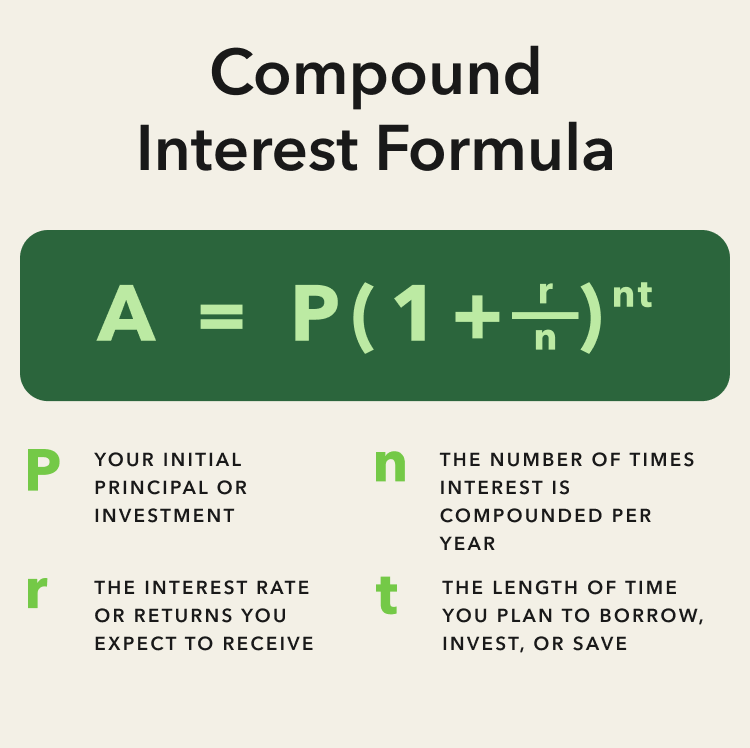
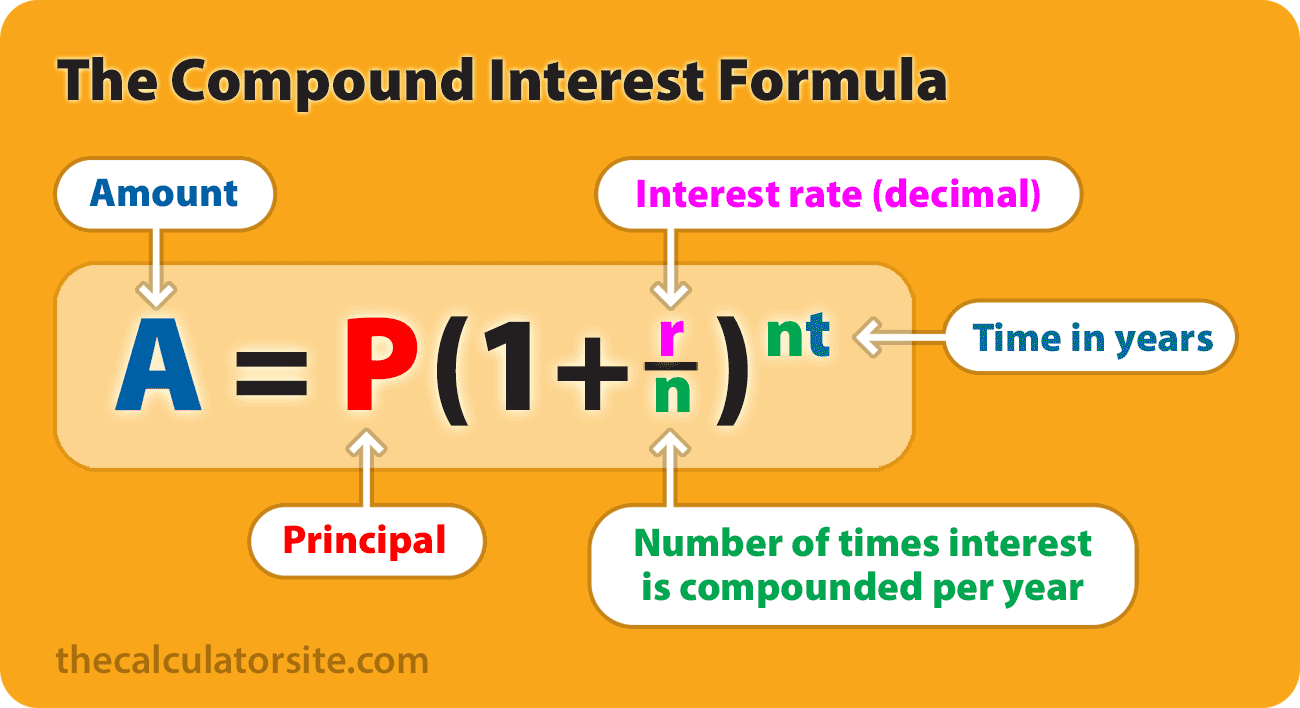
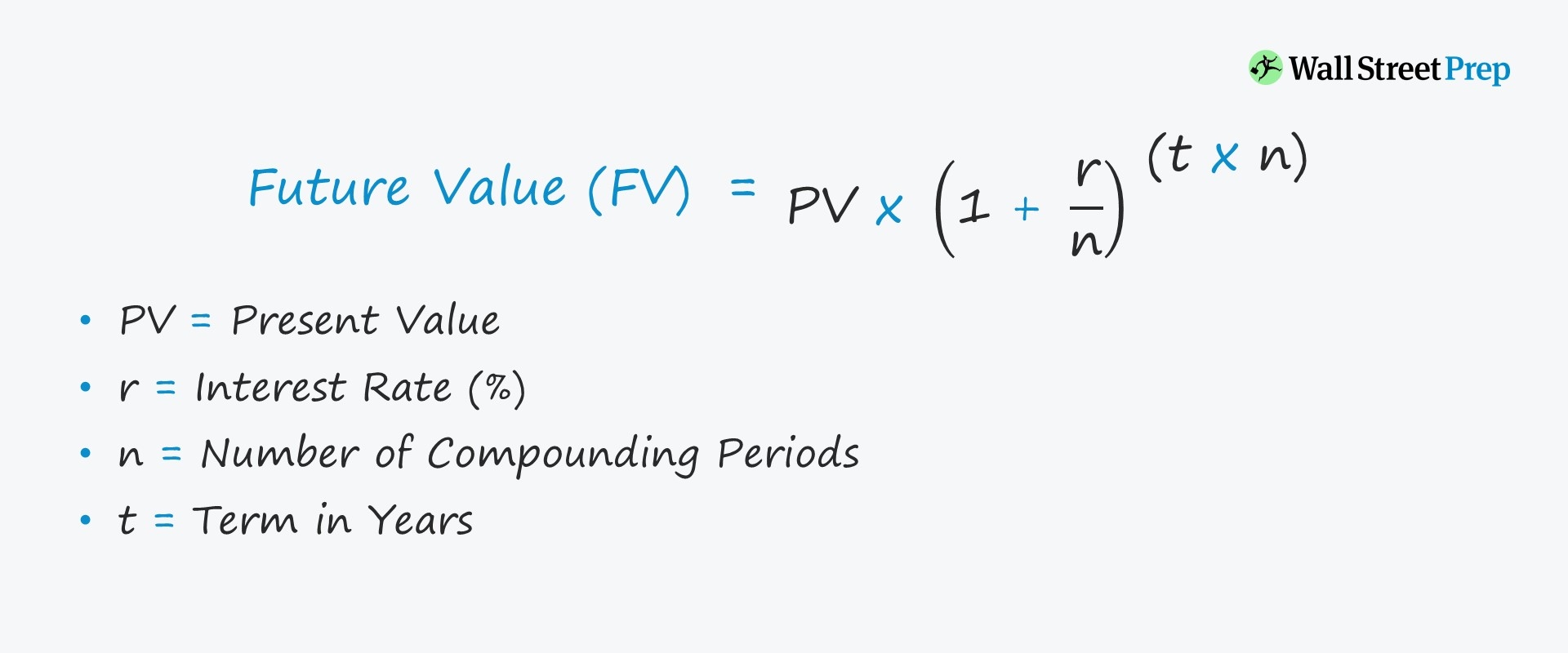
The standard formula for calculating the future value of an investment or loan with compound interest is:
$A = P (1 + frac{r}{n})^{nt}$
Where:
-
A = The future value of the investment/loan, including interest. This is the amount you will have at the end of the period.
-
P = The principal investment amount (the initial deposit or loan amount).
-
r = The annual interest rate (as a decimal).
-
n = The number of times that interest is compounded per year.
-
t = The number of years the money is invested or borrowed for.
Let’s quickly re-emphasize the importance of converting the annual interest rate to a decimal (e.g., 6% becomes 0.06) and ensuring ‘n’ and ‘t’ are consistently defined (e.g., ‘t’ in years, ‘n’ compounding frequency per year).
Step-by-Step Calculation Examples
To illustrate how the formula works, let’s walk through a few practical examples with varying compounding frequencies.
Example 1: Annual Compounding
You invest $5,000 in a savings account that offers an annual interest rate of 4%, compounded annually. How much will you have after 10 years?
-
P = $5,000
-
r = 0.04 (4%)
-
n = 1 (compounded annually)
-
t = 10 years
$A = 5000 (1 + frac{0.04}{1})^{1 * 10}$
$A = 5000 (1 + 0.04)^{10}$
$A = 5000 (1.04)^{10}$
$A = 5000 * 1.480244$
$A = $7,401.22$
After 10 years, your $5,000 investment would grow to approximately $7,401.22. The interest earned is $7,401.22 – $5,000 = $2,401.22.
Example 2: Monthly Compounding
You take out a personal loan for $10,000 at an annual interest rate of 8%, compounded monthly. If you were to let the interest accumulate for 3 years without making payments (purely theoretical for calculation purposes), how much would you owe?
-
P = $10,000
-
r = 0.08 (8%)
-
n = 12 (compounded monthly)
-
t = 3 years
$A = 10000 (1 + frac{0.08}{12})^{12 * 3}$
$A = 10000 (1 + 0.006666…)^{36}$
$A = 10000 (1.006666…)^{36}$
$A = 10000 * 1.270237$
$A = $12,702.37$
In this scenario, after 3 years, the total amount owed would be approximately $12,702.37. The interest accumulated is $2,702.37. Notice how the more frequent compounding (monthly vs. annually) results in a slightly higher final amount for the same annual rate over a shorter period.
Example 3: Daily Compounding
Imagine a high-yield savings account offering 2% annual interest, compounded daily. If you deposit $1,000, how much will you have after 1 year?
-
P = $1,000
-
r = 0.02 (2%)
-
n = 365 (compounded daily)
-
t = 1 year
$A = 1000 (1 + frac{0.02}{365})^{365 * 1}$
$A = 1000 (1 + 0.00005479…)^{365}$
$A = 1000 (1.00005479…)^{365}$
$A = 1000 * 1.020201$
$A = $1,020.20$
After one year, your $1,000 would grow to approximately $1,020.20. The difference from annual compounding ($1,000 * (1.02)^1 = $1,020) is minimal over a short period but becomes more significant over longer durations.
These examples highlight the mechanics of calculation and the impact of compounding frequency. While manually calculating compound interest is valuable for understanding, practical financial planning often involves more efficient tools.
Practical Applications and Tools for Compound Interest
Understanding the theory of compound interest is one thing; applying it to real-world financial situations is another. Compound interest is a cornerstone of various financial products and investment strategies, and modern tools make tracking and planning for it easier than ever.
Leveraging Compound Interest for Investments
For investors, compound interest is a powerful ally that can significantly accelerate wealth accumulation.
-
Retirement Accounts (401(k)s, IRAs): These tax-advantaged accounts are prime examples of vehicles designed to maximize compounding. Contributions grow tax-deferred or tax-free, allowing earnings to compound unimpeded for decades. Starting early is perhaps the single most impactful strategy here.
-
Stocks, Bonds, Mutual Funds, ETFs: When you invest in instruments that generate returns (dividends from stocks, interest from bonds, capital gains from funds), reinvesting those earnings allows them to compound. Many investment platforms offer dividend reinvestment plans (DRIPs) to automate this process.
-
Real Estate: While not always obvious, real estate can also benefit from compounding. Rental income can be reinvested into property improvements or used to acquire additional properties, leading to compounded cash flow and appreciation over time.
The common thread across these applications is the principle of allowing your returns to generate further returns.
Using Online Calculators and Spreadsheets
While manual calculations are good for comprehension, they are tedious for long-term planning or comparing multiple scenarios. Fortunately, numerous tools are available to simplify the process:
-
Online Compound Interest Calculators: A quick search will reveal dozens of free online calculators from financial institutions, investment firms, and personal finance websites. These tools typically allow you to input your principal, interest rate, compounding frequency, and time horizon to instantly see the future value. Many also include options for regular additional contributions, providing a more realistic picture of savings growth.
-
Spreadsheets (Excel, Google Sheets): For those who prefer a more customized approach, spreadsheets are incredibly versatile. You can easily set up the compound interest formula in a cell and then adjust variables to run various scenarios. This is particularly useful for building detailed financial models that incorporate irregular contributions or withdrawals.
-
Financial Planning Software/Apps: Many personal finance apps and wealth management platforms incorporate compound interest calculations into their projection tools, allowing users to visualize their financial trajectory based on their inputs.
These tools empower individuals to quickly understand the impact of different interest rates, investment periods, and compounding frequencies on their financial goals.
The Dark Side: Compound Interest on Debt
While beneficial for investments, compound interest can be a formidable foe when it comes to debt, especially high-interest debt like credit cards.
-
Credit Cards: Credit card interest often compounds daily or monthly, and at very high annual rates (e.g., 15-25% or more). If you only make minimum payments, the unpaid interest quickly gets added to your principal, and future interest is calculated on this larger amount. This can lead to debt spiraling out of control, making it incredibly difficult to pay off.
-
Loans: While mortgages and car loans typically have lower rates than credit cards, the sheer size of the principal means that compound interest still adds up significantly over the loan’s term. Understanding the total interest paid over the life of a loan is crucial for informed borrowing decisions.
Recognizing the dual nature of compound interest—as both an accelerator of wealth and a magnifier of debt—is a fundamental step in achieving financial literacy and control.
Strategies to Maximize the Power of Compounding
Harnessing the full potential of compound interest requires more than just understanding the formula; it involves strategic financial habits and decisions.
Start Early and Stay Consistent
The most critical factor in maximizing compound interest is time. Due to its exponential nature, money invested early has significantly more time to compound, leading to vastly larger sums.
-
The “Magic of Starting Early”: A dollar invested at age 25 could be worth many times more at retirement than a dollar invested at age 35, even with the same return rate. The additional decade of compounding makes an enormous difference.
-
Consistent Contributions: Regularly adding money to your investments, even small amounts, supercharges the compounding process. This is the principle behind dollar-cost averaging and consistent retirement savings.
Optimize Compounding Frequency and Interest Rate
While you often can’t control the market, you can make choices that favor higher compounding.
-
Seek Higher ‘n’: All else being equal, an account that compounds daily will grow slightly faster than one that compounds monthly, which in turn grows faster than one that compounds annually. When choosing savings accounts or GICs, consider the compounding frequency.
-
Understand APY vs. APR:
-
Annual Percentage Rate (APR) is the annual rate charged for borrowing or earned by investing, before compounding.
-
Annual Percentage Yield (APY) is the effective annual rate of return after taking into account compounding. APY is always equal to or higher than the APR when compounding occurs more than once a year. When comparing savings accounts, always look at the APY for an accurate picture of returns. For loans, consider the total cost, which often reflects compounding.
-
-
Seek Higher ‘r’ (with prudence): Naturally, a higher interest rate leads to faster growth. However, higher returns often come with higher risk. It’s crucial to balance the desire for high ‘r’ with your risk tolerance and financial goals.
Reinvest Your Earnings
The essence of compounding is earning interest on your interest. To fully realize this, you must reinvest any returns your investments generate.
-
Dividend Reinvestment Plans (DRIPs): Many companies and mutual funds offer DRIPs, which automatically use your dividend payouts to purchase more shares or units. This is a passive yet powerful way to accelerate compounding.
-
Reinvesting Interest: If your savings account pays interest, leaving it in the account allows it to become part of the principal for the next compounding cycle.
By actively pursuing these strategies, you empower compound interest to work most effectively for your financial well-being.
Conclusion
Compound interest is undeniably one of the most powerful concepts in personal finance and investing. Its ability to generate “interest on interest” means that both investments and debts don’t just grow linearly, but exponentially. By understanding the core formula, recognizing its key variables, and appreciating its pervasive role in various financial products, you gain a significant advantage in managing your money.
Whether you’re calculating the potential growth of your retirement savings, analyzing the true cost of a loan, or simply trying to optimize your emergency fund, the principles of compound interest are your compass. Embrace the power of starting early, maintaining consistency, and wisely choosing financial products, and you will unlock the extraordinary potential of compounding to build substantial wealth over the long term. Taking control of your financial future begins with understanding this fundamental force.
aViewFromTheCave is a participant in the Amazon Services LLC Associates Program, an affiliate advertising program designed to provide a means for sites to earn advertising fees by advertising and linking to Amazon.com. Amazon, the Amazon logo, AmazonSupply, and the AmazonSupply logo are trademarks of Amazon.com, Inc. or its affiliates. As an Amazon Associate we earn affiliate commissions from qualifying purchases.