
In the complex world of personal finance, understanding how your money grows – or how much it costs to borrow – is paramount. While many financial products quote an interest rate, the true measure of their yield or cost often lies in the Annual Percentage Yield (APY). APY provides a more accurate picture by factoring in the effect of compounding, particularly when that compounding occurs frequently, such as monthly. For anyone looking to make informed decisions about their savings, investments, or loans, mastering the calculation of APY with monthly compounding is not just an advantage; it’s a necessity. This guide will demystify APY, walk you through its calculation for monthly compounding, and illustrate its critical role in optimizing your financial health.

Understanding APY: More Than Just an Interest Rate
At its core, APY represents the real rate of return earned on an investment, or paid on a loan, over a year, taking into account the effect of compounding interest. Unlike a simple interest rate, which only reflects the annual interest without compounding, APY paints a comprehensive picture of growth or cost.
APY vs. APR: Unpacking the Key Distinction
The terms APY (Annual Percentage Yield) and APR (Annual Percentage Rate) are often used interchangeably, leading to confusion. However, their distinction is crucial:
-
APR (Annual Percentage Rate): This is the simple annual interest rate applied to your principal. It does not account for the impact of compounding interest within the year. For example, a credit card might state an APR of 18%, but if interest is compounded monthly, the actual cost over a year will be higher due to the effect of earning interest on previously earned interest. APR is often cited for loans and credit cards.
-
APY (Annual Percentage Yield): This is the effective annual rate of return, including the effect of compounding. APY provides a more accurate representation of the total interest you will earn on a savings account or investment, or pay on a loan, over a year. It’s particularly relevant for savings accounts, Certificates of Deposit (CDs), and other interest-bearing financial products. The higher the compounding frequency (e.g., daily, monthly, quarterly), the greater the difference between the nominal interest rate and the APY.
In essence, APY is the “truth in lending/saving” metric, revealing the true annual growth rate of your money or the true annual cost of borrowing.
The Power of Compounding: Why Time and Frequency Matter
Compounding is the process of earning returns not only on your initial principal but also on the accumulated interest from previous periods. It’s often referred to as “interest on interest” and is the engine behind significant long-term wealth growth.
The frequency of compounding plays a vital role in determining the final yield. An interest rate that compounds daily will yield slightly more than one that compounds monthly, which in turn yields more than one that compounds annually, even if their nominal (stated) annual interest rates are the same. This is because interest is added to the principal more often, allowing subsequent interest calculations to be based on a larger sum.
For instance, consider two savings accounts, both offering a 5% nominal annual interest rate.
-
Account A compounds annually: You earn 5% on your initial principal at the end of the year.
-
Account B compounds monthly: Each month, interest is calculated on your current balance (principal + previously accumulated interest) and added. By the end of the year, you will have earned slightly more than 5% of your initial principal, thanks to the monthly compounding effect. The APY for Account B will be higher than 5%.
Understanding this mechanism is fundamental to appreciating why APY, especially with frequent compounding like monthly, is the metric you should always scrutinize.
When APY is Your Best Friend (and Foe)
For savers and investors, a higher APY is always desirable. It means your money is working harder for you, growing at an accelerated rate thanks to the compounding effect. When comparing savings accounts, money market accounts, or CDs, always prioritize the APY over the stated interest rate.
Conversely, for borrowers, a higher APY (or effective annual rate) is a foe. While loans typically quote an APR, understanding the effective rate with compounding can illuminate the true cost of borrowing. For example, a credit card with an 18% APR compounded monthly will result in a higher actual annual cost than if it were compounded annually, though APR regulations often require lenders to disclose the total cost of borrowing over the loan’s life, which implicitly includes compounding. For the purpose of this article, we’ll primarily focus on APY from the perspective of savings and investments where it explicitly reflects gain.
The Core Mechanics of APY Calculation
Calculating APY, especially with monthly compounding, involves a straightforward formula that accounts for the nominal interest rate and the number of compounding periods per year.
The Fundamental APY Formula Explained
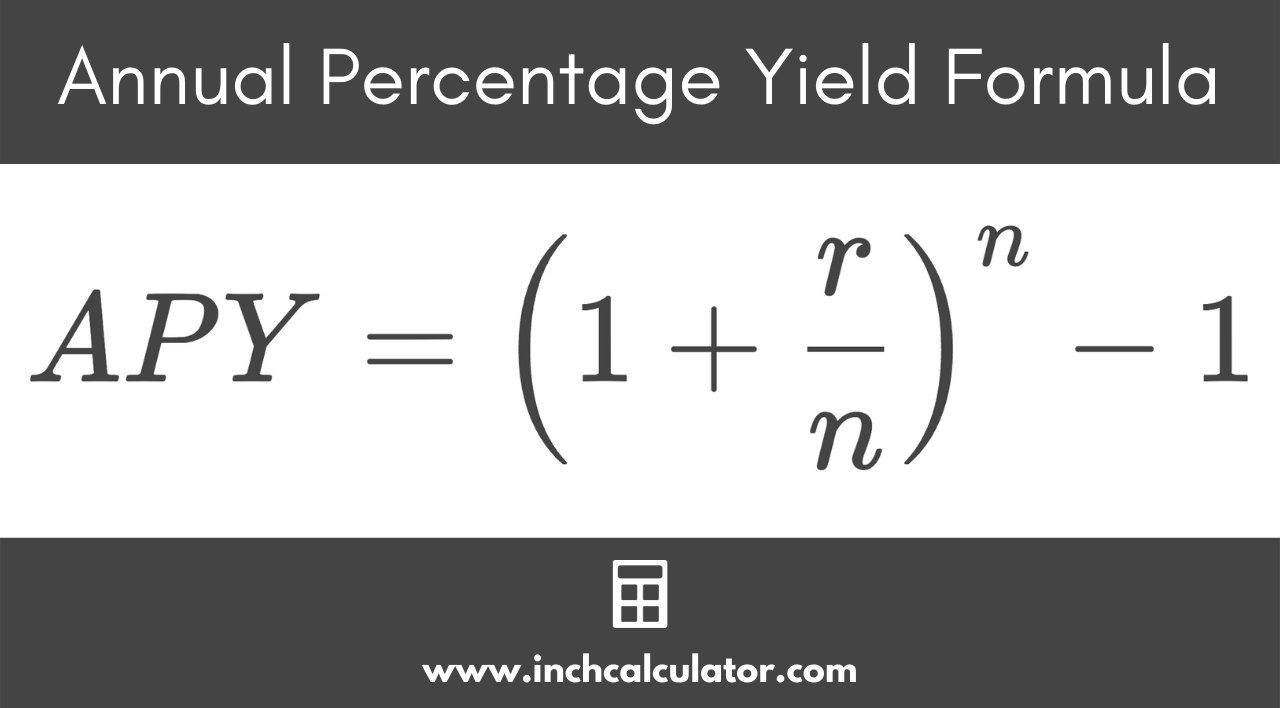
The general formula for calculating APY is:
APY = (1 + (r / n))^n - 1
Where:
-
APY= Annual Percentage Yield -
r= The nominal (stated) annual interest rate (expressed as a decimal) -
n= The number of times the interest is compounded per year
Let’s break down each component of this formula.
Deconstructing the “Compounding Periods” Variable (n)
The variable n is crucial, as it dictates how often interest is added to the principal within a year. For monthly compounding, n will always be 12, as there are 12 months in a year.
Other common values for n include:
-
Daily compounding:
n = 365 -
Quarterly compounding:
n = 4 -
Semi-annual compounding:
n = 2 -
Annual compounding:
n = 1(In this case, APY = r)
The more frequently interest is compounded (i.e., the higher the value of n), the higher the resulting APY will be for a given nominal rate r.
The Role of Nominal Interest Rate (r)
The nominal annual interest rate, r, is the advertised or stated interest rate before factoring in compounding. It’s essential to express this as a decimal in the formula. For example, if an account offers a 3% annual interest rate, r would be 0.03. If it’s 0.5%, r would be 0.005. Misrepresenting r is the most common error in APY calculations.
The formula essentially calculates the effective growth factor over one compounding period (1 + r/n), then raises it to the power of n to determine the total growth factor over a year. Subtracting 1 converts this growth factor back into a percentage yield.
Step-by-Step Guide: Calculating APY with Monthly Compounding
Now, let’s put the formula into practice with practical examples for monthly compounding. Remember, for monthly compounding, n will always be 12.
Scenario 1: Savings Account Example
Imagine you’re comparing savings accounts, and one advertises a nominal annual interest rate of 2.5%, compounded monthly. You want to know the true APY.
-
Step 1: Identify the nominal annual interest rate (
r).r = 2.5% = 0.025(as a decimal)
-
Step 2: Identify the number of compounding periods per year (
n).- Since it’s compounded monthly,
n = 12
- Since it’s compounded monthly,
-
Step 3: Apply the APY formula:
-
APY = (1 + (r / n))^n - 1 -
APY = (1 + (0.025 / 12))^12 - 1
-
-
Step 4: Calculate the term inside the parenthesis:
-
0.025 / 12 = 0.00208333... -
1 + 0.00208333... = 1.00208333...
-
-
Step 5: Raise the result to the power of
n:(1.00208333...)^12 ≈ 1.025315
-
Step 6: Subtract 1 and convert to a percentage:
-
1.025315 - 1 = 0.025315 -
0.025315 * 100% = 2.5315%
-
Therefore, the APY for a savings account with a 2.5% nominal annual interest rate compounded monthly is approximately 2.5315%. This seemingly small difference from 2.5% can add up significantly over time, especially with larger balances.
Scenario 2: Certificate of Deposit (CD) Example
Consider a 1-year CD with a stated annual interest rate of 3.0%, compounded monthly. Let’s calculate its APY.
-
Step 1: Identify
r.r = 3.0% = 0.03
-
Step 2: Identify
n.- Compounded monthly, so
n = 12
- Compounded monthly, so
-
Step 3: Apply the APY formula:
APY = (1 + (0.03 / 12))^12 - 1
-
Step 4: Calculate the term inside the parenthesis:
-
0.03 / 12 = 0.0025 -
1 + 0.0025 = 1.0025
-
-
Step 5: Raise the result to the power of
n:(1.0025)^12 ≈ 1.0304159
-
Step 6: Subtract 1 and convert to a percentage:
-
1.0304159 - 1 = 0.0304159 -
0.0304159 * 100% = 3.04159%
-
The APY for this CD is approximately 3.0416%. Again, slightly higher than the nominal rate due to monthly compounding.
Tools and Calculators for Quick APY Computation
While manual calculation is valuable for understanding, numerous online APY calculators can quickly provide these figures. Most banks and financial institutions will also explicitly state the APY alongside the nominal rate for savings products, as required by consumer protection laws. When comparing products, always use the stated APY to ensure an accurate comparison of your potential earnings.
Why Monthly Compounding Matters: Impact on Your Finances
The frequency of compounding, particularly monthly, is not a mere technicality; it has tangible effects on your financial outcomes, whether you are saving, investing, or managing debt.
Maximizing Returns: The Saver’s Advantage
For anyone building savings or investing, monthly compounding provides a distinct advantage over less frequent compounding periods. Each month, your interest earnings are added to your principal, meaning that the subsequent month’s interest calculation is based on a slightly larger sum. This creates a snowball effect that accelerates your wealth accumulation over time.
Consider two accounts, both with a 2% nominal annual rate. Account A compounds annually, and Account B compounds monthly. Over ten years, Account B will consistently outperform Account A, solely due to the increased compounding frequency. Even a seemingly small difference in APY, when magnified over decades, can result in thousands of dollars in extra earnings. This is why high-yield savings accounts or investment vehicles that compound frequently are often preferred by savvy savers.
Understanding Loan Costs: The Borrower’s Perspective
While APY is typically quoted for savings, the underlying principle of compounding frequency applies equally to loans. Credit cards, for example, often compound interest daily or monthly. If a loan’s interest is compounded monthly, it means that any unpaid interest from the previous month is added to your principal, and then the next month’s interest is calculated on that new, larger principal. This can lead to a rapid increase in your debt if you’re not making consistent payments that cover at least the monthly interest accrual.
Understanding this mechanism helps borrowers appreciate the true cost of carrying a balance. While lenders typically quote an APR, the effective rate due to frequent compounding can make paying off debt a more challenging endeavor. It underscores the importance of paying down high-interest debts as quickly as possible to prevent the compounding effect from working against you.
The Long-Term Growth Trajectory
The impact of monthly compounding is most profound over the long term. The longer your money remains invested or saved, the more opportunities it has to compound, and the more significant the difference between a simple interest rate and the APY becomes. This principle is fundamental to retirement planning, college savings, and other long-term financial goals. Even small, consistent contributions to an account with a decent APY compounded monthly can lead to substantial wealth accumulation over 20, 30, or 40 years. This long-term growth trajectory highlights the importance of starting early and letting the power of compounding work its magic.
Leveraging APY for Smarter Financial Decisions
Armed with the knowledge of how to calculate APY and its significance, you can now make more strategic financial choices.
Comparing Financial Products Effectively
The most direct application of APY understanding is in comparing similar financial products. When choosing between different savings accounts, money market accounts, or Certificates of Deposit (CDs), always look beyond the nominal interest rate and focus on the APY. A bank might advertise a 2.0% interest rate, while another advertises a 1.98% interest rate. If the first compounds annually and the second compounds monthly, the 1.98% rate might actually result in a higher APY (e.g., 2.0% vs. 2.016%), making it the better choice. Relying on APY ensures an apples-to-apples comparison of the true annual return.
Identifying True Return on Investment
For various investment vehicles that offer regular interest payments, such as certain bonds or dividend stocks that reinvest earnings, the concept of APY helps in understanding the true annual return. If an investment yields a certain percentage monthly, calculating the effective annual yield (APY) gives you a clearer picture of your total gain, which is vital for evaluating portfolio performance and making asset allocation decisions. It allows investors to assess the cumulative impact of reinvested earnings and compound growth, painting a more accurate picture than simple annual income figures.

Strategic Planning for Savings and Debt Management
Understanding APY empowers you to strategically plan your savings and debt.
-
For Savings: Prioritize accounts with the highest APY, especially those that compound frequently. Even a slight increase in APY can significantly boost your long-term wealth. Consider automating contributions to maximize the benefits of compounding over time.
-
For Debt: While APY isn’t typically quoted for consumer loans, recognizing the power of monthly compounding on debt is crucial. Focus on paying down high-interest debts with frequent compounding first. Understanding that interest is compounding monthly makes clear the urgency of minimizing debt balances to prevent runaway interest costs.
By consistently applying this knowledge, you transform from a passive observer of your finances into an active participant, optimizing every dollar you save, invest, and borrow. APY is not just a formula; it’s a fundamental principle of financial literacy that, when mastered, can unlock significant financial advantages.
aViewFromTheCave is a participant in the Amazon Services LLC Associates Program, an affiliate advertising program designed to provide a means for sites to earn advertising fees by advertising and linking to Amazon.com. Amazon, the Amazon logo, AmazonSupply, and the AmazonSupply logo are trademarks of Amazon.com, Inc. or its affiliates. As an Amazon Associate we earn affiliate commissions from qualifying purchases.