
In the intricate world of finance, where every decision can have significant monetary implications, understanding how to work out a percentage is not just a mathematical curiosity—it’s an indispensable skill. From deciphering the true cost of a loan to calculating investment returns, budgeting your monthly income, or even spotting a genuine discount, percentages form the bedrock of financial literacy. They provide a standardized way to compare parts to a whole, track changes over time, and make informed choices that directly impact your wealth and financial well-being.
This article will demystify the art of percentage calculation, breaking down the fundamental formulas and illustrating their critical applications across various financial scenarios. Whether you’re a budding investor, a shrewd consumer, a small business owner, or simply someone looking to manage their personal finances more effectively, mastering percentages is your gateway to greater financial empowerment and clarity.
The Ubiquitous Role of Percentages in Finance
Percentages are more than just numbers; they are a universal language that translates complex financial data into easily digestible insights. Their widespread application makes them fundamental to nearly every aspect of personal and business finance, serving as a critical tool for comparison, analysis, and decision-making.
More Than Just Numbers: Understanding Financial Relationships
At its core, a percentage expresses a part of a whole in terms of 100. This standardization is incredibly powerful in finance because it allows for direct comparisons that raw numbers often obscure. For instance, knowing that your investment grew by $1,000 tells you little without context. But understanding that it grew by 10% immediately gives you a clear sense of its performance relative to its initial value, or relative to other investment opportunities. Percentages help us grasp proportions, relative sizes, and the magnitude of change, which are all vital for understanding financial relationships. They clarify, for example, what portion of your income goes to housing, or what fraction of a company’s revenue is profit.
Empowering Informed Financial Decisions
Every financial decision, from the mundane to the monumental, benefits from a clear understanding of percentages. When you’re comparing interest rates on credit cards, evaluating the potential return on a stock, calculating the impact of inflation on your savings, or determining the tax implications of a bonus, percentages provide the necessary framework. They allow you to accurately weigh options, predict outcomes, and understand the real financial impact of various scenarios. Without this proficiency, one might easily misinterpret deals, underestimate costs, or overestimate gains, leading to less optimal or even detrimental financial choices. Thus, the ability to work out percentages empowers individuals and businesses to navigate the financial landscape with confidence and precision.
Mastering the Fundamentals: The Core Percentage Formula
Before diving into complex financial scenarios, it’s essential to grasp the basic mathematical principles behind percentage calculations. These foundational formulas are straightforward yet incredibly powerful, forming the basis for every financial percentage you’ll ever encounter.
The Basic Equation: Part / Whole x 100
The most fundamental way to calculate a percentage is to determine what portion of a whole a specific part represents. The formula is:
$$ text{Percentage} = left( frac{text{Part}}{text{Whole}} right) times 100 $$
Let’s say you spent $300 on groceries this month, and your total monthly budget is $2,000. To find out what percentage of your budget went to groceries:
-
Part: $300 (groceries)
-
Whole: $2,000 (total budget)
-
Calculation: ($300 / $2,000) × 100 = 0.15 × 100 = 15%
-
Result: 15% of your budget was spent on groceries.
This simple formula is the bedrock for understanding financial ratios, expense allocations, and contribution margins.
Calculating a Percentage of a Number
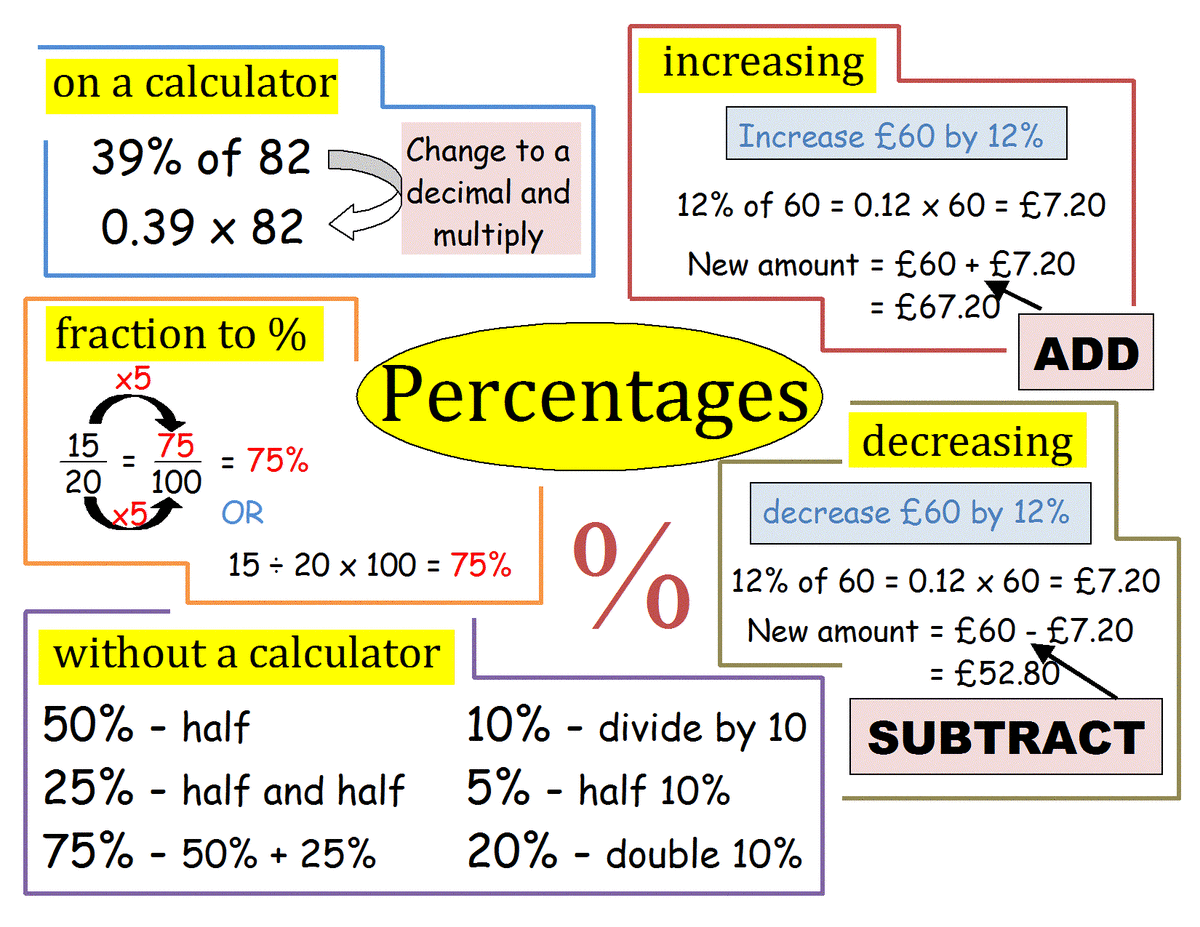
Often, you’ll need to find out what a certain percentage of a given number is. For example, if you know you have to pay 20% tax on a $500 bonus, you’d use this method. The formula involves converting the percentage to a decimal first:
$$ text{Amount} = text{Percentage (as a decimal)} times text{Whole Number} $$
To convert a percentage to a decimal, simply divide it by 100 (e.g., 20% becomes 0.20).
Using the bonus example:
-
Percentage: 20% (or 0.20 as a decimal)
-
Whole Number: $500 (bonus)
-
Calculation: 0.20 × $500 = $100
-
Result: You owe $100 in tax on your bonus.
This calculation is vital for understanding discounts, sales tax, interest accruals, and commission payments.
Determining Percentage Change: Growth and Decline
Financial markets are dynamic, constantly experiencing growth and decline. Calculating percentage change allows you to quantify this movement, whether it’s the appreciation of an investment, the increase in your salary, or a dip in market value.
The formula for percentage change is:
$$ text{Percentage Change} = left( frac{text{New Value} – text{Old Value}}{text{Old Value}} right) times 100 $$
If your investment was worth $10,000 last year and is now worth $12,500:
-
New Value: $12,500
-
Old Value: $10,000
-
Calculation: (($12,500 – $10,000) / $10,000) × 100 = ($2,500 / $10,000) × 100 = 0.25 × 100 = 25%
-
Result: Your investment grew by 25%.

If a stock dropped from $50 per share to $45 per share:
-
New Value: $45
-
Old Value: $50
-
Calculation: (($45 – $50) / $50) × 100 = (-$5 / $50) × 100 = -0.10 × 100 = -10%
-
Result: The stock declined by 10%. (A negative percentage indicates a decrease).
This formula is critical for analyzing investment performance, tracking inflation, monitoring business growth, and assessing the impact of economic trends.
Real-World Financial Applications of Percentages
With the fundamental formulas under your belt, let’s explore how percentages manifest in common financial scenarios, guiding your decisions and enhancing your financial acumen.
Navigating Discounts, Sales, and Markups
As a consumer, percentages are your best friend for understanding prices. Discounts are expressed as percentages off the original price, while sales tax is an additional percentage added.
-
Discount: A jacket is originally $120 and is advertised with a 25% discount.
-
Discount amount: 0.25 × $120 = $30
-
New price: $120 – $30 = $90
-
-
Sales Tax: You buy an item for $50 in a region with 8% sales tax.
-
Tax amount: 0.08 × $50 = $4
-
Total cost: $50 + $4 = $54
-
Understanding these calculations helps you compare deals, budget accurately for purchases, and verify the final price.
Understanding Interest Rates: Loans, Savings, and Credit
Interest rates, arguably one of the most significant financial percentages, dictate the cost of borrowing and the earnings on savings.
-
Loan Interest: You borrow $10,000 at an annual interest rate of 5%.
- Annual interest: 0.05 × $10,000 = $500. This is the cost of borrowing for one year, not including principal repayment.
-
Savings Interest: You have $1,000 in a savings account earning 2% annual interest.
- Annual earnings: 0.02 × $1,000 = $20. Your money grows by this amount.
-
Credit Card APR: An annual percentage rate (APR) of 18% means you’re charged a proportionate daily or monthly interest on your outstanding balance. A higher APR means a higher cost of carrying a balance.
Mastering interest rate calculations is crucial for managing debt, planning for retirement, and maximizing returns on your investments.
Calculating Taxes: Sales Tax, Income Tax, and More
Taxes are an unavoidable part of financial life, and they are almost always expressed as percentages.
-
Income Tax: If you earn $60,000 and fall into a 22% tax bracket for a portion of your income, you need to calculate that specific percentage.
-
Tax on income within that bracket: 0.22 × (income in that bracket).
-
Note: Tax systems are progressive, meaning different income portions are taxed at different percentages.
-
-
Property Tax: Often calculated as a percentage of your property’s assessed value.
-
Capital Gains Tax: A percentage levied on profits from the sale of assets like stocks or real estate.
Accurate tax calculations are essential for budgeting, financial planning, and ensuring compliance.
Evaluating Investment Returns and Performance
For investors, percentages are the primary metric for evaluating how well an asset or portfolio is performing.
-
Return on Investment (ROI): If you invest $5,000 and it grows to $6,500.
-
Percentage change: (($6,500 – $5,000) / $5,000) × 100 = 30%.
-
This 30% ROI tells you precisely how efficient your investment was in generating profit.
-
-
Dividend Yield: A stock pays an annual dividend of $2 per share, and its current price is $50.
- Dividend Yield: ($2 / $50) × 100 = 4%. This indicates the income generated relative to the stock’s price.
Understanding these percentages allows investors to compare different investment opportunities, monitor their portfolio’s health, and make strategic adjustments.
Budgeting and Financial Planning: Allocating Your Resources
Budgeting relies heavily on percentages to allocate income across different spending categories and savings goals. The “50/30/20 rule,” for example, suggests allocating 50% of your income to needs, 30% to wants, and 20% to savings and debt repayment.
-
If your monthly net income is $4,000:
-
Needs: 0.50 × $4,000 = $2,000
-
Wants: 0.30 × $4,000 = $1,200
-
Savings/Debt: 0.20 × $4,000 = $800
-
This percentage-based approach makes budgeting flexible and scalable, adapting easily to changes in income and ensuring a balanced financial life.
Advanced Applications and Common Pitfalls
Beyond the basic daily financial interactions, percentages play a critical role in more complex business analysis and understanding broader economic phenomena. However, they also come with nuances that, if misunderstood, can lead to costly errors.
Unpacking Profit Margins and Business Metrics
For businesses, percentages are vital for assessing profitability, efficiency, and growth.
-
Gross Profit Margin: (Gross Profit / Revenue) × 100. This indicates the percentage of revenue left after covering the cost of goods sold. A 30% gross margin means 30 cents of every dollar of revenue is available to cover operating expenses and profit.
-
Net Profit Margin: (Net Profit / Revenue) × 100. This is the ultimate measure of profitability, showing the percentage of revenue left after all expenses, including taxes, have been deducted.
-
Market Share: (Company’s Sales / Total Market Sales) × 100. This percentage indicates a company’s proportion of the total sales in its industry, a key metric for competitive analysis.
These percentages offer deep insights into a company’s financial health and operational efficiency, guiding strategic decisions on pricing, cost control, and market expansion.
The Impact of Inflation and Compound Interest
Two powerful economic forces, inflation and compound interest, are fundamentally understood through percentages.
-
Inflation: The rate at which the general level of prices for goods and services is rising, and subsequently, purchasing power is falling. If inflation is 3%, your money effectively buys 3% less next year than it does today. Understanding this helps in financial planning, especially for long-term goals like retirement.
-
Compound Interest: Often called the “eighth wonder of the world,” compound interest refers to earning interest on your initial principal and on the accumulated interest from previous periods. While the annual interest rate is a percentage, the compounding effect means your money grows exponentially. A 7% annual return compounded monthly will yield slightly more than a simple 7% annual return due to the interest earning interest more frequently. This concept is critical for long-term investing, retirement planning, and understanding the true cost of long-term debt.
Common Misinterpretations and How to Avoid Them
Despite their utility, percentages can be easily misinterpreted.
-
Percentage Points vs. Percentage Change: An interest rate increase from 5% to 6% is a 1 percentage point increase. However, it’s a ( (6-5)/5 ) * 100 = 20% percentage change in the interest rate itself. Confusing these can lead to significant miscalculations, especially in financial agreements or economic analysis.
-
Base Value Errors: Always be clear about the “whole” or “old value” you are referencing. A 50% discount followed by another 20% discount is not a 70% total discount. The second discount is applied to the already discounted price, making the total discount less than 70%.
-
Averaging Percentages: You cannot simply average percentages directly if they represent different “wholes.” For example, averaging the profit margin of a small project and a large project without weighting them by their respective revenues will give a misleading overall profit margin.
Being aware of these common pitfalls will help you interpret financial data more accurately and avoid costly errors.
Tools and Techniques for Effortless Percentage Calculations
While the underlying math is straightforward, technology offers efficient ways to handle percentage calculations, freeing up your mental energy for analysis rather than arithmetic.
Leveraging Calculators and Spreadsheets
-
Basic Calculators: Most modern calculators have a “%” button that simplifies common operations. For example, to calculate 20% of $500, you can often type “500 * 20 %” to get the result.
-
Financial Calculators: Dedicated financial calculators (like the HP 12c or Texas Instruments BA II Plus) are pre-programmed for complex financial calculations involving interest rates, present/future values, and annuities, making percentage-based financial planning much easier.
-
Spreadsheets (Excel, Google Sheets): These are perhaps the most powerful tools for working with percentages, especially for financial modeling and budgeting.
-
Direct Formulas: You can input formulas like
=(A1/B1)*100for percentage of a whole, or=A1*0.20for 20% of cell A1. -
Percentage Formatting: Cells can be formatted directly as percentages, automatically displaying decimals as percentages (e.g., 0.15 becomes 15%).
-
Scenario Analysis: Spreadsheets allow you to quickly change variables and see the impact on percentages, invaluable for budgeting, investment projections, and business planning.
-
Mental Math Shortcuts for Quick Estimates
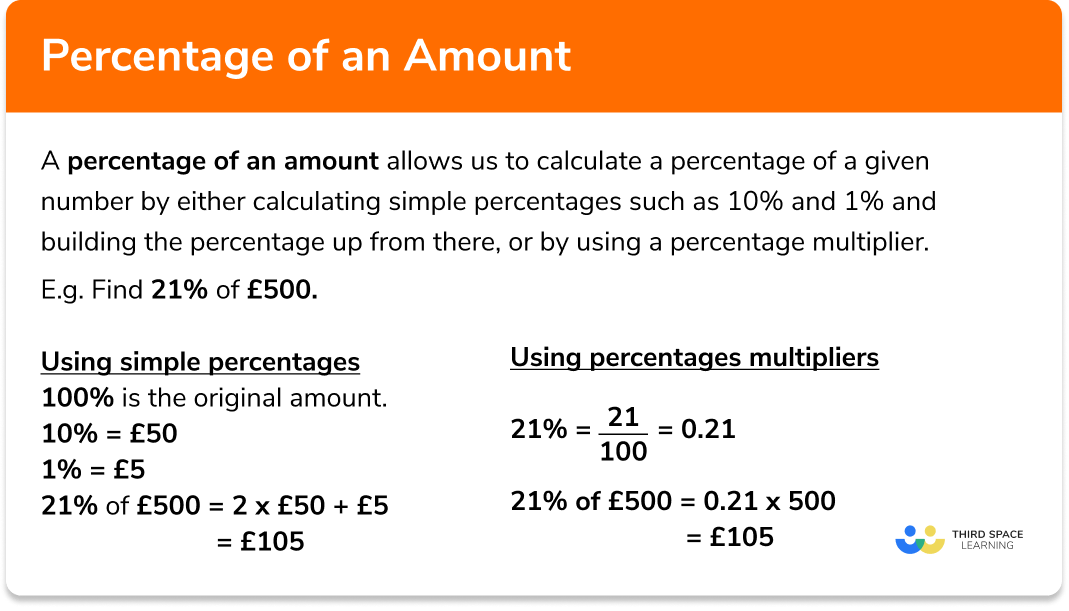
While precise calculations are often necessary in finance, knowing how to estimate percentages mentally can be incredibly useful for quick assessments or verifying calculator results.
-
Finding 10%: To find 10% of any number, simply move the decimal point one place to the left. (e.g., 10% of $450 is $45).
-
Using 10% as a Base: Once you know 10%, you can easily derive other percentages:
-
5% is half of 10% (e.g., 5% of $450 is $22.50).
-
20% is double 10% (e.g., 20% of $450 is $90).
-
To find 1% of a number, move the decimal point two places to the left (e.g., 1% of $450 is $4.50).
-
-
Rounding and Estimating: For rough estimates, round numbers to make them easier to work with. If an item is $97 and has a 20% discount, you can estimate 20% of $100 ($20) for a quick idea of the savings.
These mental shortcuts won’t replace precise calculations for critical financial decisions, but they can significantly improve your everyday financial intuition and help you make quick, informed judgments.
Mastering how to work out a percentage is not just about arithmetic; it’s about gaining a deeper understanding of financial relationships and empowering yourself to make more informed and strategic decisions. From managing personal budgets to evaluating investment opportunities and comprehending economic trends, percentages are the numerical lingua franca of finance. By understanding their fundamental calculations and diverse applications, you equip yourself with an invaluable skill set that pays dividends in every aspect of your financial life.
aViewFromTheCave is a participant in the Amazon Services LLC Associates Program, an affiliate advertising program designed to provide a means for sites to earn advertising fees by advertising and linking to Amazon.com. Amazon, the Amazon logo, AmazonSupply, and the AmazonSupply logo are trademarks of Amazon.com, Inc. or its affiliates. As an Amazon Associate we earn affiliate commissions from qualifying purchases.