
In the vast and intricate world of finance, few mathematical concepts are as fundamental and universally applied as the percentage. From personal budgeting and investment analysis to understanding market trends and corporate profitability, the ability to confidently calculate and interpret percentages is not just a useful skill—it’s an absolute necessity. Far from being a mere academic exercise, mastering how to take a percentage of a number empowers individuals and businesses alike to make informed decisions, identify opportunities, and navigate potential risks.
This guide will demystify the process, breaking down the core mechanics of percentage calculation and, more importantly, illustrating its profound relevance across the spectrum of financial activities. Whether you’re a budding investor trying to gauge returns, a small business owner calculating profit margins, or simply trying to understand a discount, a solid grasp of percentages is your indispensable financial compass. We’ll explore the basic definitions, walk through step-by-step calculations, delve into diverse financial applications, highlight common pitfalls, and suggest tools to simplify the process, all within the crucial context of money management.

The Foundation: Understanding What a Percentage Truly Means
Before we dive into the “how-to,” it’s vital to grasp the “what.” A percentage is, at its heart, a way to express a number as a fraction of 100. The word “percent” literally means “per one hundred” or “out of one hundred.” It’s a standardized way to compare parts of a whole, making complex proportions easier to understand and communicate.
Defining the “Part” and the “Whole”
Every percentage calculation involves two key components: the “part” and the “whole.”
-
The Whole (or Base): This is the total quantity or the original amount from which a portion is being taken. It represents 100% of the value.
-
The Part: This is the specific portion or amount that we want to express as a percentage of the whole.
For example, if you saved $200 out of your $1000 paycheck, your paycheck is the “whole” ($1000), and the amount you saved is the “part” ($200). The goal is to figure out what percentage $200 is of $1000.
The Ubiquity of Percentages in Finance
Percentages permeate every facet of financial life:
-
Discounts: A 20% off sale means you save 20% of the original price.
-
Interest Rates: A 5% annual interest rate on a loan or savings account directly dictates how much you pay or earn relative to the principal.
-
Taxes: Income tax, sales tax, property tax—all are calculated as percentages of a base amount.
-
Investment Returns: Whether a stock portfolio grew by 15% or a mutual fund yielded 8%, percentages quantify performance.
-
Profit Margins: Businesses track gross and net profit margins as percentages of revenue to assess efficiency.
-
Inflation: The rate at which prices for goods and services rise is expressed as a percentage.
-
Budgeting: Allocating percentages of income to different categories (e.g., 50% for needs, 30% for wants, 20% for savings).
Without percentages, comparing these diverse scenarios would be cumbersome and less intuitive. They provide a common language for financial comparisons.
Converting Between Decimals, Fractions, and Percentages
Understanding the relationship between these three forms is crucial for smooth percentage calculations:
-
Percentage to Decimal: Divide the percentage by 100 (or move the decimal point two places to the left).
- Example: 25% = 25 / 100 = 0.25
-
Decimal to Percentage: Multiply the decimal by 100 (or move the decimal point two places to the right).
- Example: 0.75 = 0.75 * 100 = 75%
-
Fraction to Percentage: Divide the numerator by the denominator to get a decimal, then convert the decimal to a percentage.
- Example: 1/4 = 0.25 = 25%
-
Percentage to Fraction: Write the percentage as a fraction over 100 and simplify.
- Example: 50% = 50/100 = 1/2
These conversions are the bedrock of any percentage-based financial calculation, allowing you to seamlessly move between different representations of a proportion.
Step-by-Step: Calculating a Percentage of a Number
Now, let’s get to the core of the operation. Calculating a percentage of a number primarily involves two main scenarios: finding what percentage one number is of another, and finding a specific percentage amount from a given whole.
The Basic Formula: (Part / Whole) * 100 or (Percentage / 100) * Whole
There are two fundamental formulas, depending on what you’re trying to find:
-
To find what percentage a “part” is of a “whole”:
Percentage = (Part ÷ Whole) × 100
-
Example: If you earned $20 commission on a $500 sale, what percentage is your commission?
-
Part = $20
-
Whole = $500
-
Percentage = ($20 ÷ $500) × 100 = 0.04 × 100 = 4%
-
-
-
To find the “part” when you know the “whole” and the “percentage”:
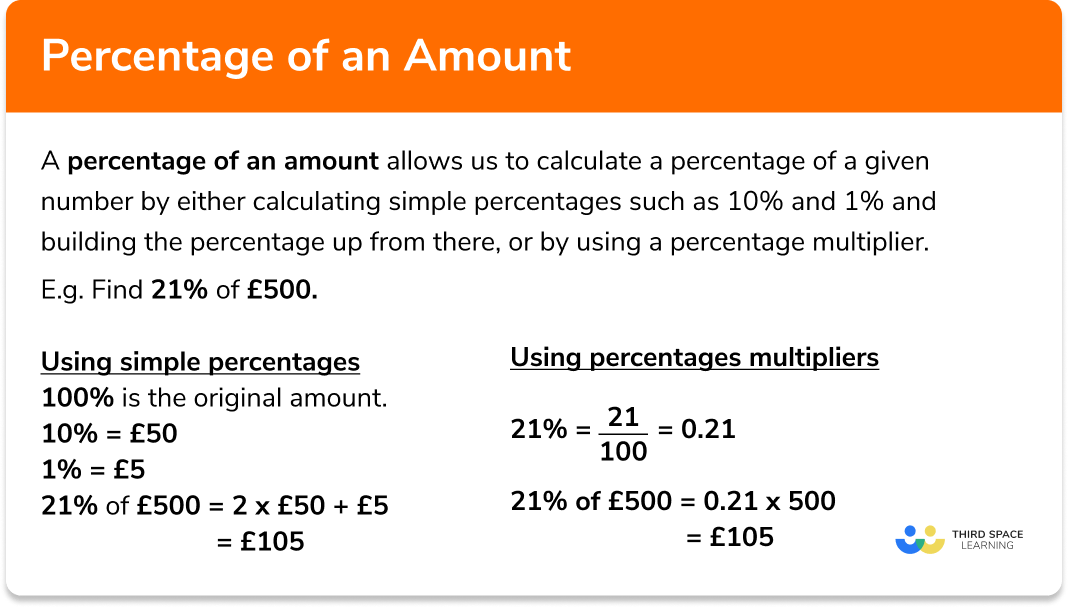
Part = (Percentage ÷ 100) × Whole
-
Alternatively, and often more simply: Part = Decimal Equivalent of Percentage × Whole
-
Example: You want to calculate a 15% tip on a $60 bill.
-
Percentage = 15% (or 0.15 as a decimal)
-
Whole = $60
-
Part (Tip) = (15 ÷ 100) × $60 = 0.15 × $60 = $9
-
-
These two formulas are the workhorses of virtually all financial percentage calculations.
Practical Examples: Discounts, Taxes, and Tips
Let’s apply these formulas to common financial scenarios:
-
Discounts: A jacket originally costs $120 and is on sale for 25% off.
-
Discount amount = (25 ÷ 100) × $120 = 0.25 × $120 = $30
-
Sale price = Original price – Discount amount = $120 – $30 = $90
-
Alternatively, if it’s 25% off, you’re paying 75% of the original price: 0.75 * $120 = $90.
-
-
Sales Tax: You buy an item for $75, and the sales tax rate is 8%.
-
Tax amount = (8 ÷ 100) × $75 = 0.08 × $75 = $6
-
Total cost = Item price + Tax amount = $75 + $6 = $81
-
-
Tips: A restaurant bill is $45, and you want to leave a 18% tip.
-
Tip amount = (18 ÷ 100) × $45 = 0.18 × $45 = $8.10
-
Total paid = Bill + Tip = $45 + $8.10 = $53.10
-
Calculating Percentage Increase or Decrease (Growth and Loss)
Beyond simple percentages of a number, finance frequently demands understanding percentage changes. This is crucial for evaluating growth, depreciation, inflation, and investment performance.
The formula for percentage change is:
Percentage Change = ((New Value – Old Value) ÷ Old Value) × 100

-
Percentage Increase (Growth): Your investment grew from $10,000 to $12,000.
-
Percentage Increase = (($12,000 – $10,000) ÷ $10,000) × 100
-
= ($2,000 ÷ $10,000) × 100 = 0.20 × 100 = 20% increase.
-
-
Percentage Decrease (Loss): A stock you own dropped from $50 per share to $40 per share.
-
Percentage Decrease = (($40 – $50) ÷ $50) × 100
-
= (-$10 ÷ $50) × 100 = -0.20 × 100 = -20% decrease.
-
(Note: A negative result indicates a decrease. You can also express this as a “20% drop.”)
-
Understanding this distinction between a percentage of a number and a percentage change is critical for accurate financial analysis.
Beyond Basics: Real-World Financial Applications of Percentages
The true power of percentages lies in their versatility. They are the analytical backbone of countless financial scenarios, enabling comparison, projection, and performance evaluation.
Personal Finance: Budgeting, Savings, and Loan Interest
-
Budgeting: The 50/30/20 rule (50% for needs, 30% for wants, 20% for savings/debt repayment) is a classic example of percentage-based budgeting. If your take-home pay is $4,000, you can quickly calculate:
-
Needs: 0.50 * $4,000 = $2,000
-
Wants: 0.30 * $4,000 = $1,200
-
Savings/Debt: 0.20 * $4,000 = $800
-
-
Savings Goals: If you want to save $10,000 in a year and can set aside $500 a month, what percentage of your goal have you reached each month?
- ($500 / $10,000) * 100 = 5% of your goal each month.
-
Loan Interest: Calculating monthly interest on a credit card balance or mortgage requires understanding the annual percentage rate (APR) and converting it to a monthly rate. If your credit card APR is 20%, the monthly rate is roughly 20% / 12 = 1.67%. Then, you apply this percentage to your average daily balance to calculate interest.
Investing: Returns, Yields, and Portfolio Allocation
-
Return on Investment (ROI): This is perhaps one of the most common and vital percentage calculations for investors. If you invest $5,000 and it grows to $5,750, your ROI is (($5,750 – $5,000) / $5,000) * 100 = 15%.
-
Dividend Yield: For income-generating investments, dividend yield (annual dividends per share / share price) is expressed as a percentage, indicating the return an investor receives in dividends relative to the stock’s price.
-
Portfolio Allocation: Investors often diversify by allocating specific percentages of their portfolio to different asset classes (e.g., 60% stocks, 30% bonds, 10% cash). This helps manage risk and target specific growth profiles.
Business Finance: Profit Margins, Markups, and Sales Growth
-
Gross Profit Margin: (Gross Profit / Revenue) * 100. A critical metric indicating how much revenue is left after accounting for the cost of goods sold.
-
Net Profit Margin: (Net Profit / Revenue) * 100. Shows the percentage of revenue that translates into actual profit after all expenses, including taxes, are deducted.
-
Markup: Businesses use markups to price products. If an item costs $50 to produce and you want a 30% markup, the selling price would be $50 + (0.30 * $50) = $65.
-
Sales Growth: Measuring the percentage increase in sales over a period (e.g., quarter-over-quarter, year-over-year) is vital for assessing business performance and market penetration.
Understanding Financial Ratios and Metrics
Many standard financial ratios—from debt-to-equity to current ratio comparisons—are implicitly or explicitly percentage-based or interpreted using percentage insights. For example, a company’s expense ratio, which tells you what percentage of revenue goes to operating expenses, is a direct percentage calculation vital for evaluating efficiency. The ability to interpret these percentages allows for meaningful comparisons between companies, industries, and historical performance.
Common Pitfalls and How to Avoid Them
While percentages are powerful, they are also prone to misinterpretation if not handled carefully. Being aware of common mistakes can save you from significant financial errors.
Misinterpreting the “Base” or “Whole”
One of the most frequent errors is applying a percentage to the wrong base number. For instance, if an item is discounted by 20%, then another 10% off the discounted price, it’s not a total of 30% off the original price. The second 10% is off a smaller base.
-
Original price: $100
-
20% off: $100 – ($100 * 0.20) = $80
-
Another 10% off the discounted price: $80 – ($80 * 0.10) = $80 – $8 = $72
-
Total discount: $100 – $72 = $28, or 28% off, not 30%.
Always be clear about which “whole” or “base” amount you are referencing for each step of a calculation.
Confusion with Percentage Points vs. Percentage Change
This distinction is crucial in finance, especially when discussing interest rates or market shifts.
-
Percentage Points: Refers to the absolute difference between two percentages.
- Example: If an interest rate increases from 4% to 5%, it’s an increase of 1 percentage point.
-
Percentage Change: Refers to the relative change.
- Example: An increase from 4% to 5% is a ((5-4)/4) * 100 = 25% increase in the interest rate itself.
Misunderstanding this difference can lead to drastically different interpretations of financial news or policy changes.
The Impact of Compounding on Percentages
Compounding, particularly compound interest, is often called the “eighth wonder of the world” because of its powerful effect over time. A small annual percentage gain, when compounded, can lead to substantial growth. Conversely, small percentage fees or interest rates, when compounded, can erode wealth significantly. When dealing with percentages over multiple periods (like annual returns or loan interest), always consider the impact of compounding, as simple percentage additions can be highly misleading.
Leveraging Tools for Accuracy and Efficiency
While understanding the manual calculation is paramount, in the fast-paced world of finance, using tools can ensure accuracy and save time, especially with complex or repetitive calculations.
The Calculator: Your Everyday Financial Ally
For quick calculations, a basic calculator is invaluable. Most standard calculators have a dedicated “%” button, which can simplify some operations (e.g., enter “100 – 25%” to get 75). However, it’s essential to understand how your specific calculator’s percentage button works, as implementations can vary. For most purposes, converting percentages to decimals (e.g., 25% to 0.25) and performing standard multiplication/division is the most reliable approach.
Spreadsheets (Excel/Google Sheets) for Complex Calculations
For managing budgets, tracking investments, or analyzing business financials, spreadsheet software like Microsoft Excel or Google Sheets is indispensable.
-
Formulas: You can set up formulas that automatically calculate percentages. For example, if your total revenue is in cell A1 and cost of goods sold is in B1, your gross profit margin could be
=(A1-B1)/A1. -
Conditional Formatting: Highlight cells based on percentage thresholds (e.g., if a profit margin drops below a certain percentage).
-
Data Analysis: Use pivot tables and charts to visualize percentage breakdowns and trends.
Spreadsheets allow for dynamic calculations, where changing one input automatically updates all related percentages, making them powerful tools for scenario planning and detailed financial analysis.
Online Calculators and Financial Apps
The internet offers a plethora of specialized online calculators for nearly every financial percentage scenario imaginable:
-
Loan Calculators: To determine monthly payments based on interest rates.
-
Mortgage Calculators: Factoring in interest, principal, and property taxes.
-
Investment Return Calculators: Projecting growth with compound interest.
-
Budgeting Apps: Many financial apps automatically track spending and categorize it into percentage breakdowns of your income.
These tools are excellent for specific, pre-defined calculations and can provide quick insights, but it’s always wise to understand the underlying percentage logic they use.
In conclusion, taking the percentage of a number is more than just a mathematical trick; it’s a fundamental pillar of financial literacy. By understanding its mechanics, its myriad applications in personal and business finance, and the common pitfalls to avoid, you equip yourself with a powerful analytical tool. Whether you’re making a simple purchase, planning for retirement, or running a multinational corporation, mastering percentages empowers you to make smarter, more confident financial decisions. Embrace this essential skill, and watch your financial acumen grow.
aViewFromTheCave is a participant in the Amazon Services LLC Associates Program, an affiliate advertising program designed to provide a means for sites to earn advertising fees by advertising and linking to Amazon.com. Amazon, the Amazon logo, AmazonSupply, and the AmazonSupply logo are trademarks of Amazon.com, Inc. or its affiliates. As an Amazon Associate we earn affiliate commissions from qualifying purchases.