
In the intricate world of personal finance, investing, and business, a single concept stands as a foundational pillar: the percentage. Far from being a mere academic exercise, understanding how to calculate and interpret percentages is an indispensable skill for anyone looking to make informed financial decisions, grow wealth, manage debt, or simply navigate the daily economic landscape. From interest rates on loans to investment returns, from sales discounts to profit margins, percentages are the universal language that quantifies proportion, change, and value relative to a whole.
This guide aims to demystify percentages, transforming what might seem like a complex mathematical operation into an accessible and powerful financial tool. We’ll delve into the fundamental “how-to,” explore practical applications across various financial scenarios, and empower you to confidently find, interpret, and leverage percentages for your financial benefit.
The Foundational Role of Percentages in Finance
Before we dive into the calculations, it’s crucial to grasp why percentages are so profoundly significant in the realm of money. They provide a standardized way to compare different quantities, assess performance, and understand the impact of various financial events, regardless of the absolute numbers involved.
What Exactly is a Percent? Demystifying the Concept
At its core, “percent” means “per hundred” or “out of one hundred.” It’s a way of expressing a number as a fraction of 100. The symbol “%” is universally recognized as representing this concept. For example, 50% means 50 out of 100, which can also be written as the fraction 50/100 or the decimal 0.50.
The beauty of percentages lies in their ability to standardize comparisons. Whether you’re comparing a small budget of $100 to a large corporate budget of $1,000,000, expressing changes or proportions as a percentage allows for an apples-to-apples comparison of relative impact, rather than just absolute dollar figures.
Why Percentages Matter More Than You Think in Money Matters
Consider these everyday financial scenarios:
-
Savings Account Interest: A bank offers 0.5% interest on your savings. What does that truly mean for your money over time?
-
Loan Rates: Your mortgage has a 4% interest rate, and your credit card charges 20%. Why is this difference critical?
-
Sales and Discounts: A store offers “25% off all items.” How much will you actually save?
-
Investment Returns: Your stock portfolio grew by 8% last year. Is that good, and what does it mean for your principal?
-
Budgeting: You allocate 30% of your income to housing. How do you calculate that amount?
Without a solid understanding of percentages, these crucial financial details remain abstract, hindering your ability to make optimal decisions. Percentages provide clarity, enabling you to quantify risks, opportunities, and the true cost or benefit of financial products and decisions.
Core Methods for Calculating Percentages
Mastering a few fundamental calculations will unlock the vast utility of percentages. There are three primary types of percentage problems you’ll encounter in finance: finding a percentage of a number, finding what percentage one number is of another, and calculating percentage change.
Calculating a Percentage of a Number
This is perhaps the most common application. You know the whole amount and a percentage, and you want to find the part.
Formula: Part = (Percentage / 100) * Whole or Part = Decimal equivalent of Percentage * Whole
Example: You want to save 15% of your $4,000 monthly income.
-
Convert 15% to a decimal: 15 / 100 = 0.15
-
Multiply by the whole amount: 0.15 * $4,000 = $600
-
You should save $600.
Another Example (Sales Discount): A shirt costs $80, and there’s a 25% discount.
-
Calculate the discount amount: (25 / 100) * $80 = 0.25 * $80 = $20
-
Calculate the new price: $80 – $20 = $60
Finding What Percentage One Number is of Another
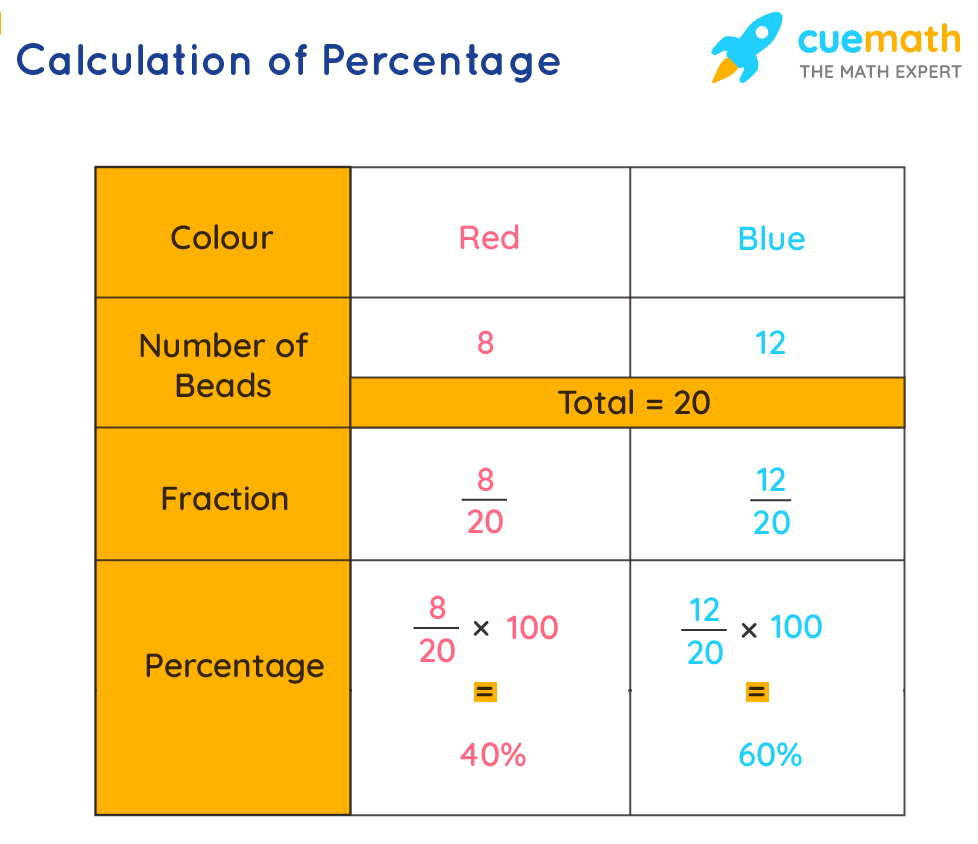
Here, you know the part and the whole, and you want to express the part as a percentage of the whole.
Formula: Percentage = (Part / Whole) * 100
Example: You spent $1,200 on rent this month, and your total income was $4,000. What percentage of your income went to rent?
-
Divide the part by the whole: $1,200 / $4,000 = 0.30
-
Multiply by 100 to convert to a percentage: 0.30 * 100 = 30%
-
30% of your income went to rent.
Another Example (Profit Margin): A product sold for $50, and its cost was $30. The profit is $20. What is the profit margin (profit as a percentage of revenue)?
- Profit Margin = ($20 / $50) * 100 = 0.40 * 100 = 40%
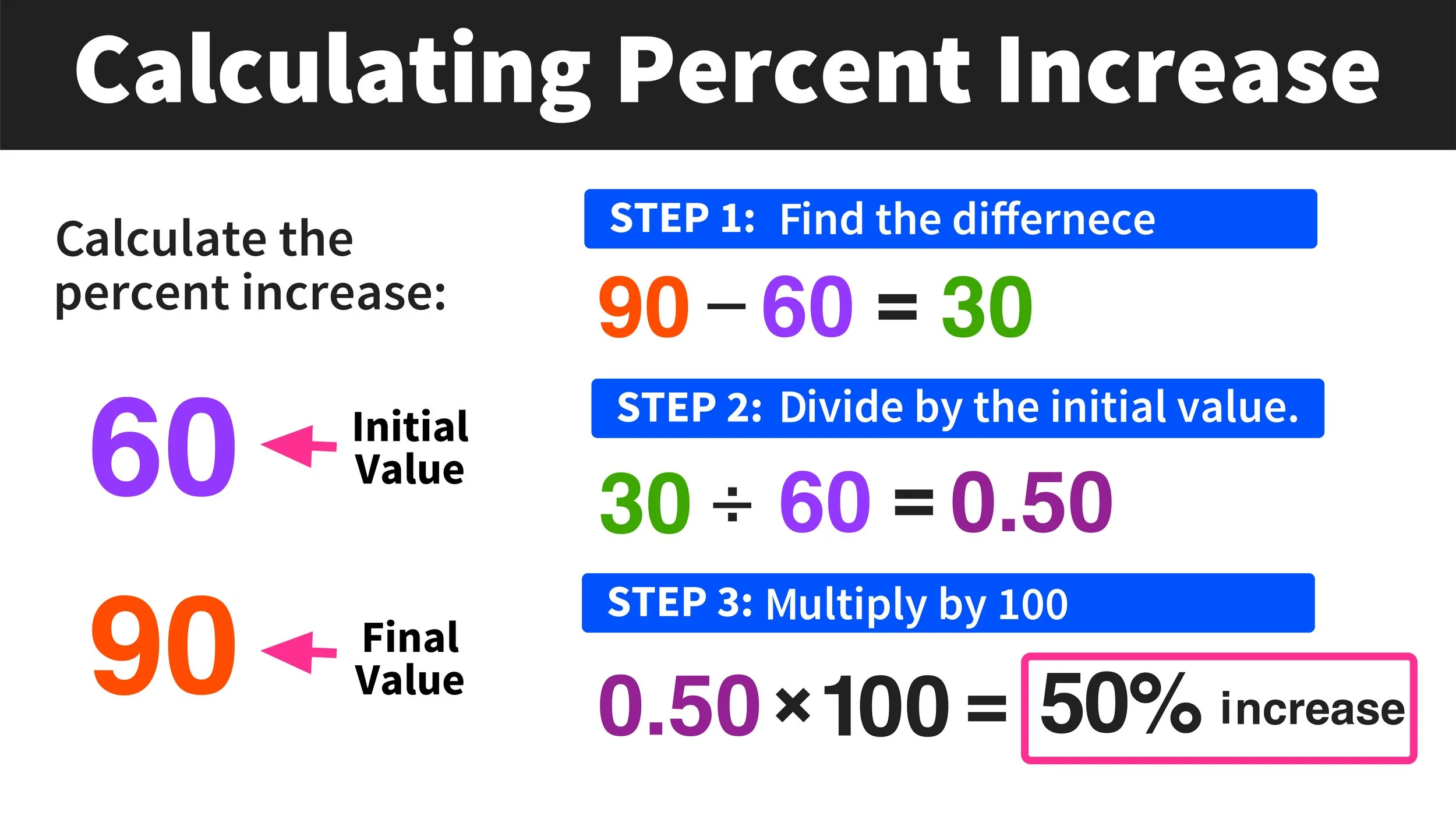
Determining Percentage Change (Increase or Decrease)
This calculation helps you understand the relative growth or decline of a financial value over time.
Formula: Percentage Change = ((New Value - Original Value) / Original Value) * 100
-
A positive result indicates a percentage increase.
-
A negative result indicates a percentage decrease.
Example (Investment Growth): Your investment portfolio started at $10,000 and grew to $10,800. What was the percentage increase?
-
Difference = $10,800 – $10,000 = $800
-
Percentage Change = ($800 / $10,000) * 100 = 0.08 * 100 = 8% increase.

Example (Value Depreciation): Your car was worth $20,000 last year and is now valued at $18,000. What is the percentage decrease?
-
Difference = $18,000 – $20,000 = -$2,000
-
Percentage Change = (-$2,000 / $20,000) * 100 = -0.10 * 100 = -10% decrease.
Practical Applications of Percentages in Personal Finance
Percentages are the bedrock of effective personal financial management, allowing you to track progress, evaluate opportunities, and mitigate risks.
Budgeting and Saving: Allocating Your Income
Many popular budgeting rules are expressed in percentages, such as the 50/30/20 rule (50% for needs, 30% for wants, 20% for savings and debt repayment). To implement these, you need to calculate specific dollar amounts from your income.
-
Calculating savings goals: If you aim to save 10% of each paycheck, knowing how to calculate that amount precisely helps you consistently meet your goal.
-
Expense analysis: By finding what percentage each expense category (housing, food, transportation) represents of your total income or spending, you can identify areas for potential cuts or adjustments.
Debt Management: Understanding Interest Rates and Repayments
Interest rates are almost universally expressed as percentages and are central to the cost of borrowing money.
-
Loan interest: Whether it’s a mortgage, car loan, or credit card, understanding the annual percentage rate (APR) is critical for knowing how much interest you’ll pay over the life of the loan. Knowing how to calculate the monthly interest portion of your payment helps you grasp the true cost of debt.
-
Minimum payments: While a minimum payment might seem small, calculating the percentage it represents of your total balance reveals how slowly you’re paying off debt and the impact of compounding interest.
Investing: Gauging Returns and Growth
The performance of investments is almost always communicated through percentage returns.
-
Return on Investment (ROI): This key metric is calculated as a percentage, indicating the profitability of an investment relative to its cost. Understanding ROI allows you to compare different investment opportunities objectively.
-
Portfolio growth: Tracking the percentage increase or decrease in your investment portfolio over various periods helps you assess your progress toward financial goals and adjust your strategy if needed.
-
Compounding: The magic of compounding interest is best understood in percentage terms, illustrating how initial gains, when reinvested, can generate further gains exponentially over time.
Business and Online Income: Leveraging Percentages for Profit
For entrepreneurs, small business owners, or those generating online income, percentages are indispensable for strategic planning, pricing, and performance evaluation.
Pricing Strategies and Profit Margins
Setting the right price for products or services often involves percentage-based calculations.
-
Markup: Businesses typically add a percentage markup to their cost to arrive at a selling price. Calculating this accurately ensures profitability.
-
Gross and Net Profit Margins: Expressed as percentages, these metrics reveal how much profit a company makes for every dollar of revenue, after accounting for direct costs (gross) and all expenses (net). Monitoring these percentages is crucial for assessing financial health.
-
Break-even analysis: Understanding sales volume required to cover costs often involves percentage calculations related to variable costs and pricing.
Commissions and Royalties: Understanding Your Earnings
Many income models, especially in sales, creative industries, or affiliate marketing, are based on percentages.
-
Sales commissions: If you earn a 10% commission on sales, knowing how to calculate this instantly allows you to project earnings based on sales volume.
-
Affiliate marketing: Online entrepreneurs earn a percentage of sales generated through their unique links. Calculating these percentages is fundamental to tracking and maximizing affiliate income.
-
Royalties: Authors, musicians, and artists often receive a percentage of sales or licensing fees for their work.
Analyzing Sales Growth and Market Share
Businesses constantly track their performance against past periods and competitors, and percentages are the standard metric.
-
Year-over-year growth: Calculating the percentage increase in sales, revenue, or customer base helps businesses understand their trajectory and measure the effectiveness of their strategies.
-
Market share: Expressing a company’s sales as a percentage of the total market sales provides insight into its competitive position and influence.
Tools and Tips for Mastering Percentage Calculations
While the underlying math is straightforward, practical execution can be streamlined with the right tools and a clear mindset.
Digital Tools: Calculators, Spreadsheets, and Apps
You don’t need to be a math whiz to work with percentages; modern tools do the heavy lifting.
-
Basic Calculators: Every smartphone has one. Simply enter the numbers and use the “%” button or perform the division/multiplication steps outlined above.
-
Spreadsheet Software (Excel, Google Sheets): Incredibly powerful for financial calculations. You can set up formulas (e.g.,
=A1*0.15for 15% of cell A1, or=(B1/A1)*100for percentage of B1 in A1) that automatically update, making budgeting, investment tracking, and business analysis much more efficient. -
Financial Apps: Many personal finance and banking apps incorporate percentage calculations directly, showing you interest accrual, savings progress, and investment returns automatically.
Common Pitfalls and How to Avoid Them
-
Confusing Percentage Points with Percentage Change: A common error. If an interest rate goes from 4% to 5%, that’s a 1 percentage point increase, but a (1/4)*100 = 25% *increase* in the rate itself. Always be clear about what you’re referencing.
-
Order of Operations: When dealing with multiple percentage adjustments (e.g., a discount followed by a tax), the order matters. Calculate sequentially.
-
Rounding Errors: Be mindful of rounding too early in complex calculations, as it can significantly affect the final number.
Cultivating a Percentage Mindset for Financial Success
Beyond the mechanics, developing a “percentage mindset” is key. When you see a financial number, automatically ask yourself:
-
“What percentage is this of my total income/spending/assets?”
-
“What is the percentage change from last month/year?”
-
“What does this percentage mean for my overall financial goal?”
This continuous questioning cultivates deeper financial awareness and empowers you to make proactive, data-driven decisions.
The Power of Percentages in Your Financial Journey
The question “how do I find the percent?” is more than a simple mathematical query; it’s an invitation to unlock a fundamental layer of financial literacy. From the smallest personal budgeting decisions to the grandest investment strategies and business ventures, percentages serve as the constant, reliable metric that provides clarity, enables comparison, and drives intelligent action.
By mastering the core calculations, understanding their varied applications in the world of money, and leveraging available tools, you transform percentages from an abstract concept into a powerful instrument for achieving financial control, growth, and prosperity. Embrace the power of percentages, and watch your financial acumen—and your wealth—grow.
aViewFromTheCave is a participant in the Amazon Services LLC Associates Program, an affiliate advertising program designed to provide a means for sites to earn advertising fees by advertising and linking to Amazon.com. Amazon, the Amazon logo, AmazonSupply, and the AmazonSupply logo are trademarks of Amazon.com, Inc. or its affiliates. As an Amazon Associate we earn affiliate commissions from qualifying purchases.