
In today’s consumer-driven world, discounts are ubiquitous. From online sales to in-store promotions, coupons, and loyalty programs, opportunities to save money seem to be everywhere. Yet, for many, the simple act of calculating a percentage discount, such as “20 percent off,” can feel like a frustrating mathematical puzzle. This seemingly straightforward calculation holds the key to significant savings, preventing overspending, and ultimately empowering you to make smarter financial decisions. Understanding how to quickly and accurately determine a discounted price isn’t just a party trick; it’s a fundamental skill for anyone serious about personal finance, budgeting effectively, and navigating the complexities of modern commerce with confidence. This article will demystify the process, providing clear, practical methods to calculate 20 percent off, and extend these principles to enhance your overall financial literacy and spending strategies.

The Fundamentals of Percentage Discounts: Why It Matters
Before diving into the mechanics, it’s crucial to grasp what a percentage discount truly represents and why mastering this skill is so vital for your financial well-being. Discounts aren’t just arbitrary numbers; they are a direct reduction in the original price of an item, offering an opportunity to acquire goods or services for less.
Understanding the Basics: What is a Percentage?
At its core, a percentage is a way of expressing a number as a fraction of 100. So, “20 percent” literally means “20 out of 100” or 20/100. When applied to a discount, it signifies that for every $100 of the original price, $20 is being deducted. Grasping this simple definition is the foundation upon which all discount calculations are built. It allows you to contextualize the saving and mentally estimate the impact on the total cost.
The Psychology of Discounts: More Than Just a Number
Retailers heavily leverage the psychological impact of discounts. A “20% off” sticker can trigger a sense of urgency, the thrill of a bargain, and the perception of getting more value for less. For consumers, this perception can be a powerful motivator, sometimes leading to impulse purchases of items that might not truly be needed. By understanding how to calculate the actual saving, you can move beyond the emotional appeal and make rational decisions based on real numbers. This empowers you to differentiate between a genuinely good deal and a clever marketing ploy, protecting your budget from unnecessary expenditures.
Common Scenarios: Everyday Applications
The ability to calculate discounts extends far beyond just shopping for clothes or electronics. Consider these everyday scenarios:
-
Groceries: Many supermarkets offer percentage-based discounts on specific items or your total bill.
-
Utilities: Some service providers offer discounts for early payment or bundles.
-
Travel: Airlines, hotels, and rental car companies frequently advertise percentage off deals.
-
Services: From haircuts to car repairs, discounts are common.
-
Investments: Understanding percentage changes is critical for tracking investment performance.
In each case, a quick and accurate calculation of the actual cost after the discount can directly impact your monthly budget and long-term financial planning. It helps you assess the true cost-effectiveness of an offer and compare it against alternatives.
Practical Methods for Calculating 20 Percent Off
Calculating 20 percent off is a fundamental financial skill that can be approached in several straightforward ways. Whether you prefer mental math, a quick estimation, or precise digital calculations, mastering these methods will serve you well.
The Subtraction Method: Simple and Direct
This is often the most intuitive approach for many. It involves two steps: first, calculate the exact dollar amount of the discount, and then subtract that amount from the original price.
-
Calculate the discount amount: Multiply the original price by the percentage (expressed as a decimal).
- Example: For an item priced at $50, 20% off would be $50 * 0.20 = $10.
-
Subtract from the original price: Take the original price and subtract the discount amount.
- Example: $50 – $10 = $40.
The final price is $40. This method clearly breaks down the discount, showing you exactly how much you’re saving in monetary terms.
The Multiplication Method: Efficiency in Your Pocket
This method is more efficient as it combines the two steps into one, directly yielding the final discounted price. If an item is 20% off, it means you are paying 80% of the original price (100% – 20% = 80%).
-
Determine the remaining percentage: Subtract the discount percentage from 100%.
- Example: 100% – 20% = 80%.
-
Multiply the original price by the remaining percentage (as a decimal):
- Example: For an item priced at $50, you would calculate $50 * 0.80 = $40.
This method is particularly useful for quick calculations, especially when you’re less interested in the exact dollar amount of the discount and more focused on the final price you’ll pay. It’s often favored by those who need to process multiple discounts rapidly.
Mental Math Shortcuts: Quick Calculations On-the-Go
For 20% off, there are some excellent mental shortcuts that can save you time and the need for a calculator.
-
Find 10% first: 10% of any number is simply that number with the decimal point moved one place to the left. Then, double it for 20%.
-
Example: For $50:
-
10% of $50 = $5.
-
20% of $50 = $5 * 2 = $10.
-
$50 – $10 = $40.
-
-
-
Divide by 5: Since 20% is 1/5, you can divide the original price by 5 to find the discount amount, then subtract it.
-
Example: For $50:
-
$50 / 5 = $10 (this is the discount).
-
$50 – $10 = $40.
-
-
These mental math tricks are invaluable when you’re in a store and need to quickly estimate a price without pulling out your phone or a calculator, allowing you to make faster decisions at the point of sale.
Using Digital Tools: Calculators, Apps, and Online Converters
For larger numbers, complex calculations, or simply for peace of mind, digital tools are your best friend.
-
Standard Calculator: Most smartphones have a built-in calculator. Input the original price, then multiply by 0.80 for 20% off, or multiply by 0.20 and subtract.
-
Percentage Calculator Apps: Numerous free apps are designed specifically for percentage calculations, often allowing you to input the original price and the discount percentage to get the final amount instantly.
-
Online Converters: A quick Google search for “percentage off calculator” will yield many websites that perform this function.
While relying on tools is convenient, understanding the underlying math ensures you can verify results and aren’t blindly trusting technology.
Beyond 20 Percent: Applying the Principles to Any Discount
Once you master “20 percent off,” you’ve essentially unlocked the ability to calculate any percentage discount. The core principles remain the same, only the numbers change. This flexibility is crucial for navigating the diverse range of promotions you’ll encounter.
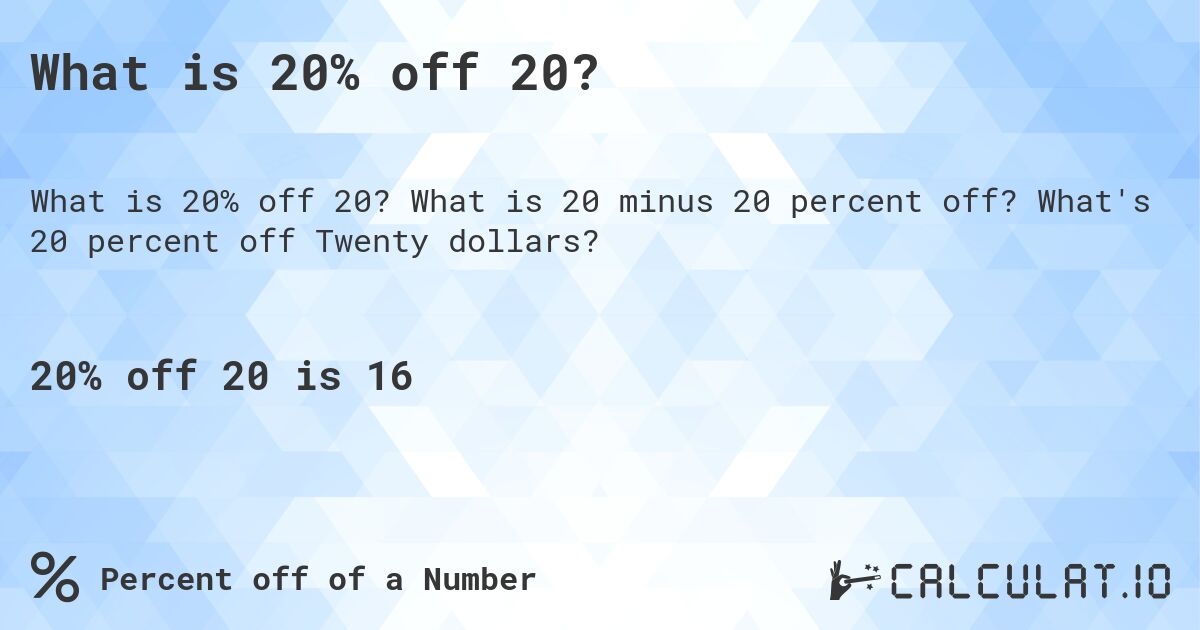
Adapting Formulas for Different Percentages
The subtraction and multiplication methods are universally applicable.
-
For 30% off:
-
Subtraction:
Original Price * 0.30(discount amount), thenOriginal Price - Discount Amount. -
Multiplication:
Original Price * 0.70(100% – 30% = 70%).
-
-
For 5% off:
-
Subtraction:
Original Price * 0.05(discount amount), thenOriginal Price - Discount Amount. -
Multiplication:
Original Price * 0.95(100% – 5% = 95%).
-
The key is converting the percentage to its decimal equivalent (divide by 100) and understanding whether you’re calculating the discount amount or the final price.
Handling Multiple Discounts: Stacking Strategies
This is where calculations can get tricky, but a clear understanding of order of operations is vital. Retailers often offer “stackable” discounts, such as “20% off sale items” plus an “additional 10% off with coupon.” Crucially, discounts are almost always applied sequentially, not cumulatively.
-
Incorrect (Cumulative): You do not add the percentages (20% + 10% = 30%) and take 30% off the original price. This would typically result in a larger discount than intended by the retailer.
-
Correct (Sequential):
-
Apply the first discount to the original price.
-
Take that new price and apply the second discount to it.
-
Example: Item $100, 20% off, then an additional 10% off.
-
$100 – (100 * 0.20) = $100 – $20 = $80 (after 20% off).
-
$80 – (80 * 0.10) = $80 – $8 = $72 (after additional 10% off).
-
-
The final price is $72, not $70 if you had incorrectly applied 30% off. Knowing this distinction can save you from miscalculating your savings or expecting a lower price than you’ll actually pay.
Understanding “Up To” Discounts and Exclusions
Be wary of phrases like “Up to 50% off” or “Save 20% on selected items.” These are often marketing ploys designed to draw you in. “Up to” means only a very small portion of items might have the maximum discount, while most have far less. Similarly, “selected items” implies that not everything qualifies. Always read the fine print, check tags carefully, and mentally (or physically) calculate the discount on the specific item you intend to purchase, rather than assuming the headline percentage applies.
Strategic Spending: Maximizing Savings and Avoiding Pitfalls
Calculating discounts is just the first step. True financial savvy comes from integrating these calculations into a broader strategy of mindful spending and budgeting. It’s not just about finding a discount; it’s about making sure that discount aligns with your financial goals.
Is a Discount Always a Good Deal? Assessing Value
A common pitfall is falling for a discount simply because it’s a discount. “20% off!” sounds great, but is it 20% off something you genuinely need or planned to buy? Is it 20% off an overpriced item? Always evaluate the intrinsic value of the item first. Ask yourself:
-
Would I buy this item at its original price if I really needed it?
-
Is this item within my budget even with the discount?
-
Am I buying it because it’s on sale, or because I’ve been planning to purchase it?
A 20% discount on an item you don’t need or can’t afford is still an unnecessary expenditure.
Budgeting with Discounts in Mind: Planning for Savings
Incorporate potential discounts into your budgeting process. If you know a major sale event (like Black Friday or end-of-season clearance) is coming up, you can earmark funds for anticipated purchases, factoring in the expected savings. This prevents impulse buying during sales by grounding your spending in a pre-approved budget. For instance, if you’ve budgeted $100 for a specific item, and you find it for 20% off, you now have $20 extra to allocate elsewhere or save.
The Trap of Impulse Buying: Resisting Discount-Driven Overspending
Discounts are powerful triggers for impulse buying. The fear of missing out (FOMO) on a “limited time offer” can override rational financial decision-making. Before hitting “add to cart” or heading to the checkout, pause. Use your discount calculation skills to verify the actual saving, then take a moment to reflect on whether this purchase aligns with your budget and needs. A 24-hour rule (waiting a day before purchasing a non-essential discounted item) can be an effective way to curb impulse buys. Remember, if you buy something you don’t need, even at 20% off, you’re not saving money – you’re spending 80% of its price.
Leveraging Loyalty Programs and Price Matching
Beyond explicit percentage discounts, smart shoppers also leverage loyalty programs and price matching policies. Loyalty programs often provide exclusive member-only discounts or points that translate into future savings. Price matching, when available, can ensure you get the best deal without having to chase every single discount across different retailers. Always factor these additional layers of potential savings into your overall financial calculations. Understanding how a 20% discount compares to a store’s competitor’s 15% discount, or how it stacks with your loyalty points, makes you a truly informed consumer.
Empowering Your Financial Decisions: The Long-Term Impact
Mastering how to figure out “20 percent off” might seem like a small, isolated skill, but its implications for your long-term financial health are profound. It’s a stepping stone towards greater financial literacy, enabling you to make more deliberate and impactful decisions with your money.
From Individual Purchases to Overall Financial Health
Every dollar saved through smart discount calculations contributes to your overall financial well-being. Over time, consistently making informed purchasing decisions, whether it’s saving $10 on groceries, $50 on a new appliance, or $200 on a vacation, adds up. These cumulative savings can be redirected towards more significant financial goals: building an emergency fund, paying down debt, investing for retirement, or saving for a down payment. The discipline learned through calculating discounts instills a broader habit of financial prudence.
Cultivating a Mindset of Financial Prudence
The ability to accurately calculate discounts fosters a more financially conscious mindset. You become less susceptible to marketing ploys and more analytical about your spending. This critical thinking extends beyond just sales; it applies to evaluating loan interest rates, understanding investment returns, and assessing the true cost of financial products. It moves you from being a passive consumer to an active financial manager, in control of your money rather than being controlled by it. This mindset shift is invaluable, transforming how you view and interact with money in every aspect of your life.

Teaching Financial Literacy: Passing on the Skills
Finally, understanding how to calculate discounts is an excellent foundational skill to pass on to younger generations. Teaching children and young adults these practical math applications connects classroom learning to real-world financial scenarios. It empowers them to become financially literate consumers from an early age, equipping them with the tools to manage their own money effectively and avoid common financial pitfalls as they grow older. By demystifying percentages and showing their immediate relevance, we help build a generation that is more financially capable and secure.
In conclusion, “how do I figure out 20 percent off” is far more than a simple arithmetic problem. It’s a gateway to greater financial independence, smarter spending, and a more robust personal finance strategy. By mastering these calculations, you equip yourself with the confidence and knowledge to navigate the marketplace, maximize your savings, and make every dollar work harder for you.
aViewFromTheCave is a participant in the Amazon Services LLC Associates Program, an affiliate advertising program designed to provide a means for sites to earn advertising fees by advertising and linking to Amazon.com. Amazon, the Amazon logo, AmazonSupply, and the AmazonSupply logo are trademarks of Amazon.com, Inc. or its affiliates. As an Amazon Associate we earn affiliate commissions from qualifying purchases.