
In the complex ecosystem of modern business finance, few areas are as opaque and potentially costly as merchant services. For business owners and financial controllers, understanding how credit card processing fees are calculated is not just a matter of administrative curiosity—it is a fundamental requirement for maintaining healthy profit margins. Among the various models used to bill merchants for credit card transactions, “Interchange Plus” pricing stands out as the most transparent, cost-effective, and professional structure available.
To navigate the financial landscape of payment processing, one must first demystify the jargon that often hides the true cost of doing business. Interchange Plus pricing, frequently referred to as “cost-plus” pricing, provides a clear window into the wholesale costs of credit card transactions, separating the mandatory fees set by card networks from the markup charged by the service provider.

The Three Pillars of Interchange Plus Pricing
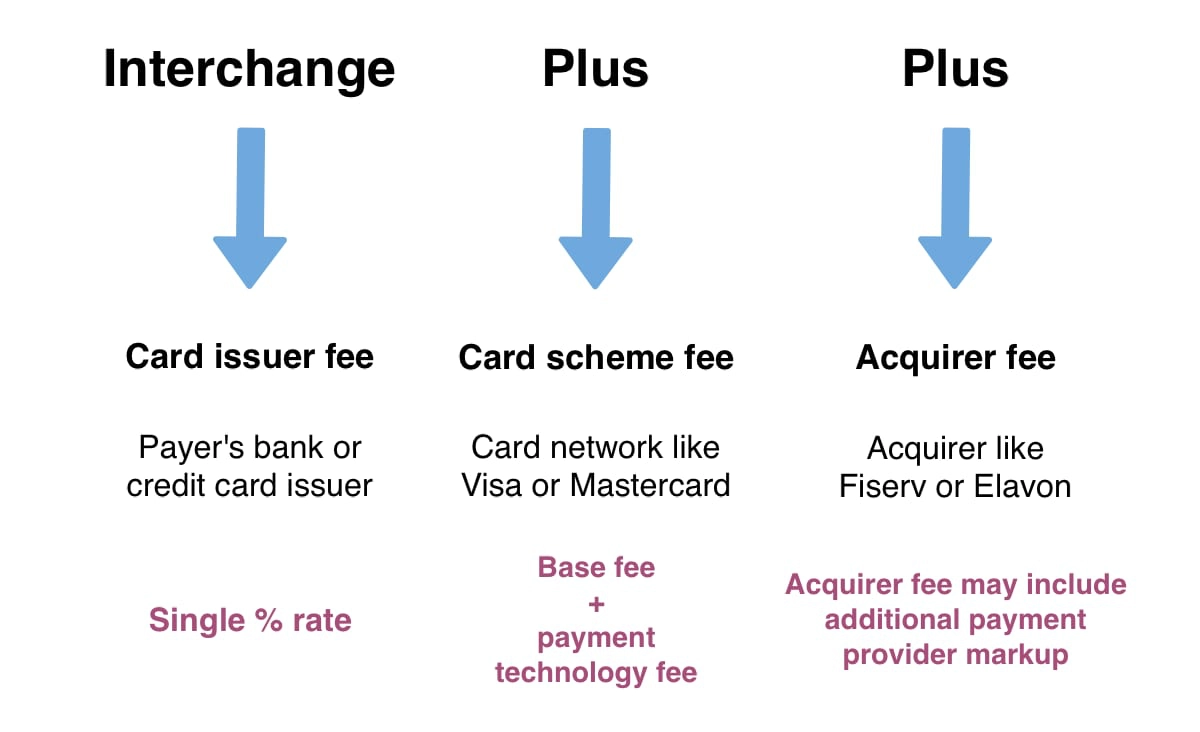
To understand Interchange Plus, one must understand the three distinct components that make up the cost of every credit card swipe, dip, or tap. Unlike other pricing models that bundle these costs into a single, confusing rate, Interchange Plus breaks them down into three transparent layers.
1. Interchange Fees (The “Interchange”)
The “Interchange” portion of the name refers to the fees paid directly to the bank that issued the credit card being used by the customer. These rates are not set by the payment processor or the merchant; they are established by the card networks (Visa, Mastercard, Discover, and American Express).
Interchange rates are non-negotiable and are determined by a variety of factors, including the type of card used (e.g., a basic debit card vs. a high-reward signature card), the industry of the merchant, and how the transaction was processed (in-person vs. online). There are hundreds of different interchange categories, and they represent the “wholesale” cost of a transaction.
2. Assessment Fees
Assessment fees are the second component of the wholesale cost. These fees are paid directly to the card networks themselves (Visa, Mastercard, etc.) for the use of their branding and infrastructure. Like interchange fees, assessments are standardized across the industry. While they are significantly lower than interchange fees—usually a fraction of a percent—they are a mandatory part of the cost structure that every merchant must pay, regardless of their processor.
3. The Processor’s Markup (The “Plus”)
The “Plus” in Interchange Plus represents the specific markup charged by the payment processor for their services. This is the only part of the pricing equation that is negotiable. This markup is typically expressed as a percentage of the transaction volume plus a small per-transaction fee (e.g., 0.20% + $0.10).
Because the processor’s fee is separated from the wholesale costs, the merchant knows exactly how much they are paying the processor for the service of facilitating the payment. This separation is the cornerstone of financial transparency in the merchant services industry.
The Financial Advantage: Transparency and Cost Savings
The primary reason financial experts and seasoned business owners prefer Interchange Plus pricing is the sheer level of transparency it offers. In a financial climate where every basis point matters, having a clear view of where money is going is essential for effective cash flow management.
Eliminating Hidden Margins
In more traditional pricing models, such as tiered pricing, processors group various interchange rates into “Qualified,” “Mid-Qualified,” and “Non-Qualified” buckets. This allows processors to hide large margins by routing many transactions into the higher-priced “Non-Qualified” tiers.
With Interchange Plus, there is no “bucket.” If a transaction costs 1.65% at the wholesale level, the merchant pays exactly 1.65% plus the agreed-upon markup. This prevents the processor from pocketing the difference between a low-cost debit transaction and a higher-cost rewards card transaction.
Optimizing the Effective Rate
For a business focused on financial health, the “effective rate” is the most important metric. This is calculated by taking the total fees paid in a month and dividing them by the total sales volume. Because Interchange Plus passes through the lowest possible wholesale costs, businesses almost always achieve a lower effective rate compared to flat-rate or tiered models, especially as their transaction volume grows.
Detailed Reporting and Auditing
Interchange Plus pricing provides a level of reporting detail that is invaluable for corporate accounting. Monthly statements under this model typically show a line-by-line breakdown of every interchange category used. This allows financial officers to see exactly which types of cards their customers are using and identify opportunities for optimization, such as encouraging certain payment methods or updating point-of-sale technology to ensure transactions qualify for the lowest possible interchange rates.
Comparing Interchange Plus to Alternative Models
To fully appreciate the value of Interchange Plus, it is necessary to compare it against the two other most common pricing structures: Flat-Rate and Tiered pricing. Each has its place in the market, but they often lack the financial efficiency required by scaling businesses.
Interchange Plus vs. Flat-Rate Pricing
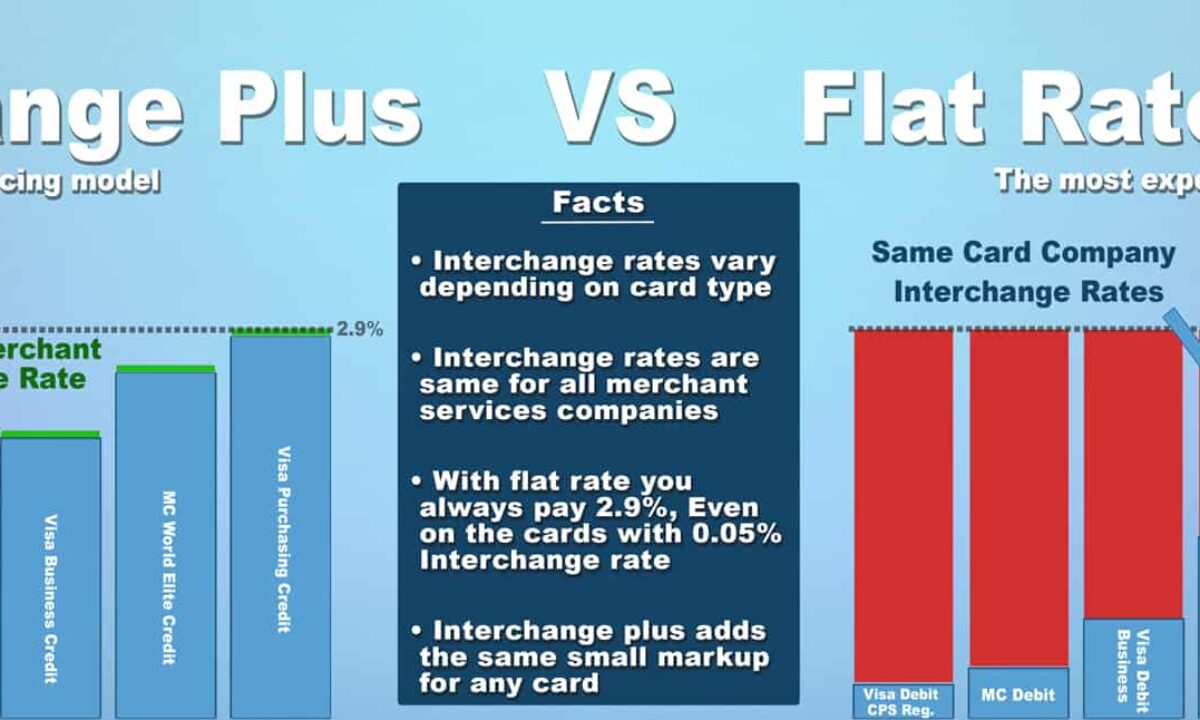
Flat-rate pricing is popularized by companies like Square, Stripe, and PayPal. In this model, the merchant pays a single, fixed percentage for every transaction (e.g., 2.9% + $0.30), regardless of the underlying interchange cost.
While flat-rate pricing is simple and predictable, it is often the most expensive option for businesses with significant volume. For example, if a customer uses a basic debit card that has an interchange rate of 0.05%, a merchant on a flat-rate plan still pays 2.9%. The processor keeps the massive spread. Interchange Plus ensures that when the wholesale cost is low, the merchant keeps the savings.
Interchange Plus vs. Tiered Pricing
Tiered pricing is often the most detrimental to a company’s bottom line. It lures merchants in with a low “teaser” rate for “Qualified” transactions, but most modern rewards cards, corporate cards, and “card-not-present” transactions fall into the “Non-Qualified” tier, which can carry rates as high as 4% or 5%.
Interchange Plus removes the subjectivity of these tiers. There is no guesswork involved; the merchant simply pays the actual cost plus a small, fixed fee. This shift from a “retail” pricing mindset to a “wholesale” pricing mindset is a hallmark of sophisticated financial management.
Who Benefits Most from Interchange Plus?
While Interchange Plus is generally considered the best all-around pricing model, its impact is most profound for specific types of business entities.
Mid-to-Large Scale Enterprises
For businesses processing more than $20,000 per month, the savings generated by switching to Interchange Plus can be substantial. In many cases, the shift from a flat-rate model to Interchange Plus can save a business anywhere from 0.5% to 1.5% on their total processing volume. For a company doing $1 million in annual credit card sales, that equates to $5,000 to $15,000 added directly to the bottom line.
B2B Companies and High-Ticket Retailers
Businesses that deal with corporate purchasing cards or high-ticket items benefit immensely from Interchange Plus. Corporate cards often qualify for “Level 2” or “Level 3” interchange data, which provides significantly lower wholesale rates if the merchant provides extra data at the point of sale. Interchange Plus allows these specific savings to be passed directly to the business, whereas flat-rate or tiered models would likely swallow those discounts as profit for the processor.
High-Volume, Low-Margin Businesses
In industries like grocery, wholesale distribution, or discount retail, where profit margins are razor-thin, every cent saved on processing is vital. Interchange Plus ensures that the merchant is not overpaying for low-cost debit transactions, which often make up a large portion of their volume.
Implementing an Interchange Plus Strategy
Transitioning to an Interchange Plus pricing model is a strategic financial move that requires due diligence. It is not merely about changing a service provider; it is about establishing a transparent partnership that supports long-term growth.
Negotiating the Markup
When shopping for an Interchange Plus provider, the “Plus” is the only variable you need to negotiate. A business should aim for a markup that is competitive for their industry and volume. It is also important to look at the per-transaction fee, as a high per-transaction fee can negate the benefits of a low percentage markup for businesses with a small average ticket size.
Watching for “Hidden” Fees
Even within an Interchange Plus model, some processors may attempt to pad their margins with ancillary fees. Financial managers should scrutinize contracts for “PCI Compliance fees,” “Statement fees,” “Batch fees,” or “Minimum processing fees.” A truly transparent provider will keep these to a minimum or eliminate them entirely in favor of the clear percentage-plus-transaction-fee structure.
The Role of Technology
The modern financial stack requires integration. When selecting an Interchange Plus provider, ensure that their gateway and hardware are compatible with your existing accounting software and ERP systems. The goal is to create a seamless flow of data where the transparent pricing of Interchange Plus is automatically reflected in the company’s financial reporting, allowing for real-time analysis of processing costs.
Ultimately, Interchange Plus pricing is the gold standard for any business that views its payment processing as a critical financial operation rather than a mere utility. By aligning the interests of the merchant and the processor and providing an unclouded view of the true costs of transaction processing, it empowers businesses to take control of their financial destiny and protect their hard-earned revenue.
aViewFromTheCave is a participant in the Amazon Services LLC Associates Program, an affiliate advertising program designed to provide a means for sites to earn advertising fees by advertising and linking to Amazon.com. Amazon, the Amazon logo, AmazonSupply, and the AmazonSupply logo are trademarks of Amazon.com, Inc. or its affiliates. As an Amazon Associate we earn affiliate commissions from qualifying purchases.