
The landscape of modern investing has shifted dramatically over the last decade. Where individual traders once had to spend hours glued to multiple monitors, deciphering complex candlestick patterns and global economic indicators, a new era of automation has emerged. At the forefront of this shift for retail investors is Galileo FX, an automated trading software—often referred to as an Expert Advisor (EA)—designed to navigate the complexities of the foreign exchange (Forex) market, as well as indices, commodities, and cryptocurrencies.
As personal finance becomes increasingly digitized, the tools used to grow wealth have become more sophisticated. Galileo FX represents a bridge between institutional-grade algorithmic trading and the individual retail investor. It is a software solution that integrates with the MetaTrader 4 (MT4) and MetaTrader 5 (MT5) platforms, allowing users to automate their trading strategies based on predefined logic and mathematical parameters.
The Role of Automated Trading in Modern Wealth Management
The primary appeal of Galileo FX lies in its ability to remove the most significant barrier to successful trading: human emotion. In the world of finance, fear and greed are the two primary drivers of poor decision-making. Investors often hold onto losing positions too long in the hope of a rebound or exit winning positions too early due to the fear of a reversal. Automated trading systems function on logic alone, executing trades strictly when the technical criteria are met.
Shifting from Manual to Algorithmic Investing
For many years, high-frequency trading and complex algorithms were the exclusive domain of hedge funds and major investment banks. These institutions used powerful servers and proprietary code to find arbitrage opportunities and execute trades in milliseconds. Galileo FX brings a version of this systematic approach to the average person’s desktop or VPS (Virtual Private Server).
The transition from manual to algorithmic investing is driven by the need for efficiency. The Forex market, in particular, operates 24 hours a day, five days a week. It is physically impossible for a human trader to monitor global currency fluctuations around the clock. An automated tool like Galileo FX monitors the markets constantly, ensuring that no opportunity is missed regardless of the time zone or the trader’s schedule.
Why Retail Investors are Turning to EAs
The rise of “side hustles” and the desire for passive income have led many to explore the financial markets. However, the learning curve for manual trading is notoriously steep, often taking years to master. Galileo FX serves as a tool that lowers this barrier to entry. While it does not eliminate the need for financial literacy, it provides a structured framework that can be optimized for different risk tolerances. By using a system that has been backtested and refined, investors can approach the market with a higher degree of statistical confidence than they might have when trading purely on intuition.
Understanding the Mechanics of Galileo FX
To understand what Galileo FX is, one must look under the hood at how it actually processes market data. Unlike “black box” algorithms that hide their logic from the user, Galileo FX is built on transparent technical indicators. It primarily utilizes signals from indicators such as the Relative Strength Index (RSI), Moving Averages, and Volatility filters to determine entry and exit points.
The Core Logic and Customization
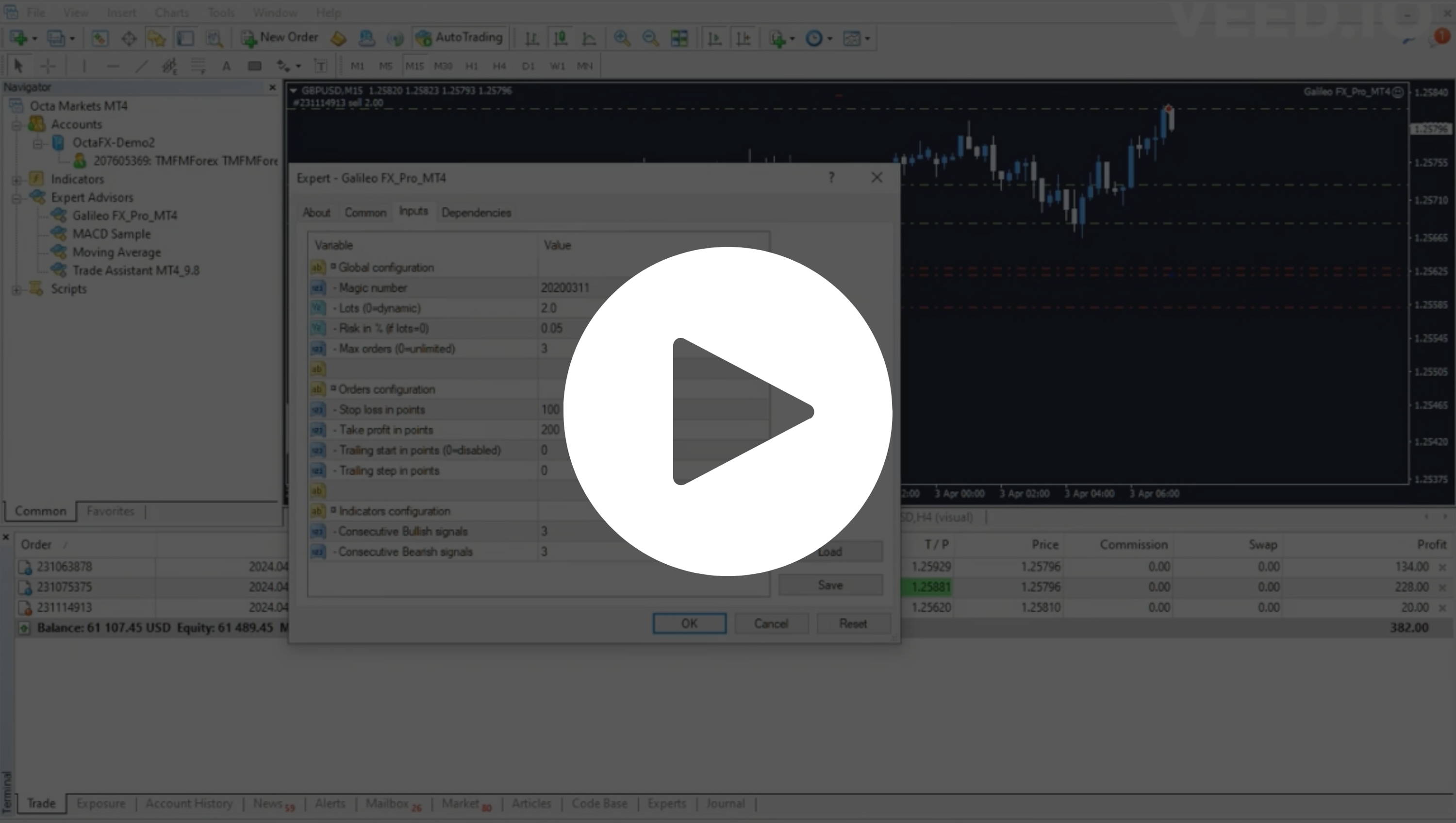
At its heart, Galileo FX is a rule-based engine. When a user installs the software, they are presented with a variety of settings that dictate how the bot behaves. These settings include the timeframes (ranging from 1-minute charts for scalping to daily charts for swing trading), the desired profit targets (Take Profit), and the maximum allowable loss (Stop Loss).
The software operates on the principle of trend following or reversals, depending on the specific “preset” applied. For example, a user might set the bot to look for oversold conditions on the RSI indicator. Once the RSI drops below a certain threshold—indicating that a currency pair may be undervalued—the bot automatically places a “Buy” order. Conversely, if the market becomes overextended, the bot can initiate a “Sell” order to capture the downward correction.
Compatibility and Integration with Brokerages
Galileo FX is not a brokerage itself; rather, it is a tool that sits on top of a trading platform. It is compatible with any broker that supports MetaTrader 4 or 5. This is a crucial distinction for investors, as it allows them to choose a regulated broker with competitive spreads and high security while using Galileo FX as their execution engine. The software reads the real-time price feeds provided by the broker and sends execution commands instantly.
Strategic Trading and Risk Management
In the realm of personal finance, the preservation of capital is just as important as the pursuit of profit. Galileo FX is frequently highlighted for its robust risk management features, which are essential for anyone looking to use automated tools responsibly.

Conservative vs. Aggressive Settings
One of the defining features of Galileo FX is its versatility. It can be configured to match the investor’s specific financial goals. A conservative investor might choose settings that prioritize high-probability trades with very tight stop-losses, aiming for steady, incremental growth. This approach minimizes “drawdown”—the peak-to-trough decline in an account’s value.
On the other hand, a more aggressive trader might use settings that allow for wider fluctuations in exchange for the potential for higher returns. Galileo FX allows users to adjust the “Lot Size,” which determines how much capital is risked on each individual trade. By carefully balancing the lot size with the total account balance, investors can ensure they are not over-leveraged, which is the most common reason for failure in the Forex market.
Market Conditions and Volatility Management
No financial market moves in a straight line. Markets cycle through periods of high volatility, low volatility, and ranging patterns. Galileo FX includes filters that allow it to stay out of the market during periods of extreme uncertainty, such as during major economic news releases or central bank announcements. By avoiding these “noisy” periods, the software helps protect the user’s balance from the unpredictable price spikes that often occur during high-impact news events.
Performance Analysis and Financial Expectations
When evaluating any financial tool, the most critical question is: Does it work? For Galileo FX, the answer is found in the data. However, it is vital for investors to distinguish between historical performance and future results.
Backtesting vs. Real-World Results
Galileo FX provides users with the ability to “backtest” strategies using historical price data. This process involves running the software against years of past market movements to see how it would have performed. While backtesting is an invaluable tool for identifying profitable patterns, professional investors use it as a guide rather than a guarantee.
Real-world performance can be influenced by “slippage” (the difference between the expected price of a trade and the price at which the trade is executed) and “spreads” (the transaction cost charged by the broker). Successful users of Galileo FX typically run the software on a “Demo Account” first, allowing them to witness how the bot handles live market conditions without risking actual capital.
The Importance of a Diversified Trading Portfolio
From a business finance perspective, relying on a single asset or a single strategy is risky. Users of Galileo FX often diversify their approach by running the bot on multiple currency pairs simultaneously—such as EUR/USD, GBP/JPY, and USD/CHF. Since different currencies react differently to global events, this diversification helps smooth out the equity curve. If one currency pair is experiencing a period of stagnation, another might be in a strong trend, allowing the software to find opportunities across a broader spectrum.
Evaluating the Cost and ROI of Galileo FX
Investing in software is an upfront capital expenditure, and like any business investment, the Return on Investment (ROI) must be calculated. Galileo FX operates on a different pricing model than many other financial services.
Subscription vs. Lifetime Licensing
Many automated trading tools in the industry require a monthly subscription fee, which can eat into the profits of smaller accounts. Galileo FX typically offers a lifetime license model. From a personal finance standpoint, this is often more favorable, as it represents a one-time cost that can be amortized over the life of the investment. Once the software has generated enough profit to cover its initial purchase price, the investor has reached the “break-even” point, and subsequent gains contribute directly to the net growth of the portfolio.

The Total Cost of Ownership
Beyond the purchase price of the software, investors must consider the “Total Cost of Ownership.” This includes the cost of a Virtual Private Server (VPS). A VPS is a remote computer that runs 24/7, ensuring that Galileo FX remains connected to the markets even if the user’s personal computer is turned off or loses internet connection. While a VPS is an additional monthly expense, it is often considered a necessary investment for professional-grade automation, as it ensures 100% uptime and reduces the risk of missed trades or execution errors.
In conclusion, Galileo FX is a sophisticated financial tool designed to democratize access to automated trading. By leveraging technical indicators and rigorous risk management protocols, it offers a systematic way to participate in the global markets. For the disciplined investor who understands that automation is a tool to enhance—not replace—a sound financial strategy, Galileo FX provides a powerful means to navigate the complexities of modern finance.
aViewFromTheCave is a participant in the Amazon Services LLC Associates Program, an affiliate advertising program designed to provide a means for sites to earn advertising fees by advertising and linking to Amazon.com. Amazon, the Amazon logo, AmazonSupply, and the AmazonSupply logo are trademarks of Amazon.com, Inc. or its affiliates. As an Amazon Associate we earn affiliate commissions from qualifying purchases.