
In the world of finance, few concepts are as fundamental yet frequently misunderstood as the bid and the ask. Whether you are a seasoned day trader navigating the fast-paced environment of the New York Stock Exchange or a personal investor looking to add a few shares of an index fund to your retirement portfolio, the bid-ask spread is the invisible hand that governs every transaction. At its core, the relationship between the ask and the bid represents the pulse of market supply and demand. Understanding these mechanics is not just a matter of academic interest; it is a critical skill for anyone looking to minimize transaction costs and maximize investment returns.
The Fundamentals of Ask and Bid Prices
To understand the financial markets, one must first recognize that every security—be it a stock, a bond, a commodity, or a currency pair—is effectively a two-way street. There is never a single “price” for an asset. Instead, there are always two prices displayed: the price at which you can sell and the price at which you can buy.
Defining the Bid Price
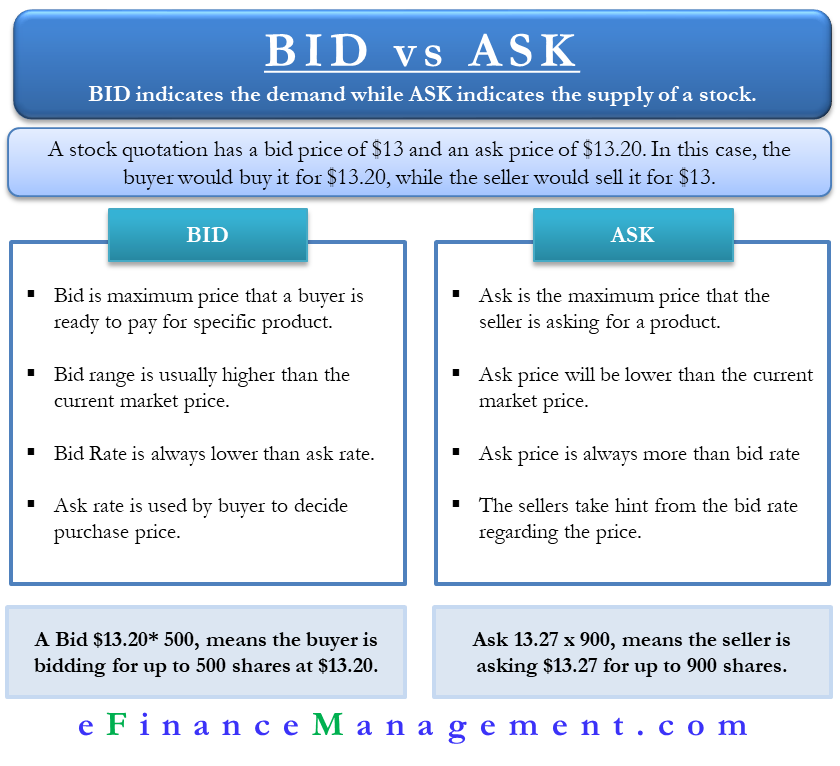
The bid price represents the maximum price that a buyer (or a group of buyers) is willing to pay for a security at a specific point in time. If you are looking to sell an asset immediately, the bid price is the amount you will receive. From the perspective of the market, the bid signifies the level of demand. When there are many buyers eager to acquire an asset, the bid price tends to rise as they compete with one another to secure the trade.
Defining the Ask Price
Conversely, the ask price (also known as the “offer”) is the minimum price that a seller is willing to accept for that same security. If you want to purchase an asset right now, the ask price is what you will have to pay. The ask represents the supply side of the equation. When sellers are plentiful and eager to exit their positions, the ask price may drop; when sellers are scarce, the ask price typically climbs.
The Bid-Ask Spread: The Hidden Cost of Trading
The difference between the bid and the ask is known as the “spread.” This gap is one of the most important concepts in personal finance and professional trading. The spread is essentially the transaction cost of the trade, beyond any commissions or fees charged by a broker.
For example, if a stock has a bid of $100.00 and an ask of $100.05, the spread is $0.05. If you were to buy the stock at the ask and immediately sell it at the bid, you would lose five cents per share. While five cents may seem negligible, for a high-frequency trader or an investor moving thousands of shares, these costs compound rapidly. In the context of business finance, managing these spreads is a vital component of liquidity management.
How Ask and Bid Prices Move the Market
The movement of bid and ask prices is a continuous dance orchestrated by millions of participants worldwide. These prices are not set by a central authority but emerge organically through the interaction of various market forces.
Liquidity and Market Depth
Liquidity refers to how easily an asset can be bought or sold without significantly affecting its price. In a highly liquid market—such as that for major global currencies or blue-chip stocks like Apple or Microsoft—there is immense “market depth.” This means there are thousands of orders resting at various price levels. In such markets, the bid-ask spread is usually incredibly narrow, often just a fraction of a percent.
In contrast, illiquid markets, such as those for small-cap stocks or certain corporate bonds, have much wider spreads. If only a few people are trading an asset, a seller might have to wait for a buyer willing to pay a much higher price, or a buyer might have to settle for a significantly lower bid to attract a seller.
The Role of Market Makers
In many modern exchanges, specialized entities known as market makers play a crucial role in maintaining the bid and ask. These are typically large financial institutions or specialized firms that stand ready to buy or sell a security at any time. They profit from the bid-ask spread. By constantly posting both a bid and an ask, they provide the “lubrication” that allows the market to function smoothly. Without market makers, the gap between what buyers want to pay and what sellers want to receive could grow so wide that trading would grind to a halt.
Limit Orders vs. Market Orders
Understanding the bid and ask allows investors to choose the right type of order. A “market order” instructs a broker to execute a trade immediately at the best available current price. For a buyer, this means buying at the ask; for a seller, this means selling at the bid.

A “limit order,” however, allows the investor to specify the maximum price they are willing to pay (on a buy order) or the minimum price they are willing to accept (on a sell order). By using limit orders, savvy investors can essentially “join the bid” or “join the ask,” waiting for the market to come to them rather than crossing the spread to meet the market. This is a key strategy for reducing investment friction.
Factors Influencing the Bid-Ask Spread
The width of the spread is not static; it expands and contracts based on real-time economic conditions and investor sentiment.
Volatility and Risk
Volatility is perhaps the greatest driver of wider spreads. When the market is uncertain—perhaps due to an unexpected economic report, a geopolitical event, or a sudden change in corporate leadership—risk increases. Market makers and individual sellers become wary of being “caught” on the wrong side of a fast-moving trade. To compensate for this increased risk, they widen the spread. During periods of extreme market stress, spreads can blow out significantly, making it much more expensive to enter or exit positions.
Trading Volume and Popularity
The more “eyes” there are on a stock, the tighter the spread usually is. High trading volume indicates a high level of interest and competition. When thousands of people are trying to buy and sell simultaneously, the competition forces the bid and ask closer together. Conversely, “thinly traded” assets are prone to wide spreads because there is less competition among market participants.
Information Asymmetry
In the realm of professional finance, spreads are also influenced by information asymmetry—the idea that some participants may know more than others. If a market maker suspects that a buyer has “inside” or superior information, they will widen the spread to protect themselves against potential losses. The spread, in this sense, acts as a protective buffer for the liquidity provider.
Strategic Implications for Personal Investing
For the average individual looking to grow their wealth, the mechanics of ask and bid prices have practical implications for long-term success. Ignoring the spread can lead to “slippage,” where the price you expected to pay is significantly different from the price you actually paid.
Navigating Low-Liquidity Assets
If you are investing in niche sectors, such as micro-cap stocks, regional real estate investment trusts (REITs), or certain types of municipal bonds, you must be hyper-aware of the spread. In these areas, a spread might be 2% or 3% of the total asset value. This means your investment has to appreciate by 3% just for you to break even. For a disciplined investor, such wide spreads require a much longer time horizon to justify the entry cost.
Timing Your Trades
The time of day can also impact the bid-ask spread. Markets are often most volatile—and spreads widest—at the opening bell and just before the closing bell. During the “mid-day lull,” spreads may stabilize, but liquidity may also be lower. For personal finance enthusiasts, executing trades during periods of high liquidity (usually mid-morning after the initial opening volatility has subsided) can often lead to better execution prices.
Minimizing Transaction Costs
In the modern era of “zero-commission” trading, it is easy to forget that trading is not actually free. Many retail brokerages make money through a practice called “payment for order flow,” where they send your trades to market makers who profit from the spread. To truly minimize costs, investors should:
- Use Limit Orders: Avoid paying the “convenience fee” of a market order.
- Check the Spread Before Buying: If the gap is too wide, it may be worth waiting or looking for a more liquid alternative, such as a similar Exchange Traded Fund (ETF).
- Invest for the Long Term: High turnover (frequent buying and selling) subjects your capital to the spread repeatedly. A “buy and hold” strategy minimizes the number of times you have to cross the spread, allowing more of your money to stay invested and compound over time.

Conclusion: Master the Spread to Master the Trade
The concepts of bid and ask are the bedrock of the financial ecosystem. They represent the eternal negotiation between buyer and seller, reflecting the collective wisdom and anxiety of the market. For the individual investor, the spread is more than just a technical detail; it is a cost of doing business that must be managed with care.
By understanding how these prices are formed, why they fluctuate, and how to use different order types to your advantage, you can navigate the markets with greater confidence. In the pursuit of financial independence and business success, every cent saved on a trade is a cent that can be put to work in your portfolio. Whether you are analyzing a corporate balance sheet or simply checking your brokerage account, always remember to look beyond the “last price” and see the bid and ask for what they truly are: the heartbeat of the global economy.
aViewFromTheCave is a participant in the Amazon Services LLC Associates Program, an affiliate advertising program designed to provide a means for sites to earn advertising fees by advertising and linking to Amazon.com. Amazon, the Amazon logo, AmazonSupply, and the AmazonSupply logo are trademarks of Amazon.com, Inc. or its affiliates. As an Amazon Associate we earn affiliate commissions from qualifying purchases.