
The deep ocean remains one of the most hostile environments known to man, characterized by pressures that defy standard engineering intuition. When a pressurized vessel fails at extreme depths, the resulting event is not a slow leak or a gradual crushing, but a catastrophic implosion—a physical phenomenon that occurs in a fraction of a second. To understand what happens to the human body during such an event, we must look through the lens of high-performance computing, materials science, and fluid dynamics. Modern technology allows us to simulate these violent transitions, providing a window into a process that occurs faster than the human brain can even process pain.
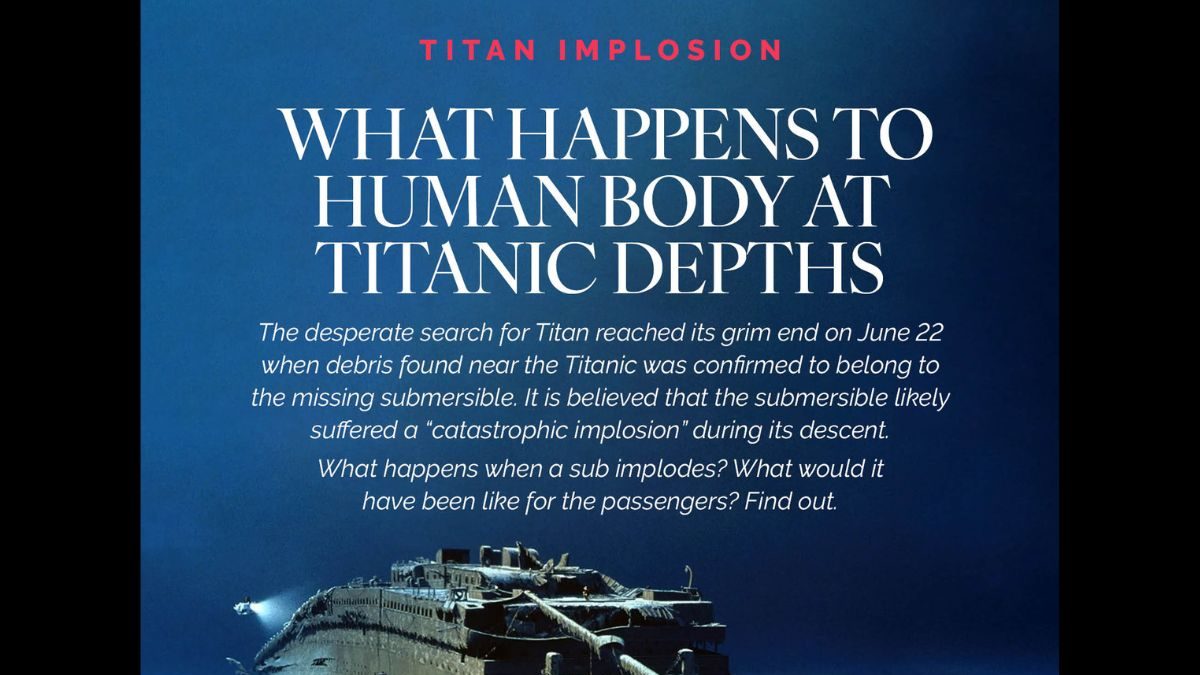
The Physics of Rapid Compression: High-Performance Computing and Fluid Dynamics
At the heart of an underwater implosion is the sudden transition of potential energy into kinetic energy. When a hull breaches at several thousand meters below sea level, the surrounding water, which has been held back by the vessel’s integrity, rushes inward to fill the vacuum. This is not a simple inflow; it is a supersonic event.
The Millisecond Timeline
Computational Fluid Dynamics (CFD) models illustrate that at depths of approximately 3,800 meters, the pressure is roughly 380 times that of the atmosphere at sea level. If a structural failure occurs, the hull collapses inward at speeds exceeding 1,500 miles per hour. The entire event—from the first fracture to the complete equalization of pressure—takes approximately 1 to 2 milliseconds.
To put this into perspective, the human brain’s response to a stimulus takes about 10 milliseconds. The transmission of a pain signal from the extremities to the brain takes even longer. Consequently, the technology of the event dictates that the human body undergoes total destruction before the nervous system can register a single data point of distress. In the world of high-speed physics, the “event” is over before the “perception” can begin.
Adiabatic Heating and Thermal Dynamics
One of the most startling revelations from thermal simulation software is the role of adiabatic heating. When a gas is compressed rapidly, its temperature rises. In the case of a submersible implosion, the air trapped inside the cabin is compressed so violently and so quickly that it momentarily reaches temperatures approaching the surface of the sun.
For the human body within this environment, this means the biological impact is twofold: mechanical shredding by the incoming water and hull fragments, followed by a localized thermal flash. This specific aspect of the tech—the rapid compression of gases—is the same principle used in diesel engines to ignite fuel, but on a scale that is orders of magnitude more intense.
Materials Science and Structural Integrity: Why Tech Fails at Depth
The technology used to protect humans from the abyss is a marvel of engineering, yet it is subject to the unforgiving laws of material fatigue and stress concentrations. When analyzing what happens to the human body, we must first analyze the failure of the materials meant to protect it.
Carbon Fiber vs. Titanium: Brittle Failure Modes
In recent years, the use of composite materials like carbon fiber in deep-sea exploration has been a topic of intense debate in the engineering community. Unlike titanium or high-strength steel, which are ductile and tend to deform (bend) before they fail, carbon fiber is a brittle composite.
Finite Element Analysis (FEA) software shows that carbon fiber fails through “delamination”—the layers of the weave literally peel apart under stress. When a carbon fiber hull fails, it does not leak; it “shatters” or “atomizes.” This catastrophic failure mode means that the human occupants are not subjected to a rising water level, but to a cloud of hyper-velocity shrapnel. The technology of the material itself dictates a violent, explosive-inward trajectory that acts as a mechanical centrifuge on biological tissue.
Finite Element Analysis (FEA) in Extreme Environments
Engineers use FEA to predict where “hot spots” of stress will occur on a vessel. Even a microscopic flaw—a void in the resin, a scratch on the hull, or a slightly misaligned titanium ring—can become a point of failure. At depth, these flaws are magnified.

When the structural integrity is compromised, the “implosion bubble” forms. As the air pocket collapses, the inward-rushing water creates a shockwave. Simulations show that this shockwave travels through the human body instantly. Because the human body is largely composed of water, it is relatively incompressible, but the air-filled cavities (lungs, sinuses, middle ear) are not. These cavities collapse instantly, causing massive internal trauma before the external kinetic force even arrives.
Forensic Technology: Reconstructing Events from Micro-Debris
When a disaster occurs, forensic technology takes over to determine the exact sequence of the implosion. This reconstruction is vital for improving future safety standards and understanding the final moments of the vessel’s occupants.
Acoustic Sensor Data and Triangulation
The ocean is an excellent conductor of sound. Global networks of hydrophones, often used for monitoring seismic activity or detecting clandestine naval movements, can pick up the “ping” of an implosion from hundreds of miles away.
By analyzing the acoustic signature of the event, technologists can determine the exact microsecond the hull gave way. The “sound” of an implosion is distinct—a sharp, high-frequency spike followed by a low-frequency rumble. This data allows researchers to calculate the energy release. For a standard deep-sea submersible, the energy released during implosion is equivalent to several dozen kilograms of TNT. This energy is directed entirely inward, focusing the full power of the ocean on the occupants.
Digital Twins and Post-Incident Analysis
In the aftermath of such events, engineers create a “digital twin” of the vessel. This is a highly accurate 3D model that incorporates the specific dive history, pressure cycles, and known material conditions of the craft. By running simulations on the digital twin, investigators can see how the human body would have been impacted by the specific failure geometry.
For instance, if the viewport (the window) was the first point of failure, the resulting “jet” of water would act like a high-pressure industrial cutter, moving at thousands of feet per second. Digital modeling confirms that in such a scenario, biological matter is essentially liquefied and dispersed into the surrounding water column before the hull even finishes its collapse.
The Future of Deep-Sea Tech: AI and Autonomous Systems
The harrowing reality of human vulnerability in the deep sea is driving a shift in the technology used for exploration. The focus is moving away from manned vessels and toward robust, AI-driven autonomous systems.
Removing the Biological Variable
The most significant advancement in deep-sea tech is the removal of the human element from the high-pressure zone. Remotely Operated Vehicles (ROVs) and Autonomous Underwater Vehicles (AUVs) utilize advanced sensor suites and haptic feedback systems to allow humans to explore the depths from the safety of a surface ship.
These machines are designed with “pressure-compensated” electronics. Instead of fighting the pressure with a heavy, air-filled hull, the internal components of an ROV are often bathed in non-conductive oil. Since oil is incompressible, the machine can operate at any depth without the risk of implosion. This technological pivot acknowledges that while we can model what happens to the human body in an implosion, we cannot yet engineer a way for the body to survive the fundamental physics of the deep.

Real-Time Structural Health Monitoring (SHM)
For future manned missions, the integration of Real-Time Structural Health Monitoring (SHM) is becoming a requirement. This technology involves embedding fiber-optic sensors within the hull material itself. These sensors act like a nervous system, detecting “acoustic emissions” (micro-cracks) as they happen.
Coupled with AI algorithms, SHM can predict a failure before it becomes catastrophic. If the system detects the signature of delamination or metal fatigue, it can trigger an emergency ascent. This tech aims to bridge the gap between human curiosity and physical limitations, ensuring that the devastating simulations of implosion remain theoretical models rather than historical records.
In conclusion, the implosion of a human-occupied vessel at depth is a masterclass in the violent efficiency of physics. Through the lens of high-performance computing and forensic engineering, we see that the transition from life to total molecular dispersal occurs with a speed and force that transcends human experience. As our technology for modeling these events becomes more sophisticated, it serves as both a grim reminder of the ocean’s power and a catalyst for the next generation of safer, more resilient exploration tools.
aViewFromTheCave is a participant in the Amazon Services LLC Associates Program, an affiliate advertising program designed to provide a means for sites to earn advertising fees by advertising and linking to Amazon.com. Amazon, the Amazon logo, AmazonSupply, and the AmazonSupply logo are trademarks of Amazon.com, Inc. or its affiliates. As an Amazon Associate we earn affiliate commissions from qualifying purchases.