
In the crowded landscape of music streaming, few platforms have undergone a technical and philosophical transformation as significant as Tidal. Originally launched by the Norwegian company Aspiro in 2014 and later thrust into the global spotlight following its acquisition by Jay-Z’s Project Panther Bidco in 2015, Tidal was positioned as the “artist-first” alternative to Spotify. However, for technology enthusiasts and audiophiles, the real story of Tidal lies in its complex relationship with audio codecs, its shifting ownership under Jack Dorsey’s Block Inc., and its pivot from proprietary formats to open-standard high-resolution audio.

The question of “what happened to Tidal” is not a story of a platform disappearing, but rather one of radical technical refinement. Over the last decade, the service has navigated the treacherous waters of the “Loudness Wars,” the rise of spatial audio, and a complete overhaul of its streaming architecture.
The Rise and Fall of MQA: A Defining Technical Shift
For years, the technical identity of Tidal was inextricably linked to MQA (Master Quality Authenticated). This proprietary audio codec was marketed as a way to deliver “master-quality” sound in a file size small enough to stream over standard mobile connections. For the tech-savvy listener, MQA was a controversial piece of software engineering that used a process called “origami folding” to hide high-frequency data within the noise floor of a standard 16-bit/44.1kHz file.
The Promise of Master Quality Authenticated Audio
MQA’s primary value proposition was its ability to correct for the temporal blurring and “ringing” effects introduced during the digital-to-analog conversion process. By providing a digital end-to-end “origami” fold, Tidal could offer 24-bit/192kHz audio quality while consuming significantly less bandwidth than a raw FLAC (Free Lossless Audio Codec) file. From a software perspective, this was an elegant solution to the limitations of mid-2010s mobile data speeds. Tidal built its “Master” tier around this technology, requiring specialized hardware—MQA decoders—to “unfold” the full resolution.
The Move to Open Standards: HiRes FLAC
The tide turned in 2023. Following the financial instability of MQA Ltd. and a growing demand from the audiophile community for transparency, Tidal made the seismic decision to transition its entire catalog to HiRes FLAC. This was a massive technical undertaking. FLAC is an open-source, lossless format that does not require proprietary licensing or specialized hardware for full unfolding.
By prioritizing FLAC, Tidal effectively “cleaned up” its technical stack. The platform now supports files up to 24-bit/192kHz in a pure, unadulterated format. This move signaled a shift away from the “black box” philosophy of MQA toward a more standard-compliant infrastructure. For users, this meant better compatibility with a wider range of Digital-to-Analog Converters (DACs) and a more honest representation of the source material. The transition required re-ingesting millions of tracks and updating the app’s playback engine to prioritize FLAC streams over the legacy MQA versions.
The Block Acquisition and the Pivot to Ecosystem Integration
In 2021, Jack Dorsey’s Square (now Block Inc.) acquired a majority stake in Tidal for approximately $300 million. This move initially baffled the tech world, but the underlying logic was rooted in data ecosystems and financial technology. Under Block, Tidal stopped trying to be just a music player and started becoming a component of a larger technical suite designed for creators.
Tidal as a Fintech Component
The integration of Tidal into the Block ecosystem (which includes Cash App and Square) represented a move toward “Direct-to-Artist” payments. From a software development standpoint, this involved building new backend systems to handle micro-payments and transparent royalty tracking. While Spotify operates on a complex “pro-rata” model, Tidal experimented with “Fan-Centered Royalties,” a technical framework where a portion of a user’s subscription fee goes directly to the artists they actually listen to.
This required a significant overhaul of Tidal’s data processing pipelines. Tracking individual user behavior with enough precision to allocate funds in real-time is a high-concurrency data challenge. This shift moved Tidal’s development focus away from purely consumer-facing features toward robust financial reporting and API integrations for artists.
Empowering the Creator Economy Through Data
Under the Block umbrella, Tidal has expanded its “Tidal Artist Home” platform. This is a centralized dashboard that allows artists to manage their presence, but more importantly, it provides them with granular data analytics. In the modern tech landscape, data is the primary currency. Tidal’s shift toward providing artists with deep-link integrations and performance metrics allows the platform to compete not on subscriber count, but on the utility of its tools for the people making the music.
User Experience and the Competitive Software Landscape

While the backend was being re-engineered, the frontend of Tidal had to evolve to keep pace with Apple Music and Spotify. The “what happened” in terms of user experience is a story of Tidal finding a middle ground between the “minimalist” aesthetic and the “data-heavy” utility of a professional tool.
Interface Refinements and Algorithm Maturity
Early versions of Tidal were criticized for a cluttered UI and a discovery algorithm that felt subpar compared to Spotify’s “Discover Weekly.” To combat this, Tidal invested heavily in its recommendation engine. Using machine learning models that prioritize acoustic characteristics over just “popularity” data, Tidal’s “My Mix” and “Daily Discovery” features have become significantly more accurate.
The app’s architecture was also optimized for speed. Navigation transitions were smoothed out, and the “Max” quality setting was integrated into a simplified toggle system. This UI/UX evolution was necessary to support the new tiered hierarchy of audio quality, ensuring that users could easily distinguish between “Low,” “High,” and “Max” (HiRes FLAC) without needing a degree in audio engineering.
Cross-Platform Compatibility and Tidal Connect
One of the most successful technical features introduced was “Tidal Connect.” Similar to Spotify Connect, this technology allows the Tidal app to act as a remote control for high-end audio hardware. From a networking perspective, Tidal Connect is superior to standard Bluetooth or even AirPlay, as it allows the hardware (like a network streamer or an integrated amplifier) to pull the stream directly from Tidal’s servers.
This preserves the bit-perfect integrity of the high-resolution file. The development of the Tidal Connect SDK (Software Development Kit) allowed third-party manufacturers like Bluesound, KEF, and Cambridge Audio to bake Tidal directly into their hardware. This move secured Tidal’s position as the software of choice for the “prosumer” audio market.
The Future of Tidal in the Era of Spatial Audio and AI
As we look at the current state of Tidal, it is clear that the platform is positioning itself as the premium alternative in an increasingly commodified market. The “what happened” is an evolution toward the cutting edge of audio science, specifically in the realms of spatial audio and AI-driven curation.
Beyond Stereo: Dolby Atmos and 360 Reality Audio
Tidal was an early adopter of object-based audio formats. Unlike traditional stereo, Dolby Atmos and Sony’s 360 Reality Audio allow sound engineers to place individual sounds in a three-dimensional space. The technical challenge here is significant: these files are much larger and require specific metadata to be decoded correctly by the user’s device.
Tidal’s mobile and desktop apps were updated to handle these complex bitstreams, ensuring that users with compatible headphones or home theater systems could experience immersive audio. By supporting these formats, Tidal has maintained its “tech-first” reputation, catering to users who want more than just a 256kbps AAC stream.
Navigating the AI-Generated Music Wave
The most recent challenge for Tidal—and all streaming platforms—is the explosion of AI-generated music. Tidal’s response has been one of technical curation. While some platforms have struggled with “bot” accounts uploading thousands of AI tracks to game the royalty system, Tidal has implemented stricter ingest filters and metadata verification processes.
The platform’s focus on high-fidelity audio serves as a natural barrier to entry; most AI-generated content is currently produced at lower bitrates or lacks the dynamic range required to justify a “Max” quality badge. By maintaining a high technical bar for entry, Tidal is effectively using its “Hi-Fi” branding as a quality control mechanism.
Conclusion: A Niche Carved in Code
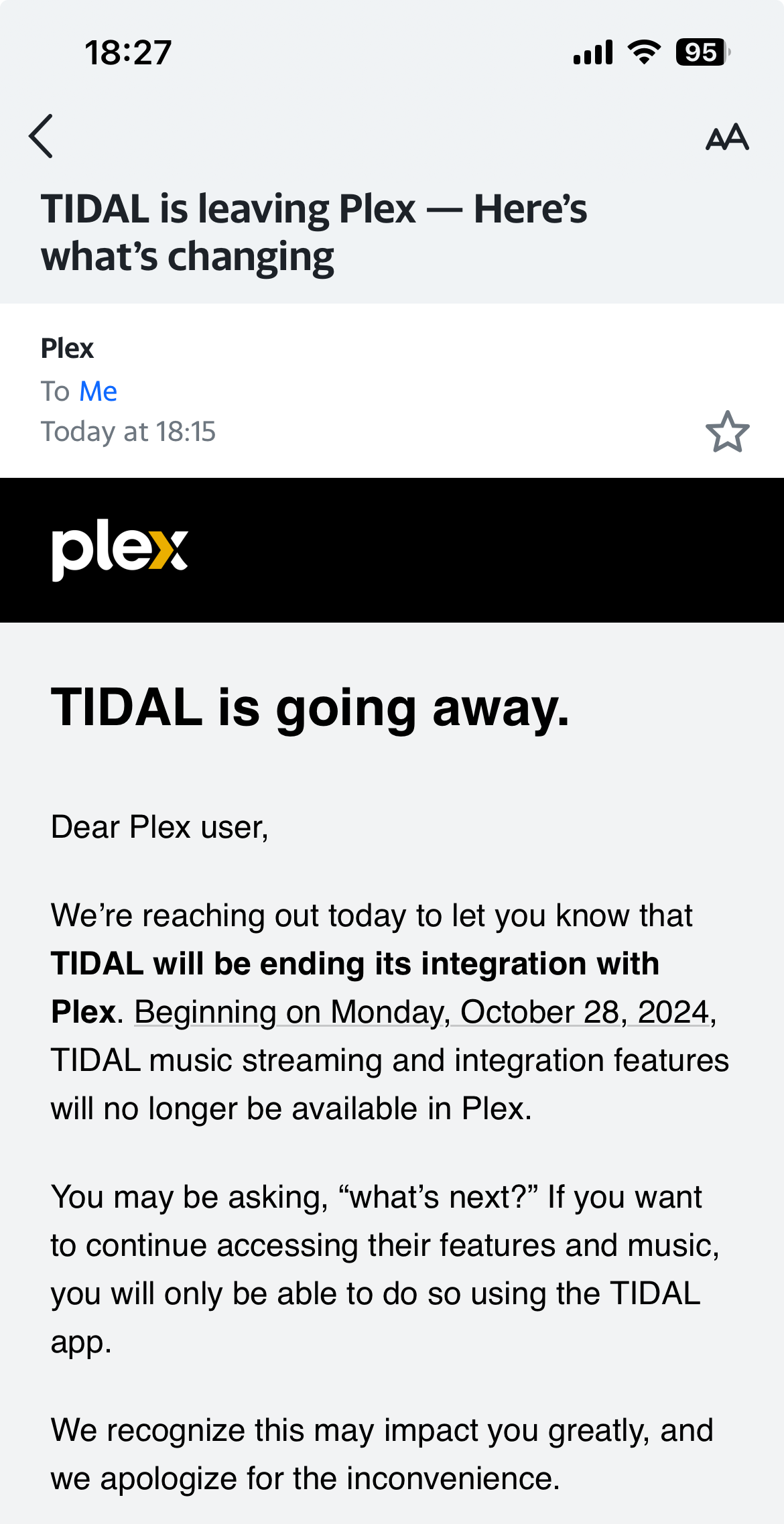
What happened to Tidal is that it grew up. It moved past the celebrity-driven hype of its relaunch and settled into a role as the industry’s most technically advanced mainstream streaming service. By ditching the proprietary shackles of MQA in favor of HiRes FLAC, integrating into the Block ecosystem to support the creator economy, and doubling down on hardware integration via Tidal Connect, the platform has secured its future.
Tidal no longer tries to beat Spotify at being the “everything app” for music. Instead, it has focused on the engineering of sound. For the user who values bit-depth, sample rates, and the ethical distribution of digital wealth, Tidal has evolved from a struggling underdog into a sophisticated, high-performance tool that defines the modern intersection of technology and art.
aViewFromTheCave is a participant in the Amazon Services LLC Associates Program, an affiliate advertising program designed to provide a means for sites to earn advertising fees by advertising and linking to Amazon.com. Amazon, the Amazon logo, AmazonSupply, and the AmazonSupply logo are trademarks of Amazon.com, Inc. or its affiliates. As an Amazon Associate we earn affiliate commissions from qualifying purchases.