
In the landscape of business finance and operational management, the term “FTE” serves as a fundamental metric for translating labor into a quantifiable financial asset. FTE, or Full-Time Equivalent, is a unit that indicates the workload of an employed person in a way that makes it comparable across various contexts. Instead of counting individual heads—which can be misleading when a workforce is composed of a mix of full-time, part-time, and seasonal employees—FTE looks at the total number of hours worked to represent them as standardized full-time units.
For business owners, CFOs, and financial analysts, understanding FTEs is not merely an HR exercise; it is a critical component of budgeting, tax compliance, and strategic scaling. By normalizing labor hours, a company can accurately measure productivity, forecast hiring needs, and determine eligibility for various government programs and tax credits.
The Mechanics of FTE: Calculation and Financial Significance
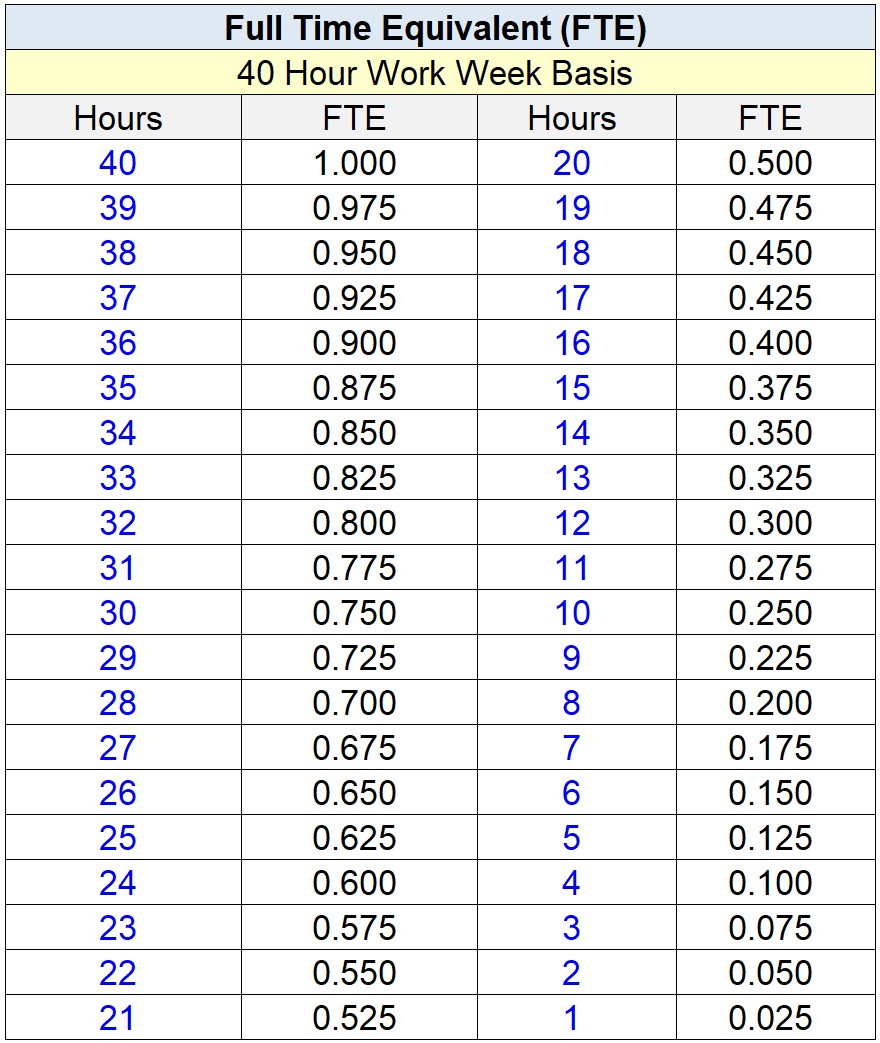
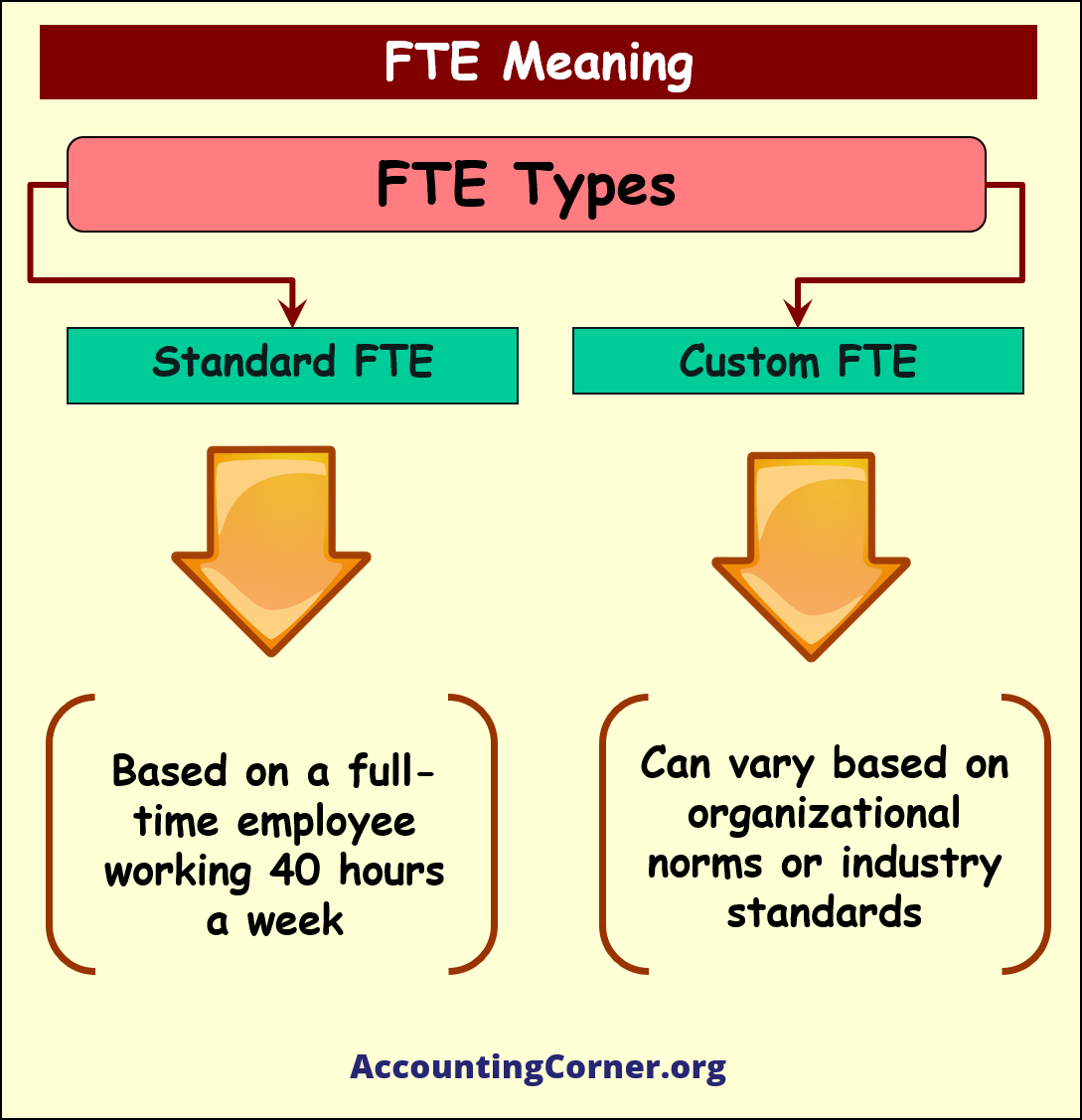
At its core, the Full-Time Equivalent is a ratio. To calculate it, an organization must first define what constitutes a “full-time” schedule, which is typically 40 hours per week or 2,080 hours per year (assuming 52 weeks). Once this baseline is established, any combination of employee hours can be converted into an FTE value.
The Basic FTE Formula
The calculation is straightforward: divide the total number of hours worked by all employees (part-time and full-time) by the number of hours in a full-time schedule.
For example, if a small business defines full-time as 40 hours per week and has:
- Two employees working 40 hours each (2.0 FTE)
- Three employees working 20 hours each (1.5 FTE)
- One employee working 10 hours (0.25 FTE)
The total FTE for this business is 3.75. Financially, this tells the business that while they have six people on the payroll, their labor capacity and cost structure are equivalent to 3.75 full-time employees. This distinction is vital for accurate financial modeling, as it prevents the “headcount” from distorting the reality of labor expenses.
Why FTE Matters Beyond the Payroll Department
From a financial management perspective, the FTE metric is used to determine the “labor burden.” This includes not just wages, but the total cost of employment, including benefits, taxes, and overhead. When a company calculates its “Revenue per FTE,” it gains a high-level view of its operational efficiency. If a firm’s revenue remains stagnant while its FTE count increases, it indicates a decrease in labor productivity or an over-hiring problem that could jeopardize profit margins. Conversely, a rising revenue-per-FTE ratio often signals that the company is leveraging technology or better processes to get more value out of its human capital.
FTE in Financial Planning, Budgeting, and Resource Allocation
Strategic financial planning requires a granular understanding of how labor converts into output. Without the FTE metric, budgeting for a growing company becomes a guessing game. By using FTEs, financial officers can create more accurate “top-down” and “bottom-up” budgets that reflect the true cost of operations.
Optimizing Labor Costs and Resource Allocation
In project-based industries—such as software development, construction, or consulting—FTEs are used to estimate the viability of new contracts. If a project requires 5,000 hours of labor over six months, a financial analyst can divide those hours by the standard working hours in that period to determine exactly how many FTEs are needed.
This allows for precise cost-benefit analyses. If the project requires 5.0 FTEs, but the company only has 3.0 FTEs available, the financial plan must account for either new hires, overtime pay (which carries a higher cost), or subcontracting. Each of these options has a different impact on the company’s bottom line and cash flow. Using FTEs ensures that the business doesn’t over-commit its resources, which is a common cause of financial distress in scaling companies.
Capitalizing Labor: CAPEX vs. OPEX
A nuanced aspect of FTE management in business finance is the capitalization of labor. In many jurisdictions, the labor cost associated with creating a long-term asset (like internal-use software or a new manufacturing facility) can be treated as a Capital Expenditure (CAPEX) rather than an Operating Expense (OPEX).
By tracking FTEs dedicated specifically to development projects, a company can move those costs to the balance sheet, where they are depreciated over time. This can significantly improve the appearance of the income statement in the short term, as it reduces the immediate expenses reported. However, this requires rigorous FTE tracking to satisfy auditors that the labor was indeed spent on asset creation rather than routine maintenance.

The Role of FTEs in Tax Compliance and Business Valuation
Beyond internal management, FTE counts are a legal and regulatory necessity. Governments and financial institutions use FTE benchmarks to determine a company’s obligations and its eligibility for financial assistance.
Tax Credits and the Affordable Care Act (ACA)
In the United States, the Internal Revenue Service (IRS) and the Department of Labor use FTE counts to define “Applicable Large Employers” (ALEs). Under the Affordable Care Act, businesses with 50 or more FTEs are required to provide health insurance to their full-time staff or face significant financial penalties.
Crucially, the IRS uses a specific FTE calculation that counts part-time employees toward the total. If a business has 40 full-time employees and 20 part-time employees who each work 15 hours a week, the 20 part-timers count as 7.5 FTEs (300 total hours divided by 40). This brings the total to 47.5 FTEs. If the business hires a few more part-timers, they may cross the 50-FTE threshold, triggering a massive shift in their financial obligations toward employee benefits. Small business owners must monitor their FTE count monthly to avoid unexpected tax liabilities.
FTEs in Mergers and Acquisitions (M&A)
When a company is being valued for sale or merger, investors look closely at the FTE count as part of the due diligence process. A high headcount with a low FTE count might suggest a fragmented workforce with high turnover or administrative complexity.
Furthermore, during an acquisition, the “Revenue per FTE” and “EBITDA per FTE” are used to compare the target company against industry benchmarks. If the target company has a significantly lower revenue per FTE than its competitors, the buyer might see an opportunity to improve margins by streamlining the workforce or automating tasks. Alternatively, it could be a red flag that the company’s business model is too labor-intensive to be profitable at scale.
Strategies for Managing FTEs to Increase Profitability
Effective financial leadership involves more than just counting FTEs; it involves optimizing them. High-performing companies use FTE data to make tactical decisions that protect their margins and drive growth.
Balancing the Workforce Mix
One of the most effective ways to manage the financial impact of labor is to adjust the ratio of full-time employees to part-time or contract workers. By maintaining a core group of full-time FTEs and supplementing them with fractional or part-time staff, a business can remain agile. This “elastic” workforce strategy allows a company to scale its FTE count up during peak demand periods without committing to the long-term fixed costs and benefit obligations associated with permanent full-time hires. From a cash flow perspective, this converts fixed labor costs into variable costs, which reduces risk during market downturns.
Tracking Productivity and Labor Burden
To maximize profitability, finance teams should calculate the “Labor Burdened FTE Cost.” This is the total cost of one FTE, including salary, payroll taxes, insurance, 401(k) matches, and even office space or equipment.
Once the true cost of an FTE is known, management can set realistic performance targets. For instance, if a tech firm knows that one FTE costs them $150,000 annually, and their target profit margin is 20%, that FTE must generate at least $187,500 in value. By tracking this on a departmental level, CFOs can identify which areas of the business are “revenue-generating” versus “cost centers” and reallocate budget accordingly.
The Future of FTE in a Digital Economy
As the gig economy grows and remote work becomes standardized, the traditional definition of an FTE is evolving. However, its importance as a financial tool remains unchanged. Automation and Artificial Intelligence are now allowing companies to produce the same output with fewer human FTEs. This shift is changing the way analysts look at “Operating Leverage”—the degree to which a firm can increase operating income by increasing revenue without a proportional increase in labor costs.
In this new era, the most successful businesses will be those that view FTEs not just as a headcount, but as a unit of investment. Every 1.0 FTE added to the payroll should represent a calculated move toward higher production, better service, or increased innovation. By mastering the nuances of FTE calculation and application, business leaders can ensure their organizations remain financially lean, legally compliant, and strategically positioned for long-term profitability.
Understanding “what are FTEs” is the first step in moving from basic bookkeeping to advanced financial engineering. Whether you are managing a small startup or a multi-national corporation, the FTE remains the gold standard for measuring the pulse of your labor economy and the health of your bottom line.
aViewFromTheCave is a participant in the Amazon Services LLC Associates Program, an affiliate advertising program designed to provide a means for sites to earn advertising fees by advertising and linking to Amazon.com. Amazon, the Amazon logo, AmazonSupply, and the AmazonSupply logo are trademarks of Amazon.com, Inc. or its affiliates. As an Amazon Associate we earn affiliate commissions from qualifying purchases.