
In the modern financial landscape, the distinction between traditional asset management and high-stakes fantasy football has become increasingly blurred. For the serious player, a fantasy draft is not merely a game of sports trivia; it is a complex exercise in capital allocation, risk assessment, and market timing. To excel in a competitive league, one must view their roster as a diversified investment portfolio, where every draft pick represents a unit of capital that must yield a specific Return on Investment (ROI).
Success in fantasy football hinges on understanding the “Value Over Replacement Player” (VORP), a concept mirrored in finance as Alpha. To maximize your season-long gains, your draft order must be dictated by scarcity, volatility, and the strategic timing of acquisitions. This guide outlines the optimal order to draft positions, treated through the lens of professional financial strategy.
1. The Core Portfolio: Securing High-Volume Assets in Rounds 1-3
The opening rounds of a fantasy draft are where you establish your “Blue Chip” holdings. In these early stages, the primary objective is capital preservation. You are looking for assets with high floors and proven track records—players who will provide a steady stream of “dividends” (points) throughout the fiscal year.
The Case for the Anchor Running Back
Traditionally, the Running Back (RB) position has been the gold standard of fantasy investments due to extreme scarcity. In a standard market, there are only a handful of “three-down backs” who receive the bulk of their team’s touches. Drafting a premier RB in Round 1 or 2 is akin to investing in a dominant, large-cap tech stock. These players provide a positional advantage that is difficult to recoup later in the draft. By securing an elite RB early, you mitigate the risk of being forced to buy into a volatile “Running Back by Committee” (RBBC) situation later, which is the fantasy equivalent of a penny stock.
The Rise of the Tier-1 Wide Receiver
As the NFL has shifted toward a pass-heavy economy, Wide Receivers (WRs) have become more stable long-term assets. While RBs suffer from higher “depreciation” (injury risk), elite WRs often provide more consistent year-over-year returns. If you are drafting at the end of the first round, the market may dictate that a Tier-1 WR is a better value than a Tier-2 RB. This is a “Value Investing” play—taking the best available asset rather than reaching for a position of need.
Avoiding the Early-Round Trap
The most common mistake in early-round capital allocation is overpaying for “onesie” positions—Quarterback (QB) and Tight End (TE). Unless a player like Travis Kelce or Patrick Mahomes offers a statistical deviation so significant that they function as a separate asset class, drafting them in the first two rounds often represents an inefficient use of capital. You are paying a premium for a position where the “Replacement Level” talent is still relatively productive.
2. Mid-Round Value Investing: Identifying Market Inefficiencies
Once your core holdings are established, Rounds 4 through 8 are where championships are won. This is the “Growth” phase of your draft. The goal here is to identify players whose market price (Average Draft Position or ADP) is lower than their projected output.
Exploiting the “Dead Zone”
The “Dead Zone” typically refers to RBs drafted in rounds 3-6 who lack elite profiles but are pushed up the board due to perceived scarcity. A savvy investor avoids these traps. Instead, this is the optimal time to load up on “WR2s with WR1 upside.” These are players in high-octane offenses who may be the second option but benefit from a high volume of targets. In a diversified portfolio, these WRs act as mid-cap stocks with significant room for appreciation.
Strategic Timing for the Elite Quarterback
While we avoid QBs in the earliest rounds, there is a “sweet spot” in the middle rounds. If a dual-threat QB—one who earns points through both passing and rushing yards—falls to Round 5 or 6, they represent a high-upside acquisition. Rushing yards for a QB are the “compound interest” of fantasy football; they provide a higher floor and a massive ceiling. Securing a top-tier signal-caller here allows you to ignore the position for the rest of the draft, saving roster spots for speculative assets.
The Tight End Arbitrage
The Tight End market is notoriously top-heavy. If you missed out on the elite tier, the best financial move is often to wait. Drafting a TE in the middle rounds often results in mediocre returns. Instead, look for “Arbitrage” opportunities—players who offer 80% of the production of a top-tier TE at 30% of the cost. This allows you to allocate your mid-round capital toward more impactful WR or RB depth.
3. Late-Round Speculation: High-Upside Growth Stocks
The final third of your draft should be dedicated to high-risk, high-reward “speculative” assets. At this stage, the opportunity cost of a failed pick is nearly zero. You are looking for “moonshots”—players who could potentially see a massive increase in value due to injury to a starter or a change in team dynamics.
The “Handcuff” Strategy as Insurance
In financial terms, a “handcuff” is a form of insurance. By drafting the backup to your primary Running Back, you are hedging against the risk of injury. While some argue this limits the ceiling of your portfolio, it provides essential downside protection for your most expensive assets. In deep leagues with thin waiver wires, this insurance policy is often worth the late-round capital.
Rookie Speculation
Rookies are the “IPO” stocks of fantasy football. They enter the market with high uncertainty but immense potential. In the double-digit rounds, targeting rookie WRs and RBs is a winning strategy. As the season progresses and these players acclimate to the professional level, their “market value” often skyrockets. The goal is to acquire them before they become “household names” on the weekly waiver wire.
Treating Kickers and Defense as Operating Expenses
In any business, you want to keep operating expenses as low as possible. In fantasy football, the Kicker (K) and Defense/Special Teams (D/ST) positions are your operating expenses. They are highly volatile and largely unpredictable from year to year. Strategic managers should never draft these positions before the final two rounds. In many cases, “Streaming”—the practice of cycling through these positions weekly based on favorable matchups—is a more efficient use of resources than holding a single high-cost unit.
4. Risk Management and Portfolio Rebalancing
A draft is only the beginning of the fiscal year. To maintain a winning trajectory, you must be prepared to manage your “portfolio” throughout the season. This requires a cold, analytical approach to roster spots and trade negotiations.
The Waiver Wire: The Secondary Market
The waiver wire is where you find “undervalued assets” that were missed during the initial offering (the draft). Efficient capital management requires you to be aggressive on the waiver wire early in the season. A player who sees a surprise increase in usage in Week 1 is a “strong buy.” Using your Waiver Wire Priority or Free Agent Acquisition Budget (FAAB) effectively is the equivalent of reinvesting profits to acquire new equity.
Trading: Mergers and Acquisitions
Trading in fantasy football should always be approached as a “win-win” for your specific needs, but with an eye toward maximizing your net gain. If you have a surplus of WRs (over-exposure in one sector), you should look to trade for an RB (diversification). The key is to sell “high” on players performing above their sustainable mean and buy “low” on elite assets suffering from temporary market fluctuations.
Sunk Cost Fallacy
One of the most dangerous psychological traps in both finance and fantasy football is the sunk cost fallacy. Just because you spent a high draft pick on a player does not mean you must keep them on your roster if the data changes. If an asset is underperforming and the underlying metrics (snap count, targets, efficiency) suggest a permanent decline, the professional move is to “cut your losses” and move that capital into a more productive asset.
5. Conclusion: Executing the Diversified Draft Strategy
The order in which you draft positions should not be static; it should be a fluid response to the market conditions of your specific league. However, by following a disciplined financial framework, you can consistently put yourself in a position of power.
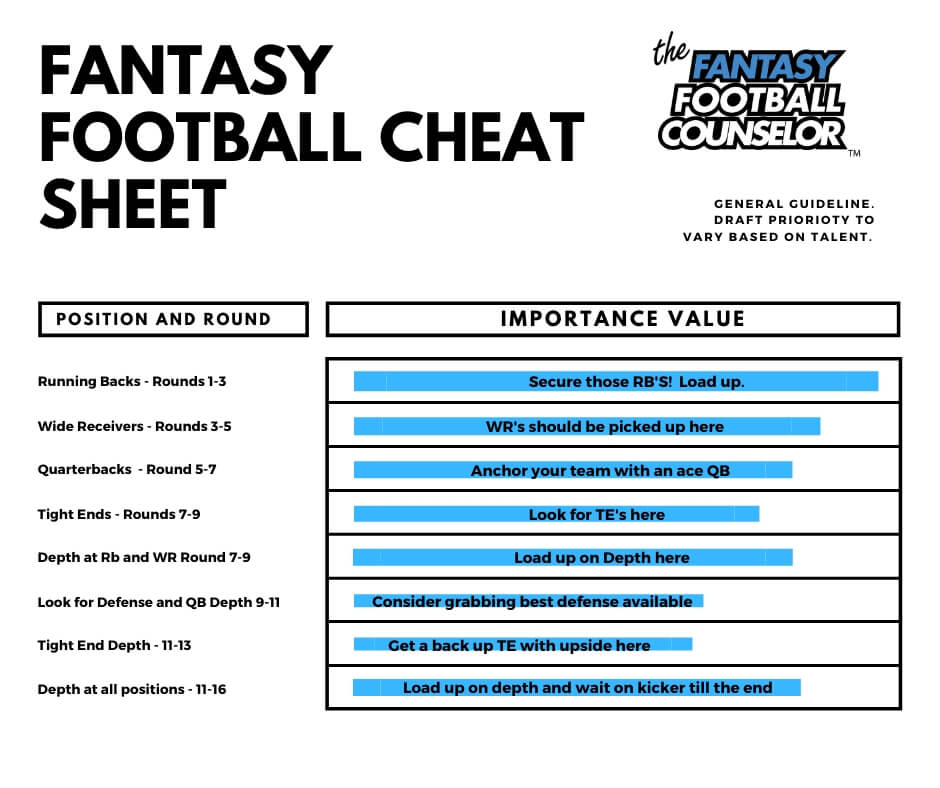
- Rounds 1-3: Build your core with high-volume RBs and WRs. Protect your principal.
- Rounds 4-8: Seek out growth and identify market inefficiencies in the WR and QB markets.
- Rounds 9-15: Speculate on high-upside rookies and secure insurance for your primary holdings.
- Final Rounds: Minimize expenses by taking Kickers and Defenses last.
By treating your fantasy football draft as a strategic investment exercise, you remove the emotional volatility that plagues many players. You aren’t just drafting a team; you are managing a portfolio. And in a game where the margin for error is razor-thin, the manager with the best capital allocation strategy is the one who will be holding the trophy—and the prize money—at the end of the year.
aViewFromTheCave is a participant in the Amazon Services LLC Associates Program, an affiliate advertising program designed to provide a means for sites to earn advertising fees by advertising and linking to Amazon.com. Amazon, the Amazon logo, AmazonSupply, and the AmazonSupply logo are trademarks of Amazon.com, Inc. or its affiliates. As an Amazon Associate we earn affiliate commissions from qualifying purchases.