
The Second Industrial Revolution, often referred to as the “Technological Revolution,” represents one of the most transformative eras in human history. Lasting roughly from 1870 to the start of World War I in 1914, this period was characterized by a rapid acceleration in scientific discovery, standardized manufacturing, and the birth of the modern technological infrastructure that defines our world today. Unlike the First Industrial Revolution, which was driven by steam power and basic mechanization, the Second Industrial Revolution was defined by electricity, the internal combustion engine, and the massive expansion of telecommunications.
To understand the trajectory of modern software, artificial intelligence, and digital connectivity, we must first analyze the hardware and systemic breakthroughs of this era. It was during these decades that humanity moved from localized, manual processes to global, automated systems, laying the groundwork for the digital age.

The Technological Architecture of Modernity
The primary driver of the Second Industrial Revolution was the transition from heavy, localized steam power to the versatile and scalable nature of electricity. This shift was not merely a change in energy source; it was a fundamental redesign of how technology interacts with environment and labor.
From Steam to Electricity: The Power Grid Evolution
The introduction of the electrical grid is perhaps the most significant technological milestone of the 19th century. In the early stages of the revolution, inventors like Thomas Edison and Nikola Tesla battled over the standards of electrical distribution—Direct Current (DC) versus Alternating Current (AC). The eventual triumph of AC power allowed for the long-distance transmission of energy, enabling factories to move away from water sources and coal mines.
For the first time, power could be “delivered” as a utility. This decentralization of power is the direct ancestor of today’s cloud computing. Just as modern developers tap into remote server farms for processing power, 19th-century manufacturers tapped into a central grid for mechanical power. Electricity allowed for the electrification of the factory floor, leading to the creation of smaller, more efficient machine tools and the ability to operate twenty-four hours a day through the implementation of incandescent lighting.
The Internal Combustion Engine and Mobile Technology
While electricity powered the stationary world, the internal combustion engine revolutionized mobility. Developed and refined by engineers like Nikolaus Otto and Gottlieb Daimler, this technology replaced the bulky steam engine with a compact, high-efficiency power plant fueled by petroleum. This breakthrough didn’t just give rise to the automobile; it created the necessity for a global fuel infrastructure and advanced metallurgy. The internal combustion engine was the “microchip” of its day—a high-density energy solution that could be integrated into various form factors, from ships and tractors to the first airplanes.
Communication and Connectivity Breakthroughs
The Second Industrial Revolution marked the end of geographical isolation. Before this era, information could only travel as fast as a horse or a ship. The technological breakthroughs in telecommunications during this period provided the first blueprint for the globalized, real-time data networks we use today.
The Telegraph and the Birth of Real-Time Data
The expansion of the telegraph network across continents and under oceans (the first transatlantic cable) was the 19th-century equivalent of the internet. It allowed for the near-instantaneous transmission of information across thousands of miles. This “Victorian Internet” changed the logic of business and technology. It enabled the synchronization of railway schedules, the coordination of global supply chains, and the rapid dissemination of scientific data.
The telegraph introduced the concept of encoding information—using Morse code to translate language into electrical pulses. This was a critical step in the evolution toward binary code. The ability to abstract information from physical objects and transmit it as a signal is the core principle upon which all modern digital technology is built.
The Telephone: Forging the First Social Networks
By 1876, Alexander Graham Bell’s telephone took connectivity a step further by enabling the transmission of the human voice. This was a massive leap in user interface technology. While the telegraph required specialized operators, the telephone was an intuitive device that could be used by anyone. The rapid adoption of telephone exchanges created the first large-scale interactive networks. These networks required complex switching systems, which served as the mechanical precursors to the digital routers and switches that manage today’s internet traffic.

Mass Production and the Standardization of Tech
As the revolution progressed, the focus shifted from the invention of new tools to the optimization of how those tools were produced. This era saw the birth of “Big Tech” in its original form—massive industrial giants that leveraged standardized processes to dominate global markets.
Interchangeable Parts and the Assembly Line
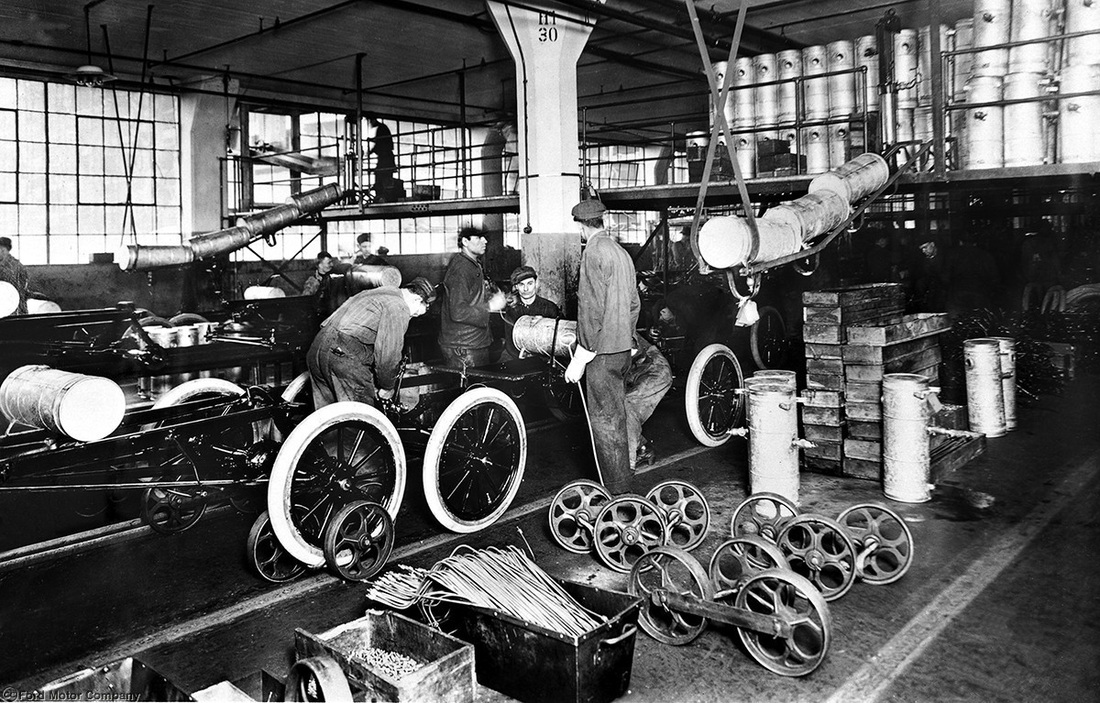
The concept of interchangeable parts, combined with Henry Ford’s refinement of the moving assembly line, changed the nature of hardware forever. Before this, every machine was a bespoke creation; if a part broke, a new one had to be hand-forged. Standardization meant that components could be mass-produced with high precision.
This movement toward standardization is mirrored in modern software engineering through the use of APIs and modular code libraries. Just as Ford used standardized chassis and engines to scale production, modern developers use standardized frameworks to build complex applications. The efficiency gains of the assembly line drove down the cost of technology, making gadgets like the sewing machine, the typewriter, and the bicycle accessible to the general public.
Steel and Chemical Engineering: The Hardware of Progress
The Bessemer process for steel production allowed for the mass manufacture of high-quality steel at a low cost. Steel became the literal skeleton of the Second Industrial Revolution, used for skyscrapers, bridges, and the massive machinery required for other technological sectors.
Simultaneously, the rise of the chemical industry introduced synthetic materials and dyes. The development of industrial-scale chemical engineering allowed for the creation of plastics and refined petroleum products. These materials provided the durability and insulation necessary for the next century of electronic and mechanical innovation. Without the chemical breakthroughs of the late 1800s, the hardware components required for modern computing—such as silicon wafers and plastic housings—would have no technological foundation.
The Legacy of the Second Industrial Revolution in the Digital Age
The Second Industrial Revolution did not simply end; it evolved into the Third (Digital) and Fourth (AI and Cyber-Physical) Industrial Revolutions. The logic of the 19th-century engineer—efficiency, connectivity, and scalability—remains the driving force of the modern tech sector.
From Electricity to Electrons: The Path to Computing
The transition from the mechanical computers of Charles Babbage to the electronic computers of the mid-20th century was only possible because of the electrical infrastructure established during the Second Industrial Revolution. The vacuum tubes and transistors that define modern hardware are refinements of the electrical principles discovered by Faraday, Maxwell, and Tesla.
Furthermore, the corporate structures that emerged during this time—the large research and development (R&D) labs like Bell Labs and General Electric—created the model for modern tech giants like Google and Apple. The idea that a private corporation could serve as a hub for pure scientific discovery was a product of the late 19th-century industrial ecosystem.
Lessons for the Fourth Industrial Revolution (AI/IoT)
Today, we are navigating the Fourth Industrial Revolution, characterized by Artificial Intelligence, the Internet of Things (IoT), and biotechnology. There are striking parallels between our current era and the Second Industrial Revolution. Just as the electrification of factories transformed labor 150 years ago, the “algorithmization” of industry is transforming labor today.
The Second Industrial Revolution teaches us that the true power of a technology is not found in the invention itself, but in the network effect created when that technology becomes standardized and accessible. The steam engine was a tool, but the electrical grid was a platform. In the modern context, we are moving from individual AI tools to a comprehensive “intelligence grid” that will likely mirror the transformative impact of the electrical rollouts of the 1880s.
As we look at modern gadgets—smartphones that contain billions of transistors, GPS systems that rely on global satellite networks, and AI that processes trillions of data points—we are seeing the refined, digital descendants of the steel, wires, and engines of the Second Industrial Revolution. It was the era that taught humanity how to build at scale, how to communicate at the speed of light, and how to harness the fundamental forces of nature to power a technological future.
aViewFromTheCave is a participant in the Amazon Services LLC Associates Program, an affiliate advertising program designed to provide a means for sites to earn advertising fees by advertising and linking to Amazon.com. Amazon, the Amazon logo, AmazonSupply, and the AmazonSupply logo are trademarks of Amazon.com, Inc. or its affiliates. As an Amazon Associate we earn affiliate commissions from qualifying purchases.