
The intersection of federal law, workplace safety, and institutional finance creates a complex landscape for government operations. For any large-scale organization, whether in the private sector or the public sphere, the cost of labor is often the single greatest budgetary line item. Protecting that investment through safety standards is not merely a legal obligation; it is a financial imperative. When we ask which standard makes Occupational Safety and Health Administration (OSHA) requirements applicable to federal agencies, we are looking at a specific legal bridge that ensures the public sector adheres to the same safety benchmarks as private enterprise.
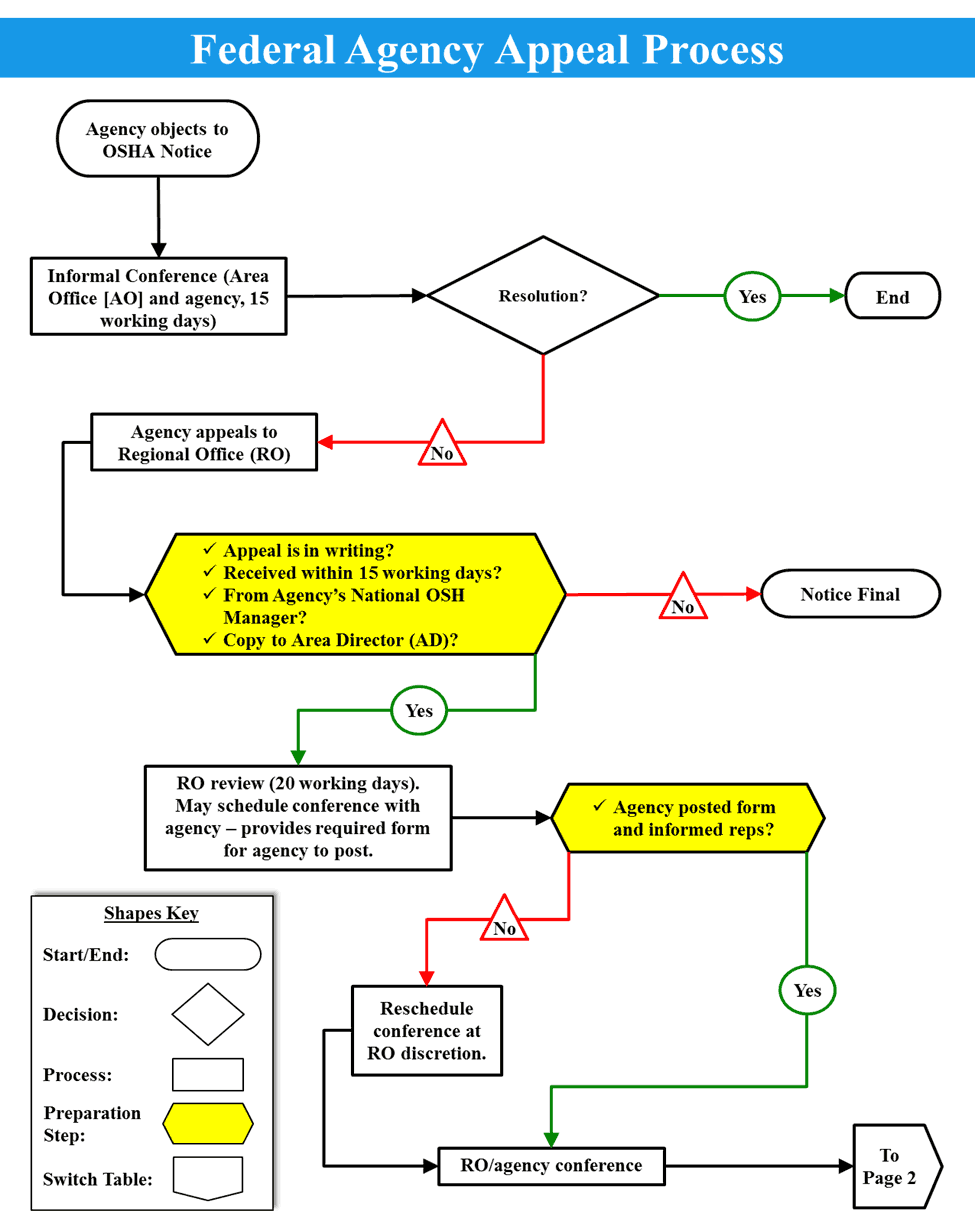
The foundational answer lies in Section 19 of the Occupational Safety and Health Act of 1970 (OSH Act) and is further solidified by Executive Order 12196. These mandates do more than dictate safety protocols; they define the risk management framework and financial accountability of the federal government as an employer.
The Legal and Financial Foundation: Section 19 and Executive Order 12196
To understand the financial implications of federal safety compliance, one must first identify the “standard” that bridges the gap between the OSH Act—which was primarily written for private employers—and the sprawling federal workforce. Section 19 of the OSH Act, titled “Federal Agency Safety Programs and Responsibilities,” provides the initial statutory requirement. It tasks the head of each federal agency with the responsibility to establish and maintain an effective and comprehensive occupational safety and health program.
However, Section 19 was initially somewhat broad. The real teeth were added in 1980 through Executive Order 12196, “Occupational Safety and Health Programs for Federal Employees.” This order, signed by President Jimmy Carter, specifically directed federal agency heads to comply with OSHA standards that apply to private sector employers, unless the Secretary of Labor provides an alternative.
The Fiscal Responsibility of Compliance
From a business finance perspective, this alignment ensures that the federal government does not operate at a competitive disadvantage regarding safety or, conversely, that it does not externalize the costs of worker injury to the taxpayer. Compliance costs money, but non-compliance is exponentially more expensive. When an agency integrates 29 CFR Part 1960—the specific regulations for federal employee safety—it is essentially creating a financial buffer against the volatility of workplace accidents.
29 CFR Part 1960: The Operational Standard
While Section 19 and EO 12196 provide the authority, 29 CFR Part 1960 provides the methodology. This part of the Code of Federal Regulations details how agencies should record injuries, conduct inspections, and manage safety committees. For a CFO or a budget director within a federal agency, these regulations act as a blueprint for operational efficiency. By standardizing safety across all agencies, the government can achieve economies of scale in safety training, equipment procurement, and auditing.
The Economic Impact of Workplace Safety in Federal Operations
The financial health of a federal agency is often measured by its ability to deliver services within a strict budgetary framework. Safety standards directly impact this health. When OSHA requirements are applied through the lens of Section 19, they act as a mechanism for cost containment.
The Cost of Workplace Injuries and Illnesses
Workplace injuries represent a significant financial leak. In the federal sector, these costs are often captured through the Federal Employees’ Compensation Act (FECA). When a federal employee is injured because a safety standard was ignored, the resulting medical bills and disability payments are paid out of agency funds. These are “sunk costs” that provide zero return on investment. By strictly adhering to OSHA standards, agencies can reduce their FECA liabilities, allowing more funds to be directed toward their primary missions.
Indirect Costs and Productivity Loss
Beyond the direct medical payments, the “indirect costs” of safety failures can be three to five times higher than the direct costs. These include:
- Administrative Overhead: The time spent by HR and management investigating accidents and filing paperwork.
- Training and Onboarding: The cost of hiring and training temporary or permanent replacements for injured workers.
- Operational Downtime: The loss of productivity when a facility must be closed or a process halted due to a safety incident.
In the world of business finance, these are known as productivity killers. By following the standards set forth in 29 CFR Part 1960, federal managers can stabilize their workforce, ensuring that human capital—the government’s most valuable asset—is preserved and utilized efficiently.
Risk Management and the “Business of Safety”
Federal agencies operate like massive conglomerates. The Department of Defense, the Veterans Administration, and the Postal Service employ hundreds of thousands of people across diverse environments. Managing the risk of such a large workforce requires a standardized approach to safety that mimics the risk management strategies of Fortune 500 companies.
Identifying Hazards as Financial Risks
Under the OSHA standards applicable to federal agencies, hazard identification is the first step in risk mitigation. From a financial perspective, a hazard is a potential liability. Whether it is poor air quality in an office building or hazardous chemical exposure in a laboratory, failing to address these issues is a failure in financial oversight.
The OSHA standards require agencies to conduct regular inspections and provide a mechanism for employees to report unsafe conditions without fear of reprisal. This “bottom-up” reporting is a classic risk management tool. It allows the organization to identify and fix small problems before they become catastrophic—and expensive—failures.
Investing in Safety Technology
Modern safety compliance often involves the procurement of specialized software and hardware. This might include AI-driven monitoring systems, ergonomic furniture, or advanced personal protective equipment (PPE). While these represent an upfront capital expenditure (CAPEX), they are justified through a long-term reduction in operating expenses (OPEX).
Financial officers in the federal sector look for a high internal rate of return (IRR) on safety investments. If spending $1 million on an automated safety monitoring system reduces yearly FECA claims by $250,000, the system pays for itself in four years. This is the logic that makes OSHA standards a vital part of federal business finance.
The Role of Auditing and Accountability
In any financial system, accountability is the cornerstone of success. The standards that make OSHA applicable to federal agencies also establish a system of auditing and reporting that ensures agencies remain fiscally and operationally responsible.
The Annual Report to the Secretary of Labor
Every federal agency is required to submit an annual report on its occupational safety and health program to the Secretary of Labor. This report includes data on injuries, illnesses, and the progress made in hazard abatement. From a management perspective, this is akin to an annual financial audit. It forces transparency and allows for benchmarking across different agencies.
If an agency shows a spike in injuries, it signals a breakdown in management controls. In the corporate world, this would lead to a decrease in shareholder value. In the federal world, it leads to increased oversight and potential budgetary shifts.
The Financial Incentives for Safety Excellence
While federal agencies don’t face the same “fines” as private companies (OSHA cannot currently fine federal agencies in the same way it fines a private construction firm), the reputational and political costs are high. Furthermore, agencies that demonstrate excellence in safety often see improvements in employee morale and retention.
In a tight labor market, the cost of employee turnover is a significant financial burden. A reputation for safety makes an agency an “employer of choice,” reducing recruitment costs and ensuring a higher quality of applicant. This intangible asset—a safe and healthy workforce—is a critical component of an agency’s long-term financial stability.
Conclusion: Safety as a Strategic Financial Asset
The question of which standard makes OSHA requirements applicable to federal agencies leads us to a broader realization: safety is a strategic asset. By using Section 19 of the OSH Act and Executive Order 12196 as the foundation, and 29 CFR Part 1960 as the roadmap, the federal government has created a system that prioritizes the health and financial security of its operations.
Applying these standards is not merely about checking boxes for a regulatory body. It is about the prudent management of public resources. Every dollar saved from a prevented workplace injury is a dollar that can be spent on national security, public health, or infrastructure. In this light, OSHA compliance is a masterclass in risk management and financial stewardship, proving that the safest way to operate is also the most fiscally responsible way to lead. By viewing safety through the lens of money and business finance, we see that the protection of the worker and the protection of the budget are, in fact, one and the same.
aViewFromTheCave is a participant in the Amazon Services LLC Associates Program, an affiliate advertising program designed to provide a means for sites to earn advertising fees by advertising and linking to Amazon.com. Amazon, the Amazon logo, AmazonSupply, and the AmazonSupply logo are trademarks of Amazon.com, Inc. or its affiliates. As an Amazon Associate we earn affiliate commissions from qualifying purchases.