
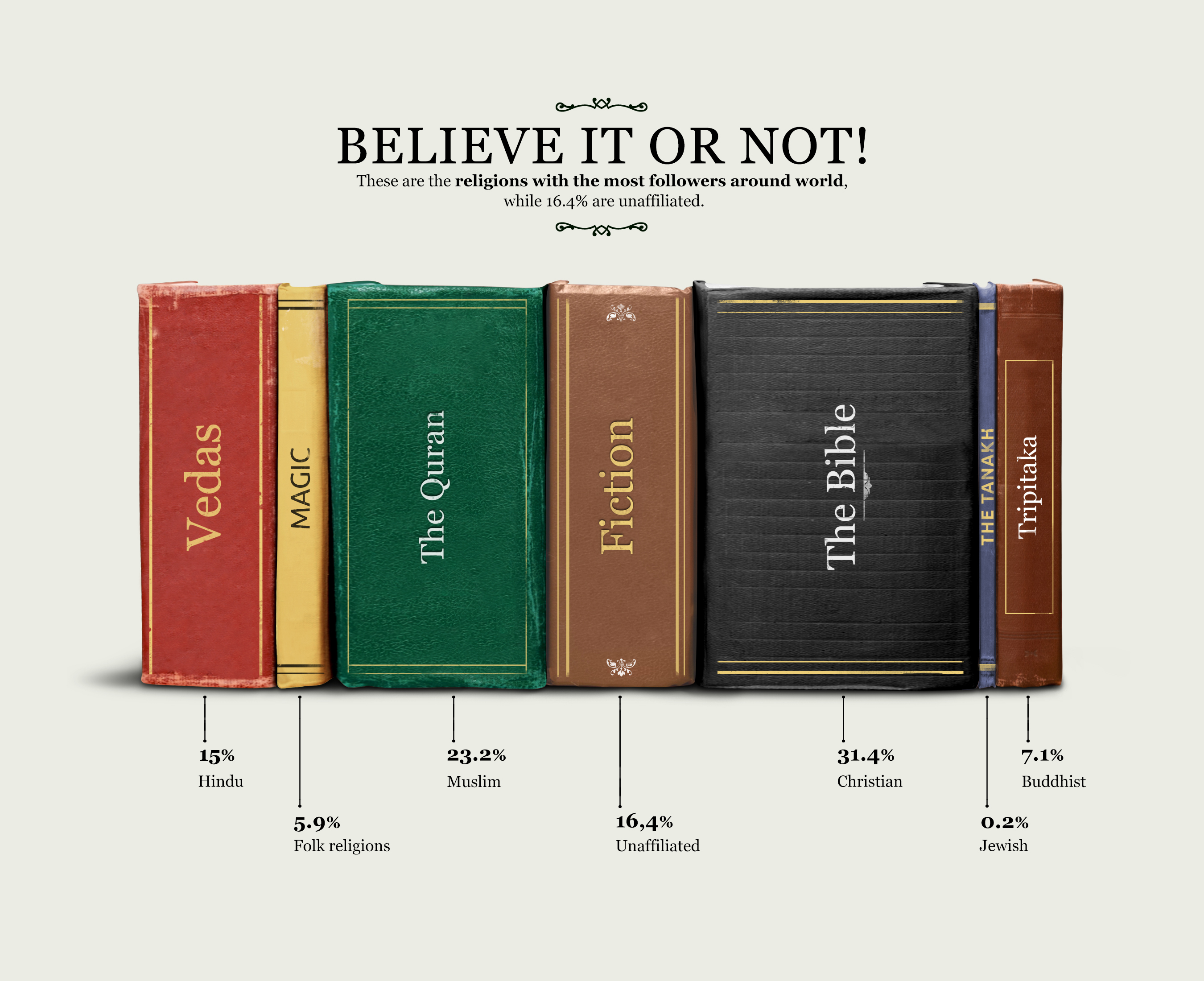
In the contemporary landscape of technological advancement, the concept of “religion” has migrated from the hallowed halls of traditional temples into the glowing silicon of data centers. As we navigate the complexities of the twenty-first century, the quest for the most “accurate” worldview is no longer confined to theological debate; it has become a technical challenge centered on data integrity, algorithmic precision, and the systemic reliability of information. In this context, “Dataism” and the various philosophical frameworks surrounding artificial intelligence, blockchain, and open-source ecosystems have emerged as the competing belief systems of our time. To determine which of these “digital religions” is most accurate, we must analyze how they interpret reality, process truth, and guide human progress through the lens of modern technology.
The Rise of Dataism: When Information Becomes the Supreme Authority
The most prominent contender for the title of the most accurate modern framework is Dataism. This philosophy posits that the universe consists of data flows and that the value of any phenomenon or entity is determined by its contribution to data processing. From a technological perspective, Dataism isn’t just a trend; it is the underlying engine of the global economy. It suggests that if we have enough data and sufficient computing power, we can predict everything from market fluctuations to human behavior with unerring accuracy.
The Mathematical Foundations of Digital Faith
At the core of this movement is the belief in the mathematical certainty of algorithms. Unlike human intuition, which is subject to cognitive biases and emotional variance, a well-tuned algorithm offers a version of truth that is reproducible and quantifiable. In fields like high-frequency trading or genomic sequencing, the “accuracy” of the data-driven approach is indisputable. Here, the “religion” of the data scientist is built upon the dogma of the Large Sample Size. The more information we feed into the machine, the closer we get to a perfect representation of reality. This pursuit of the “Ground Truth”—the empirical reality that supervised learning models strive to reach—is the modern equivalent of seeking divine enlightenment.
Predictive Analytics as Modern Prophecy
In traditional structures, prophets provided glimpses into the future based on revelation. In the tech sector, we use predictive analytics. By analyzing historical patterns, machine learning models can forecast outcomes with a level of precision that was previously unimaginable. Whether it is a weather model predicting a hurricane’s path or an AI predicting a server failure before it happens, the accuracy of these systems provides a sense of security and control. The “faith” placed in these systems is not blind; it is backed by backtesting and validation sets. However, the accuracy of this digital religion is only as good as the data it consumes—leading to the eternal tech struggle of “garbage in, garbage out.”
Algorithmic Accuracy vs. Human Context
As we deep-dive into which technological framework offers the most accurate path forward, we encounter the tension between raw computational power and the nuances of human context. The current “orthodoxy” in Silicon Valley is centered on Large Language Models (LLMs) and Generative AI. These tools represent a new sect of digital belief: that language itself, when processed at a massive scale, can unlock the sum of human knowledge.
The Gospel of the Large Language Model
LLMs like GPT-4, Claude, and Gemini are often viewed as the ultimate repositories of “truth.” Users turn to them for answers to complex questions, treating the chat interface as a digital oracle. The accuracy of these models is staggering in its breadth, yet it remains fundamentally probabilistic rather than deterministic. The “religion” of connectionism—the idea that artificial neural networks can mimic human thought—claims accuracy by approximating the way the human brain processes information. Yet, this accuracy is frequently challenged by “hallucinations,” where the model generates plausible-sounding but factually incorrect information.
To improve accuracy, the tech industry has introduced Retrieval-Augmented Generation (RAG). RAG acts as a corrective scripture, forcing the AI to reference specific, vetted documents before providing an answer. This shift highlights a critical realization in the tech world: accuracy is not found in the model alone, but in the synergy between the model’s reasoning capabilities and a verified, external “source of truth.”
Bias, Hallucination, and the Search for Inerrant Code
The search for the most accurate digital framework must also address the “original sin” of technology: algorithmic bias. If the data used to train an AI is skewed, the resulting output will be an accurate reflection of that skew, but an inaccurate reflection of objective reality. Developers and ethicists are currently engaged in a massive effort to “sanitize” and “align” these systems. This process of alignment is, in many ways, a search for a moral and factual compass within code. The goal is to create a system that is not only technically accurate in its calculations but also “accurate” in its representation of human values and ethics.
Decentralization: The Reformation of the Digital Landscape
If Dataism represents the centralized “cathedral” of tech—where massive corporations hold the keys to the servers—then the Decentralized Movement (Web3 and Blockchain) represents the “reformation.” This framework argues that the most accurate way to manage information and value is through a distributed ledger that no single entity can manipulate.
Blockchain as a Trustless System of Truth
In the “religion” of decentralization, the supreme authority is the consensus mechanism. Whether it is Proof of Work (PoW) or Proof of Stake (PoS), the goal is to create a “trustless” environment. In this context, accuracy is defined as the integrity of the record. A blockchain is accurate because it is immutable; once a transaction is recorded, it cannot be changed without the consensus of the entire network. For many technologists, this is the most accurate system because it removes the “human element”—the propensity for corruption, error, and centralized control. The code is law, and the ledger is the final, unalterable truth.
The Shift from Centralized Authorities to Peer-to-Peer Verification
The accuracy of centralized systems often relies on the reputation of the institution—be it a bank, a government, or a tech giant. However, as digital security threats and misinformation campaigns rise, the “accuracy” of these institutions is increasingly called into question. The decentralized movement offers a different path: accuracy through transparency. In an open-source, peer-to-peer framework, anyone can audit the code. This “radical transparency” is viewed by its proponents as the only way to ensure that a system remains accurate and honest over the long term.
Choosing the Most “Accurate” Framework for Future Innovation
When we ask “what religion is most accurate” in a technological sense, we are really asking: which framework provides the most reliable foundation for the future of humanity? Is it the data-driven determinism of the AI giants, the immutable ledgers of the decentralists, or the collaborative transparency of the open-source community?
Balancing Efficiency with Ethics
The most “accurate” technological path is likely not found in any single extreme but in an integration of these frameworks. A system that relies purely on data without ethical oversight becomes a digital autocracy. Conversely, a system that is perfectly decentralized but inefficient cannot solve the massive computational problems of the modern age. The industry is currently moving toward a “hybrid” model where the accuracy of AI is tempered by the verification of blockchain and the scrutiny of open-source development.
Digital security also plays a vital role in this quest for accuracy. An accurate system that is easily hacked is no longer accurate; its data is compromised, and its outputs are untrustworthy. Therefore, the “priesthood” of cybersecurity—the professionals who guard the integrity of our digital systems—are the essential protectors of truth in the modern world. They ensure that the “accuracy” we rely on in our apps, financial tools, and AI assistants is not an illusion manufactured by a malicious actor.
The Integration of Symbolic and Connectionist AI
As we look toward the next horizon of technology, the quest for accuracy is leading to “Neuro-symbolic AI.” This approach combines the pattern recognition strengths of neural networks (Connectionism) with the hard-coded logic of symbolic AI. By merging these two schools of thought, technologists hope to create systems that can both “think” intuitively and “reason” logically. This synthesis represents the pinnacle of the search for digital accuracy—a system that understands the messy, nuanced data of the real world while adhering to the rigid, unfailing laws of logic.
In conclusion, the most “accurate” digital religion is the one that remains open to correction. In technology, as in science, truth is not a static destination but a process of constant iteration. The frameworks that dominate today—AI, Blockchain, and Dataism—are the tools we use to map the complexities of our world. Their accuracy is measured by their utility, their resilience, and their ability to enhance the human experience. As we continue to refine these tools, we are not just building software; we are constructing the belief systems that will define the next era of civilization. The quest for accuracy in code and data is, ultimately, a quest to better understand ourselves and the universe we inhabit.
aViewFromTheCave is a participant in the Amazon Services LLC Associates Program, an affiliate advertising program designed to provide a means for sites to earn advertising fees by advertising and linking to Amazon.com. Amazon, the Amazon logo, AmazonSupply, and the AmazonSupply logo are trademarks of Amazon.com, Inc. or its affiliates. As an Amazon Associate we earn affiliate commissions from qualifying purchases.