
In the competitive landscape of modern recruitment, an interview is no longer a mere verification of the facts listed on a resume. It is a sophisticated marketing exercise. When a hiring manager asks, “What is your greatest achievement?” they are not simply looking for a trophy or a high-dollar figure. They are inviting you to define your personal brand. This question serves as the centerpiece of your professional narrative, offering a high-stakes opportunity to align your unique value proposition with the corporate identity of your prospective employer.
To succeed, you must move beyond the literal interpretation of the question and treat it as a strategic branding tool. Your response should communicate not just what you did, but who you are as a professional “product.” By understanding the mechanics of brand storytelling, you can transform a standard interview answer into a compelling case study of your individual excellence.

The Power of Narrative in Personal Branding
At its core, a personal brand is the set of expectations, memories, stories, and relationships that, taken together, account for a consumer’s (or employer’s) decision to choose one product or person over another. When you respond to the greatest achievement question, you are building a narrative arc that establishes your market position.
Shifting from Fact-Checking to Storytelling
A common mistake among candidates is treating the interview like a deposition. They list dates, titles, and metrics without a cohesive theme. In personal branding, facts provide the foundation, but storytelling provides the “stickiness.” A well-told story about a specific achievement triggers an emotional and cognitive response in the interviewer, making your brand more memorable than those who rely solely on data.
To shift into storytelling mode, you must identify the conflict, the stakes, and the resolution of your achievement. Branding is about creating a “Hero’s Journey” where you are the protagonist who overcomes organizational obstacles to deliver exceptional value. This narrative approach allows the interviewer to visualize you performing similar feats within their company.
Defining Your Unique Selling Proposition (USP)
Every strong brand has a Unique Selling Proposition—the one thing it does better than anyone else. Your greatest achievement should be the primary evidence for your USP. Are you the “Turnaround Specialist” who saves failing projects? Are you the “Creative Disruptor” who finds untapped revenue streams? Or perhaps the “Empathetic Leader” who builds high-performing teams from scratch?
By selecting an achievement that highlights your USP, you create a consistent brand image. If your resume says you are an innovator, your greatest achievement should involve a breakthrough idea. If you claim to be a technical expert, the achievement should revolve around solving a complex architectural problem. Consistency between your stated skills and your narrative proof is the hallmark of a professional personal brand.
Engineering Your Achievement Archetype
Selecting the right story is only half the battle; the structure of that story determines how your brand is perceived. In brand marketing, clarity is king. If the audience has to work too hard to understand the value, the brand fails. To ensure your brand message is clear, you must use a structured framework that emphasizes results and impact.
The Problem-Action-Result (PAR) Framework
The PAR framework—often referred to as the STAR method (Situation, Task, Action, Result)—is the industry standard for articulating achievements. However, from a branding perspective, the “Action” and “Result” phases require the most strategic weight.
- Problem: Define the challenge in a way that highlights its difficulty. If the problem seems easy, the achievement seems small. Frame the situation as a significant threat or a massive opportunity for the organization.
- Action: This is where you showcase your specific brand attributes. Instead of saying “we did,” say “I led,” “I architected,” or “I negotiated.” Highlight the specific skills—your tools of the trade—that make your brand unique.
- Result: Quantify the success. In branding, metrics are the social proof of your effectiveness. Whether it is a 20% increase in efficiency, a $1M cost saving, or the successful launch of a product six weeks ahead of schedule, the result must be tangible.
Aligning Your Brand with Corporate Values
A brand does not exist in a vacuum; it exists in a market. In an interview, the market is the specific company you are talking to. High-level personal branding involves “brand mirroring”—adjusting the emphasis of your story to reflect the values of the organization.
If the company prides itself on rapid growth and aggressive sales, your achievement should focus on scale and revenue. If the company emphasizes sustainability and corporate social responsibility, your achievement should highlight ethical leadership or community impact. By aligning your personal brand with the corporate identity, you signal that you are a “cultural fit,” which is often the deciding factor in high-level hiring decisions.
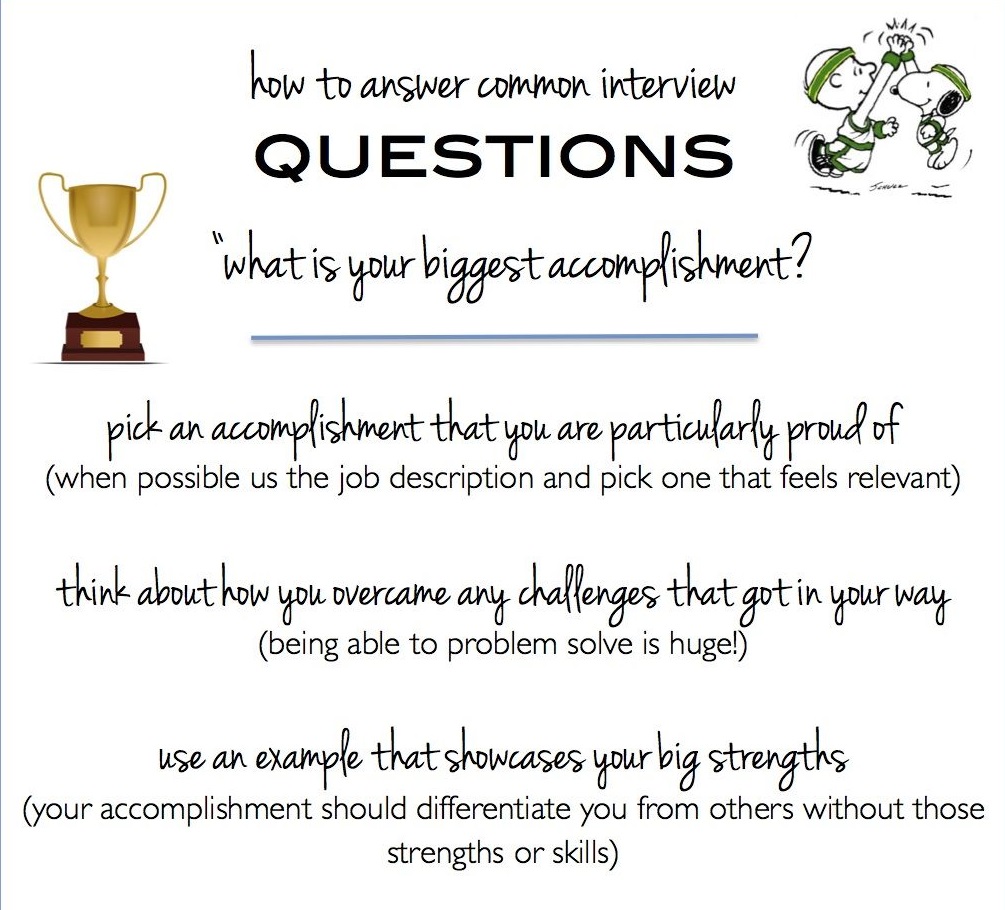
Strategic Selection: Choosing the Right Story for Your Brand
Not all achievements are created equal. Some may be personally meaningful but fail to move the needle on your professional brand. Strategic selection requires an objective analysis of your career highlights to determine which story offers the highest return on investment.
Evaluating High-Impact Moments
To find your brand’s “flagship product”—your greatest achievement—look for moments where you exceeded expectations, not just met them. Meeting a quota is a duty; exceeding it by 50% while mentoring the rest of the team is an achievement.
Consider the “Scale, Scope, and Stakes” of your work. Did you manage a larger budget than usual? Did you oversee a project with international reach? Were the consequences of failure particularly dire? The more significant the stakes, the more powerful the brand message. You want to choose a story that demonstrates you are capable of handling the specific level of responsibility required by the new role.
Bridging the Gap Between Past Success and Future Value
The most effective brand strategy is forward-looking. While the “greatest achievement” question asks about the past, the interviewer is really asking about the future. Your response must bridge the gap between what you did then and what you will do for them now.
After detailing the result of your achievement, conclude by explaining the “transfereable insight.” For example: “This experience taught me how to manage cross-functional teams under extreme pressure, a skill I plan to bring to your upcoming global expansion project.” This technique, known as “future-pacing,” transforms your personal brand from a history lesson into a valuable asset that the company can utilize immediately.
Delivery and Body Language: Branding Beyond the Words
In the world of branding, the packaging is often as important as the product. How you deliver your answer—your tone, your confidence, and your body language—is an integral part of your personal brand. You are the spokesperson for “Brand You,” and your delivery must be polished, professional, and authentic.
The Tone of Confidence vs. Arrogance
There is a fine line between branding and bragging. Arrogance is focused on self-aggrandizement (“I’m the best”), while branding is focused on value delivery (“I achieved these results for the organization”). To stay on the right side of this line, focus on the “we” of the process and the “I” of the specific contribution. Acknowledge the support of your team, but be clear about your unique role in the success. This demonstrates a brand that is both high-achieving and collaborative—a highly desirable combination in any corporate environment.
Authenticity as a Brand Pillar
In the digital age, consumers can spot an inauthentic brand from a mile away, and hiring managers are no different. Your greatest achievement must be true, and your passion for it must be evident. When you talk about something you are genuinely proud of, your body language naturally becomes more engaged, your eyes brighten, and your voice carries more conviction. Authenticity builds trust, and trust is the foundation of any strong brand relationship. If you try to fabricate or exaggerate an achievement, your brand will appear hollow and unreliable.
Case Studies: Branding Excellence in Action
To illustrate how different brand identities can approach this question, let’s look at three distinct “Brand Archetypes” and how they might frame their greatest achievement.
The Leadership Narrative
Brand Identity: The Transformational Leader.
Achievement: Turning around a disengaged, underperforming department.
Strategy: This candidate focuses on the human element of branding. They describe the low morale and high turnover they inherited (The Problem), the implementation of new communication protocols and mentorship programs (The Action), and the subsequent 40% increase in productivity and 90% employee retention rate (The Result). The brand message: “I build the teams that build the business.”
The Innovation Narrative
Brand Identity: The Visionary Strategist.
Achievement: Developing a new digital tool that streamlined the customer journey.
Strategy: This candidate emphasizes forward-thinking and technical prowess. They describe an outdated manual process that was causing customer churn (The Problem), their initiative to design and pilot an automated AI-driven solution (The Action), and the resulting 15% increase in customer satisfaction scores and $500k in annual savings (The Result). The brand message: “I leverage technology to solve complex business problems.”
The Efficiency Narrative
Brand Identity: The Operational Excellence Expert.
Achievement: Restructuring the supply chain to mitigate global disruptions.
Strategy: This candidate highlights reliability and risk management. They describe a scenario where geopolitical shifts threatened the company’s raw material supply (The Problem), their strategic move to diversify vendors and implement “just-in-case” inventory models (The Action), and the fact that the company maintained 100% uptime while competitors faced stockouts (The Result). The brand message: “I provide stability and resilience in volatile markets.”
By viewing the “greatest achievement” question through the lens of personal branding, you transform a standard interview interaction into a strategic positioning opportunity. You are not just answering a question; you are launching a brand that promises—and proves—high-impact value. Through careful narrative construction, alignment with corporate values, and authentic delivery, you ensure that your brand remains top-of-mind long after the interview concludes.
aViewFromTheCave is a participant in the Amazon Services LLC Associates Program, an affiliate advertising program designed to provide a means for sites to earn advertising fees by advertising and linking to Amazon.com. Amazon, the Amazon logo, AmazonSupply, and the AmazonSupply logo are trademarks of Amazon.com, Inc. or its affiliates. As an Amazon Associate we earn affiliate commissions from qualifying purchases.