
Navigating the landscape of death taxes in the United States requires a keen understanding of both federal mandates and state-specific statutes. For residents of Illinois, or those with significant property holdings within the state, the financial implications of passing on wealth are particularly complex. While many states have abolished their versions of “death taxes,” Illinois remains one of a handful of jurisdictions that imposes a significant levy on the transfer of wealth upon a person’s passing.
To manage personal finances effectively and ensure that a legacy is preserved for future generations, it is vital to understand the nuances of the Illinois tax code. This guide provides a deep dive into what is commonly referred to as the “inheritance tax” in Illinois—though, as we will explore, the technical terminology and the practical applications of this tax are often misunderstood by the public.
Understanding the Illinois Estate Tax vs. Inheritance Tax
The first and most critical distinction to make in any discussion regarding Illinois law is the difference between an inheritance tax and an estate tax. While the terms are often used interchangeably in casual conversation, they represent two different methods of taxation.
An inheritance tax is a levy paid by the individual who receives the money or property. The tax rate is often determined by the relationship between the decedent and the beneficiary; for example, a child might pay a lower rate than a distant cousin or a friend. Conversely, an estate tax is a levy on the total value of the deceased person’s assets before any distributions are made to heirs. The tax is paid out of the estate’s funds rather than by the beneficiaries individually.
Illinois officially repealed its inheritance tax years ago and replaced it with an estate tax. Therefore, if you are an heir living in Illinois and you receive a bequest from a loved one, you generally do not owe the state of Illinois a specific “inheritance tax” on that windfall. However, the estate itself may owe a substantial amount to the Illinois Department of Revenue before you ever see a dime.
The $4 Million Exemption Threshold
The most significant feature of the Illinois estate tax is its exemption threshold. Currently, the Illinois estate tax applies only to estates with a total value exceeding $4 million. For many middle-class families, this threshold means their estates will pass to heirs tax-free at the state level. However, for business owners, farmers, and individuals with significant real estate or investment portfolios, the $4 million mark is a relatively low hurdle.
The Problem of Decoupling
Illinois is “decoupled” from the federal estate tax system. In the past, state and federal taxes were synchronized, making planning much simpler. Today, the federal government offers a much higher exemption—currently exceeding $13 million for individuals—while Illinois remains fixed at $4 million. This discrepancy creates a “tax gap” where an estate might be exempt from federal taxes but still owe hundreds of thousands of dollars to the state of Illinois.
How the Illinois Estate Tax is Calculated
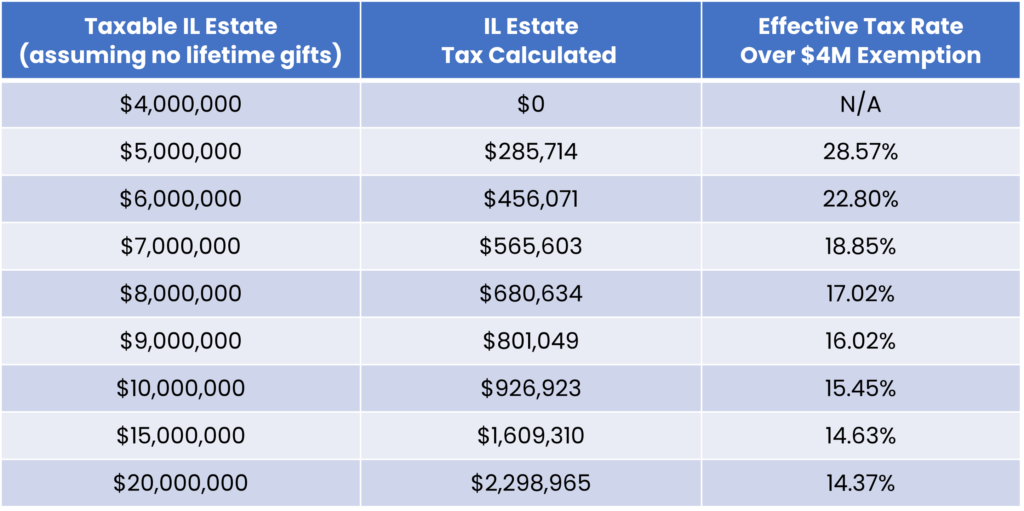
Calculating the tax liability for an Illinois estate is not as simple as applying a flat percentage to everything over $4 million. The state utilizes a progressive rate structure that can reach as high as 16%. However, the calculation method is notoriously complex because it is based on a legacy formula from the federal tax code that was repealed at the federal level but remains “frozen” in Illinois law.
The Taxable Estate Breakdown
To determine the tax, the executor must first calculate the “taxable estate.” This includes all assets owned by the decedent at the time of death, such as:
- Real estate (including primary residences and vacation homes)
- Bank accounts and certificates of deposit
- Investment portfolios (stocks, bonds, mutual funds)
- Business interests and private equity
- Retirement accounts (IRAs, 401(k)s)
- Life insurance proceeds (if the decedent owned the policy)
Once the gross estate is determined, certain deductions are allowed, such as debts, funeral expenses, and administrative costs. The remaining figure is the taxable estate.
The “Cliff” and the Progressive Rate
If the taxable estate is $4,000,001, the tax is not just levied on the single dollar over the limit. Instead, the calculation effectively reaches back into the exemption. While it is not a true “cliff” where the entire $4 million is taxed immediately, the effective tax rate on the amounts just above the exemption can be surprisingly high. As the estate grows in value, the rate scales up, capping at 16% for very large estates.
Filing Requirements
For estates that exceed the $4 million threshold, the executor must file Form IL-706 (Illinois Estate and Generation-Skipping Transfer Tax Return). This must be filed within nine months of the date of death. Failure to file on time can result in significant interest and penalties, which can quickly erode the liquid assets of the estate.
Comparing State and Federal Estate Tax Obligations
Strategic financial planning requires a dual-track approach: managing the federal burden while simultaneously addressing the state-level liability. Because the federal exemption is so much higher than the Illinois exemption, many Illinois residents find themselves in a “taxable trap.”
The Portability Gap
One of the most valuable features of the federal estate tax system is “portability.” This allows a surviving spouse to inherit the unused portion of their deceased spouse’s federal exemption. If a husband passes away and uses none of his $13.61 million exemption, his wife can claim it, giving her a total federal exemption of over $27 million.
Illinois, however, does not recognize portability. Each individual has a $4 million exemption, and it is a “use it or lose it” proposition. If a spouse dies and leaves everything to the survivor without proper trust planning, the first spouse’s $4 million Illinois exemption is effectively wasted. When the second spouse eventually passes away, they only have their own $4 million exemption to apply to the combined assets, potentially resulting in a massive, avoidable tax bill.
Federal Deductibility
It is worth noting that any estate tax paid to the state of Illinois is generally deductible on the federal estate tax return (Form 706). While this provides some relief for ultra-high-net-worth individuals who owe both taxes, it does little for those whose estates fall between the $4 million state threshold and the $13.61 million federal threshold.
Strategic Financial Planning to Mitigate Tax Liability
Because the Illinois estate tax is aggressive compared to many other states, proactive financial planning is essential for wealth preservation. Investors and heads of households should consider several vehicles and strategies to reduce the “taxable footprint” of their estate.
1. The Use of Credit Shelter Trusts (Bypass Trusts)
To solve the “portability” problem mentioned earlier, estate planners often use Credit Shelter Trusts. Instead of leaving everything directly to a spouse, the first spouse’s assets (up to $4 million) are placed into a trust. The surviving spouse can still benefit from the income and use the principal for specific needs, but the assets are technically not part of the survivor’s estate. This allows a couple to shield up to $8 million from Illinois taxes.
2. Gifting Strategies and the Three-Year Rule
One of the most effective ways to reduce an estate is to give money away while you are still alive. Illinois does not have a state gift tax. This means an individual can theoretically give away millions of dollars the day before they die and avoid the 16% Illinois estate tax.
However, there is a caveat. The federal government has a gift tax, though it shares the $13.61 million exemption with the estate tax. More importantly, for Illinois purposes, any gifts made that were subject to federal gift tax must be “added back” into the Illinois estate calculation if they were made within a certain framework. Despite this, utilizing the annual federal gift tax exclusion ($18,000 per recipient in 2024) remains a premier strategy for slowly reducing the estate’s value without any tax consequences.
3. Irrevocable Life Insurance Trusts (ILITs)
Life insurance is often a major contributor to an estate exceeding the $4 million mark. If you own a $2 million policy and have $2.5 million in other assets, you are over the limit. By placing the life insurance policy into an ILIT, the proceeds are no longer considered part of your taxable estate. This not only removes the value from the tax calculation but also provides the heirs with tax-free liquidity to pay any state taxes that may be due on other illiquid assets, like a family business or farm.
4. Qualified Terminable Interest Property (QTIP) Trusts
Illinois allows for a “state-only” QTIP election. This is a sophisticated maneuver where an estate can claim a marital deduction for state purposes even if they don’t do so for federal purposes. This allows for a deferral of the Illinois tax until the death of the second spouse, providing more flexibility in how assets are managed and liquidated.
The Broader Economic Impact of Illinois Death Taxes
The existence of the Illinois estate tax has broader implications for personal finance and the regional economy. Financial advisors often point to the “tax exodus” of high-net-worth individuals moving from Illinois to states like Florida, Texas, or Arizona—states that have no state-level estate or inheritance taxes.
Impact on Family Businesses and Farms
Perhaps the most sensitive area of the Illinois estate tax is its impact on family-owned enterprises. Illinois is a major agricultural hub, and with land prices rising, a multi-hundred-acre farm can easily exceed the $4 million threshold. Without proper liquid assets to pay the tax, heirs may be forced to sell a portion of the family land or business just to satisfy the Illinois Department of Revenue. While there are some “special use valuation” protections for farms, they are strict and require the heirs to continue farming the land for a set period.
Residency and “Domicile” Considerations
For those considering moving to avoid the tax, it is important to understand that Illinois is aggressive in defending its tax base. Simply owning a home in Florida is not enough; one must establish a “domicile” outside of Illinois. This involves shifting voter registration, driver’s licenses, and spending the majority of one’s time outside the state. Furthermore, any real estate physically located in Illinois will still be subject to the Illinois estate tax, regardless of where the owner lives.

Conclusion for the Prepared Investor
The Illinois estate tax is a significant factor in the financial lifecycle of any resident with an accumulating net worth. While the $4 million exemption offers a safety net for many, it remains a low bar for those who have invested wisely in real estate, retirement accounts, and business ventures.
By understanding the distinction between inheritance and estate taxes, recognizing the lack of portability in Illinois law, and utilizing advanced trust and gifting strategies, individuals can protect their life’s work. Managing this tax is not merely about “beating the system”—it is about responsible stewardship of assets to ensure that the maximum amount of capital stays within the family and the community, rather than being diverted to the state treasury. Wealth preservation in Illinois requires a proactive, informed, and disciplined approach to personal finance.
aViewFromTheCave is a participant in the Amazon Services LLC Associates Program, an affiliate advertising program designed to provide a means for sites to earn advertising fees by advertising and linking to Amazon.com. Amazon, the Amazon logo, AmazonSupply, and the AmazonSupply logo are trademarks of Amazon.com, Inc. or its affiliates. As an Amazon Associate we earn affiliate commissions from qualifying purchases.