
The Federal Poverty Level (FPL) is one of the most significant metrics in the American financial landscape, acting as a gatekeeper for dozens of federal and state assistance programs. For 2024, the FPL has seen adjustments that reflect the economic shifts and inflationary pressures of the previous year. Understanding “what is FPL for 2024” is not merely an academic exercise; for millions of households, it is a critical component of personal finance that determines eligibility for health insurance subsidies, food assistance, and various tax credits. As costs for housing, energy, and groceries continue to fluctuate, staying informed about these thresholds is essential for effective budgeting and long-term financial health.
The Mechanics of the 2024 Federal Poverty Level
The 2024 FPL guidelines are issued annually by the Department of Health and Human Services (HHS). These figures are a simplified version of the poverty thresholds used by the U.S. Census Bureau for statistical purposes. While the Census Bureau uses thresholds to track the number of people living in poverty across the nation, the HHS guidelines—what we commonly refer to as “the FPL”—are used for administrative purposes to determine financial eligibility for certain programs.
How the 2024 Figures are Calculated
The FPL for 2024 is calculated based on the Consumer Price Index for All Urban Consumers (CPI-U). Because inflation was a dominant theme throughout 2023, the 2024 guidelines have shifted upward to account for the decreased purchasing power of the dollar. This adjustment is vital because it prevents individuals from losing access to essential benefits simply because their wages saw a nominal increase that didn’t actually outpace the cost of living.
The Geographic Variance
It is important to note that the FPL is not uniform across all 50 states. The HHS provides three distinct sets of guidelines:
- The 48 Contiguous States and the District of Columbia: This is the standard set of numbers used by the majority of the population.
- Alaska: Because the cost of living is significantly higher in Alaska due to logistics and heating requirements, the FPL thresholds are higher.
- Hawaii: Similar to Alaska, Hawaii’s remote location and high cost of goods lead to a higher poverty level threshold.
For financial planning purposes, ensuring you are looking at the correct table for your specific location is the first step in determining your eligibility for various financial tools and assistance.
Breakdown of the 2024 FPL Guidelines by Household Size
The FPL increases as the number of individuals in a household increases. For 2024, the baseline for a single individual in the 48 contiguous states is $15,060. This number serves as the “100% FPL” mark. Many programs use a percentage of this number (such as 138%, 200%, or 400%) to set their specific eligibility ceilings.
2024 Poverty Guidelines (48 Contiguous States and D.C.)
- 1 Person: $15,060
- 2 Persons: $20,440
- 3 Persons: $25,820
- 4 Persons: $31,200
- 5 Persons: $36,580
- 6 Persons: $41,960
- 7 Persons: $47,340
- 8 Persons: $52,720
For households with more than eight members, an additional $5,380 is added for each extra person. In Alaska, the baseline for an individual starts higher at $18,810, and in Hawaii, it starts at $17,310.
Understanding Percentages of FPL
In the world of personal finance, you will rarely see a program that cuts off exactly at 100% of the FPL. Instead, financial tools and government agencies use multiples. For example, to qualify for certain legal aid services, your income might need to be below 125% of the FPL. For a family of four in 2024, 125% would equal $39,000 ($31,200 x 1.25). Understanding how to multiply the base FPL by these percentages is key to predicting your financial standing for the upcoming year.
How FPL Impacts Healthcare and Insurance Premiums
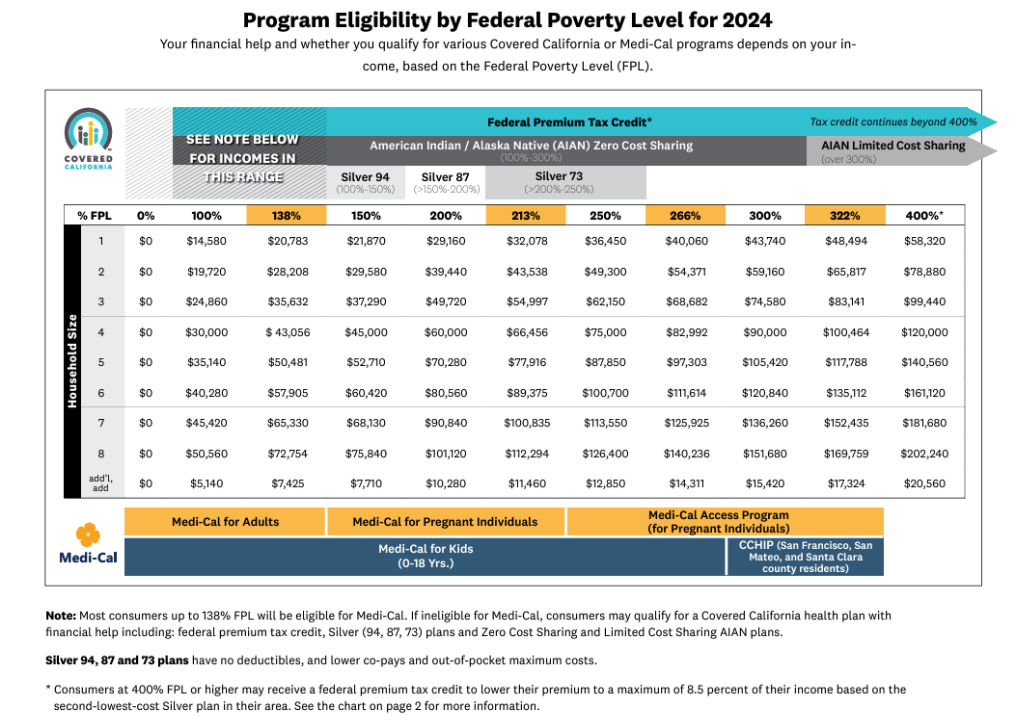
Perhaps the most common use of the FPL in modern personal finance is its role in the Affordable Care Act (ACA) and the Health Insurance Marketplace. The FPL determines whether you qualify for Premium Tax Credits (PTC) and Cost-Sharing Reductions (CSR), which can save a household thousands of dollars annually.
Premium Tax Credits and the 100%–400% Range
Generally, households with incomes between 100% and 400% of the FPL qualify for subsidies that lower the monthly cost of health insurance. However, due to recent legislative changes like the Inflation Reduction Act, the “subsidy cliff” (where subsidies vanished entirely above 400% FPL) has been temporarily eliminated through 2025. This means that even if your income exceeds 400% of the 2024 FPL ($60,240 for an individual), you may still qualify for credits if your insurance premiums exceed 8.5% of your household income.
Cost-Sharing Reductions (CSR)
If your income falls between 100% and 250% of the FPL, you may qualify for “extra savings” known as Cost-Sharing Reductions. These are only available if you enroll in a “Silver” tier plan. These reductions lower your out-of-pocket maximums, deductibles, and co-payments. For a household of two earning $40,000 in 2024 (roughly 195% FPL), choosing a Silver plan with CSR could mean the difference between a $5,000 deductible and a $1,500 deductible.
Medicaid and CHIP Eligibility
In states that have expanded Medicaid, the eligibility threshold is typically 138% of the FPL. For 2024, an individual earning up to $20,782 would likely qualify for Medicaid in expansion states. The Children’s Health Insurance Program (CHIP) often has much higher thresholds, sometimes up to 200% or 300% of the FPL, ensuring that children in middle-income families have access to affordable healthcare even if their parents do not qualify for Medicaid.
Financial Assistance and Program Eligibility
Beyond healthcare, the 2024 FPL serves as the benchmark for a wide array of programs that impact a household’s bottom line. For those managing a tight budget or seeking to maximize their financial resources, knowing these thresholds is a form of strategic wealth management.
Supplemental Nutrition Assistance Program (SNAP)
SNAP, formerly known as food stamps, generally uses a gross income limit of 130% of the FPL. For a family of three in 2024, the gross monthly income limit would be approximately $2,797 ($25,820 x 1.30 / 12). By understanding these numbers, families can better navigate the application process and understand why their benefits might increase or decrease as their income changes.
Low Income Home Energy Assistance Program (LIHEAP)
Energy costs are a major line item in any household budget. LIHEAP helps low-income households with heating and cooling costs. The federal limit for LIHEAP is often the greater of 150% of the FPL or 60% of the State Median Income. For 2024, a single person at 150% FPL would be at $22,590. Tapping into these resources can free up capital for other investments or emergency savings.
Legal Services and Education
Many non-profit legal aid groups utilize the 125% FPL threshold to provide pro-bono services. Furthermore, certain student loan repayment plans and fee waivers for standardized testing (like the SAT or GRE) or college applications are tied to FPL guidelines. For students and young professionals, these FPL-linked waivers represent a direct “income boost” by removing necessary expenses.
Wealth Management Strategies for Navigating FPL Thresholds
In the realm of high-level personal finance, the FPL is more than just a threshold for assistance; it is a target for income manipulation strategies. Many savvy taxpayers use “Modified Adjusted Gross Income” (MAGI) to stay within certain FPL percentages to maximize their benefits.
Managing Your MAGI
Since most FPL-based programs look at your MAGI rather than your gross salary, there are several ways to strategically lower your income to stay below a specific FPL tier.
- Retirement Contributions: Contributions to a traditional IRA or a 401(k) reduce your MAGI. If a family is just $1,000 over the limit for a significant healthcare subsidy, contributing that $1,000 to a retirement account can effectively “pay for itself” by unlocking thousands in insurance savings.
- Health Savings Accounts (HSA): Contributions to an HSA are also deducted from your income for MAGI purposes. This is a double win: you build a tax-advantaged health fund while potentially qualifying for lower insurance premiums via the FPL guidelines.
- Business Expenses: For those with side hustles or freelance income, documenting all legitimate business expenses is crucial. These expenses reduce your net income, which is what is factored into FPL calculations.

The “Income Floor” Strategy
It is also important to remember that for ACA subsidies, there is an income floor. In states that have not expanded Medicaid, falling below 100% of the FPL can actually result in losing subsidies, creating a “coverage gap.” In these specific instances, a financial strategy might involve increasing reported income—perhaps by converting a portion of a Traditional IRA to a Roth IRA—to ensure the household hits at least 100% of the FPL to qualify for Marketplace credits.
As we move through 2024, the FPL will remain a cornerstone of the American financial structure. Whether you are a business owner calculating employee benefits, a family planning your healthcare needs, or an individual optimizing your tax strategy, the 2024 FPL figures are a vital tool in your financial arsenal. By understanding where these lines are drawn, you can make more informed decisions about your income, your investments, and your overall economic security.
aViewFromTheCave is a participant in the Amazon Services LLC Associates Program, an affiliate advertising program designed to provide a means for sites to earn advertising fees by advertising and linking to Amazon.com. Amazon, the Amazon logo, AmazonSupply, and the AmazonSupply logo are trademarks of Amazon.com, Inc. or its affiliates. As an Amazon Associate we earn affiliate commissions from qualifying purchases.