
In the lexicon of modern procedural dramas, few terms have permeated the public consciousness as deeply as “unsub.” Popularized by the long-running series Criminal Minds, the term serves as the foundational unit of the Behavioral Analysis Unit’s (BAU) workflow. However, while the show uses the term to describe a mysterious antagonist, the reality of identifying an “unsub” has transitioned from the realm of traditional psychology into the sophisticated world of high-level technology, digital forensics, and artificial intelligence.
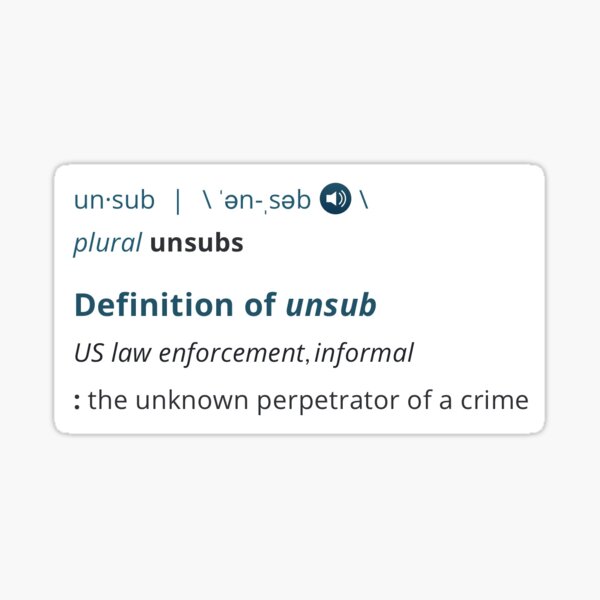
In its most literal sense, “unsub” is an abbreviation for “Unknown Subject of an investigation.” Within the context of technology and modern digital security, the unsub represents the “Threat Actor”—the anonymous entity behind a breach, a social engineering campaign, or a sophisticated cyberattack. Understanding the “unsub” in today’s landscape requires more than just a psychological profile; it requires a deep dive into the technological tools that track, identify, and predict the movements of these unknown subjects across the digital frontier.
The Anatomy of an Unsub: From Behavioral Profiling to Digital Intelligence
In the early seasons of Criminal Minds, the profiling of an unsub focused primarily on geography, victimology, and the “signature” left at a physical crime scene. In the modern tech niche, these concepts have been digitized. The “crime scene” is now a compromised server or a leaked database, and the “signature” is found in the lines of code or the specific tools used to bypass encryption.
Understanding the “Unknown Subject”
The term “unsub” was historically used by the FBI to refer to a person of interest who has not yet been identified. In the tech world, this is the equivalent of a “Zero-Day” actor or an Advanced Persistent Threat (APT). When a company realizes its security has been breached, the perpetrator is an unsub. The objective of the technical team—much like the BAU—is to “put a face to the file.”
This identification process has evolved through several technological generations. We have moved past the era where a simple IP address was enough to identify a subject. With the advent of Virtual Private Networks (VPNs), Onion Routing (Tor), and proxy chaining, the modern unsub is more obscured than ever. Technology, however, has kept pace, offering new ways to de-anonymize these subjects through behavioral analytics.
The Shift from Psychology to Data Science
Traditional profiling relied on the “M.O.” (Modus Operandi) and the “Signature.” In the technology sector, this has been replaced by “TTPs” (Tactics, Techniques, and Procedures). While an unsub’s M.O. might involve how they gain access to a network, their technical signature often lies in the specific language used in their scripts, the time of day they execute commands, and the specific vulnerabilities they choose to exploit.
Data science allows investigators to aggregate thousands of data points to create a “Digital Profile.” By analyzing the “keystroke dynamics” or the specific coding style of an unsub, software can now determine with high probability if a current attack is being executed by the same subject who targeted a different infrastructure months prior. The “profile” is no longer a folder of photographs; it is a complex dataset of digital behavior.
The Digital Footprint: Identifying the Modern Unsub through OSINT
The identification of an unsub on Criminal Minds often involves a breakthrough moment where a technical analyst—like the character Penelope Garcia—finds a needle in a digital haystack. In reality, this process is known as Open Source Intelligence (OSINT). OSINT is the practice of collecting and analyzing data from publicly available sources to identify an unknown subject.
Leveraging Open Source Intelligence
OSINT has become the most powerful tool in the arsenal of digital investigators. An unsub might be careful to hide their IP address, but they often leave “digital breadcrumbs” elsewhere. This can include mentions on underground forums, the reuse of a specific handle across different platforms, or even the metadata embedded in a file they uploaded years ago.
Tools such as Maltego or SpiderFoot allow tech professionals to map out the connections between an unsub’s disparate online personas. By visualizing these links, investigators can see how an anonymous hacker in one forum might be linked to a registered domain name in another, eventually leading to a real-world identity. This is the technological evolution of the “evidence board” seen in procedural dramas.
The Role of Metadata and Exif Data
Every time an unsub interacts with technology, they risk leaving behind metadata. Metadata is “data about data.” For instance, a photo posted by an unsub might contain Exif (Exchangeable Image File Format) data, which reveals the GPS coordinates of where the photo was taken, the device used, and the exact timestamp.
In the tech industry, scrubbing metadata is a standard security practice, but many unsubs make mistakes. Digital forensics experts use specialized software to peel back these layers. Even if an unsub is using sophisticated encryption, the “leaks” often happen at the application layer. This transition from physical evidence to digital artifacts is the cornerstone of 21st-century profiling.

AI and Algorithmic Profiling: Predicting the Unsub’s Next Move
One of the most fascinating aspects of Criminal Minds is the BAU’s ability to predict what an unsub will do next. In the tech sphere, this is no longer a matter of human intuition; it is the result of predictive modeling and Machine Learning (ML).
Behavioral Analytics and Machine Learning
Artificial Intelligence (AI) has revolutionized how we understand the “unknown subject.” By feeding historical data of cyberattacks into machine learning models, security systems can now identify patterns that are invisible to the human eye. These AI-driven systems monitor network behavior in real-time. If a user’s behavior deviates from their established baseline—such as accessing sensitive files at 3:00 AM or transferring large amounts of data to an external server—the system flags them as a potential unsub (or an insider threat).
This is known as User and Entity Behavior Analytics (UEBA). Instead of waiting for a crime to be committed, tech-driven profiling seeks to identify the unsub while they are still in the “pre-attack” phase. The algorithms look for the digital equivalent of “casing a joint,” such as port scanning or credential stuffing, allowing for proactive defense.
Facial Recognition and Biometric Databases
In cases where an unsub is captured on digital surveillance, AI-powered facial recognition technology has become a game-changer. By cross-referencing an image against massive biometric databases, law enforcement and security tech firms can identify a subject in seconds.
Beyond simple facial recognition, “gait analysis” and “voice biometrics” are emerging technologies that help identify unsubs even when their faces are obscured. These tools analyze the way a person walks or the unique frequencies of their voice. In the tech-heavy world of modern investigation, the physical traits of the unsub are translated into mathematical vectors, making anonymity increasingly difficult to maintain.
Cybersecurity and Threat Actor Profiling: The Unsubs of the Digital Realm
In the world of cybersecurity, the term “unsub” is often swapped for “Threat Actor.” These entities range from “script kiddies” to state-sponsored hacking groups. Just as the BAU categorizes unsubs by their motivations—visionary, missionary, or power-assertive—cybersecurity professionals categorize threat actors by their objectives.
Advanced Persistent Threats (APTs)
An APT is the most sophisticated version of a digital unsub. These are typically groups of highly skilled individuals, often backed by nation-states, who engage in long-term, targeted attacks. Profiling an APT involves looking at their “Digital Fingerprints,” such as the specific malware families they use or the time zones in which they are most active.
Tech firms like Mandiant and CrowdStrike specialize in this type of profiling. They assign names to these “unsubs” (e.g., Fancy Bear, Lazarus Group) based on their observed behaviors and technical capabilities. By understanding the profile of the threat actor, organizations can better tailor their defenses against the specific tools that the unsub is likely to use.
Forensics in the Wake of a Breach
When a breach occurs, digital forensics and incident response (DFIR) teams are called in to conduct a “post-mortem” analysis. This is the digital equivalent of an autopsy. The goal is to reconstruct the unsub’s movements throughout the network.
Technicians use tools like EnCase or FTK Imager to create bit-for-bit copies of hard drives and memory. They look for deleted files, hidden partitions, and logs that the unsub tried to wipe. This technical reconstruction allows investigators to determine the “patient zero”—the exact point of entry—and trace the unsub’s lateral movement through the system.

The Convergence of Tech and Behavioral Science
The term “unsub” may have started as a piece of law enforcement jargon, but in the modern era, it represents the intersection of human psychology and technological capability. The “Unknown Subject” is no longer just a person; they are a collection of data points, a series of network logs, and a profile generated by an algorithm.
As we look toward the future, the identification of the unsub will become even more automated. The integration of AI with global surveillance and digital tracking means that the window of anonymity for any “unknown subject” is rapidly closing. Whether in the context of a television drama or a high-stakes cybersecurity incident, the hunt for the unsub remains a driving force behind the development of our most advanced investigative technologies.
Ultimately, what “unsub” means in Criminal Minds is the starting point of an investigation. In the tech world, it is the catalyst for a sophisticated digital dragnet designed to turn the unknown into the known, ensuring that in the digital age, no subject stays “unknown” for long.
aViewFromTheCave is a participant in the Amazon Services LLC Associates Program, an affiliate advertising program designed to provide a means for sites to earn advertising fees by advertising and linking to Amazon.com. Amazon, the Amazon logo, AmazonSupply, and the AmazonSupply logo are trademarks of Amazon.com, Inc. or its affiliates. As an Amazon Associate we earn affiliate commissions from qualifying purchases.