
For nearly a decade, prospective homebuyers and those looking to refinance enjoyed a period of historically low interest rates. The era of “cheap money” defined the real estate market, fueling a surge in home values and making the dream of homeownership accessible to millions. However, the tide has turned. Since 2022, mortgage rates have climbed significantly, reaching levels not seen in twenty years.
To the average consumer, this shift can feel sudden and punitive. Yet, the movement of mortgage rates is rarely a result of a single factor. Instead, it is the outcome of a complex interplay between central bank policy, global bond markets, and the persistent pressure of inflation. Understanding why mortgage rates are going up requires a deep dive into the mechanics of the financial system and the macroeconomic landscape.
The Role of the Federal Reserve and Monetary Policy
When discussing interest rates, the conversation almost always begins with the Federal Reserve, the central bank of the United States. While the Fed does not set mortgage rates directly, its influence over the cost of borrowing is unparalleled.
The Federal Funds Rate vs. Mortgage Rates
The primary tool of the Federal Reserve is the Federal Funds Rate—the interest rate at which commercial banks borrow and lend to each other overnight. When the Fed raises this rate, it becomes more expensive for banks to acquire capital. To maintain their profit margins, banks pass these costs on to consumers in the form of higher interest rates for credit cards, auto loans, and, indirectly, mortgages. Although a 30-year fixed-rate mortgage does not track the Fed funds rate one-for-one, the two are tethered by the broader cost of liquidity in the financial system.
Taming Inflation: The Fed’s Balancing Act
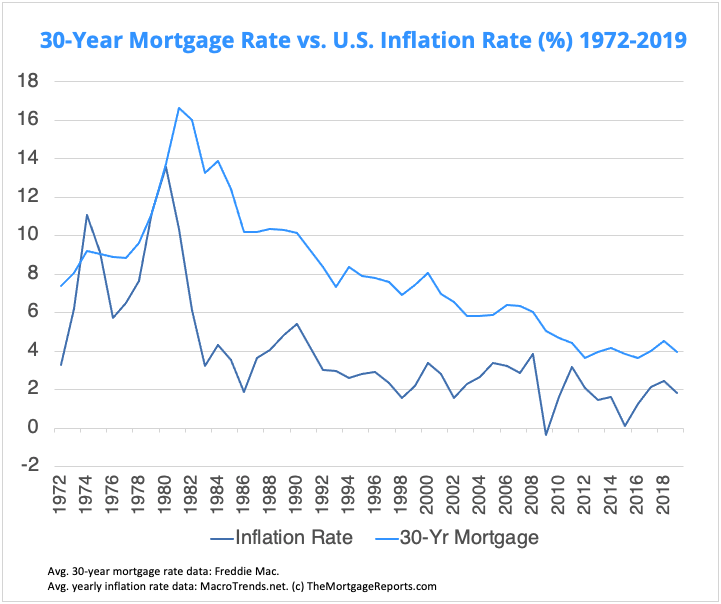
The most significant driver of recent rate hikes has been the Federal Reserve’s aggressive stance against inflation. Following the pandemic, a combination of supply chain disruptions, increased consumer demand, and government stimulus led to a sharp rise in the Consumer Price Index (CPI). To prevent the economy from overheating and to stabilize the purchasing power of the dollar, the Fed transitioned from “Quantitative Easing” (pumping money into the system) to “Quantitative Tightening” (removing it). By raising rates, the Fed deliberately cools the economy, making borrowing more expensive to discourage spending and lower prices.
The Impact of the Bond Market and 10-Year Treasury Yields
To understand mortgage rates, one must look past the headlines of the Federal Reserve and toward the bond market. Specifically, the 30-year fixed-rate mortgage is most closely correlated with the yield on the 10-year U.S. Treasury note.
Why Mortgages Track the 10-Year Treasury
Lenders do not hold onto 30-year mortgages for the full duration of the loan; instead, they bundle them into Mortgage-Backed Securities (MBS) and sell them to investors. Investors view these MBS as competing with other “safe” investments, primarily U.S. government bonds. Because a mortgage carries more risk than a government bond (due to the possibility of default or early payoff), investors demand a higher yield for a mortgage than they do for a 10-year Treasury note. When the yield on the 10-year Treasury rises due to economic projections or government debt issuance, mortgage rates must rise alongside them to remain attractive to investors.
Investor Sentiment and the “Spread”
The “spread” refers to the difference between the 10-year Treasury yield and the average 30-year mortgage rate. Historically, this spread sits around 1.5 to 2 percentage points. However, in times of economic uncertainty, this spread widens. When investors are nervous about the future of the housing market or the direction of the economy, they demand even higher returns to compensate for the perceived risk. This explains why mortgage rates can sometimes jump even when the Federal Reserve remains stationary—it is a reflection of the market’s collective anxiety about the future.
Broader Economic Indicators and Market Volatility
Mortgage rates are a forward-looking indicator. They reflect what the market believes will happen in the coming months and years. Consequently, any data point that suggests the economy is stronger or more inflationary than expected can cause rates to tick upward.
Inflationary Pressure and Purchasing Power
Inflation is the “arch-nemesis” of fixed-income investors. If an investor buys a mortgage-backed security that pays 4% interest, but inflation is running at 5%, the investor is effectively losing money in real terms. To protect themselves against the eroding power of inflation, investors demand higher interest rates on new loans. Therefore, whenever a new CPI report shows that inflation is remaining “sticky” or higher than anticipated, the bond market reacts instantly, pushing mortgage rates higher to stay ahead of the curve.
The Strong Labor Market Paradox
Under normal circumstances, a strong labor market is a sign of a healthy economy. However, in an inflationary environment, low unemployment can actually drive mortgage rates higher. A robust job market means consumers have more money to spend, which keeps demand high and puts upward pressure on prices. If the monthly jobs report shows significant growth, the Federal Reserve is more likely to keep interest rates high for a longer period to ensure the economy doesn’t “run too hot.” Consequently, good news for the workforce is often viewed as “bad news” for mortgage rates.
Mortgage-Backed Securities (MBS) and Risk Premiums
The mechanics of how mortgages are funded play a vital role in the interest rates offered to homeowners. The secondary market for mortgages is a cornerstone of the global financial system, and changes in its structure have direct consequences.
The End of Quantitative Easing
During the 2008 financial crisis and again during the 2020 pandemic, the Federal Reserve became a massive buyer of Mortgage-Backed Securities. By purchasing these securities, the Fed increased demand, which lowered yields and kept mortgage rates at record lows. However, as the Fed began its “balance sheet runoff,” it stopped buying these securities. With the largest buyer in the world stepping away from the table, other private investors had to step in. These private investors require higher yields than the Fed did, contributing to the upward trajectory of rates.
Quantifying Risk in a Changing Economy
Lenders must also account for the cost of servicing loans and the risk of “prepayment.” When rates are falling, people refinance their homes, which is a risk for the investor who loses out on high-interest payments. Conversely, when rates are rising, people stay in their homes longer (the “lock-in effect”), which changes the duration and risk profile of the security. This volatility in the market makes it more expensive for lenders to hedge their positions, and those hedging costs are eventually baked into the rate offered to the consumer.
Strategies for Homebuyers and Homeowners in a High-Rate Environment
While the macroeconomic forces driving rates higher are outside the control of the individual, there are financial strategies to navigate this challenging environment. High rates do not necessarily mean it is a bad time to buy; rather, it means the financial planning must be more precise.
Lock-In Strategies and Floating Rates
In a volatile market, “rate locks” become essential. Once a buyer finds a property, locking in a rate for 30, 45, or 60 days protects them from sudden spikes during the closing process. Some buyers are also revisiting Adjustable-Rate Mortgages (ARMs). While ARMs carry the risk of future increases, they often offer a lower initial rate than a 30-year fixed mortgage, which can provide temporary relief with the hope of refinancing later if rates eventually decline.
The Importance of Credit Health and Down Payments
In a high-rate environment, the “tiering” of interest rates becomes more pronounced. The difference between a 700 credit score and a 780 credit score can result in a significant difference in the monthly payment. Maximizing one’s credit profile before applying is the most effective way to mitigate the impact of rising national rates. Furthermore, larger down payments or “buying down the rate” with discount points can reduce the long-term interest burden, though it requires more upfront capital.

The Long-View Investment Perspective
From a historical perspective, the ultra-low rates of 2020 and 2021 were the anomaly, not the 6% or 7% rates seen today. Real estate remains a powerful hedge against inflation because as prices for goods and services rise, the value of the physical asset (the home) typically rises as well, while the debt remains fixed. For many investors and homeowners, the focus is shifting from “when will rates go down” to “how do I make the numbers work today.”
In conclusion, mortgage rates are going up because the global economy is in a state of recalibration. The transition from an era of stimulus and low inflation to one of fiscal restraint and persistent price pressures has fundamentally altered the cost of capital. By monitoring the Federal Reserve, the 10-year Treasury yield, and the health of the labor market, one can better anticipate the future of mortgage rates and make informed, strategic decisions in the realm of personal finance.
aViewFromTheCave is a participant in the Amazon Services LLC Associates Program, an affiliate advertising program designed to provide a means for sites to earn advertising fees by advertising and linking to Amazon.com. Amazon, the Amazon logo, AmazonSupply, and the AmazonSupply logo are trademarks of Amazon.com, Inc. or its affiliates. As an Amazon Associate we earn affiliate commissions from qualifying purchases.