
In the world of real estate investing, few metrics carry as much weight as Net Operating Income, commonly referred to as NOI. Whether you are a seasoned institutional investor or a newcomer looking at your first rental property, understanding NOI is fundamental to assessing the profitability and market value of an income-producing asset. It serves as the primary indicator of a property’s ability to generate income from its core operations, independent of financing or tax considerations.
For anyone operating within the “Money” niche—focusing on personal finance, wealth building, and business finance—NOI is the bedrock upon which investment decisions are built. It allows for an “apples-to-apples” comparison between different properties, providing a clear window into the financial health of a real estate venture.

Understanding Net Operating Income (NOI)
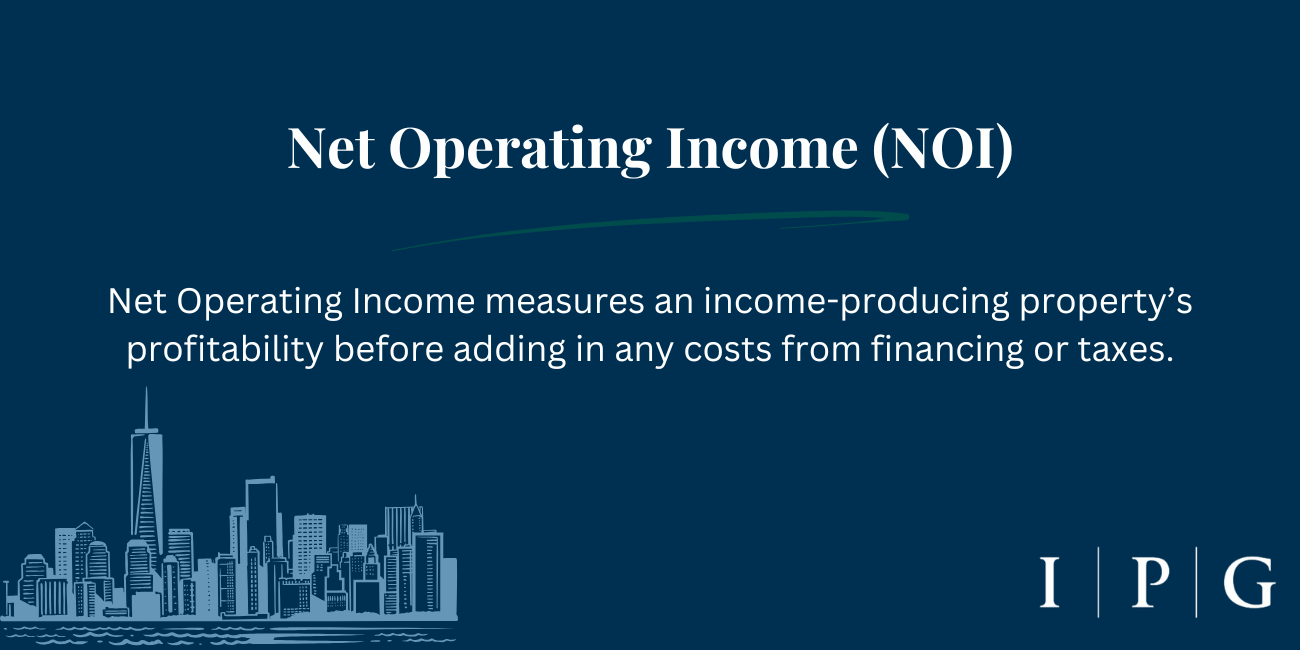
At its simplest level, Net Operating Income is a calculation used to analyze the profitability of income-generating real estate investments. NOI equals all revenue from the property, minus all reasonably necessary operating expenses. Unlike “Net Income” in corporate accounting, which includes interest and taxes, NOI focuses strictly on the property’s operational efficiency.
The Core Components of NOI
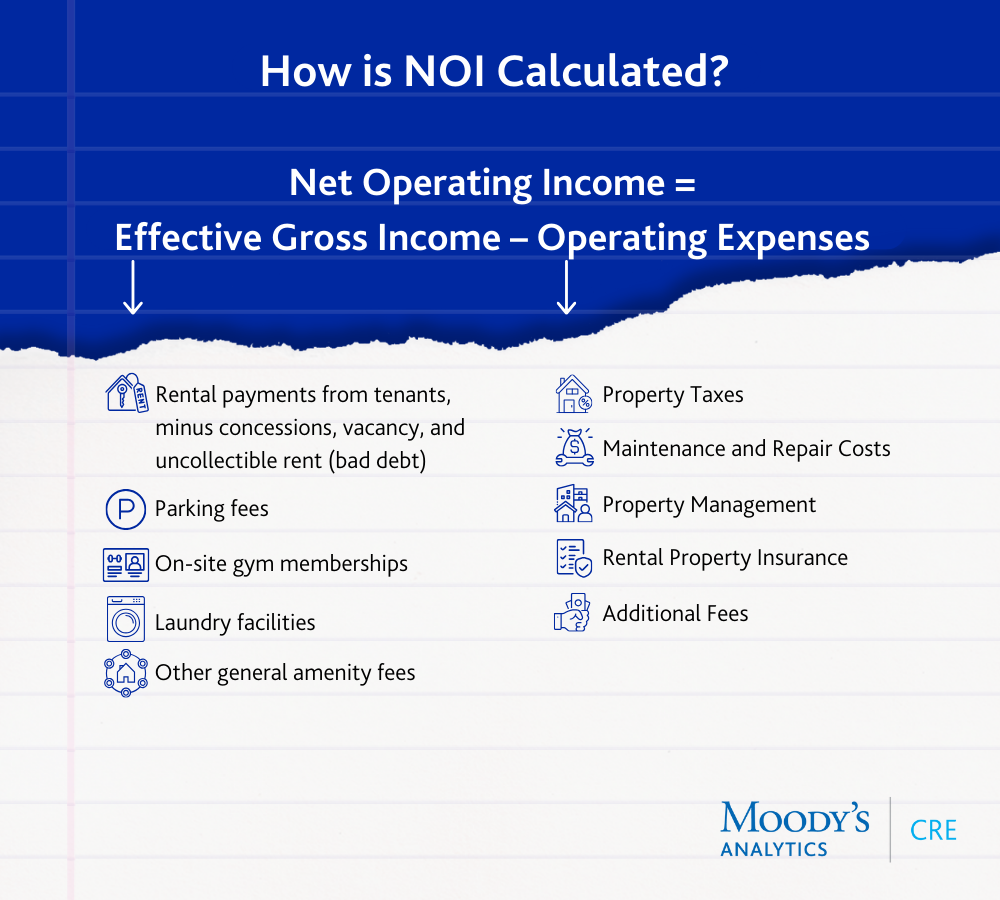
To calculate NOI accurately, one must first understand the two primary variables: Gross Operating Income (GOI) and Operating Expenses.
- Gross Operating Income (GOI): This starts with Potential Gross Income (PGI), which is the total rent a property would generate if it were 100% occupied with no collection losses. From PGI, you subtract vacancy losses and credit losses (tenants who fail to pay). You then add “Other Income,” which might include revenue from parking fees, laundry facilities, storage unit rentals, or vending machines.
- Operating Expenses: These are the costs required to run and maintain the property on a day-to-day basis. Common operating expenses include property management fees, property taxes, insurance, utilities (not paid by tenants), repairs, maintenance, and landscaping.
It is important to note that NOI does not include “debt service”—the principal and interest payments on a mortgage. It also excludes capital expenditures (large, one-time improvements like a new roof), depreciation, and income taxes. By excluding these variables, NOI tells you how well the property performs as an asset, regardless of who owns it or how it is financed.
The Formula for Calculating NOI
The formula is straightforward but requires precise data to be effective:
NOI = (Gross Potential Income + Other Income) – (Vacancy Losses + Operating Expenses)
For example, imagine an apartment complex that generates $500,000 in annual rent. It has a 5% vacancy rate ($25,000) and earns an additional $10,000 from laundry and parking. Its operating expenses (taxes, insurance, maintenance) total $180,000.
The calculation would be:
($500,000 + $10,000) – $25,000 – $180,000 = $305,000 NOI.
This figure represents the annual cash profit generated by the property before any mortgage payments are made.
Why NOI is the Gold Standard for Real Estate Valuation
In business finance, the value of an asset is often tied to the cash it produces. In real estate, NOI is the engine that drives the valuation process. Investors and lenders use it to determine if a property is worth the asking price and if it can support the debt required to purchase it.
Using NOI to Determine Property Value (The Cap Rate)
The most common way to value a commercial or multi-family property is by using the Capitalization Rate, or “Cap Rate.” The Cap Rate is the ratio of Net Operating Income to property asset value.
Value = NOI / Cap Rate
If the market Cap Rate for a specific type of property in a specific area is 6%, and the property has an NOI of $300,000, the estimated value would be $5,000,000 ($300,000 / 0.06).
This relationship highlights why increasing NOI is the primary goal of real estate investors. In the example above, if the investor finds a way to increase the NOI by just $10,000 (through rent increases or expense reductions), the property value increases by approximately $166,666 at that same 6% Cap Rate. This “forced appreciation” is one of the most powerful wealth-building tools in the money and investing sector.
NOI vs. Cash Flow: Distinguishing the Differences
One of the most frequent points of confusion for new investors is the difference between NOI and Cash Flow. While they are related, they serve different analytical purposes.
- NOI is “above the line.” It looks at the property’s performance as an isolated entity. It tells you the yield the property generates on its own merits.
- Cash Flow is “below the line.” It is calculated by taking the NOI and subtracting debt service (mortgage payments) and capital expenditures (CapEx).
An investor might find a property with a high NOI, but if they take out a high-interest loan with a large monthly payment, the actual cash flow in their pocket might be zero or even negative. Therefore, while NOI determines the value of the asset, cash flow determines the sustainability of the investment for the specific owner.
Strategies to Maximize Your Net Operating Income
Since NOI directly impacts valuation, sophisticated investors are constantly looking for ways to optimize this figure. Increasing NOI involves a two-pronged approach: maximizing revenue and minimizing operating expenses.
Revenue Optimization Beyond Rent
Increasing the base rent is the most obvious way to boost NOI, but it isn’t the only way. Savvy property owners look for “ancillary income” streams that can turn underutilized space into profit centers.
- Premium Amenities: Charging for reserved parking spots, storage lockers, or high-speed internet packages can significantly move the needle.
- Pet Policies: Implementing monthly pet rent rather than just a one-time deposit can add thousands to the annual GOI.
- Utility Billback Systems (RUBS): In many older buildings, the owner pays for water, sewer, and trash. Implementing a Ratio Utility Billing System (RUBS) allows the owner to bill these costs back to the tenants, effectively transferring an operating expense into a revenue recovery line item, which directly increases NOI.
Strategic Expense Management
On the other side of the equation, reducing expenses is often faster and more controllable than increasing rent. However, this must be done without deferred maintenance, which could hurt the property’s long-term value.
- Energy Efficiency: Retrofitting a building with LED lighting, low-flow toilets, and smart thermostats can drastically reduce utility costs.
- Tax Appeals: Property taxes are often the largest single line-item expense. Regularly appealing property tax assessments to ensure they reflect true market value can save an investor tens of thousands of dollars.
- Contract Renegotiation: Periodically bidding out services like landscaping, trash removal, and insurance can reveal lower-cost alternatives or provide leverage to negotiate better rates with current vendors.
Common Pitfalls and Limitations of the NOI Metric
While NOI is an indispensable tool, it is not a complete picture of an investment’s health. Relying solely on NOI without context can lead to poor financial decisions.
What NOI Excludes (And Why It Matters)
As mentioned earlier, NOI excludes capital expenditures (CapEx). This is a critical distinction. CapEx includes major costs like replacing an HVAC system, paving a parking lot, or replacing a roof. While these are not “operating expenses” in an accounting sense (because they add long-term value to the asset), they still require real cash.
If an investor only looks at NOI, they might see a highly profitable building. However, if that building requires $200,000 in immediate roof repairs, the NOI doesn’t reflect that upcoming cash drain. Investors must look at the “Adjusted NOI” or “Cash Flow After CapEx” to understand the true liquidity requirements of the asset.
The Impact of Market Volatility
NOI is a snapshot in time. It is based on current rents and current expenses. In a volatile economy, several factors can quickly erode NOI:
- Inflation: If the costs of labor, materials, and utilities rise faster than a landlord can increase rents (especially in rent-controlled areas), the NOI will shrink.
- Market Vacancy: A sudden shift in the local economy (such as a major employer leaving town) can increase vacancy rates. Since vacancy is subtracted before calculating NOI, a rise from 5% to 15% vacancy can devastate the bottom line.
- Interest Rate Sensitivity: While interest rates don’t change the NOI itself, they change the Cap Rate that the market is willing to pay. When interest rates rise, Cap Rates typically rise as well. If the Cap Rate goes up while your NOI stays the same, your property value drops.
Conclusion: The Role of NOI in Financial Mastery
For anyone focused on the “Money” niche—investing, business finance, and wealth creation—Net Operating Income is more than just an acronym. It is a vital sign of a real estate asset’s health. It serves as the primary metric for valuation, the baseline for debt coverage, and the scoreboard for operational efficiency.
By mastering the nuances of NOI, investors can strip away the noise of financing and personal tax situations to see the raw earning power of a property. Whether you are analyzing a small duplex or a massive commercial plaza, the ability to accurately calculate, interpret, and improve NOI is what separates successful investors from those who simply own real estate. In the quest for financial independence and portfolio growth, NOI remains the ultimate north star.
aViewFromTheCave is a participant in the Amazon Services LLC Associates Program, an affiliate advertising program designed to provide a means for sites to earn advertising fees by advertising and linking to Amazon.com. Amazon, the Amazon logo, AmazonSupply, and the AmazonSupply logo are trademarks of Amazon.com, Inc. or its affiliates. As an Amazon Associate we earn affiliate commissions from qualifying purchases.