
In the rapidly evolving landscape of healthcare technology, the acronym “CC” stands as one of the most critical data points in a patient’s journey. While it has two primary meanings—Chief Complaint and Cubic Centimeter—its role within modern HealthTech, Electronic Health Records (EHR), and Clinical Decision Support Systems (CDSS) has transformed these simple definitions into foundational elements of medical data architecture. For developers, data scientists, and healthcare IT professionals, understanding the technical implications of the “CC” is essential for building interoperable, efficient, and AI-driven medical platforms.
The Digital Foundation: CC as the Chief Complaint
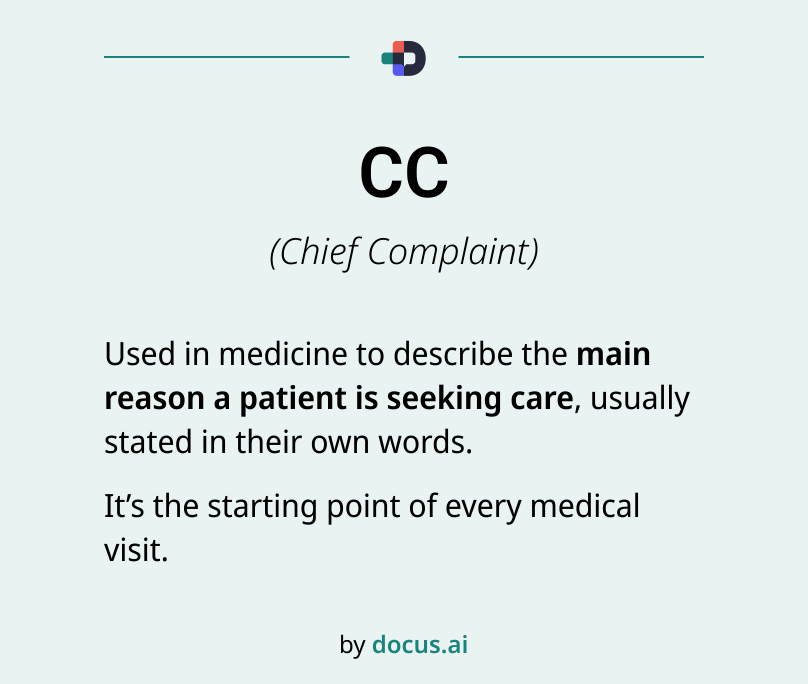
In clinical terminology, the CC is the “Chief Complaint.” This is the concise statement describing the symptom, problem, condition, or other factor that is the reason for a patient encounter. In the legacy era of paper charts, the CC was a handwritten note. Today, in the era of Digital Transformation, the CC is a high-value data entry point that triggers a cascade of automated workflows.
Structured vs. Unstructured Data in EHRs
The first technical challenge in capturing the CC is the format. Many legacy EHR systems (Electronic Health Records) treat the Chief Complaint as a free-text field—unstructured data. While this allows for clinical nuance, it is notoriously difficult for machines to parse. Modern HealthTech solutions are moving toward “Structured CC” entry. This involves using drop-down menus or predictive text mapped to standardized terminologies like SNOMED CT (Systematized Nomenclature of Medicine – Clinical Terms) or ICD-10.
By converting a patient’s spoken words (e.g., “my chest feels tight”) into a structured code, the software can instantly cross-reference the CC with the patient’s medical history, current medications, and known allergies. This structured approach is the bedrock of interoperability, allowing different software systems to communicate a patient’s primary issue without ambiguity.
The Role of CC in Triage Algorithms
In emergency department software and telemedicine apps, the CC is the primary input for automated triage algorithms. When a patient enters their CC into a digital portal, the software utilizes logic trees to determine the level of urgency. For instance, a CC of “shortness of breath” will trigger a higher priority flag in a system’s queue than “minor skin rash.” The technical sophistication of these algorithms depends on the system’s ability to recognize synonyms and severity indicators within the CC entry.
Natural Language Processing: Deciphering the Patient’s Voice
One of the most exciting frontiers in medical technology is the application of Natural Language Processing (NLP) to the Chief Complaint. Because patients rarely speak in standardized medical codes, software must act as a bridge between human language and machine-readable data.
Machine Learning and Sentiment Analysis
Advanced AI tools are now being integrated into patient intake modules to analyze the “CC” for more than just keywords. Using Sentiment Analysis and context-aware NLP, these tools can gauge the severity of a complaint based on the patient’s choice of words. If a patient describes their CC as “unbearable” or “the worst I’ve ever felt,” the system can escalate the digital chart to a human provider immediately.
This level of tech-driven analysis reduces the burden on administrative staff and ensures that the most critical data points are highlighted. Technologies such as BioBERT—a pre-trained language model specifically for biomedical text—are being utilized to help EHR systems understand the nuances of the CC in ways that traditional keyword matching never could.
Voice-to-Text and Ambient Clinical Intelligence
The way the CC is recorded is also undergoing a technological revolution. Ambient Clinical Intelligence (ACI) uses microphones and AI to listen to the conversation between a doctor and a patient. The AI identifies the Chief Complaint from the natural conversation and automatically populates the CC field in the EHR. This reduces “documentation fatigue” for physicians and allows for a more natural patient-provider interaction, all while maintaining a highly accurate digital record.
CC as Cubic Centimeter: Precision in the Internet of Medical Things (IoMT)
While “Chief Complaint” dominates the diagnostic conversation, the second meaning of CC—Cubic Centimeter—is equally vital in the context of medical hardware, IoT, and automated pharmaceutical delivery. In technical and engineering terms, 1 CC is equivalent to 1 milliliter (mL), and this measurement is the standard for dosage in digital infusion pumps and smart syringes.

Integration with Smart Infusion Pumps
In a modern hospital’s “Smart Stack,” infusion pumps are connected to the facility’s wireless network (IoMT). When a physician orders a specific volume of medication, the data is sent from the EHR directly to the pump. The software must be calibrated to recognize “CC” and “mL” interchangeably to ensure precision. A technical error in how these units are processed could lead to significant dosage inaccuracies.
The technology behind these pumps includes “Guardrails” or Dose Error Reduction Systems (DERS). This software contains a drug library that sets hard and soft limits on how many CCs of a particular medication can be administered over a specific timeframe. This is a prime example of how a simple medical term like “CC” is protected by layers of software logic to ensure patient safety.
Robotics and Automated Pharmacy Dispensing
In automated pharmacies, robots use high-precision sensors to measure liquids in CCs. The software controlling these systems must manage high-throughput data while maintaining microscopic accuracy. Integration between the pharmacy information system (PIS) and the hardware ensures that the CC count requested by the practitioner is exactly what is dispensed by the robotic arm.
Data Interoperability and the FHIR Standard
The goal of modern healthcare IT is to create a seamless flow of data across different platforms—from a wearable device to a primary care physician’s tablet, and finally to a hospital’s central server. To make the CC (Chief Complaint) useful across this journey, the industry relies on standards like HL7 and FHIR (Fast Healthcare Interoperability Resources).
Mapping the CC in FHIR
In the FHIR framework, the Chief Complaint is often categorized under the “Encounter” resource. For developers, this means that “CC” isn’t just a label; it’s a specific data element that must be mapped correctly so that if a patient moves from a specialist to a surgeon, the new system understands exactly why the patient sought care in the first place.
The technical challenge lies in “semantic interoperability”—ensuring that two different systems not only receive the data but also understand it. If a telehealth app records a CC as “cephalalgia” and the hospital’s EHR looks for “headache,” the tech stack must have a mapping layer that recognizes these as the same entity. This is where standardized vocabularies (like LOINC and SNOMED) are integrated into the API layers of medical software.
The Future: Predictive Analytics and the “Pre-CC”
As we look toward the future of Tech in medicine, the concept of the Chief Complaint is being augmented by predictive analytics. We are entering an era of the “Pre-CC,” where wearable technology identifies physiological anomalies before the patient even realizes they have a complaint.
Wearable Integration and Proactive Triage
If an Apple Watch or a continuous glucose monitor (CGM) detects a sustained spike in heart rate or blood sugar, the software can trigger an alert. In this scenario, the “CC” is generated by a sensor rather than a human statement. This data-driven CC allows for proactive intervention. The software ecosystem must be robust enough to handle this influx of “continuous data,” filtering out noise to identify actionable medical terms that require clinical attention.
The Digital Twin Concept
In high-end computational medicine, the “Digital Twin” is a virtual model of a patient’s biology. When a CC is entered into the system, the AI can run simulations on the Digital Twin to predict potential outcomes or suggest the most effective treatment pathways. This transforms the CC from a retrospective note into a prospective tool for personalized medicine.
Conclusion: The Two-Letter Powerhouse of HealthTech
While “CC” may seem like a simple shorthand in a medical dictionary, its role in the technology sector is vast and complex. As a “Chief Complaint,” it is the primary data trigger for AI, NLP, and triage algorithms that streamline clinical workflows. As a “Cubic Centimeter,” it is the unit of precision for the IoMT and automated delivery systems that keep patients safe.
For those building the future of healthcare technology, the CC is a reminder that even the most basic medical terms require a sophisticated digital architecture to be truly effective. By focusing on structured data, interoperability standards, and the power of machine learning, we can ensure that every “CC” recorded is a step toward a more efficient, accurate, and human-centric healthcare system. The evolution of the CC from a handwritten note to a data-rich digital entity is a microcosm of the larger digital revolution currently reshaping the world of medicine.
aViewFromTheCave is a participant in the Amazon Services LLC Associates Program, an affiliate advertising program designed to provide a means for sites to earn advertising fees by advertising and linking to Amazon.com. Amazon, the Amazon logo, AmazonSupply, and the AmazonSupply logo are trademarks of Amazon.com, Inc. or its affiliates. As an Amazon Associate we earn affiliate commissions from qualifying purchases.