
Determining which conflict in human history holds the grim title of the deadliest is not merely a task for historians; it has become a complex challenge for data scientists, computational analysts, and digital forensic experts. While historical accounts provide the narrative, modern technology provides the tools to reconcile conflicting records, analyze demographic shifts, and model the true scale of human loss. Through the lens of data science and military technology, we can look beyond the surface of historical texts to understand the factors that led to the staggering mortality rates of World War II, the Mongol conquests, and the Taiping Rebellion.

The Data Science of Mortality: Quantifying History’s Deadliest Conflicts
The primary hurdle in answering “what war killed the most people” lies in the reliability of historical data. For centuries, casualty counts were based on rough estimates, propaganda-heavy official reports, or the incomplete records of the victors. Today, the tech industry provides sophisticated software and methodologies to clean and interpret this data, transforming fragmented history into quantifiable insights.
Algorithmic Modeling and Bayesian Statistics
Modern researchers utilize Bayesian statistical modeling to fill in the gaps of missing historical records. By feeding known variables—such as pre-war population density, agricultural yields, and documented troop movements—into machine learning algorithms, data scientists can generate a more accurate “expected” mortality range for conflicts like the Mongol conquests. These algorithms account for “excess mortality,” which includes not just direct combat deaths but the technological and logistical breakdowns that lead to famine and disease.
For instance, when analyzing the Taiping Rebellion, where estimates range wildly from 20 million to 100 million deaths, modern computational tools help identify outliers in regional census data. By applying anomaly detection software, researchers can isolate the specific impact of conflict-induced displacement from natural demographic fluctuations, providing a clearer digital picture of the catastrophe.
Challenges in Digital Reconstruction
The challenge for software developers in the historical niche is the “siloed” nature of global archives. Many records from the deadliest wars in Asian or African history have yet to be digitized. However, the rise of Optical Character Recognition (OCR) and Natural Language Processing (NLP) is changing this. AI-driven tools are now capable of scanning millions of pages of handwritten logs and ancient manuscripts, identifying patterns of loss that were previously invisible to the human eye. This technological bridge allows us to compare the industrial-scale slaughter of the 20th century with the pre-industrial devastation of earlier eras on a standardized data scale.
Technological Advancement as a Driver of Casualty Scales
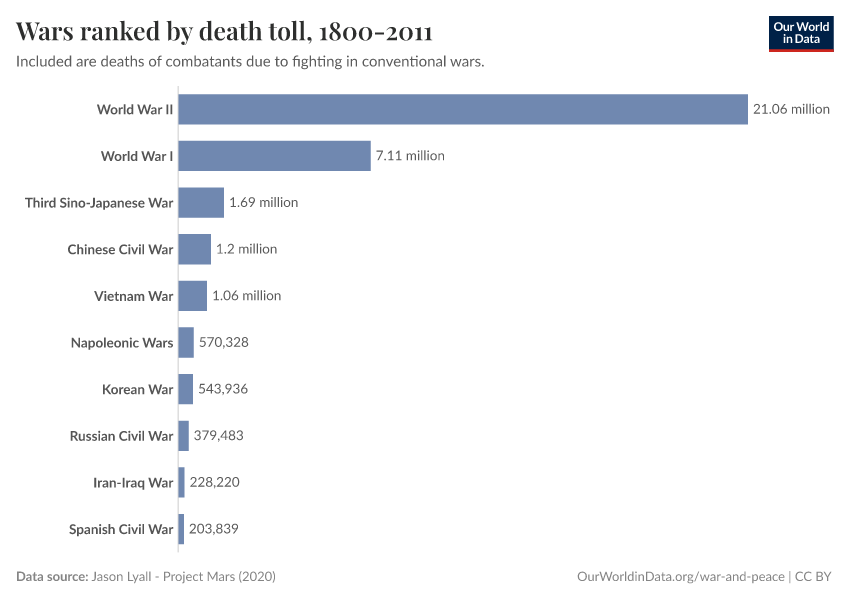
When we ask which war killed the most people, the answer is inextricably linked to the technological evolution of the tools of war. World War II is widely recognized as the deadliest conflict in human history, with estimates ranging from 70 million to 85 million deaths. This scale was only possible because of a radical shift in military technology: the industrialization of lethality.
The Industrialization of Conflict
The mid-20th century saw the integration of assembly-line manufacturing with high-performance engineering. This “tech stack” of warfare included long-range heavy bombers, mechanized infantry, and sophisticated chemical munitions. Technology effectively removed the “human bottleneck” of combat. In previous centuries, the rate of killing was limited by the physical endurance of soldiers and the reload speed of primitive firearms. By the 1940s, the emergence of strategic bombing technology allowed for the destruction of entire urban centers in a matter of hours, a feat of “efficiency” that fundamentally altered the mortality curve of global conflict.
From Kinetic Energy to Nuclear Physics

The technological peak of World War II—the development of the atomic bomb—represented a paradigm shift in how we measure war’s impact. The Manhattan Project was as much a triumph of computational mathematics and physics as it was a military endeavor. The shift from kinetic weaponry (bullets and blades) to thermal and radiation-based technology meant that casualties could be measured in hundreds of thousands from a single deployment. This leap in destructive capability is a primary reason why modern data indicates that 20th-century conflicts far exceed ancient wars in terms of absolute numbers, even when accounting for smaller historical global populations.
Digital Forensics: Uncovering Lost Records through AI and Satellite Imagery
In recent years, the hunt for the truth behind historical death tolls has moved from the library to the cloud. Digital forensic technologies are now the frontline tools for uncovering the scale of past wars, particularly those where records were intentionally destroyed or never kept.
Remote Sensing and Mass Graves
Satellite imagery and LiDAR (Light Detection and Ranging) have become essential gadgets for modern historians and archeologists. These technologies allow researchers to “see through” dense forest canopies or detect subtle soil disturbances from orbit. In the context of “what war killed the most people,” this tech is used to locate mass graves and abandoned settlements associated with the Thirty Years’ War or the various Mongol incursions. By mapping these sites digitally, researchers can estimate population loss with a degree of geographic precision that was impossible just two decades ago.
Natural Language Processing in Archival Research
One of the most exciting applications of AI in historical analysis is the use of NLP to synthesize millions of disparate data points. If we want to know the true toll of the An Lushan Rebellion in 8th-century China—a conflict often cited as one of the deadliest—we face a massive language and data barrier. AI tools can now parse through digitized dynastic records, cross-referencing tax rolls with military recruitment lists across different dialects and scripts. This software can identify “statistical echoes”—recurring patterns of population decline—that help validate or refute historical claims of tens of millions of deaths.
The Tech Stack of Modern Warfare: Lessons from the Past
To understand why certain wars resulted in such high mortality, we must look at the communications and logistical technology of the era. The deadliest wars are rarely just about the weapons; they are about the systems that manage them.
In World War II, the development of radar, early programmable computers like the Colossus and ENIAC, and sophisticated encryption (Enigma) were the “software” that directed the “hardware” of destruction. These tools allowed for more coordinated, large-scale operations across multiple continents simultaneously. The ability to synchronize movements of millions of men via radio and telegraph meant that conflict was no longer localized. It became a global system of attrition.
When we analyze these historical data points through modern business intelligence tools, we see that the deadliest wars are those that successfully integrated “Total War” logistics—the mobilization of a nation’s entire technological and industrial base. The high death toll of World War II was a direct result of this “tech integration,” where every advancement in civilian manufacturing was repurposed for military output.
The Future of Conflict Analysis: AI and Predictive Modeling
Identifying the deadliest war of the past is a prerequisite for preventing the deadliest war of the future. Today’s defense tech is not just focused on weaponry, but on predictive modeling and digital security. Global think tanks use supercomputers to run simulations of potential conflicts, analyzing how modern cyber-warfare, AI-driven drones, and hypersonic missiles might impact civilian populations.
These simulations draw directly on the data we have gathered from the 20th century. By studying the “mortality blueprints” of World War II and the Great War through data visualization tools, analysts can identify the “tipping points” where a conflict transitions from a military skirmish to a demographic catastrophe. The goal of modern military tech—counterintuitively—is often to increase precision to the point where “excess mortality” is minimized, avoiding the horrific “total war” statistics of the past.
In conclusion, while history gives us the names of the wars, technology gives us the numbers. Whether it is through the use of AI to scan ancient texts, satellite imagery to find lost battlefields, or complex algorithms to model population decline, our understanding of “what war killed the most people” is constantly being refined by the digital revolution. We now know that World War II remains the deadliest, not just because of the bravery or brutality of those involved, but because it was the first conflict to leverage the full, terrifying power of industrial and computational technology. As we continue to develop even more advanced tools, the data from our past remains our most valuable asset in ensuring that the title of “deadliest war” stays firmly in the history books rather than in our future.
aViewFromTheCave is a participant in the Amazon Services LLC Associates Program, an affiliate advertising program designed to provide a means for sites to earn advertising fees by advertising and linking to Amazon.com. Amazon, the Amazon logo, AmazonSupply, and the AmazonSupply logo are trademarks of Amazon.com, Inc. or its affiliates. As an Amazon Associate we earn affiliate commissions from qualifying purchases.