
The federal minimum wage represents the lowest hourly compensation that employers are legally required to pay their employees in the United States. Established as a cornerstone of labor rights and economic policy, this figure serves as a floor for the American labor market. Currently, the federal minimum wage stands at $7.25 per hour, a rate that has remained unchanged since July 2009. While this figure provides a baseline, the financial landscape surrounding minimum compensation is complex, involving a tug-of-war between federal mandates, state-level legislation, and the evolving purchasing power of the US dollar.

For individuals navigating personal finance, or business owners managing corporate overhead, understanding the mechanics of the federal minimum wage is essential. It is not merely a number on a paycheck; it is a critical economic indicator that influences consumer spending, business scalability, and the overall standard of living for millions of workers across the country.
The Evolution and History of the Federal Minimum Wage
The federal minimum wage was not always a feature of the American economy. It was born out of the Great Depression as part of the Fair Labor Standards Act (FLSA) of 1938. Signed into law by President Franklin D. Roosevelt, the FLSA was designed to protect workers, stabilize the post-depression economy, and ensure that labor was compensated fairly enough to sustain a basic standard of living.
The Inception of the FLSA
In 1938, the first federal minimum wage was set at $0.25 per hour. At the time, its primary goal was to eliminate “labor conditions detrimental to the maintenance of the minimum standard of living necessary for health, efficiency, and general well-being of workers.” Over the decades, Congress has periodically amended the FLSA to increase this rate, reflecting changes in the cost of living and the broader economic climate.
Historical Adjustments and Stagnation
Between 1938 and 2009, the federal minimum wage was raised 22 times. The most significant period of growth occurred between the 1950s and the late 1970s, a time when the minimum wage’s purchasing power was at its peak. Adjusted for inflation, the 1968 minimum wage of $1.60 per hour would be worth over $12.00 today. However, the most recent increase occurred over a decade ago. Since 2009, the $7.25 rate has seen its real value eroded by inflation, leading to a significant gap between the legal minimum and the “living wage” required to meet basic needs in many parts of the country.
The Impact of Minimum Wage on Business Finance and Strategy
From the perspective of business finance, the federal minimum wage is a primary driver of labor costs. For industries that rely heavily on entry-level or hourly labor—such as retail, hospitality, and fast food—fluctuations in the minimum wage directly impact the bottom line, profit margins, and pricing strategies.
Managing Labor Costs and Overhead
When the federal minimum wage remains static, businesses can more easily predict their long-term labor expenses. However, a stagnant wage can also lead to higher turnover rates and lower employee morale, which carry their own hidden costs in recruitment and training. Many forward-thinking companies have adopted “efficiency wage” strategies, voluntarily paying above the federal minimum to attract higher-quality talent and reduce the administrative burden of constant hiring cycles.
The Debate on Wage Hikes and Employment
Economists often debate the impact of raising the minimum wage on business solvency. Proponents of higher wages argue that increased pay puts more disposable income into the hands of consumers, which in turn drives demand for products and services. Critics, however, suggest that significant hikes can lead to “disemployment effects,” where businesses reduce their headcount or turn to automation to offset the increased cost of human labor. For small businesses operating on thin margins, a mandatory wage increase requires a delicate balance of raising prices for consumers versus absorbing the costs internally.
The Tipped Minimum Wage
A critical sub-section of business finance is the “tipped minimum wage.” Under federal law, employers of “tipped employees” (those who customarily receive more than $30 a month in tips) are allowed to pay a cash wage of just $2.13 per hour, provided that this amount plus the tips received equals at least the federal minimum wage of $7.25. If the tips do not bridge that gap, the employer is legally required to make up the difference. This structure is a central component of the financial models used in the American restaurant industry.
Federal vs. State Minimum Wage: A Fragmented Landscape
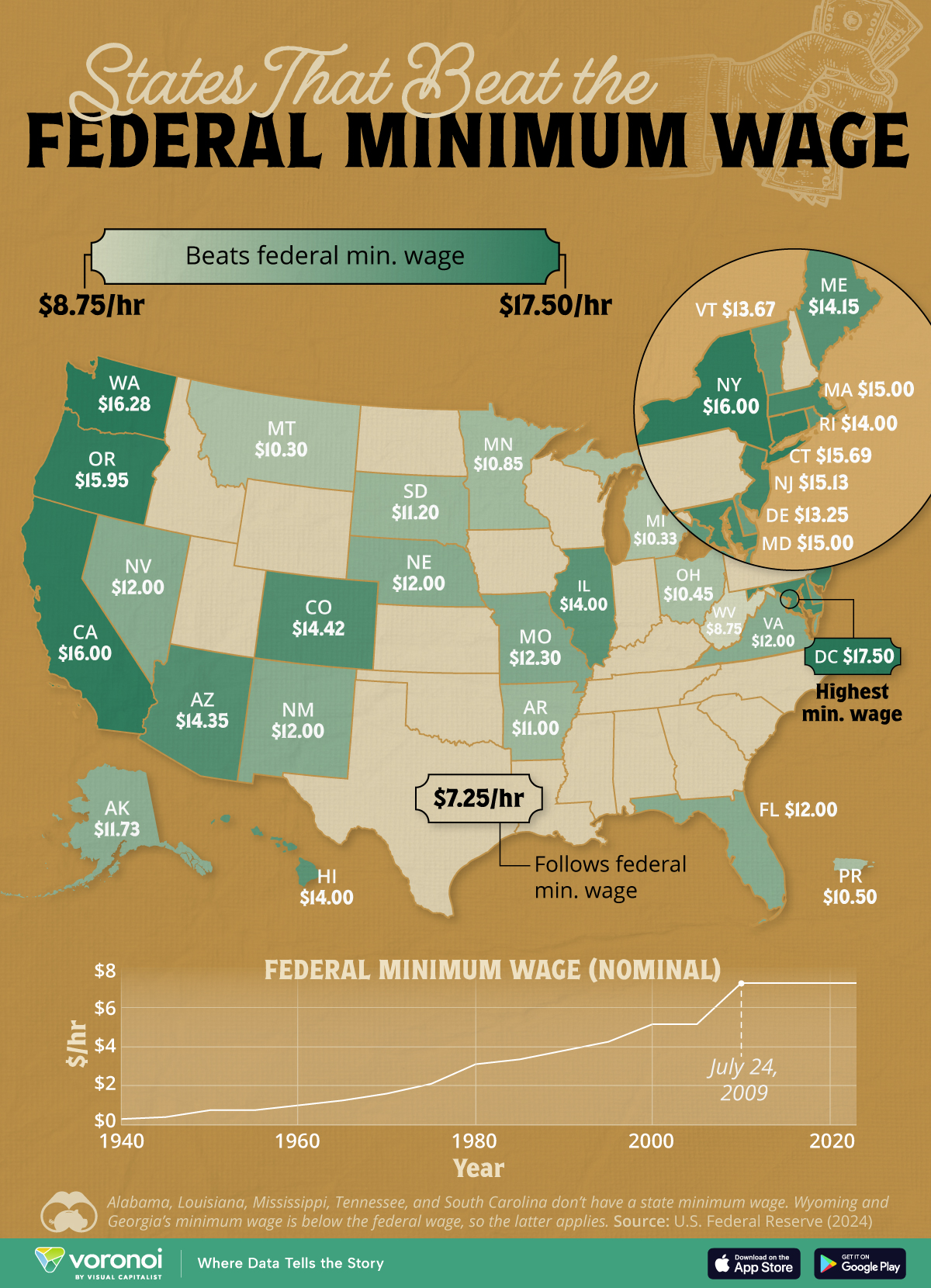
One of the most confusing aspects of US labor law for both employees and employers is the interplay between federal and state mandates. While the federal government sets a “floor,” the Constitution allows individual states to set their own, higher minimum wage rates.
The Rule of Preeminence
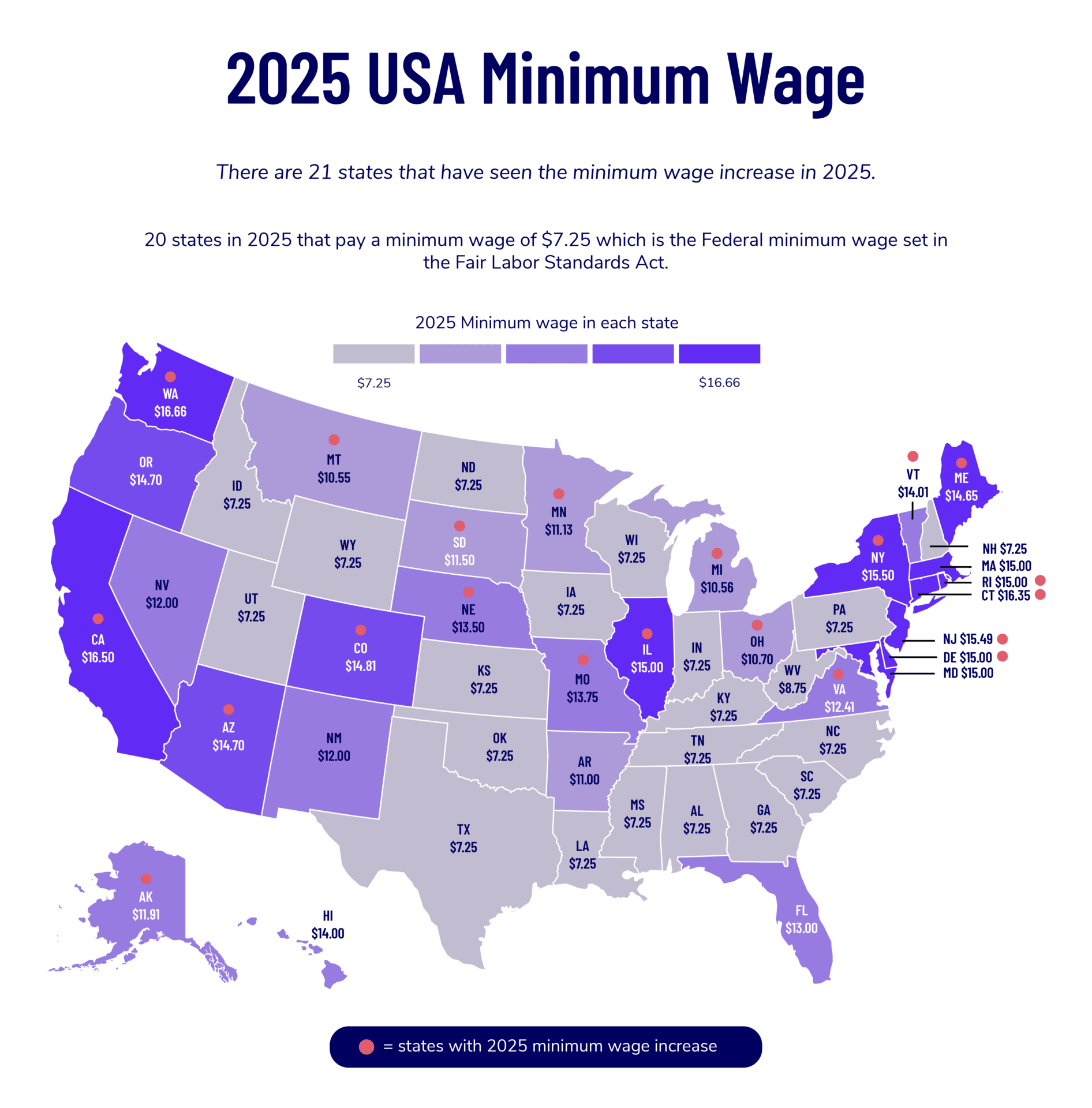
In legal and financial terms, if a state or a specific city has a minimum wage higher than the federal rate, the employer is required by law to pay the higher of the two. As of 2024, thirty states and the District of Columbia have established minimum wages that exceed the federal $7.25. Several states, such as California, New York, and Washington, have moved toward or surpassed a $15.00 hourly baseline, often indexing these rates to inflation to ensure they keep pace with rising costs.
States Without Minimum Wage Laws
There are five states—Alabama, Louisiana, Mississippi, South Carolina, and Tennessee—that have not established a state-level minimum wage. In these jurisdictions, the federal $7.25 rate serves as the default. Additionally, some states have “preemption” laws that prevent local municipalities (cities or counties) from setting their own higher minimum wages, creating a uniform standard across the state regardless of varying costs of living between rural and urban areas.
The Economic Consequences of Divergence
This fragmentation creates a complex environment for multi-state corporations. A retail brand operating in both Georgia (federal minimum) and Washington State (significantly higher) must manage two entirely different payroll structures and financial strategies. This often leads to geographical differences in product pricing and service levels, as businesses attempt to maintain consistent profit margins across different regulatory environments.
Minimum Wage and Personal Finance Strategy
For the individual, the federal minimum wage is the starting point for personal budgeting and financial planning. However, in the modern economy, the gap between the federal minimum and the cost of basic necessities—housing, healthcare, and education—has widened.
The “Living Wage” Concept
Financial analysts often distinguish between the “minimum wage” (the legal limit) and the “living wage” (the income required to cover basic expenses without government assistance). According to various financial tools and cost-of-living calculators, there is no state in the US where a full-time worker earning $7.25 per hour can afford a modest two-bedroom apartment at fair market rent. This reality necessitates a different approach to personal finance for those at the entry level of the labor market.
Budgeting and Upskilling
For those currently earning the federal minimum, financial strategy often focuses on two pillars: strict budget management and aggressive upskilling. Managing a household on $7.25 an hour requires a deep understanding of government tax credits (such as the Earned Income Tax Credit) and community resources. Simultaneously, the “online income” and “side hustle” culture has become a financial lifeline for many. Leveraging digital platforms to develop specialized skills—such as coding, digital marketing, or technical trades—is often the most effective way to move beyond the federal minimum wage floor.
The Role of Debt and Credit
Low-wage earners face unique challenges regarding credit and debt. With limited disposable income, any financial emergency can lead to high-interest debt cycles. Understanding the “poverty trap” is an essential part of financial literacy; when income is low, the cost of credit is often higher, making it even more difficult to build wealth. This underscores the importance of policy discussions surrounding the minimum wage, as the baseline rate directly affects a person’s ability to save, invest, and participate in the broader economy.
The Future of the Federal Minimum Wage
As we look toward the future of American finance, the federal minimum wage remains one of the most hotly contested topics in Washington. Various legislative proposals, such as the “Raise the Wage Act,” have sought to increase the federal rate to $15.00 or higher over a multi-year period and eliminate the sub-minimum wage for tipped workers.
Indexing to Inflation
One of the most discussed financial tools for future policy is “indexing.” Rather than waiting years for a Congressional act to raise the wage, some suggest tying the federal minimum wage to the Consumer Price Index (CPI) or median wage growth. This would ensure that the minimum wage’s purchasing power remains constant, providing more stability for both workers’ personal finances and businesses’ long-term financial planning.
Automation and the Digital Economy
The rise of AI and automation also looms over the minimum wage debate. As technology becomes cheaper, the financial incentive for businesses to replace low-wage human labor with automated systems increases—especially if the federal minimum wage is significantly raised. This creates a complex intersection between tech and finance, where the legal price of labor may accelerate the adoption of digital alternatives in the service and manufacturing sectors.
In conclusion, the US federal minimum wage is more than just a figure on a payroll ledger. It is a fundamental element of the American financial system that dictates the flow of capital between employers and the workforce. Whether you are an entrepreneur calculating your next hire’s ROI or an individual building a personal financial plan, the $7.25 federal floor remains a pivotal, if controversial, anchor in the landscape of modern finance. Understanding its history, its regional variations, and its economic implications is the first step in navigating the complexities of the US economy.
aViewFromTheCave is a participant in the Amazon Services LLC Associates Program, an affiliate advertising program designed to provide a means for sites to earn advertising fees by advertising and linking to Amazon.com. Amazon, the Amazon logo, AmazonSupply, and the AmazonSupply logo are trademarks of Amazon.com, Inc. or its affiliates. As an Amazon Associate we earn affiliate commissions from qualifying purchases.