
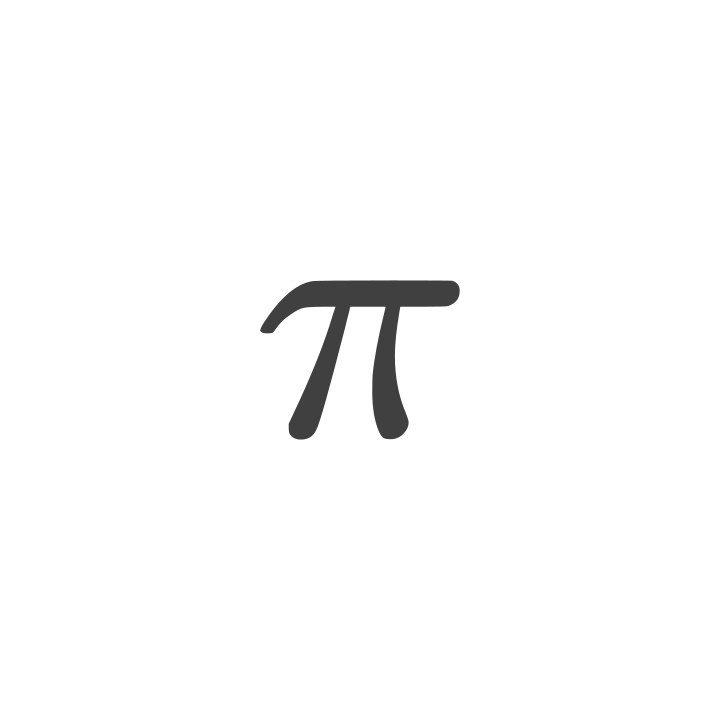
The symbol π, representing the mathematical constant pi, is perhaps the most recognized mathematical notation in the world. While most are introduced to it in secondary school as the ratio of a circle’s circumference to its diameter, its utility extends far beyond basic geometry. In the realm of technology, pi is not merely a number but a foundational pillar that supports digital signal processing, cryptographic security, high-performance computing, and the complex algorithms that drive artificial intelligence.
Understanding the symbol pi within a tech-centric framework requires moving past the approximation of 3.14. It is an irrational number, meaning its decimal expansion never repeats and never ends. This infinite complexity is precisely why it remains so vital to the evolution of hardware and software. From the oscillations of a sound wave to the rendering of complex 3D environments in modern gaming, pi is the invisible architecture of the digital age.

The Mathematical Foundation of Digital Architecture
At the core of all digital communication is the concept of a wave. Whether it is a Wi-Fi signal, a cellular data packet, or the audio flowing through a pair of Bluetooth headphones, these signals are represented mathematically as sine and cosine waves. These functions are intrinsically linked to the circle and, by extension, the constant pi.
Signal Processing and the Fourier Transform
One of the most important algorithms in the history of technology is the Fast Fourier Transform (FFT). The FFT allows computers to take a signal—such as a voice recording—and break it down into its constituent frequencies. This process is essential for everything from MP3 compression to the way your smartphone filters out background noise during a call.
The mathematical formulas governing these transformations rely heavily on pi. Because pi defines the period of trigonometric functions, it is the constant that allows software to synchronize frequencies and reconstruct digital data into human-usable information. Without the precise application of pi, digital audio would be a garbled mess of noise, and high-speed data transmission across fiber-optic cables would be impossible.
Graphics Rendering and 3D Modeling
In the world of software development and digital design, pi is the gatekeeper of realism. When a developer creates a 3D environment in an engine like Unreal Engine or Unity, they are essentially managing a massive collection of geometric data.
Every time a character rotates, a camera pans, or a light source casts a realistic shadow, the software is performing calculations involving pi. Spherical interpolation, used to create smooth rotations in animations, and the calculations for “pi-based” ray tracing are what allow modern graphics to look photorealistic. By defining the geometry of curves and spheres, pi allows engineers to simulate the way light bounces off surfaces, creating the immersive digital worlds we see in modern cinema and gaming.
High-Performance Computing: The Race for Pi’s Digits
For decades, the calculation of pi has served as the ultimate “stress test” for computer hardware. In the tech industry, calculating pi to trillions of digits is not just a mathematical pursuit; it is a way to demonstrate the power, stability, and efficiency of new CPU architectures and cloud computing infrastructures.
Stress-Testing Hardware and Stability
When a new processor is released, engineers often run programs like “Super PI” or “y-cruncher.” These programs force the CPU to calculate pi to millions or billions of decimal places. This process is incredibly resource-intensive, pushing the processor to its thermal limits and testing its ability to handle complex floating-point operations without errors.
If a system can calculate pi to a billion places without crashing, it is considered stable. This makes pi a benchmark for the reliability of high-end workstations and servers that power our global digital economy. It is the yardstick by which we measure the raw computational progress of Silicon Valley.
Cloud Computing and Distributed Systems
In recent years, the quest for the most digits of pi has moved to the cloud. In 2022, Google Cloud researchers calculated pi to 100 trillion digits, a feat that showcased the massive scale and reliability of their Compute Engine infrastructure.
This record-breaking endeavor was not just for show; it served as a case study for how distributed systems can handle massive datasets. The calculation required 82 petabytes of data moving through the cloud ecosystem. By using pi as the target, tech companies can refine their data-handling techniques, improve storage throughput, and optimize the networking protocols that eventually benefit all cloud-based services, from streaming platforms to enterprise databases.

Pi in Cryptography and Digital Security
Digital security is built on the foundation of randomness and the difficulty of solving specific mathematical problems. Pi plays a unique role here due to its status as an irrational and “normal” number—meaning that its digits appear to be randomly distributed.
Pseudorandom Number Generators (PRNGs)
In programming, generating a truly random number is surprisingly difficult. Most software uses Pseudorandom Number Generators (PRNGs). Some of the most secure algorithms use the digits of pi as a “nothing-up-my-sleeve” number. Because the digits of pi are fixed and universally known, but also appear random, they can be used to initialize cryptographic systems.
Using pi ensures that the starting point (the “seed”) of a random sequence was not chosen maliciously or with a hidden “backdoor.” This builds trust in the security of the encryption. When you see the symbol pi in a technical whitepaper for a new blockchain or encryption protocol, it often signifies that the developers are using its digits to ensure transparency and security in their algorithmic foundations.
The Challenge of Large Primes and Complex Curves
Modern encryption, such as RSA or Elliptic Curve Cryptography (ECC), relies on the geometry of curves and the properties of large prime numbers. Pi is deeply intertwined with these concepts. For example, the distribution of prime numbers is related to the Riemann zeta function, which frequently outputs values involving pi.
As we move toward the era of post-quantum cryptography, researchers are looking at new ways to protect data. Many of these theoretical frameworks involve multi-dimensional lattices and complex circular geometries where pi remains a constant factor. As technology evolves to counter the threats posed by quantum computers, the mathematical properties of pi will continue to be a primary line of defense.
Future Tech: Quantum Computing and Robotics
As we look toward the horizon of technology, the symbol pi remains just as relevant in the “New Tech” sectors of quantum computing and autonomous robotics as it was in the early days of the silicon chip.
Quantum Gates and Phase Rotations
Quantum computers do not operate on standard bits (0s and 1s) but on qubits. These qubits exist in a state of superposition, which is often represented using a “Bloch Sphere.” To manipulate the state of a qubit, quantum engineers apply “gates” that rotate the state of the qubit around this sphere.
These rotations are measured in radians, a unit of angular measure based on pi. A “half-turn” of a qubit is represented as π, and a “quarter-turn” as π/2. Without the precision provided by pi, we would be unable to program quantum computers or execute the complex algorithms required for quantum supremacy. In the quantum realm, pi is the literal language of logic.
Robotics and Autonomous Navigation
For a robot or an autonomous vehicle to navigate the physical world, it must constantly translate digital code into physical movement. This is done through actuators and sensors. Whether it’s a robotic arm in a Tesla factory or a drone delivering a package, the calculation of circular motion is constant.
The “Odometry” of a robot—the method it uses to estimate its change in position over time—relies on the circumference of its wheels. Every rotation of a motor is a calculation of 2π times the radius. Furthermore, LiDAR and Radar systems use pi-based circular sweeps to map their surroundings in 360 degrees. As AI and robotics become more integrated into our daily lives, the symbol pi will be working behind the scenes of every automated movement we witness.
The Transcendental Constant of the Digital Age
The symbol pi represents more than a number; it represents the bridge between the continuous, curved world of physical reality and the discrete, linear world of digital code. Technology is our attempt to model and manipulate the universe, and because the universe is filled with circular and wave-like patterns, pi is an essential tool in the engineer’s kit.
From the first lines of code in a signal-processing app to the trillion-digit calculations in a global cloud network, pi provides the precision required for innovation. It is a symbol of the infinite potential of computation. As we continue to push the boundaries of what is possible with AI, quantum physics, and space exploration, the constant π will remain the silent partner in every technological breakthrough, proving that some mathematical truths are as eternal as the technology they help create.
aViewFromTheCave is a participant in the Amazon Services LLC Associates Program, an affiliate advertising program designed to provide a means for sites to earn advertising fees by advertising and linking to Amazon.com. Amazon, the Amazon logo, AmazonSupply, and the AmazonSupply logo are trademarks of Amazon.com, Inc. or its affiliates. As an Amazon Associate we earn affiliate commissions from qualifying purchases.