
In the rapidly evolving landscape of digital media, the New York Times has successfully transitioned from a traditional newspaper into a diversified technology company. Central to this transformation is its gaming division, which has produced several viral sensations. The latest addition to this digital suite is Strands, a word puzzle that has captured the attention of millions. But beyond the surface-level gameplay, Strands represents a significant milestone in app design, software engineering, and the strategic use of gamification to drive digital subscriptions. To understand what Strands is, one must look past the grid of letters and explore the sophisticated technology and design philosophy that powers it.

The Anatomy of a Digital Word Game: How Strands Functions
At its core, Strands is a daily word puzzle that challenges players to find themed words within a grid of letters. While it may appear similar to a traditional word search, the underlying software logic is far more complex. Unlike a standard word search where words are laid out in straight lines—horizontally, vertically, or diagonally—Strands utilizes a “neighboring cell” logic. This means that words can twist and turn in any direction, provided the letters are adjacent to one another.
The Spangram: The Architectural Anchor
One of the unique technical features of Strands is the “Spangram.” This is a word or phrase that describes the day’s theme and must touch two opposite sides of the grid—either top to bottom or left to right. From a software perspective, the Spangram acts as the anchor for the entire grid’s generation. When the puzzle is designed, the Spangram is usually the first element placed, dictating how the remaining themed words can be woven around it. This requires a sophisticated pathfinding algorithm to ensure that the remaining letters can be utilized to form the other required words without leaving “dead” or unusable letters behind.
Word Validation and Pathfinding Algorithms
The technology behind validating a player’s move in Strands involves real-time pathfinding. As a user drags their finger or mouse across the letters, the application must constantly check for two things: first, is the path continuous (i.e., are the letters adjacent?), and second, does the resulting string of letters exist in the game’s specific dictionary?
Interestingly, Strands employs a dual-layered validation system. The first layer checks the word against the specific “theme words” for that day. If it matches, the letters are permanently highlighted. The second layer checks the word against a broader English dictionary. If a player finds a valid English word that is not part of the day’s theme, the software tracks this as progress toward a “hint.” This secondary validation requires the app to have an efficient, lightweight dictionary stored either locally or accessible via a fast API to ensure there is no latency in the user experience.
UI/UX Engineering: Designing for Engagement and Accessibility
The success of a digital game often hinges less on the complexity of its code and more on the intuitiveness of its user interface (UI) and the quality of the user experience (UX). Strands is a masterclass in minimalist software design, optimized for the “mobile-first” era.
Mobile-First Optimization and Haptic Feedback
The primary interaction in Strands is the “drag-to-connect” motion. This is a tactile experience that has been fine-tuned for touchscreens. The software must distinguish between an intentional drag and an accidental tap, requiring precise gesture recognition. To enhance the experience, developers often integrate haptic feedback—subtle vibrations that occur when a word is successfully completed or when a player reaches the end of a valid path. This physical response creates a satisfying “reward” loop, a psychological principle often used in software to increase user retention.
Minimalist Aesthetics and Cognitive Load
From a design perspective, Strands adheres to the “less is more” philosophy. The color palette is muted, focusing on soft blues, yellows, and grays, which reduces eye strain during prolonged play. The interface is remarkably clean, with no intrusive menus or advertisements cluttering the screen. This design choice minimizes “cognitive load,” allowing the user to focus entirely on the linguistic challenge. By removing distractions, the software facilitates a “flow state,” where the user becomes fully immersed in the task at hand.
Accessibility and Inclusive Design
Accessibility is a critical component of modern software development. The NYT Games team has ensured that Strands is playable for a wide range of users. This includes high-contrast modes for users with visual impairments and ensuring that the color-coding of the “Spangram” versus regular theme words is distinguishable for those with color blindness. Furthermore, the responsive design of the web app ensures that whether a user is on a 6-inch smartphone or a 27-inch desktop monitor, the grid remains perfectly scaled and interactive.
The Data Science Behind the Game: Complexity, Themes, and Player Retention
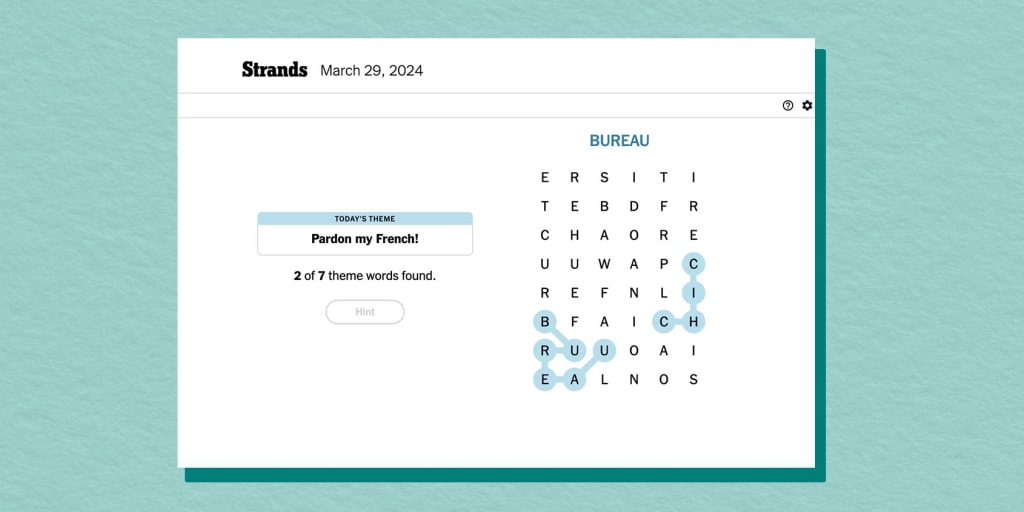
While the front end of Strands is simple, the back end is powered by data. The New York Times uses sophisticated analytics to monitor how players interact with their puzzles, which informs future game development and difficulty scaling.
Complexity Scoring and Difficulty Scaling
Not every Strands puzzle is created equal. The difficulty of a puzzle is determined by several technical factors: the length of the theme words, the obscurity of the theme itself, and the “branching factor” of the letter grid. The branching factor refers to how many possible paths a player might take from a single letter. If a letter “S” is surrounded by multiple vowels, the number of potential words increases, making it harder to find the correct one. Data scientists analyze “time-to-completion” metrics from beta testers to assign a difficulty rating to each day’s puzzle, ensuring a balanced mix of easy and challenging days to keep the audience engaged.
The “Daily Reset” Technology
The concept of the “Daily Game” is a powerful retention tool in the tech world. By releasing only one puzzle every 24 hours, the software creates a scarcity that drives daily active users (DAU). This requires a robust backend system that can handle massive spikes in traffic at midnight, when the new puzzle is released. The “daily reset” is synchronized across global time zones, ensuring that the entire community is solving the same puzzle simultaneously, which fosters a sense of collective digital experience.
Shareability and the Emoji Grid
A key tech trend popularized by Wordle and adopted by Strands is the “shareable results” feature. When a player completes the puzzle, the software generates a grid of emojis or symbols that represents their path to victory without spoiling the actual words. This is a brilliant piece of “viral engineering.” These small, text-based visualizations are optimized for social media platforms like X (formerly Twitter) and WhatsApp. Because they are lightweight and visual, they act as free advertisements, drawing new users into the NYT Games ecosystem.
The Strategic Ecosystem: Games as a Software-as-a-Service (SaaS) Growth Engine
To understand why a news organization would invest so heavily in a word game like Strands, one must look at the broader business strategy of digital subscriptions. Strands is not just a game; it is a entry point into a sophisticated SaaS (Software as a Service) model.
From Content to Product
In the digital age, content is often commoditized. To differentiate itself, the NYT has shifted toward providing “products.” The NYT Games app is a standalone subscription product that exists alongside the news app and the Cooking app. By bundling these services, the company increases the “stickiness” of its subscriptions. A user might initially subscribe for the journalism, but they stay for the daily habit of solving Strands. This reduces “churn”—the rate at which subscribers cancel their service—because the cost of losing their daily game progress and streak becomes a psychological barrier to leaving.
The Unified User Account
Technically, Strands is integrated into a unified user account system. This allows for cross-platform synchronization. A player can start a game on their laptop during a lunch break and finish it on their smartphone during their evening commute. This requires a robust cloud-based architecture to save state data in real-time. By tracking user progress across different puzzles (Wordle, Connections, The Crossword, and Strands), the NYT builds a comprehensive data profile of its users, which can be used for personalized marketing and product development.
The Future of Digital Word Puzzles: AI, Procedural Generation, and Beyond
As Strands continues to grow, the technology behind it is likely to become even more advanced. One of the most exciting frontiers in this niche is the integration of Artificial Intelligence and Large Language Models (LLMs).
AI-Assisted Puzzle Creation
Currently, many word puzzles are human-curated to ensure a high level of wit and thematic resonance. However, AI can significantly speed up the production process. LLMs can be used to brainstorm themes, suggest obscure but valid words, and even test the difficulty of a grid by simulating how a human player might search for words. We may soon see “dynamic puzzles” that adapt their difficulty in real-time based on the player’s skill level, powered by machine learning algorithms that understand individual player patterns.
Procedural Generation and Endless Modes
While the “daily” aspect of Strands is its biggest draw, there is a technical opportunity for “procedural generation”—where the software creates an infinite number of puzzles on the fly. This would allow for an “Endless Mode,” turning the daily ritual into a more traditional mobile gaming experience. However, the challenge for developers is maintaining the high quality of human-curated themes in a procedurally generated environment.

Community-Led Software Features
We are also seeing a trend toward community involvement in digital games. In the future, the tech stack for Strands could include a “Puzzle Maker” tool, allowing users to create and share their own grids. This would transform Strands from a centralized product into a decentralized platform, further cementing its place in the digital zeitgeist.
In conclusion, Strands is much more than a simple word game. It is a sophisticated piece of digital software that sits at the intersection of linguistic science, UI/UX design, and data-driven business strategy. By leveraging the power of mobile-first engineering, psychological engagement loops, and a robust subscription-based tech stack, the New York Times has created a digital product that is as technically impressive as it is addictive. As the boundaries between media and technology continue to blur, Strands serves as a blueprint for how legacy brands can innovate and thrive in a digital-first world.
aViewFromTheCave is a participant in the Amazon Services LLC Associates Program, an affiliate advertising program designed to provide a means for sites to earn advertising fees by advertising and linking to Amazon.com. Amazon, the Amazon logo, AmazonSupply, and the AmazonSupply logo are trademarks of Amazon.com, Inc. or its affiliates. As an Amazon Associate we earn affiliate commissions from qualifying purchases.