
In the realm of philosophy, Pascal’s Wager is a celebrated argument for the belief in a higher power, positing that even if the existence of a deity is unlikely, the potential benefits of belief (infinite reward) so vastly outweigh the costs (finite sacrifice) that it is the only rational choice. While originally framed as a theological proposition by the 17th-century mathematician Blaise Pascal, this logic has evolved into one of the most powerful frameworks for modern financial decision-making.
In the context of money, investing, and wealth management, Pascal’s Wager is the ultimate study in asymmetric risk. It asks a fundamental question: If you are wrong about a financial trend, an asset class, or an economic shift, what is the maximum you can lose versus the maximum you can gain? By applying this framework, investors can move beyond simple “probability” and focus on “consequences,” a shift that separates the retail amateur from the sophisticated wealth builder.
The Philosophical Foundation of Financial Risk Management
At its core, Pascal’s Wager is not about certainty; it is about the rational response to uncertainty. In finance, we often mistake the most likely outcome for the only outcome. We build portfolios based on the average return of the S&P 500 or the historical stability of the housing market. However, Pascal’s logic forces us to look at the “tails”—the extreme ends of the probability curve.
The Quad of Outcomes
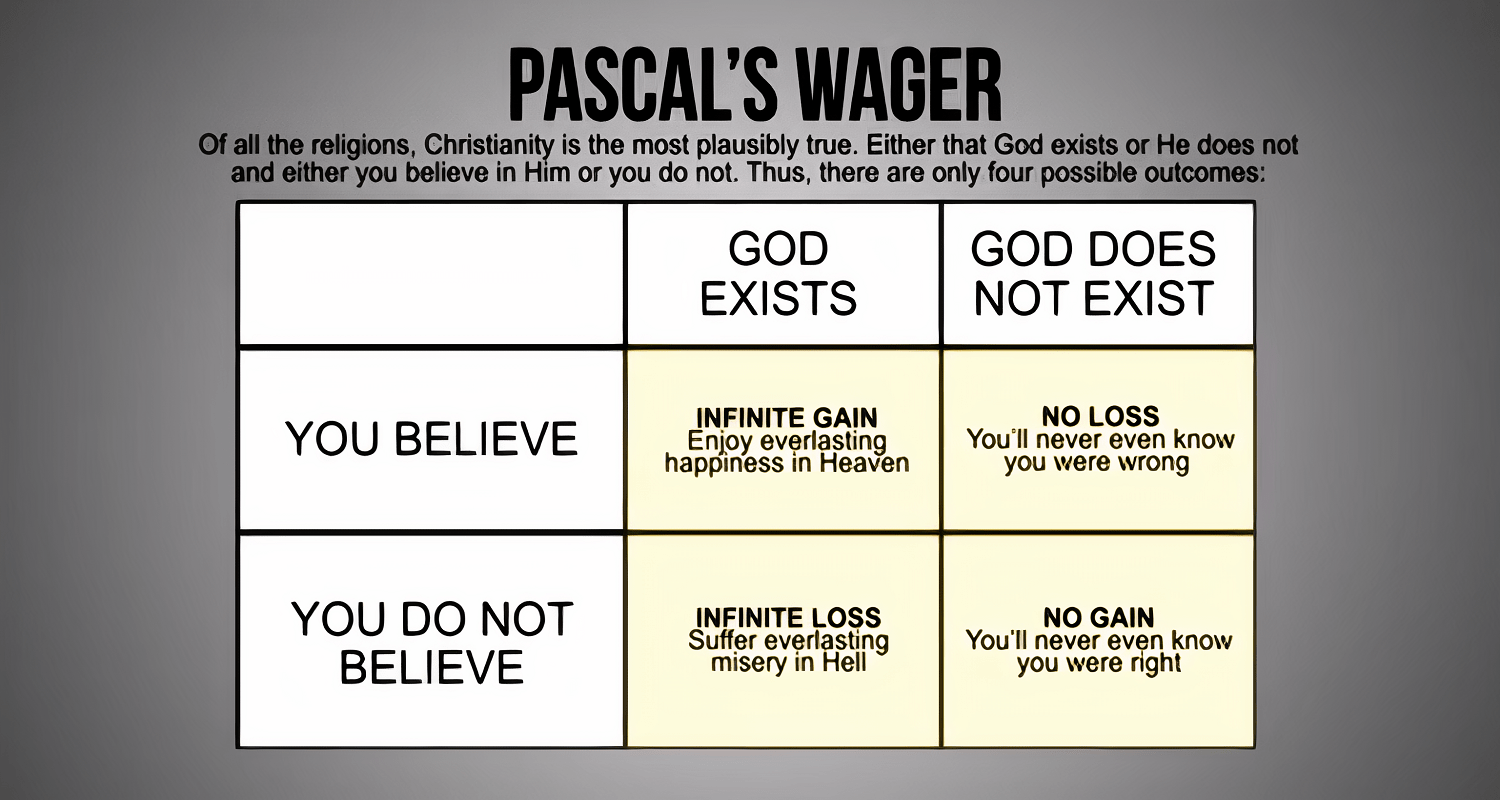
To understand how this applies to your wallet, consider a simple 2×2 matrix. On one axis, you have your “Bet” (e.g., investing in a specific asset or preparing for an economic downturn). On the other axis, you have the “Reality” (whether that event occurs).
- You Bet / Event Occurs: You achieve significant wealth or avoid a total loss.
- You Bet / Event Does Not Occur: You lose a small amount of capital (the cost of the “bet” or insurance).
- You Don’t Bet / Event Occurs: You face a catastrophic loss or miss a life-changing opportunity.
- You Don’t Bet / Event Does Not Occur: You remain in your current state, perhaps saving a small amount of “insurance” money.
In this matrix, the cost of being wrong in “You Bet” is limited and finite, while the cost of being wrong in “You Don’t Bet” can be infinite ruin or permanent regret. This is the heart of asymmetric risk management.
Expected Value vs. Extreme Consequences
Traditional financial advisors often preach “Expected Value” (EV). If there is a 90% chance of a 5% gain and a 10% chance of a 50% loss, the EV is positive. However, Pascal’s Wager argues that if that 10% chance leads to “ruin”—the total loss of your ability to play the game—the EV doesn’t matter.
In money management, the goal is not just to maximize gains but to avoid the “point of zero.” If you have $1 million and you lose it all, a 1,000% gain on $0 is still $0. Pascal’s Wager in finance prioritizes the preservation of the “right to keep playing” over the pursuit of marginal gains.
Asymmetric Investing: The “Small Stake, Massive Upside” Strategy
The most direct application of Pascal’s Wager in modern investing is the pursuit of asymmetry. This is the strategy of placing bets where the downside is strictly capped, but the upside is potentially uncapped. This is the logic that governs venture capital, options trading, and emerging technology investments.
Venture Capital and the Power Law
Venture Capital (VC) is Pascal’s Wager in practice at a corporate scale. A VC firm might invest in 50 startups. They know, statistically, that 40 of them will fail, resulting in a total loss of the capital invested in those specific companies. However, the cost of those failures is finite—it is exactly the amount of money put into the seed rounds.
The “Wager” is that 1 or 2 of those companies will become the next Amazon or Google. The upside of those few winners is so massive (1,000x or 10,000x) that it renders the 40 losses irrelevant. The VC is wagering that the “cost of belief” (the lost capital in failures) is a small price to pay for the “infinite reward” of a unicorn. For personal finance, this translates to keeping the bulk of your wealth in stable assets while dedicating a small, “disposable” percentage to high-variance “moonshots.”
Black Swan Events and Tail Risk Protection
Nassim Nicholas Taleb, author of The Black Swan, popularized the idea that history is driven by rare, unpredictable, and high-impact events. Pascal’s Wager is the primary tool for surviving these events.
If you wager that a “Black Swan” (like a global pandemic, a sudden currency devaluation, or a technological revolution) will happen, and you are wrong, you lose a small premium in the form of hedges or insurance. But if you wager that it won’t happen and you are wrong, you lose everything. Professional traders often use “long volatility” strategies—buying cheap out-of-the-money options that expire worthless 99% of the time but pay out 50:1 when the market crashes. They are wagering on the extreme, because the cost of being wrong is a small fee, while the cost of being right is a fortune.
Defensive Financial Planning: The Cost of Being Wrong
While asymmetry is often associated with high-growth investing, it is equally vital in defensive financial planning. This is where Pascal’s Wager becomes a tool for the average household, not just the hedge fund manager.
Insurance as a Pure Pascalian Wager
Insurance is the most common financial instrument that follows Pascal’s logic. Consider term life insurance. If you pay $50 a month for a policy and you don’t die, you have “lost” $600 a year. This is a finite, manageable cost. However, if you do not have insurance and you die, the “cost” to your family is potentially infinite in terms of lost income, debt, and stability.
The wager here is clear: The rational actor accepts the small, certain loss (the premium) to avoid the uncertain, catastrophic loss. We apply this same logic to health insurance, homeowners’ insurance, and even cybersecurity protection for our digital assets. We are not betting that the catastrophe will happen; we are betting that we cannot afford for it to happen while we are unprepared.
Diversification and the Preservation of Capital
Diversification is often described as “the only free lunch in finance.” It is also a Pascalian hedge. If you put all your money into one “perfect” stock, you might get rich faster, but you are wagering that no unforeseen event will ever destroy that company. If you are wrong, the cost is total.
By diversifying across asset classes—stocks, bonds, real estate, precious metals, and cash—you are making a series of wagers. You are accepting that you will never have 100% of your money in the “best” performing asset of the year. In exchange, you ensure that you will never have 100% of your money in the “worst” performing asset. The finite “cost” of lower potential returns is the price you pay to avoid the infinite downside of total portfolio collapse.
Applying the Wager to Career and Income Strategy
In the modern economy, the Wager extends beyond your brokerage account and into your professional life. With the rise of AI and the gig economy, the traditional “safe” career is becoming an increasingly risky bet.
The Side Hustle as a Strategic Hedge
Building a side hustle or an online income stream is a classic Pascalian Wager. The cost is your time and perhaps a small amount of startup capital (the “finite sacrifice”). If the business fails, you are out some hours of sleep and a few hundred dollars.
However, if the business succeeds, it provides “infinite reward” in the form of income decoupling from your time, a safety net against layoffs, and the potential for a lifestyle-changing exit. In an era of corporate volatility, wagering on your own brand and skills is a more rational bet than wagering on a single employer’s long-term stability.
Skills Acquisition in a Volatile Economy
When a new technology emerges—such as Generative AI—many people ignore it, hoping it is a passing fad. Using Pascal’s logic, the rational move is to learn the basics. If you spend 20 hours learning a new tool and it becomes irrelevant, you have lost 20 hours. If you ignore it and it reshapes your entire industry, you may lose your career. The “cost” of staying updated is low, while the “cost” of obsolescence is extreme.
The Limits of the Wager: Avoiding the Gambler’s Fallacy
While Pascal’s Wager is a powerful tool, it must be applied with mathematical rigor. The most common mistake is miscalculating the “cost of the bet.”
The Danger of Infinite Downside
Pascal’s original wager assumed the “cost” of belief was merely a few earthly pleasures and some time at church. In finance, if the cost of the “bet” is your mortgage money or your health, it is no longer a Pascalian Wager—it is a reckless gamble. To truly apply this logic, the “finite sacrifice” must truly be finite and manageable. You should never wager “the house” on a “maybe,” even if the potential payout is infinite.
The Importance of Position Sizing
In investing, the Wager only works if you survive long enough for the “infinite reward” to manifest. This requires strict position sizing. If you identify an asymmetric opportunity (like a high-risk tech stock or a new cryptocurrency), Pascal’s Wager suggests you should own it. However, it does not suggest you should put 90% of your net worth into it.
The rational Pascalian investor puts 1% or 2% into several different asymmetric bets. This ensures that the “cost of being wrong” (the 98% of your portfolio that isn’t in that specific asset) doesn’t ruin you, while the 2% stake is large enough to move the needle if the “infinite reward” comes to fruition.
Conclusion: Living the Asymmetric Life
Pascal’s Wager teaches us that in a world of uncertainty, the goal isn’t to be “right” about every prediction—the goal is to ensure that you are never “critically wrong.” In finance, this means shifting your focus from “what is likely to happen” to “what happens to me if the unlikely occurs.”
By building a life and a portfolio based on asymmetric risk, you protect yourself from the downside of the world’s chaos while remaining perfectly positioned to capture the upside of its evolution. Whether it is through insurance, diversification, side hustles, or small stakes in emerging technologies, the Wager remains the most rational way to navigate the complex, high-stakes game of money.
aViewFromTheCave is a participant in the Amazon Services LLC Associates Program, an affiliate advertising program designed to provide a means for sites to earn advertising fees by advertising and linking to Amazon.com. Amazon, the Amazon logo, AmazonSupply, and the AmazonSupply logo are trademarks of Amazon.com, Inc. or its affiliates. As an Amazon Associate we earn affiliate commissions from qualifying purchases.