
For many investors, opening a brokerage app to find a sea of red can be a jarring experience. The question “why is the stock market down today?” is one of the most frequently searched queries in the financial world, yet the answer is rarely singular. The global financial ecosystem is a complex web of interconnected variables where a shift in one corner of the globe can trigger a sell-off thousands of miles away. Understanding the mechanics behind a market downturn is essential for maintaining a disciplined investment strategy and avoiding the pitfalls of emotional decision-making.
In this deep dive, we will explore the primary catalysts that drive market pullbacks, from macroeconomic shifts and corporate earnings to the psychological undercurrents that dictate investor behavior.
1. Macroeconomic Catalysts and the Shadow of Interest Rates
The most common driver of a broad market decline is the shifting landscape of macroeconomic policy. Markets are inherently forward-looking; they do not just price in what is happening now, but what they expect to happen in the next six to twelve months.
The Influence of Federal Reserve Policy
Central banks, particularly the Federal Reserve in the United States, act as the “conductors” of the global economy. When the Fed adopts a “hawkish” stance—signaling that it will raise interest rates to combat inflation—the stock market typically reacts negatively. Higher interest rates increase the cost of borrowing for corporations, which can stifle expansion and reduce net profit margins. Furthermore, higher rates increase the “discount rate” used by analysts to value future cash flows, making stocks, especially high-growth tech stocks, appear more expensive.
Inflationary Pressures and Consumer Spending
Inflation is a double-edged sword. While moderate inflation is a sign of a growing economy, runaway inflation erodes the purchasing power of consumers. If the Consumer Price Index (CPI) report comes in higher than expected, markets often tumble. Investors fear that persistent inflation will force the Fed to keep rates higher for longer, potentially tipping the economy into a recession. When consumers pay more for gas and groceries, they have less discretionary income to spend on the products and services offered by publicly traded companies.
The Role of Treasury Yields
There is an inverse relationship between bond yields and stock prices. When the yield on the 10-year Treasury note rises, it offers investors a “risk-free” alternative to the volatility of the stock market. If an investor can get a guaranteed 4% or 5% return from the government, they are less likely to risk their capital in equities unless the potential returns are significantly higher. This shift in capital from stocks to bonds is a frequent cause of daily market dips.
2. Corporate Earnings and the Gravity of Forward Guidance
While macro trends set the stage, individual company performance provides the script. Earnings season, which occurs four times a year, is a period of heightened volatility where the “why” behind a market drop becomes much more specific.
Missed Expectations and Valuation Resets
Even if a company reports record-breaking profits, its stock price can still fall if those profits were lower than what analysts predicted. The market prices in “perfection” for many leading companies. When a blue-chip firm misses its revenue targets, it creates a ripple effect across its entire sector. Investors begin to question if the “miss” is an isolated incident or a sign of a broader cooling in that specific industry.
The Power of Forward Guidance
Often, the reason a stock (and the broader index) drops isn’t because of what happened in the last quarter, but what the CEO says about the next quarter. This is known as “forward guidance.” If a major retailer warns that inventories are piling up or a tech giant suggests that AI spending isn’t yielding immediate returns, investors will sell off the stock in anticipation of leaner times ahead. Because the major indices like the S&P 500 are market-cap weighted, a significant drop in a few massive companies can pull the entire market down.
Supply Chain Disruptions and Input Costs
In a globalized economy, corporate health is tied to the efficiency of supply chains. A strike at a major port, a shortage of semiconductor chips, or a spike in the price of raw materials like copper or oil can squeeze profit margins. When companies report that their “cost of goods sold” (COGS) is rising faster than they can raise prices for consumers, investors see a threat to the bottom line and adjust their positions accordingly.
3. Geopolitical Tensions and Global Stability
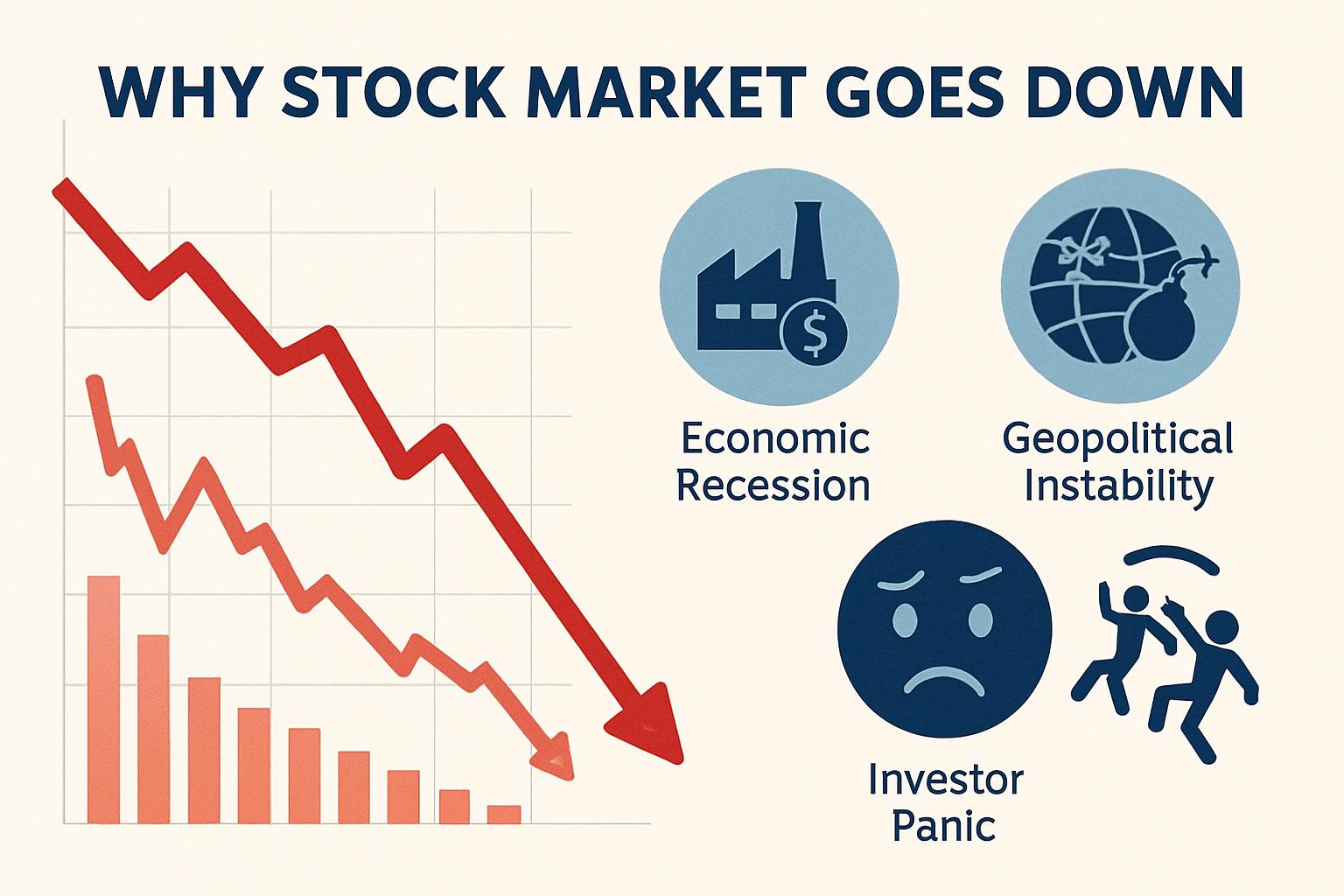
The stock market hates uncertainty more than it hates bad news. Geopolitical instability is the ultimate source of uncertainty, often leading to “black swan” events that cause sudden, sharp market declines.
Energy Security and Commodity Volatility
Conflicts in oil-rich regions or areas vital to global trade routes can cause immediate spikes in energy prices. Since energy is a primary input for almost every industry—from manufacturing to transportation—high oil prices act as a tax on the entire economy. When geopolitical tensions rise, the market often undergoes a “flight to quality,” where investors sell stocks and move into gold or the U.S. Dollar.
Trade Relations and Regulatory Shifts
Changes in trade policy, such as the imposition of tariffs or export bans on sensitive technologies, can disrupt the business models of multi-national corporations. If the world’s two largest economies engage in a trade dispute, the market reacts by pricing in the increased costs and reduced market access. Similarly, sudden regulatory crackdowns in major markets can wipe out billions in market capitalization overnight, as seen in various sectors ranging from social media to pharmaceutical pricing.
4. Investor Psychology and the Mechanics of Market Sentiment
Technical factors and human emotion often exacerbate fundamental economic news. The stock market is not just a collection of spreadsheets; it is a reflection of human psychology.
Fear, Greed, and the “Herd Mentality”
The “Fear and Greed Index” is a popular tool used to measure market sentiment. When the market begins to dip, fear can become contagious. Panic selling occurs when investors see prices falling and sell their holdings to “prevent further loss,” without considering the long-term fundamentals of their investments. This herd mentality can create a downward spiral that pushes prices far below their intrinsic value.
Technical Support Levels and Algorithmic Trading
In the modern era, a significant portion of daily trading volume is driven by high-frequency trading (HFT) algorithms. These programs are often set to sell automatically if a stock or index breaks below a certain “support level”—a price point where a stock has historically found buyers. If the S&P 500 breaks through a key psychological level (like a round number or a 200-day moving average), it can trigger a wave of automated selling that accelerates the day’s losses.
Margin Calls and Forced Liquidation
When the market drops significantly, investors who have borrowed money to buy stocks (trading on margin) may face “margin calls.” Their brokers require them to deposit more cash or sell their positions immediately to cover the loan. This forced liquidation adds more selling pressure to the market, often leading to the “capitulation” phase where the market bottoms out after the last of the forced sellers have exited.
5. Strategic Management: How to React to a Down Market
Understanding why the market is down is only half the battle; the other half is knowing what to do—or what not to do—with your portfolio.
The Importance of a Long-Term Perspective
Historical data shows that the stock market has a 100% recovery rate from downturns given a long enough time horizon. Market corrections (a drop of 10%) and bear markets (a drop of 20% or more) are a natural part of the economic cycle. For the long-term investor, these “red days” are often the best times to acquire high-quality assets at a discount.
Diversification as a Shield
If your portfolio is diversified across different asset classes (stocks, bonds, real estate) and sectors (healthcare, utilities, technology), a downturn in one area is often mitigated by stability in another. For example, during a period of high interest rates, “value” stocks in the financial or energy sectors may perform better than “growth” stocks in the tech sector.
Rebalancing and Dollar-Cost Averaging
A down market provides an opportunity to rebalance your portfolio. If your stock allocation has shrunk because of a market dip, you may need to sell some bonds to buy more stocks to return to your target allocation. Additionally, “dollar-cost averaging”—the practice of investing a fixed amount of money at regular intervals—is particularly effective during downturns. By continuing to invest when prices are low, you lower your average cost per share, positioning yourself for significant gains when the market inevitably recovers.
In conclusion, while the sight of a falling market can be stressful, it is rarely a reason for panic. Whether the decline is driven by the Federal Reserve’s interest rate path, a disappointing earnings report from a tech giant, or geopolitical unrest, these movements are the price of admission for long-term wealth creation. By understanding the underlying “why,” investors can move past the noise and stay focused on their long-term financial goals.
aViewFromTheCave is a participant in the Amazon Services LLC Associates Program, an affiliate advertising program designed to provide a means for sites to earn advertising fees by advertising and linking to Amazon.com. Amazon, the Amazon logo, AmazonSupply, and the AmazonSupply logo are trademarks of Amazon.com, Inc. or its affiliates. As an Amazon Associate we earn affiliate commissions from qualifying purchases.