
The Dow Jones Industrial Average (DJIA) remains the most cited barometer of the American economy. When news anchors or push notifications announce that the “market is down,” they are usually referring to this century-old index of 30 prominent “blue-chip” companies. However, for the modern investor, a red number on a screen often triggers a sense of unease. Understanding why the Dow drops on any given day requires more than a glance at a ticker; it requires an analysis of the intricate web of monetary policy, corporate health, and investor psychology.

This article explores the fundamental drivers of market downturns, categorizing the reasons behind a Dow decline into structural, economic, and psychological frameworks, while offering a strategic perspective for long-term wealth management.
The Mechanics of the Dow Jones Industrial Average
To understand why the Dow drops, one must first understand how it is constructed. Unlike the S&P 500, which is market-capitalization-weighted, the Dow is a price-weighted index. This structural quirk means that companies with higher share prices have a disproportionate influence on the index’s daily movement, regardless of their actual company size.
How the Price-Weighted Index Works
In a price-weighted system, a $5 change in a stock priced at $200 has the same impact on the Dow as a $5 change in a stock priced at $50, even if the latter represents a much larger percentage move for that specific company. Consequently, if a high-priced constituent like UnitedHealth Group or Goldman Sachs reports disappointing news, the Dow can drop significantly even if the other 29 companies remain stable. Investors often see a “drop” not as a systemic failure of the economy, but as a mathematical result of a few high-priced laggards.
The Role of the “Blue-Chip” 30
The Dow consists of 30 massive, established companies across various sectors, excluding utilities and transportation. Because these are “mature” companies, they are often viewed as proxies for the broader industrial and consumer health of the United States. When the Dow drops, it often signals that investors are concerned about the “old guard” of the economy—the retailers, manufacturers, and financial institutions that form the backbone of domestic commerce.
Primary Economic Drivers Behind a Market Sell-Off
The most common reasons for a daily drop in the Dow are rooted in macroeconomic shifts. The market is a forward-looking mechanism; it doesn’t trade on what is happening today, but on what investors expect to happen six to nine months from now.
Inflationary Pressures and Interest Rate Hikes
The Federal Reserve is perhaps the single most influential entity regarding Dow performance. When inflation data—such as the Consumer Price Index (CPI)—comes in higher than expected, the market anticipates that the Federal Reserve will raise interest rates to cool the economy.
Higher interest rates are a “double whammy” for stocks. First, they increase the cost of borrowing for the companies within the Dow, potentially squeezing profit margins. Second, they increase the “discount rate” used by analysts to value future cash flows. When rates go up, the present value of future earnings goes down, leading to an immediate repricing of stocks. This is a primary reason why the Dow might drop sharply following a Fed meeting or a hawkish speech by a central bank official.
Corporate Earnings and Growth Forecasts
Every quarter, the companies in the Dow report their financial results. While a company might report record profits, the Dow can still drop if that company’s “guidance” (its forecast for the future) is weak. If a major component like Microsoft or Apple suggests that consumer demand is waning or that supply chain issues are eating into margins, the entire index can feel the weight. Investors trade on the Delta—the difference between expectation and reality. If the reality is even slightly dimmer than the forecast, a sell-off is the standard response.

Geopolitical Tensions and Global Stability
The companies in the Dow are multinational giants. They rely on global stability for their supply chains and international sales. Political instability in Europe, trade tensions with China, or conflict in the Middle East can lead to “de-risking.” In these scenarios, institutional investors move capital out of “risk assets” (stocks) and into “safe havens” (Gold or U.S. Treasuries). This flight to quality results in a lower Dow, as the selling pressure outweighs the buying interest.
Psychological and Technical Factors in a Dow Decline
Market movements are not always driven by spreadsheets and economic reports. Often, the Dow drops because of the collective behavior of millions of human participants and the algorithms they have programmed.
Investor Sentiment and the “Fear Gauge”
The VIX, often called the “Fear Gauge,” measures market volatility. When the VIX spikes, the Dow usually drops. This is often driven by “sentiment”—the general mood of the investing public. News cycles can create a feedback loop: a negative headline leads to a small drop, which triggers anxiety, leading to more selling. This “herd mentality” can cause the Dow to drop more than the underlying economic data would justify, as fear becomes the primary driver of the day’s trading volume.
Programmatic Trading and Algorithm Triggers
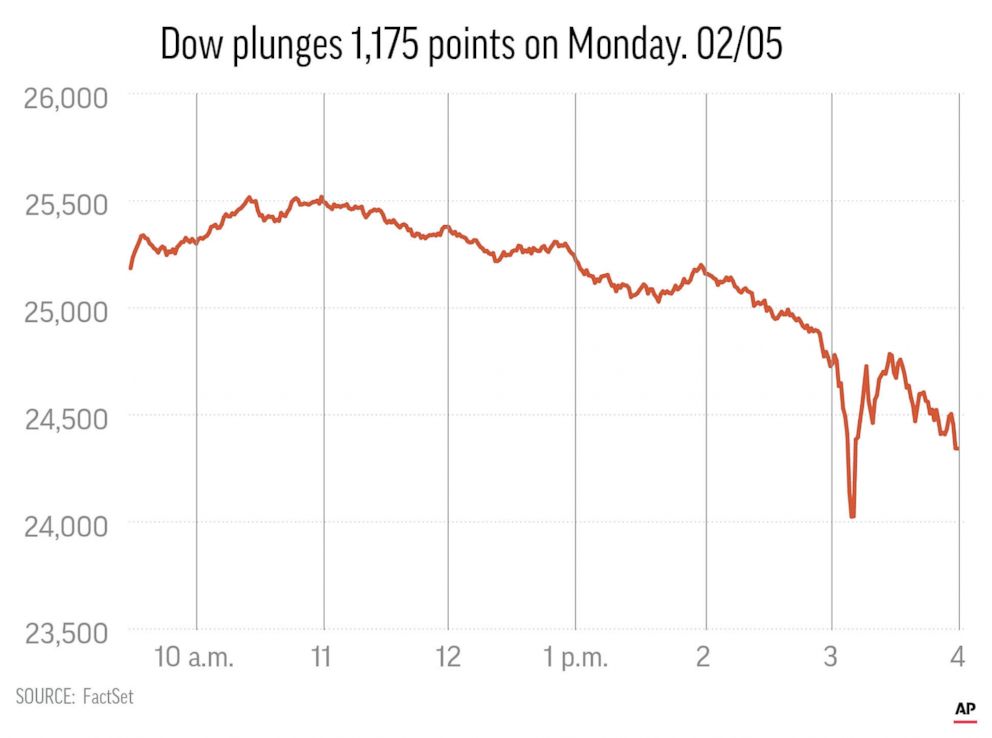
In the modern era, a significant portion of trading volume is executed by high-frequency trading (HFT) algorithms. These programs are designed to react to specific technical levels. For instance, if the Dow drops below a “moving average” (a technical support level), it may trigger thousands of automated sell orders. This can lead to a “cascade effect” where the drop accelerates rapidly in a matter of minutes. While these drops are often temporary, they contribute to the volatility that characterizes a “red day” on Wall Street.
Strategic Responses: What a Drop Means for Your Portfolio
For the individual investor, a drop in the Dow should be viewed through the lens of strategy rather than emotion. While a 500-point decline looks dramatic on a news ticker, it is often a small percentage of the total index value.
Long-term Investing vs. Short-term Noise
History shows that the Dow has a 100% recovery rate from its downturns over a long enough time horizon. For those in the “accumulation phase” of their lives—saving for retirement or long-term goals—a drop in the Dow is actually an opportunity. It allows the investor to practice “Dollar Cost Averaging,” where they buy more shares of high-quality companies at lower prices. Distinguishing between “noise” (daily fluctuations) and “signal” (long-term economic shifts) is the hallmark of a sophisticated investor.
The Importance of Diversification and Rebalancing
A significant drop in the Dow serves as a “stress test” for a portfolio. If a 2% or 3% drop in the index causes a 10% drop in an individual’s portfolio, it suggests a lack of diversification. Money management isn’t just about picking winners; it’s about managing risk. Professional financial planning involves rebalancing—selling assets that have performed well and buying those that have dipped—to maintain a consistent risk profile. When the Dow drops, it often provides the perfect timing to rebalance back into equities from bonds or cash.
Conclusion: Perspective in the Face of Volatility
The question “Why did the Dow drop today?” rarely has a single answer. It is usually a confluence of Federal Reserve policy, corporate earnings reports, and the collective psychology of the market. While the headlines focus on the “lost value,” it is important to remember that the stock market is a market of stocks, not a monolith.
A drop in the Dow is a natural part of the economic cycle. It clears out excess speculation, recalibrates valuations, and provides entry points for disciplined capital. By understanding the mechanics of the index and the economic drivers behind the movements, investors can move away from reactive decision-making and toward a proactive, evidence-based approach to building wealth. In the world of finance, the most successful participants are not those who avoid the drops, but those who understand them and stay the course.
aViewFromTheCave is a participant in the Amazon Services LLC Associates Program, an affiliate advertising program designed to provide a means for sites to earn advertising fees by advertising and linking to Amazon.com. Amazon, the Amazon logo, AmazonSupply, and the AmazonSupply logo are trademarks of Amazon.com, Inc. or its affiliates. As an Amazon Associate we earn affiliate commissions from qualifying purchases.