
Oracle Corporation (ORCL), long considered a legacy titan of the enterprise software world, has recently undergone a dramatic valuation rerating that has captured the attention of Wall Street. For years, the company was viewed as a stable but slow-growing provider of database management systems. However, a series of strategic pivots and financial milestones have propelled the stock to new heights. Understanding why Oracle stock went up requires a deep dive into the intersection of cloud infrastructure economics, artificial intelligence (AI) monetization, and disciplined financial management.
Investors are no longer pricing Oracle as a “legacy” firm; they are pricing it as a critical infrastructure provider for the next generation of computing. This shift in market sentiment is backed by hard data, ranging from accelerated cloud revenue growth to massive increases in Remaining Performance Obligations (RPO).

The Explosive Growth of Oracle Cloud Infrastructure (OCI)
The primary engine behind Oracle’s stock appreciation is the rapid scaling of Oracle Cloud Infrastructure (OCI). While Amazon Web Services (AWS), Microsoft Azure, and Google Cloud have historically dominated the cloud landscape, Oracle has carved out a high-growth niche that is now yielding significant financial returns.
Outpacing Industry Growth Rates
In recent fiscal quarters, Oracle’s cloud infrastructure revenue has grown at rates exceeding 40% to 50% year-over-year, frequently outperforming the growth rates of its larger competitors. This growth is significant because cloud infrastructure is a high-margin business once it reaches scale. Investors have responded positively to the fact that Oracle is not just participating in the cloud market but is actively gaining market share. The financial community views this as a validation of Oracle’s Gen 2 Cloud architecture, which was built specifically to handle high-performance workloads more efficiently than its predecessors.
Expanding Operating Margins
A key reason the stock price has reacted so favorably is the expansion of operating margins. Transitioning a business from on-premise licensing to cloud subscriptions is often painful in the short term—a phenomenon known as the “SaaS swallow.” However, Oracle has moved past the initial drag of this transition. As more customers migrate to OCI, the recurring revenue stream provides a predictable and expanding profit margin. Financial analysts look for “operating leverage,” where revenue grows faster than expenses. Oracle has demonstrated this leverage, leading to higher earnings per share (EPS) and, consequently, a higher stock price.
The Role of Remaining Performance Obligations (RPO)
One of the most bullish signals in Oracle’s financial reports has been the surge in Remaining Performance Obligations (RPO). This metric represents the total value of future contracts that have been signed but not yet recognized as revenue. When Oracle reports a massive jump in RPO—sometimes in the tens of billions of dollars—it provides investors with high visibility into future revenue. A growing RPO indicates that demand for Oracle’s cloud services is outstripping its current capacity, a classic signal of a “growth” stock that justifies a premium valuation multiple.
The AI Revolution: A Financial Catalyst
The rise of generative AI has acted as a massive tailwind for Oracle. Unlike previous tech cycles, the AI boom requires an astronomical amount of specialized compute power, and Oracle has positioned its data centers to be the preferred destination for AI developers.
Strategic Partnership with NVIDIA
Oracle’s stock price has often moved in tandem with news regarding its partnership with NVIDIA. By integrating NVIDIA’s latest H100 and Blackbridge GPUs into its clusters, Oracle has become a primary provider for AI startups and established enterprises looking to train large language models (LLMs). From an investment perspective, this partnership transforms Oracle into a “pick and shovel” play for the AI gold rush. Investors are buying Oracle stock because the company is effectively renting out the digital real estate and hardware necessary for AI to exist.
Multi-Cloud Collaborations with Microsoft and Google
In a move that surprised the industry but delighted the markets, Oracle has entered into significant partnerships with its erstwhile rivals, Microsoft Azure and Google Cloud. These “multi-cloud” agreements allow customers to run Oracle databases directly within the Azure or Google Cloud environments. Financially, this is a masterstroke. It reduces the friction for customers to stay within the Oracle ecosystem, ensuring that “sticky” database revenue remains intact even as customers diversify their cloud providers. These partnerships have removed a significant “risk discount” that previously weighed on Oracle’s stock, as investors no longer fear Oracle will be boxed out by the “Big Three” hyperscalers.
Capitalizing on Training and Inference Demands
The financial markets are particularly interested in the distinction between AI training and AI inference. Oracle’s OCI is uniquely suited for the “training” phase due to its high-speed RDMA (Remote Direct Memory Access) networking. Because training AI models requires thousands of GPUs to work in unison, Oracle’s architectural advantages result in lower costs and faster times for developers. This cost-efficiency attracts more high-spending clients, driving up the company’s “Average Revenue Per User” (ARPU) and fueling the stock’s upward trajectory.
Fundamental Strength and Valuation Metrics
Beyond the excitement of AI and the cloud, Oracle’s stock has risen because of its underlying financial health. The company’s management has been aggressive in returning value to shareholders while maintaining a fortress-like balance sheet.
Strong Free Cash Flow Generation
For value-oriented investors, free cash flow (FCF) is the ultimate metric of a company’s health. Despite the heavy capital expenditure (Capex) required to build out data centers, Oracle has managed to maintain robust cash flow. This cash flow supports the company’s dividend and its ability to service debt. When a company can grow at 40% in its cloud segment while still generating billions in FCF, it attracts a broader range of institutional investors—from growth-oriented hedge funds to conservative pension funds.
Forward P/E Ratios and Market Rerating
Historically, Oracle traded at a discount compared to the broader tech sector, often carrying a forward Price-to-Earnings (P/E) ratio in the mid-teens. As the market began to recognize Oracle as a growth leader in AI and cloud, that multiple expanded. A “rerating” occurs when the market decides a company is worth more per dollar of profit than it used to be. Oracle’s P/E multiple has shifted higher, reflecting the market’s belief that its future earnings will be higher-quality and more persistent. This multiple expansion is a primary driver of the stock’s recent price appreciation.
Dividend Growth and Share Repurchases
Oracle has a long history of rewarding shareholders through dividends and share buybacks. While the dividend yield may be modest compared to utility stocks, the consistency and growth of the payout signal management’s confidence in the long-term profitability of the firm. Furthermore, by reducing the total share count through repurchases, Oracle increases the “earnings per share” for remaining holders. This financial engineering, when backed by actual business growth, creates a powerful “flywheel” effect that pushes the stock price higher over time.
Strategic Shift from Legacy Software to SaaS
The transition of Oracle’s massive installed base from legacy, on-premise software to modern Software-as-a-Service (SaaS) applications is another reason for the stock’s ascent. This shift transforms one-time licensing fees into permanent, recurring revenue.
The Dominance of NetSuite and Fusion
Oracle’s SaaS portfolio, led by ERP (Enterprise Resource Planning) solutions like NetSuite and Oracle Fusion, has become a gold mine. These tools are mission-critical for businesses; a company is unlikely to switch its accounting or HR software once it is integrated. This “stickiness” creates a high barrier to entry for competitors and ensures a steady stream of high-margin revenue. Investors value recurring SaaS revenue at a much higher multiple than one-time sales because it is far more predictable.
Vertical Integration and the Cerner Acquisition
The acquisition of Cerner, a leader in healthcare electronic health records, was initially met with some skepticism due to its size and the complexity of integration. However, as Oracle has begun to move Cerner’s massive data sets to OCI and modernize its software interface, the financial potential has become clear. By dominating the healthcare vertical, Oracle is positioning itself to capture a larger slice of one of the global economy’s most resilient sectors. The market is now pricing in the long-term synergies of this acquisition, contributing to the stock’s bullish momentum.
Future Outlook: Why the Momentum Might Sustain
The rise in Oracle’s stock is not just a reflection of past performance but an anticipation of future dominance. Several forward-looking factors suggest that the financial markets see more room for growth.
Aggressive Capital Expenditure Plans
Oracle has announced plans to spend billions of dollars on new data centers globally. While high Capex can sometimes scare investors, in this context, it is seen as a sign of overwhelming demand. Oracle only builds capacity when it has a clear line of sight to customer contracts. This disciplined approach to expansion suggests that the revenue growth seen in recent quarters is not a fluke but the beginning of a long-term trend.
Sovereign Cloud Opportunities
In an era of increasing data privacy regulations, Oracle has pioneered the concept of the “Sovereign Cloud.” This allows governments and highly regulated industries to keep their data within their own borders while still utilizing the power of the cloud. This niche provides Oracle with a competitive “moat” that is difficult for other providers to replicate quickly. The financial markets view this as a massive, untapped market that will provide a new layer of growth for the next decade.
Conclusion for Investors
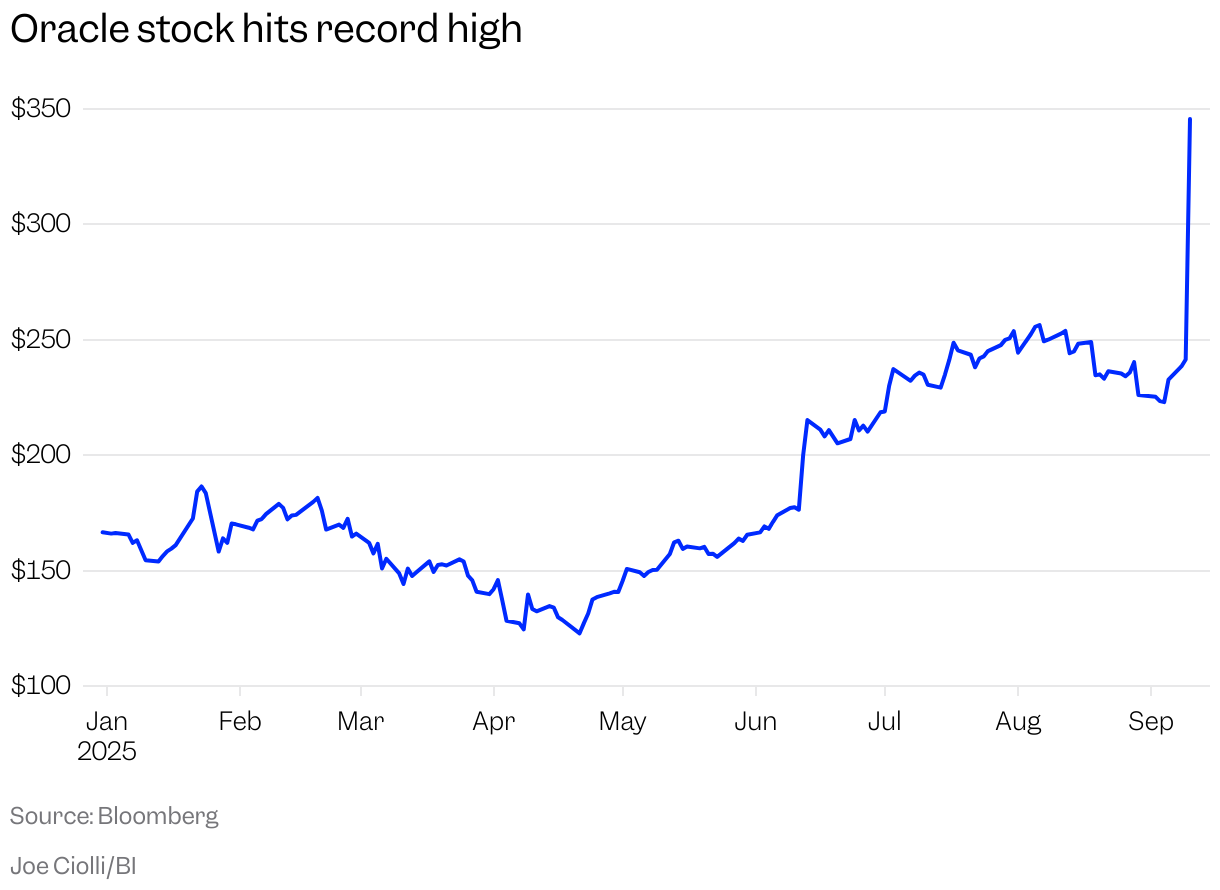
The surge in Oracle stock is the result of a “perfect storm” of positive financial catalysts. The company has successfully transitioned from a legacy software provider to a cutting-edge cloud and AI powerhouse. With accelerating revenue growth, expanding margins, strategic AI partnerships, and a disciplined approach to capital allocation, Oracle has fundamentally changed its financial profile. For the investing community, the “new” Oracle represents a rare combination of stability and explosive growth potential, justifying its climb to record-breaking valuations.
aViewFromTheCave is a participant in the Amazon Services LLC Associates Program, an affiliate advertising program designed to provide a means for sites to earn advertising fees by advertising and linking to Amazon.com. Amazon, the Amazon logo, AmazonSupply, and the AmazonSupply logo are trademarks of Amazon.com, Inc. or its affiliates. As an Amazon Associate we earn affiliate commissions from qualifying purchases.