
The calculator is perhaps one of the most underappreciated triumphs of human engineering. In the modern era, we access sophisticated computational power through our smartphones, smartwatches, and laptops without a second thought. However, the journey from physical counting beads to the silicon-based microchips of today is a multi-century saga of innovation. To answer the question of “who created the calculator,” one must look beyond a single inventor and instead examine a lineage of visionaries who transitioned the world from manual arithmetic to automated logic.

This article explores the technological milestones of the calculator, identifying the key figures who revolutionized how we interact with numbers and how these gadgets paved the way for the modern computing era.
The Mechanical Pioneers: The 17th Century Breakthroughs
For millennia, humans relied on the abacus—a manual aid that required the user to perform the mental heavy lifting. The true “tech” breakthrough began in the 17th century when inventors sought to automate the carry-over mechanism in addition and subtraction.
Blaise Pascal and the Pascaline
In 1642, a 19-year-old French mathematician named Blaise Pascal invented what is widely considered the first mechanical calculator: the Pascaline. Pascal’s motivation was purely practical; he wanted to assist his father, a tax commissioner, with the grueling labor of re-calculating taxes.
The Pascaline used a series of geared wheels. When one wheel completed a full revolution (representing ten units), it would automatically advance the neighboring wheel by one notch. This “carry” mechanism was a revolutionary feat of engineering. Although it was expensive and prone to jamming, Pascal’s device proved that mathematics could be delegated to a machine, marking the birth of mechanical computing.
Leibniz and the Quest for Multi-Functional Logic
A few decades later, the German polymath Gottfried Wilhelm Leibniz expanded on Pascal’s foundation. In 1673, Leibniz debuted the “Stepped Reckoner.” While Pascal’s machine was largely limited to addition and subtraction, Leibniz envisioned a device that could multiply and divide using a specialized gear known as the “Leibniz wheel.”
Beyond the hardware, Leibniz’s greatest contribution to the tech world was his advocacy for the binary system—the 1s and 0s that form the bedrock of all modern software and AI. His work suggested that calculation was not just about numbers, but about logical states, a concept that would lie dormant for nearly two centuries before the digital age.
Industrialization and the First Commercial Successes
As the Industrial Revolution took hold, the demand for precision in engineering, navigation, and commerce skyrocketed. The calculator transitioned from a laboratory curiosity into a scalable tool for industry.
The Arithmometer: Scaling Mathematics
In 1820, Thomas de Colmar received a patent for the Arithmometer. While earlier machines were fragile prototypes, the Arithmometer was the first commercially successful mechanical calculator. It was robust enough for daily office use and could perform all four basic arithmetic functions with relative ease. For the next 90 years, variations of this machine dominated the tech landscape of financial houses and scientific institutions, proving that there was a massive market for “computational hardware.”
Charles Babbage: The Father of Programmable Tech
While Thomas de Colmar was perfecting the desktop calculator, Charles Babbage was dreaming of something much larger. In the 1820s and 30s, Babbage designed the Difference Engine and later the Analytical Engine.
While these were not “calculators” in the handheld sense, they were the spiritual ancestors of the modern computer. Babbage’s designs included an “input,” a “mill” (CPU), and a “store” (memory). He moved the niche from simple arithmetic toward programmable computation. Although his machines were never fully completed in his lifetime due to the limitations of Victorian metalworking, his blueprints provided the theoretical framework for the electronic revolution that would follow a century later.
The Electronic Leap: From Vacuum Tubes to Microchips
The mid-20th century saw a radical shift in technology. The move from mechanical gears to electronic components allowed for faster processing and, eventually, a drastic reduction in size.
ANITA and the Desktop Revolution
In 1961, the British firm Bell Punch Co. released the ANITA (A New Inspiration To Arithmetic). This was the world’s first all-electronic desktop calculator. It replaced clunking mechanical gears with vacuum tubes and cold-cathode tubes. While it was the size of a typewriter and required a constant power source, it was silent and near-instantaneous. This transition marked the moment the “calculator” became an electronic gadget, setting the stage for the semiconductor industry.
The Transistor’s Role in Portability
The invention of the transistor at Bell Labs in 1947 changed everything. By the mid-1960s, companies like Sharp and Canon began replacing bulky vacuum tubes with transistors. This led to a “size race.” The goal was no longer just to calculate, but to make the hardware small enough to fit on a desk—and eventually, in a pocket. This era established the Japanese tech industry as a dominant force in consumer electronics, a position it held for decades.
The Pocket Calculator Revolution and Handheld Computing
The 1970s was the decade of the “Calculator Wars.” As integrated circuits (ICs) became more affordable, the technology transitioned from high-end professional equipment to a household commodity.
Texas Instruments and the “Cal-Tech” Project
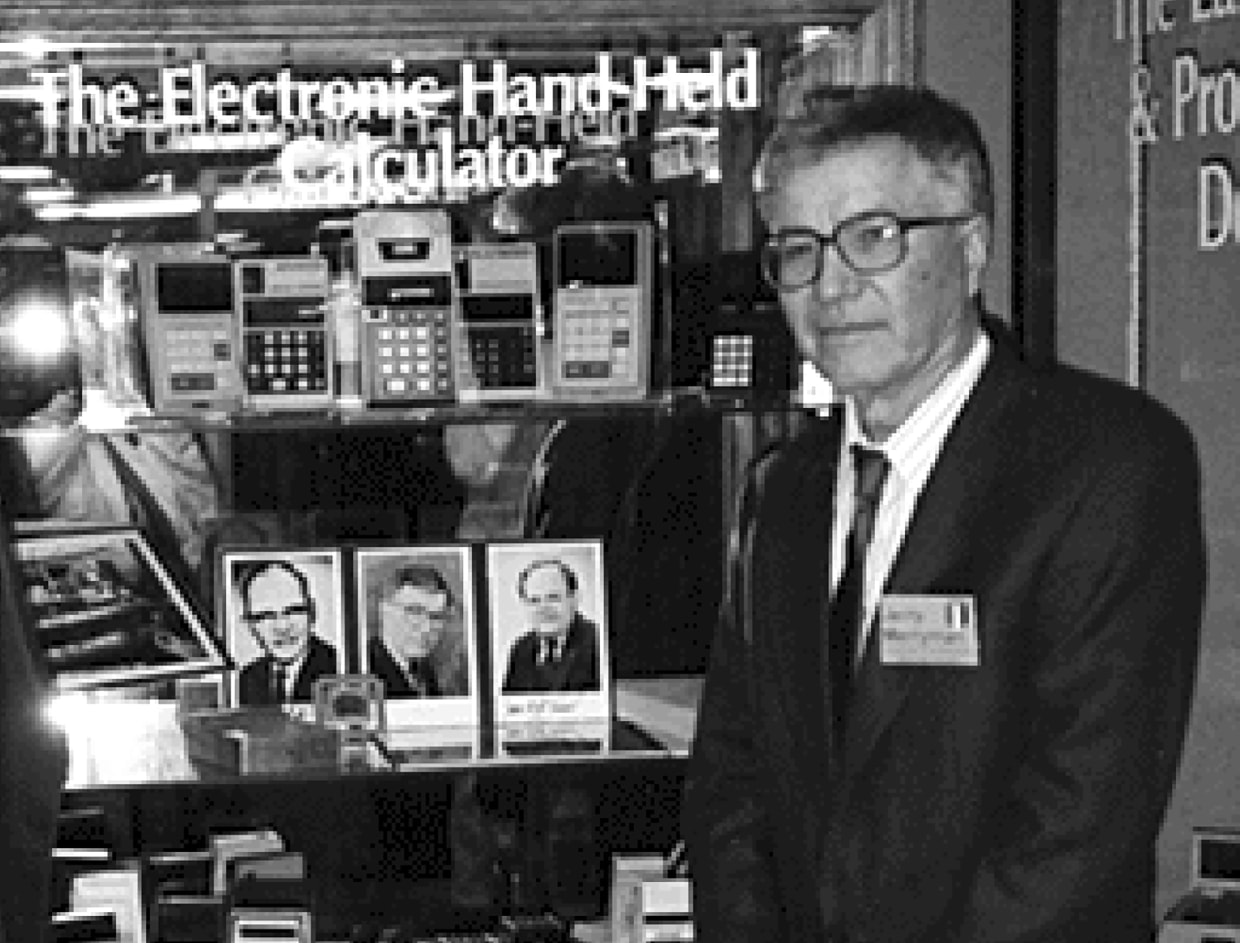
The quest for the first truly handheld calculator was led by Jack Kilby at Texas Instruments. In 1967, Kilby and his team developed the “Cal-Tech” prototype. It was a battery-powered device that could fit in the palm of a hand and print results on a small thermal paper tape.
By the early 1970s, Texas Instruments and Bowmar began releasing consumer models. This was a pivotal moment in tech history; it was the first time that a complex computer-like device was marketed directly to the average person. It democratized mathematics, removing the barrier of entry for students and professionals alike.
The HP-35: Redefining Professional Engineering
While Texas Instruments targeted the mass market, Hewlett-Packard (HP) targeted the elite. In 1972, Bill Hewlett challenged his engineers to fit the functionality of a massive scientific mainframe into a shirt pocket. The result was the HP-35, the world’s first scientific handheld calculator.
The HP-35 featured trigonometric and exponential functions, effectively killing the slide rule overnight. It used Reverse Polish Notation (RPN), which became a cult favorite among engineers. The HP-35 wasn’t just a tool; it was a status symbol for the tech-savvy elite, much like the first iPhone would be decades later.
The Digital Transformation: Software, Apps, and AI
Today, the dedicated hardware calculator is becoming a niche tool, used primarily in standardized testing or specialized engineering. However, the “calculator” as a concept has expanded into every facet of our digital lives.
From Dedicated Hardware to Smartphone Integration
In the 1990s and 2000s, the calculator was absorbed into the “Swiss Army Knife” of gadgets: the smartphone. When Apple launched the iPhone in 2007, the calculator app was a Day 1 feature. This represented the final stage of the calculator’s evolution from physical gears to lines of code. The hardware was no longer a set of wheels or even a dedicated chip; it was a software simulation running on a multi-purpose processor.
The Future: Cloud Computing and AI-Driven Math
We are currently in the era of the “Hyper-Calculator.” Modern tools like WolframAlpha, Desmos, and AI-integrated solvers have moved beyond arithmetic. We now have “calculators” that can solve symbolic algebra, perform complex calculus, and visualize data in three dimensions.
Artificial Intelligence has pushed this even further. Apps can now “see” a handwritten equation via a smartphone camera and solve it instantly, explaining the steps along the way. These AI tools are the direct descendants of Pascal’s wheels and Babbage’s engines, fulfilling the ancient dream of automating the most difficult tasks of the human mind.

Conclusion
The creation of the calculator was not the work of a single inventor, but a collaborative relay race spanning centuries. From Blaise Pascal’s mechanical gears to Jack Kilby’s integrated circuits, each milestone was a response to the technological needs of the era.
The calculator remains one of the most significant “gateway” technologies. It taught humanity how to build machines that think, how to miniaturize components, and how to interface with complex logic. While we may no longer carry a dedicated plastic device in our pockets, the spirit of the calculator lives on in every line of code and every microchip that powers our modern world. Understanding who created the calculator helps us appreciate the massive technological scaffolding that supports our digital lives today.
aViewFromTheCave is a participant in the Amazon Services LLC Associates Program, an affiliate advertising program designed to provide a means for sites to earn advertising fees by advertising and linking to Amazon.com. Amazon, the Amazon logo, AmazonSupply, and the AmazonSupply logo are trademarks of Amazon.com, Inc. or its affiliates. As an Amazon Associate we earn affiliate commissions from qualifying purchases.