
The history of technology is often viewed through the lens of the “computer age,” a period defined by the rapid advancement of silicon chips and digital interfaces. However, the true genesis of modern computing lies in a much older quest: the drive to automate mathematics. When we ask, “When was the first calculator invented?” the answer is not a single date but a series of revolutionary milestones that transformed human cognition. From ancient mechanical devices to the first pocket-sized microprocessors, the evolution of the calculator is the story of how humanity outsourced the labor of logic to machines.

The Ancient Roots of Automated Arithmetic
Before the existence of gears or electricity, the fundamental need for precision in commerce, astronomy, and engineering birthed the earliest calculating tools. While these were not “calculators” in the modern sense of being self-contained machines, they set the logic for everything that followed.
The Abacus: The World’s First Digital Interface
The abacus is often cited as the first calculating tool, appearing in various forms in Mesopotamia, Egypt, and China as early as 2700–2300 BC. Though it relies on a human operator to move beads, it represents the first time humans used a physical system to represent decimal places and perform complex addition and subtraction. In a technical sense, the abacus was the first “hardware” designed to optimize the “software” of human thought.
The Antikythera Mechanism: Analog Complexity
Discovered in a shipwreck off the coast of Greece, the Antikythera mechanism (dated to roughly 150–100 BC) is frequently described by historians as the world’s first analog computer. This complex system of bronze gears was used to predict astronomical positions and eclipses for calendar-level accuracy. It proved that the concept of using mechanical gear ratios to solve mathematical equations existed over two thousand years ago, far predating the European Renaissance.
The Renaissance of Mechanics: Pascal and Leibniz
The true birth of the “calculator” as a standalone mechanical device occurred in the 17th century. This era saw a shift from manual tools like the abacus to autonomous mechanisms where the user simply input numbers and turned a crank.
Pascal’s Pascaline (1642)
The title of “first mechanical calculator” is most often attributed to the French mathematician and physicist Blaise Pascal. At just 19 years old, Pascal invented the Pascaline to assist his father, a tax collector, with tedious calculations.
The Pascaline was a masterpiece of clockwork engineering. It featured a series of geared wheels, each representing a digit from zero to nine. Its most significant technical contribution was the “carry” mechanism. When a wheel moved from nine to zero, it automatically advanced the adjacent wheel by one. While it could only perform addition and subtraction directly, it laid the mechanical foundation for all future computational hardware.
Leibniz and the Stepped Reckoner
In 1671, the German polymath Gottfried Wilhelm Leibniz took Pascal’s design a step further. Leibniz, who also co-invented calculus and the binary system (the language of modern computers), wanted a machine that could multiply and divide.
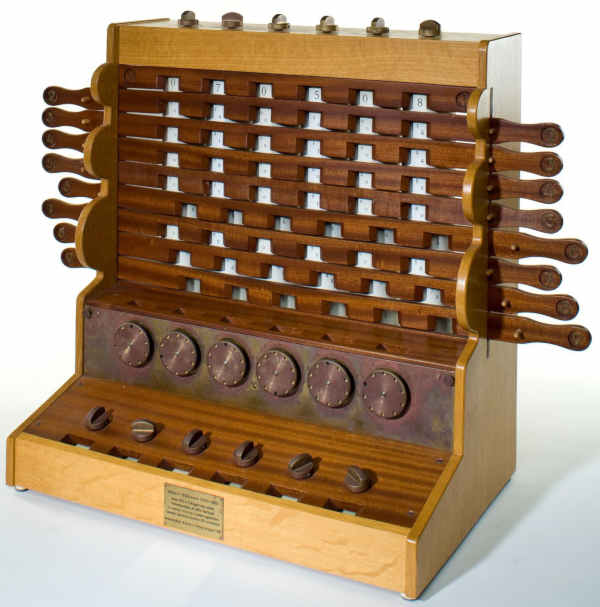
He developed the “Stepped Reckoner,” which utilized a specialized gear known as the Leibniz wheel. This device was the first to implement a formal mechanical algorithm for multiplication through repeated addition. Although the Stepped Reckoner suffered from mechanical friction and manufacturing limitations of the time, its design remained the standard for mechanical calculators for the next 200 years.
From Mechanical Giants to Desktop Machines
As the Industrial Revolution took hold, the demand for precision in engineering and banking surged. The calculator moved from being a laboratory curiosity to a commercially viable tech product.
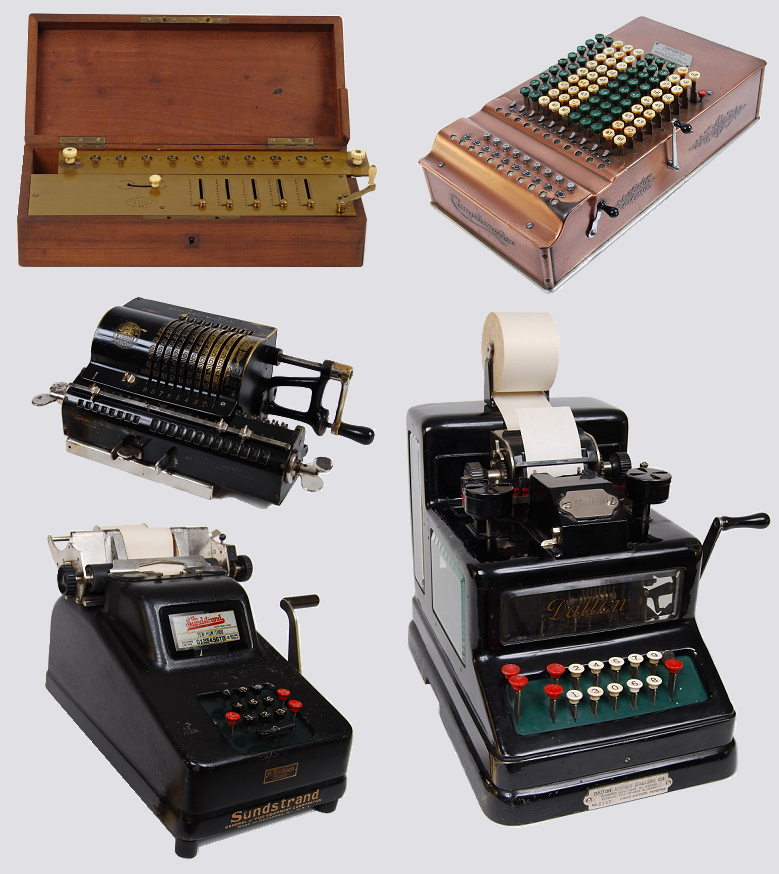
The Arithmometer: Commercial Success
In 1820, Thomas de Colmar patented the Arithmometer. While Pascal and Leibniz proved the concept, Colmar was the first to make a machine robust enough for daily office use. It was the first commercially successful calculator, and it remained in production for nearly a century. This device brought “desktop computing” to the Victorian era, allowing insurance companies and banks to perform long-form division and multiplication with unprecedented speed.
The Curta Calculator: A Masterpiece of Miniaturization
One of the most legendary pieces of tech in the history of calculation is the Curta calculator. Designed by Curt Herzstark while he was a prisoner in a concentration camp during WWII, the Curta was a hand-held, cylindrical mechanical calculator.
Often called the “pepper grinder” because of its shape and crank, the Curta was an engineering marvel. It contained over 600 tiny parts and could perform all four arithmetic functions with 11-digit precision. Until the rise of electronic pocket calculators in the 1970s, the Curta was the ultimate gadget for engineers, surveyors, and rally car racers.
The Silicon Revolution: The Birth of the Electronic Calculator
The most radical shift in the history of the calculator—and perhaps all of technology—occurred in the mid-20th century. This was the transition from moving gears to moving electrons.
The Transition to Vacuum Tubes and Transistors
In the early 1960s, the first all-electronic desktop calculators appeared. Machines like the ANITA (A New Inspiration To Arithmetic) used vacuum tubes and cold-cathode tubes to perform calculations silently and almost instantaneously. However, these machines were the size of cash registers and consumed massive amounts of power.
The invention of the transistor at Bell Labs changed everything. Transistors allowed for smaller, more reliable, and faster circuits. By the late 1960s, companies like Sharp and Canon were racing to create the first “LSI” (Large Scale Integration) calculators, which condensed thousands of transistors onto a few silicon chips.
The Handheld Revolution and the Microchip
A pivotal moment in tech history occurred in 1971 when the Japanese company Busicom commissioned a young American firm called Intel to design chips for a new calculator. Intel’s engineers, led by Ted Hoff, realized that instead of designing several custom chips for one calculator, they could create a single, programmable “micro-processor.”
This resulted in the Intel 4004—the world’s first microprocessor. The calculator, specifically the quest to make it smaller and cheaper, was the catalyst that birthed the modern CPU. Shortly after, in 1972, Hewlett-Packard released the HP-35, the world’s first scientific handheld calculator, effectively making the slide rule obsolete overnight.
The Future of Calculation in the Age of AI and Software
Today, the dedicated calculator has largely been absorbed into the ecosystem of smartphones and computers. However, the technology continues to evolve, moving away from simple arithmetic toward complex symbolic computation.
Scientific Calculators and Graphing Powerhouses
While most people use the calculator app on their iPhone for basic math, dedicated hardware like the TI-84 or the HP Prime remains essential in STEM education. These devices are no longer just calculators; they are sophisticated computers capable of 3D graphing, algebraic manipulation, and Python programming. They represent the pinnacle of “single-tasking” tech—hardware optimized for a specific, high-performance cognitive load.
From Dedicated Hardware to Integrated Software Ecosystems
In the current tech landscape, “calculation” has evolved into “computation.” We have moved from the Pascaline to cloud-based engines like WolframAlpha and AI-driven tools like ChatGPT and Gemini. These tools don’t just solve x + y; they interpret natural language, simulate physics, and predict market trends using neural networks.
The question of “when was the first calculator invented” reminds us that every smartphone in our pocket is the direct descendant of Pascal’s gears and Intel’s first calculator chips. We have reached a point where the calculator is no longer a separate tool but a fundamental layer of our digital reality, integrated into every algorithm that powers our modern world. The journey from the abacus to AI-driven mathematics is a testament to the human desire to build tools that not only help us think but eventually, help us think better.
aViewFromTheCave is a participant in the Amazon Services LLC Associates Program, an affiliate advertising program designed to provide a means for sites to earn advertising fees by advertising and linking to Amazon.com. Amazon, the Amazon logo, AmazonSupply, and the AmazonSupply logo are trademarks of Amazon.com, Inc. or its affiliates. As an Amazon Associate we earn affiliate commissions from qualifying purchases.