
For anyone involved in the world of finance, from seasoned institutional investors to budding retail traders and even those simply tracking their retirement accounts, understanding the operating hours of Wall Street is not just a matter of trivia—it’s fundamental. Wall Street, often used as a metonym for the entire U.S. financial market, is the epicenter of global capitalism, where billions of dollars worth of stocks, bonds, and other financial instruments change hands daily. Knowing precisely when the markets open, close, and the nuances of pre-market and after-hours trading can significantly impact investment strategies, risk management, and overall financial decision-making.

The rhythms of the market—the opening bell, the frenetic midday trading, and the closing gavel—are steeped in tradition and are vital for maintaining an orderly and transparent marketplace. These specific timings provide structure, liquidity, and a common framework for participants worldwide. This article will delve into the standard operating hours of the major U.S. exchanges, explore the increasingly important extended trading sessions, detail market holidays, and discuss why these timings are so crucial for anyone navigating the complex currents of the financial world. Whether you’re planning a trade, analyzing a company’s earnings report, or simply looking to understand the forces that move your portfolio, a clear grasp of Wall Street’s clock is an indispensable tool in your financial arsenal.
The Standard Operating Hours of U.S. Financial Markets
At the heart of Wall Street are its two primary stock exchanges: the New York Stock Exchange (NYSE) and the NASDAQ Stock Market. These two giants dictate the conventional trading day for the vast majority of publicly traded U.S. securities. Understanding their core operating hours is the foundational step for any market participant.
New York Stock Exchange (NYSE) and NASDAQ
The NYSE, known for its iconic trading floor and specialist system, and the NASDAQ, a fully electronic exchange synonymous with technology and growth companies, both adhere to the same standard trading schedule for their regular sessions. This schedule is typically:
- Market Open: 9:30 AM Eastern Time (ET)
- Market Close: 4:00 PM Eastern Time (ET)
This means the standard trading day runs for six and a half hours, Monday through Friday, excluding market holidays. During these hours, orders are executed, prices are discovered through the interplay of supply and demand, and the lion’s share of daily trading volume occurs. The opening bell ceremony at the NYSE, often featuring prominent figures, and the closing bell, signaling the end of the day’s regular trading, are well-known symbols of the financial world.
Understanding Eastern Time (ET)
It is critical to note that all times referenced for U.S. stock market operations are based on Eastern Time (ET), which can be either Eastern Standard Time (EST) or Eastern Daylight Time (EDT) depending on the time of year. For investors and traders located in different time zones, accurately converting these hours is paramount to avoid missing crucial trading windows or misinterpreting market events. For example, a trader on the West Coast of the U.S. (Pacific Time) would see the market open at 6:30 AM PT and close at 1:00 PM PT. Similarly, international investors must make the necessary adjustments to their local time. This universal adoption of Eastern Time helps standardize communication and operations across a globally diverse participant base.
Why These Hours Are Crucial
The defined market hours serve several vital functions. Firstly, they concentrate liquidity, ensuring that a sufficient number of buyers and sellers are present simultaneously, which helps facilitate efficient price discovery and reduces volatility caused by thin trading. This concentration also contributes to tighter bid-ask spreads, making it cheaper to execute trades. Secondly, the fixed schedule allows for systematic processing of orders, settlement of trades, and dissemination of information. Financial news outlets, data providers, and institutional research houses align their operations with these hours, creating a synchronized environment for information flow. For individual investors, understanding these hours enables them to plan their trading activities, monitor their portfolios effectively, and react promptly to breaking news or economic data releases that occur during market hours. The structured nature of the trading day provides predictability and reduces uncertainty, which are critical elements for maintaining market integrity and investor confidence.
Navigating Beyond Standard Trading Sessions
While the regular 9:30 AM to 4:00 PM ET window defines the core trading day, the advent of electronic trading has significantly expanded the periods during which investors can buy and sell securities. Pre-market and after-hours trading sessions offer flexibility and opportunities but also come with their own unique characteristics and risks.
Pre-Market Trading: Getting a Head Start
Pre-market trading refers to the period before the official market open. For major U.S. exchanges like the NYSE and NASDAQ, pre-market trading typically begins as early as 4:00 AM ET and extends until the market officially opens at 9:30 AM ET. This session is particularly active for professional traders and institutions who wish to react to news that breaks overnight, such as international market movements, company earnings announcements made before the open, or significant geopolitical developments.
The primary advantage of pre-market trading is the ability to act on information ahead of the broader market. A company might announce stellar earnings results at 7:00 AM ET, and traders can buy shares in anticipation of a positive surge at the open. Conversely, negative news can lead to pre-emptive selling. However, pre-market trading is characterized by significantly lower liquidity compared to regular hours. Fewer participants mean wider bid-ask spreads and potentially greater price volatility. Executing large orders can be challenging, and prices may not always reflect the true market sentiment due to the limited trading volume. Investors should exercise caution, understanding that prices established in pre-market can be volatile and may not hold once the regular session begins.
After-Hours Trading: Reacting to Late-Breaking News
Following the close of the regular trading session at 4:00 PM ET, after-hours trading commences and can last until 8:00 PM ET, or even later with some brokerage platforms. This session is crucial for reacting to news that emerges after the market closes, such as quarterly earnings reports, company press releases, or economic data. For instance, if a tech giant releases its much-anticipated earnings at 4:15 PM ET, investors have the opportunity to trade its stock in the after-hours session based on that information, rather than waiting until the next morning.
Similar to pre-market trading, after-hours sessions offer the benefit of immediate response to new information. However, they share the same disadvantages: lower liquidity, wider spreads, and increased volatility. Institutional investors and algorithmic trading systems often dominate these sessions. For retail investors, participating in after-hours trading requires a keen understanding of these dynamics. It’s not uncommon for a stock to experience significant price swings in after-hours trading only for those movements to partially or completely reverse at the next day’s regular market open, once full liquidity is restored and a broader consensus forms.
The Role of Electronic Communication Networks (ECNs)
The existence and growth of pre-market and after-hours trading are largely facilitated by Electronic Communication Networks (ECNs). ECNs are automated trading systems that match buy and sell orders electronically, bypassing the traditional exchange floor. They allow institutional and individual investors to place orders directly into the market, even outside of regular exchange hours, and find counterparties. Brokerage firms provide access to these ECNs, enabling their clients to participate in extended-hours trading. Without these electronic platforms, the concept of continuous trading beyond the standard 6.5-hour window would be far less practical, highlighting how technology has reshaped the landscape of market accessibility and timing.
Market Closures and Their Implications
While the trading week typically runs Monday to Friday, Wall Street, like many other workplaces, observes a number of holidays throughout the year. These closures are not merely days off; they have significant implications for market participants, affecting trading strategies, liquidity, and even the processing of financial transactions.
Official Stock Market Holidays
The U.S. stock markets (NYSE and NASDAQ) observe a set schedule of holidays when they are completely closed. These typically include:
- New Year’s Day
- Martin Luther King, Jr. Day
- Washington’s Birthday (Presidents’ Day)
- Good Friday (though not a federal holiday, it’s observed by the stock markets)
- Memorial Day
- Juneteenth National Independence Day
- Independence Day (Fourth of July)
- Labor Day
- Thanksgiving Day
- Christmas Day
When one of these holidays falls on a weekend, the market typically observes it on the nearest weekday (e.g., if July 4th falls on a Saturday, the market might close on Friday, July 3rd). These full closures mean absolutely no trading occurs, providing a complete break for market participants and allowing financial systems to reset. For investors, it means no opportunity to react to news that breaks on a holiday, potentially leading to significant “gap” openings or closings on the next trading day.
Early Closures and Special Circumstances
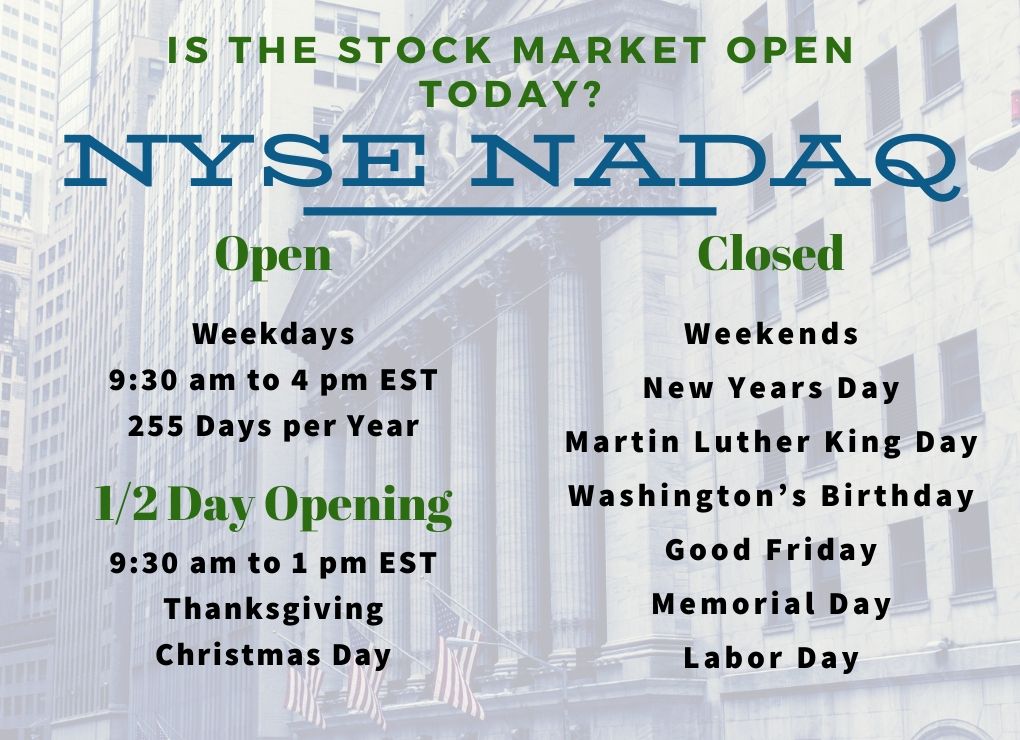
In addition to full-day holidays, the U.S. stock markets sometimes have early closures. These often occur on the day before or after certain major holidays, such as the day after Thanksgiving (Black Friday) or Christmas Eve. On these days, the market might close at 1:00 PM ET instead of the usual 4:00 PM ET. While trading is still possible, the reduced hours can lead to lower liquidity and increased volatility in the condensed session.
Special circumstances, though rare, can also lead to unscheduled market closures or delays. These might include severe weather events impacting New York City, significant national emergencies, or technological failures. Such unexpected disruptions are closely monitored by regulators and exchanges to ensure market integrity and investor safety. The impact of such closures can range from minor inconvenience to significant operational challenges for firms and traders.
Impact on Trading Strategies and Liquidity
Market closures, whether scheduled or unscheduled, profoundly affect trading strategies and market liquidity. For instance, options traders must be mindful of expiration dates falling on or around holidays, as they might have fewer trading days than anticipated to manage their positions. Day traders are simply out of commission. Swing traders and long-term investors need to consider “weekend risk” or “holiday risk,” where significant global news or company-specific announcements occur during a market closure, potentially leading to large price movements when trading resumes.
Liquidity, already a concern in extended trading sessions, can also be affected around holidays. Trading volumes often decline in the days leading up to and immediately following a holiday as participants take time off or reduce their exposure. This reduced liquidity can lead to choppier price action and makes it more challenging to execute trades at desired prices, especially for larger blocks of shares. Understanding the holiday schedule is thus not just about knowing when you can’t trade, but also about anticipating changes in market behavior and planning portfolio adjustments accordingly.
The Global Interconnectedness of Market Hours
While the focus has been on Wall Street’s specific operating times, it’s crucial to understand that the world’s financial markets are a highly interconnected global network. The closing bell in New York doesn’t signify the end of trading; it merely marks a shift in the primary geographical focus of market activity.
The “Trading Day” Across Time Zones
The concept of a “trading day” is a continuous, 24-hour cycle that rolls across the globe, driven by different time zones. As Wall Street closes, markets in Asia are already several hours into their trading day, and European markets are approaching their close. This creates an unbroken chain of financial activity:
- Asia Opens First: The trading week typically kicks off in Asia, with major exchanges like Tokyo (Nikkei), Shanghai, Hong Kong, and Sydney opening as early as Sunday evening ET.
- Europe Takes Over: As Asian markets conclude or are well into their afternoon, European markets in London, Frankfurt, and Paris begin their sessions. There’s an overlap between Asian and European trading, and then a significant overlap between European and U.S. trading.
- Wall Street Dominates: The U.S. session, particularly Wall Street, is the most liquid and influential, often setting the tone for the subsequent Asian open.
- Latin America Concludes: Markets in regions like Brazil or Mexico may conclude trading shortly after New York.
This continuous cycle means that news and economic data released in one part of the world can instantly influence markets across different time zones. For example, a major economic policy announcement in China during its trading hours will likely impact European markets hours later, and then U.S. markets upon their opening.
How Wall Street’s Hours Influence Global Markets
Wall Street’s operating hours are particularly significant because of the sheer volume and influence of the U.S. economy and its financial markets. The U.S. dollar is the world’s primary reserve currency, and many global commodities are priced in USD. Decisions made by the Federal Reserve, U.S. economic data, and earnings from major U.S. multinational corporations have ripple effects felt worldwide.
During the overlap between European and U.S. trading hours (roughly 8:00 AM ET to 11:30 AM ET), liquidity is at its highest across the global equity, forex, and bond markets. This period is often characterized by heightened volatility and significant price movements as major participants from both continents are actively engaged. When Wall Street closes, European markets have often already concluded or are winding down, and the baton is effectively passed to the Asian markets for the next cycle. Any significant moves in U.S. futures markets during the U.S. overnight session can then influence how Asian markets open.
Managing International Portfolios
For investors with international portfolios or those trading global instruments, understanding the interplay of different market hours is absolutely critical. It informs decisions about when to place orders, when to monitor news affecting specific regions, and how to manage currency exposures. For instance, an investor holding shares in a European company might monitor both the local European market hours and the U.S. market hours due to potential spillover effects.
Furthermore, economic calendars become globalized. An investor tracking an S&P 500 ETF must also be aware of interest rate decisions from the European Central Bank or manufacturing data from China, as these can impact the sentiment and valuations that will greet U.S. markets upon their opening. The interconnectedness necessitates a comprehensive, 24/7 awareness for active global investors, reinforcing why Wall Street’s schedule is but one piece of a much larger, always-on puzzle.
Strategic Considerations for Investors and Traders
The timing of market operations isn’t just a logistical detail; it forms a critical component of any well-thought-out investment or trading strategy. Different market sessions present unique characteristics that savvy participants can leverage or must account for.
Optimizing Your Trading Approach Based on Market Sessions
- The Open (9:30 AM – 10:00 AM ET): The first 30 minutes to an hour of the regular trading session are often the most volatile and offer some of the greatest opportunities for day traders. This period is driven by the collective reaction to overnight news, pre-market activity, and the influx of orders accumulated before the open. High volatility can lead to significant price swings, but also carries higher risk. Scalpers and momentum traders often thrive in this window.
- Mid-Day Lull (10:00 AM – 3:00 PM ET): After the initial burst of activity, the market often settles into a more subdued pace. Volume can decrease, and price movements may become more range-bound. This period might be suitable for swing traders looking for established trends or investors making less time-sensitive portfolio adjustments. Algorithmic trading systems often dominate this quieter period.
- The Close (3:00 PM – 4:00 PM ET): The final hour of trading often sees a resurgence in activity, though typically less volatile than the open. Institutions may be rebalancing portfolios, executing large orders to meet end-of-day requirements, or attempting to “mark the close” to influence closing prices. This period can offer opportunities for traders looking to capture end-of-day momentum or anticipate the next day’s open.
- Extended Hours (Pre-Market & After-Hours): As discussed, these sessions are characterized by lower liquidity and higher volatility. They are best suited for traders with experience in managing such conditions, those needing to react immediately to breaking news, or those employing specific arbitrage strategies. Retail investors should approach extended hours with caution, using limit orders to control prices.
The Psychology of Market Open and Close
The psychological impact of market opening and closing times is profound. The opening bell often brings a mix of excitement and anxiety, as investors react to new information. This can lead to irrational exuberance or panic selling, particularly in the initial minutes. Similarly, the anticipation of the closing bell can create a “fear of missing out” (FOMO) or a rush to liquidate positions, influencing prices in the final hour.
Understanding these psychological biases is crucial for maintaining discipline. Seasoned traders often develop routines to manage the emotional rollercoaster of the market open. They may wait for the initial volatility to subside, or conversely, have specific strategies designed to exploit it. The absence of trading during holidays can also build up psychological pressure, leading to pent-up demand or supply that explodes on the next trading day.
Tools and Resources for Tracking Market Activity
To effectively navigate Wall Street’s hours and the broader global financial landscape, investors and traders rely on a suite of tools and resources:
- Financial News Outlets: Major financial news services (e.g., Bloomberg, Reuters, Wall Street Journal, CNBC) provide real-time updates on market hours, holiday schedules, and breaking news that can impact trading.
- Online Brokerage Platforms: Most modern brokerage platforms clearly display market hours, indicate if trading is in pre-market or after-hours, and often provide customizable alerts for market open/close.
- Economic Calendars: These calendars list upcoming economic data releases, central bank announcements, and company earnings reports, often indicating the time of release (usually in ET) so investors can anticipate market reactions.
- Trading Software and Charting Tools: Advanced trading platforms offer comprehensive charting capabilities that include extended-hours data, allowing traders to visualize price action outside of the regular session.
- World Clock/Time Zone Converters: Essential for international investors or those tracking global markets, ensuring accurate conversion of market hours to local time.
By utilizing these resources, investors can stay informed, plan their trades strategically, and adapt to the ever-changing rhythms of Wall Street and the global financial ecosystem.
Conclusion
Understanding “when Wall Street opens” is far more than knowing a simple time; it’s about comprehending the intricate operational structure that underpins global financial markets. From the standard 9:30 AM to 4:00 PM ET regular session to the dynamic and often volatile pre-market and after-hours trading, each period presents unique opportunities and challenges for investors and traders. Market holidays and special closures further punctuate the trading calendar, demanding careful consideration for risk management and strategy adjustments.
Moreover, Wall Street’s schedule is not an isolated phenomenon but an integral part of a continuous, 24-hour global trading cycle. The flow of capital and information across time zones means that activity in Tokyo or London can directly influence the opening in New York, underscoring the interconnectedness of our financial world. For anyone serious about managing their finances, investing, or trading, a comprehensive grasp of these timings is indispensable. It empowers more informed decision-making, helps in optimizing trading strategies, and ultimately contributes to navigating the complex and often thrilling currents of the financial markets with greater confidence and insight. The clock never truly stops in the global financial arena, but knowing when the heart of it beats loudest is key to success.
aViewFromTheCave is a participant in the Amazon Services LLC Associates Program, an affiliate advertising program designed to provide a means for sites to earn advertising fees by advertising and linking to Amazon.com. Amazon, the Amazon logo, AmazonSupply, and the AmazonSupply logo are trademarks of Amazon.com, Inc. or its affiliates. As an Amazon Associate we earn affiliate commissions from qualifying purchases.