
For anyone looking to engage with the world of investing, one of the most fundamental questions is “When does the US stock market open?” This seemingly simple query unlocks a vast landscape of market dynamics, trading strategies, and critical decision-making for both novice and seasoned investors. Understanding the operating hours of the major US stock exchanges is not merely about knowing when you can place an order; it’s about grasping the rhythm of the market, identifying periods of high liquidity, reacting to crucial news, and strategizing your investment approach effectively.
The US stock market, primarily represented by the New York Stock Exchange (NYSE) and the Nasdaq Stock Market, operates on a structured schedule designed to ensure fairness, efficiency, and broad participation. However, the concept of “opening” extends beyond just the standard daytime hours, encompassing pre-market and after-hours sessions that offer different opportunities and challenges. This article will delve into the intricacies of US stock market operating hours, exploring standard sessions, extended trading periods, market holidays, and the strategic implications for investors navigating this dynamic financial environment.
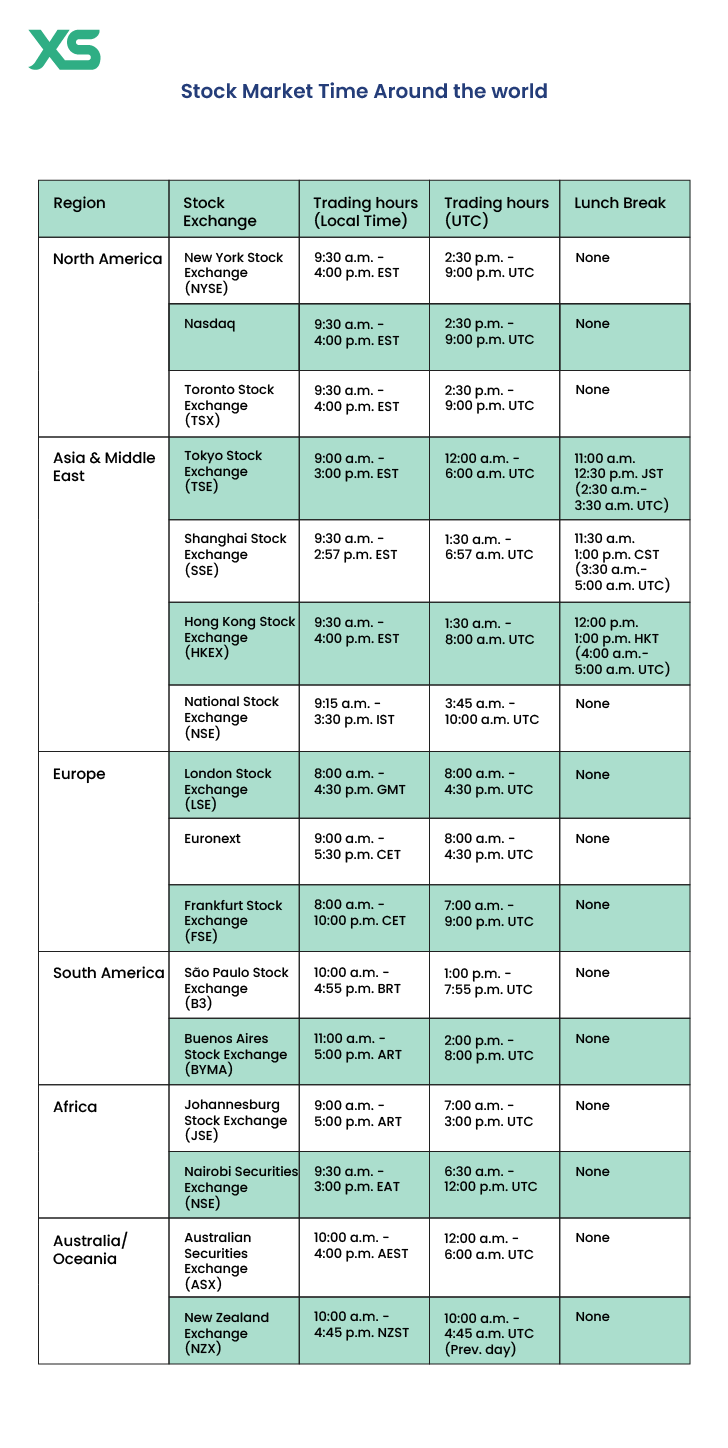
Understanding Standard Trading Hours
The core of US stock market activity revolves around its standard trading hours, a period characterized by the highest volume and liquidity. These hours are widely known and form the basis for most investment strategies.
New York Stock Exchange (NYSE) and Nasdaq
The two titans of the US stock market, the New York Stock Exchange (NYSE) and the Nasdaq Stock Market, adhere to the same official trading schedule for their regular sessions. Both exchanges are open for trading from 9:30 AM Eastern Time (ET) to 4:00 PM ET, Monday through Friday. This six-and-a-half-hour window is when the vast majority of transactions occur, market makers are most active, and price discovery is generally considered most efficient.
The NYSE, based on Wall Street in New York City, is the world’s largest stock exchange by market capitalization, home to many of the most established “blue-chip” companies. Nasdaq, while also based in New York, is known for listing technology and growth companies and operates entirely electronically, unlike the NYSE’s hybrid system of floor trading and electronic trading. Despite their operational differences and the types of companies they attract, their regular trading hours are synchronized to provide a cohesive market environment. This standardization simplifies trading for investors and brokers alike, ensuring that all participants are operating within the same timeframe for conventional transactions.
Key Trading Sessions: Regular vs. Extended Hours
While the 9:30 AM to 4:00 PM ET period defines regular trading hours, it’s crucial for investors to understand that market activity isn’t confined to this window. The broader market environment also includes what are known as “extended hours” trading sessions.
- Regular Trading Session: This is the primary session, from 9:30 AM ET to 4:00 PM ET. It’s characterized by deep liquidity, tighter bid-ask spreads, and a large volume of institutional and retail participation. Price movements during these hours are generally seen as more representative of the market consensus due to the sheer number of participants.
- Pre-Market Trading Session: This session typically begins as early as 4:00 AM ET and runs until the market officially opens at 9:30 AM ET.
- After-Hours Trading Session: This session commences immediately after the regular close at 4:00 PM ET and can extend as late as 8:00 PM ET.
These extended hours provide flexibility but come with distinct characteristics and risks that differentiate them significantly from the regular session. They cater to investors who need to react quickly to news released outside regular hours or those operating in different time zones, but require a more nuanced approach.
Why These Hours Matter for Investors
Understanding the distinct phases of market operation is paramount for several reasons. Firstly, liquidity is highest during regular trading hours. This means there are more buyers and sellers available, making it easier to execute trades at competitive prices without significantly impacting the stock’s price. For most retail investors, executing orders during this window is generally recommended.
Secondly, news events often dictate activity. While major economic data releases and corporate earnings reports can occur at any time, their impact is most profoundly felt during regular market hours, especially at the open or close. However, significant announcements made after hours will drive activity in the subsequent pre-market or after-hours sessions.
Finally, risk management is tied to trading hours. The volatility in extended hours can be much higher due to lower liquidity, leading to wider bid-ask spreads and potentially larger price swings on smaller volumes. For investors, knowing when these conditions prevail allows them to adjust their strategies, whether it’s using limit orders, scaling positions, or simply choosing to avoid trading during less liquid periods. Ignorance of these dynamics can lead to suboptimal trade executions or unexpected losses.
Navigating Pre-Market and After-Hours Trading
Beyond the standard 9:30 AM to 4:00 PM ET window, opportunities and risks emerge during extended trading sessions. These periods allow for flexibility but demand a deeper understanding of market mechanics.
What is Pre-Market Trading?
Pre-market trading refers to the period before the official market open, typically from 4:00 AM ET to 9:30 AM ET. During this time, trading is facilitated by electronic communication networks (ECNs) and alternative trading systems (ATSs), allowing institutions and some retail investors to place buy and sell orders.
The primary driver for pre-market activity is often the release of corporate earnings reports or significant economic news that occurs overnight or early in the morning before the regular session begins. Companies strategically time these announcements to allow investors time to digest the information before the formal opening, though often with a flurry of activity in the pre-market. For instance, if a major tech company announces better-than-expected earnings at 7:00 AM ET, its stock price might surge in pre-market trading as investors react.
However, pre-market trading is characterized by lower liquidity and higher volatility. Fewer participants mean that even relatively small trades can cause disproportionately large price movements. Bid-ask spreads tend to be wider, making it more challenging to execute trades at desired prices and increasing transaction costs. Retail investors participating in pre-market trading typically use limit orders to control their entry or exit prices, as market orders can be executed at surprisingly disadvantageous levels due to thin trading.
The Dynamics of After-Hours Trading
After-hours trading takes place after the regular market close, usually from 4:00 PM ET to 8:00 PM ET. Similar to pre-market trading, it’s primarily conducted through ECNs and ATSs. This session is frequently influenced by news and events that occur after the market closes, such as late-day corporate announcements, analyst upgrades/downgrades, or international market developments.
For example, if a company announces a major acquisition deal at 5:00 PM ET, its stock price could see significant movement in after-hours trading as investors react to the news. After-hours trading offers convenience for investors who might be unavailable during regular hours or who need to act swiftly on new information. It also serves as a crucial period for institutional investors to adjust their portfolios based on late-breaking news without waiting for the next day’s open.
Like pre-market, after-hours trading is marked by reduced liquidity and increased volatility. The limited number of participants means that prices can be more erratic, and significant gaps can form between the after-hours closing price and the next day’s opening price. Investors need to be acutely aware of these conditions, understanding that the price at which they execute a trade after hours might not reflect the broader market consensus that will emerge during regular trading.
Advantages and Disadvantages of Extended Sessions
Advantages:
- Flexibility: Allows investors to react to news and execute trades outside standard working hours.
- Early Reaction: Opportunity to get ahead of the curve on significant news events before the full market reacts.
- Convenience: Ideal for those in different time zones or with commitments during regular market hours.
Disadvantages:
- Lower Liquidity: Fewer participants can lead to difficulty in executing large orders without impacting price, and wider bid-ask spreads.
- Increased Volatility: Prices can swing dramatically on thin volume, leading to unpredictable movements.
- Limited Order Types: Not all brokerages offer full functionality for extended-hours trading; often, only limit orders are available.
- Competition: Institutional investors often have faster access and better technology, potentially putting retail investors at a disadvantage.
- Price Discrepancy: The price at which a trade is executed in extended hours may differ significantly from the next day’s opening price.
Stock Market Holidays and Early Closures
While the US stock market generally adheres to a Monday-to-Friday schedule, it observes several federal holidays throughout the year when trading is suspended. Additionally, there are instances of early closures that investors must be aware of.
Major US Stock Market Holidays
The NYSE and Nasdaq typically close in observance of nine federal holidays. These days are non-trading days, meaning no regular, pre-market, or after-hours trading occurs. It’s crucial for investors to be aware of these closures to avoid missed opportunities or unexpected delays in trade execution. The major holidays observed include:
- New Year’s Day: January 1
- Martin Luther King, Jr. Day: Third Monday in January
- Presidents’ Day (Washington’s Birthday): Third Monday in February
- Good Friday: The Friday before Easter
- Memorial Day: Last Monday in May
- Juneteenth National Independence Day: June 19
- Independence Day: July 4
- Labor Day: First Monday in September
- Thanksgiving Day: Fourth Thursday in November
- Christmas Day: December 25
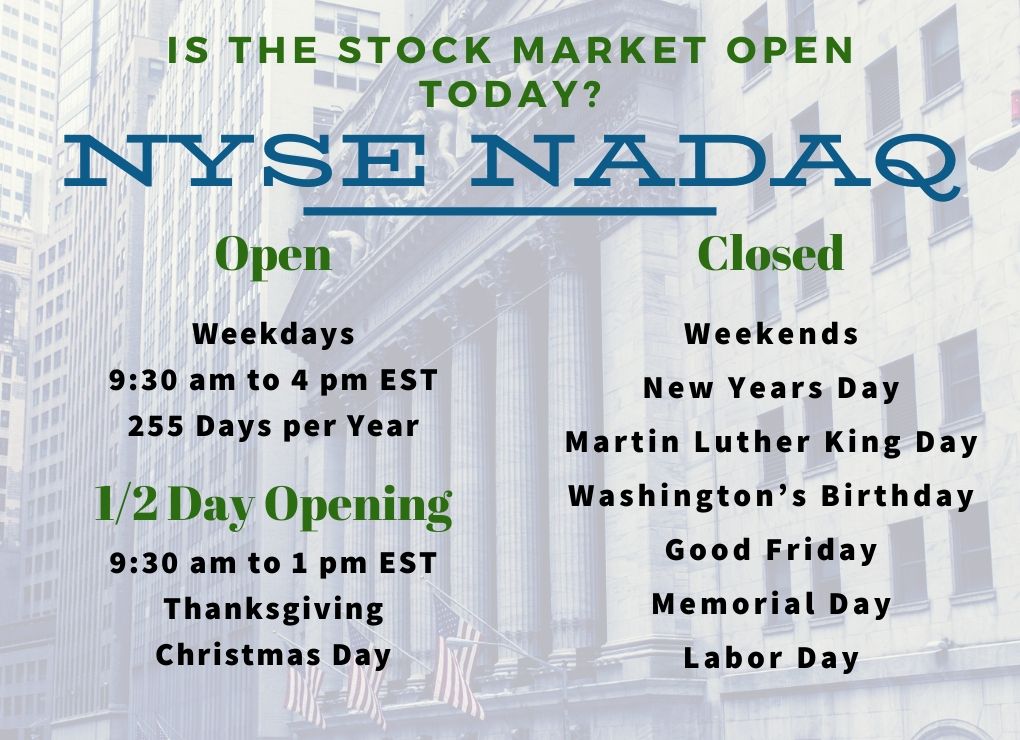
If a holiday falls on a weekend, the market typically observes it on the closest weekday (e.g., if Christmas falls on a Saturday, the market might close on the preceding Friday; if it falls on a Sunday, it might close on the following Monday). Investors should always consult the official holiday schedules published by the NYSE and Nasdaq at the beginning of each year.
Understanding Early Closure Days
In addition to full holidays, the US stock market occasionally observes early closures. These are typically half-days where the market closes at 1:00 PM ET instead of 4:00 PM ET. Common days for early closures include:
- The day after Thanksgiving (Black Friday): This is a routine early close.
- Christmas Eve: If it falls on a weekday, the market often closes early.
- New Year’s Eve: If it falls on a weekday, the market often closes early.
These early closures, while less frequent than full holidays, can still impact trading strategies, especially for day traders or those expecting to react to late-day news. The reduced trading hours mean compressed liquidity and a quicker response window to any market-moving events occurring during the truncated session.
Planning Around Non-Trading Days
For investors, planning around stock market holidays and early closures is essential for several reasons:
- Trade Execution: Orders placed on a holiday will not be executed until the next trading day, which could lead to missed opportunities or price changes.
- Options Expiration: For options traders, understanding the exact market calendar is critical as expiration dates are firm, regardless of holidays.
- Fund Settlement: Bank holidays often coincide with stock market holidays, impacting the settlement of funds from trades. If you sell shares, the cash might not be available until a few business days later, prolonged by a holiday.
- News Reaction: Major economic reports or company announcements might still occur on non-trading days, and the market will react vigorously on the next open. Being aware allows investors to anticipate potential volatility.
Staying informed through official exchange websites, reputable financial news sources, or your brokerage’s calendar is the best practice to avoid surprises related to market closures.
Factors Influencing Trading Hours and Market Dynamics
The US stock market’s operating hours, while seemingly fixed, are part of a larger, interconnected global financial system. Various factors beyond just the clock influence market dynamics across these trading periods.
Time Zones and Global Market Interconnection
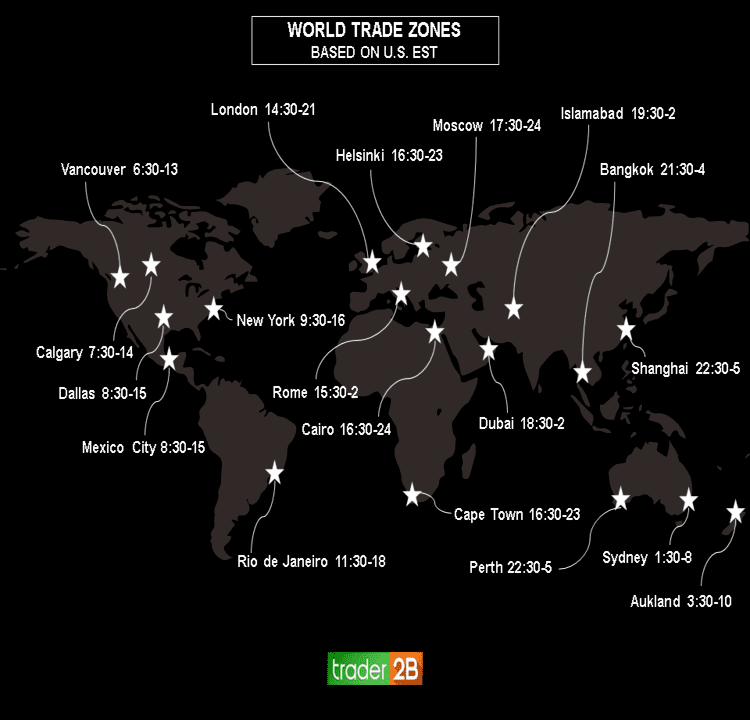
The US stock market operates on Eastern Time (ET), which aligns with New York City. However, investors and financial institutions operate globally. This means that when the US market is closing, Asian markets might be opening, and European markets are in full swing or winding down. This interconnectedness creates a continuous global trading environment.
- Impact of Overseas Markets: Performance in Asian and European markets can influence pre-market and early regular session trading in the US. For instance, a sharp downturn in a major European index could lead to a weaker opening for US stocks as investors react to global sentiment.
- Currency and Commodity Markets: Foreign exchange (forex) and commodity markets (like oil and gold) trade almost 24 hours a day, five days a week. Movements in these markets can significantly impact specific sectors or the broader US equity market during any trading session. For example, a surge in crude oil prices overnight could trigger a rally in energy stocks during the US pre-market.
- Investor Access: For investors in different US time zones (e.g., Pacific Time) or international investors, the standard 9:30 AM – 4:00 PM ET window translates to different local times, requiring strategic timing for active participation.
Volatility and Liquidity Across Trading Periods
The interplay between volatility and liquidity is a critical consideration for investors, and it varies significantly across different trading sessions.
- Opening and Closing Bells (Regular Hours): The first and last hour of the regular trading session (9:30 AM – 10:30 AM ET and 3:00 PM – 4:00 PM ET) are typically the most volatile and liquid. The opening hour sees a rush of orders accumulated overnight or during pre-market, leading to rapid price discovery. The closing hour often sees institutional rebalancing, order fulfillment, and last-minute reactions, contributing to heightened activity.
- Mid-Day Lull: The middle of the regular trading day (roughly 11:00 AM – 2:00 PM ET) often experiences a dip in trading volume and liquidity, leading to potentially tighter trading ranges and less dramatic price movements.
- Extended Hours: As discussed, pre-market and after-hours trading inherently suffer from lower liquidity, making them susceptible to higher volatility. A relatively small number of trades can lead to significant price swings, creating both opportunities for quick profits and risks of substantial losses. Understanding this dynamic is crucial for setting appropriate order types (e.g., limit orders) and managing risk.
The Role of Economic Data and News Releases
Major economic data points and company-specific news releases are powerful catalysts for market movement, and their timing relative to trading hours is critical.
- Scheduled Economic Reports: Key economic indicators (e.g., inflation reports, unemployment figures, GDP growth) are often released before the market opens (e.g., 8:30 AM ET) or occasionally during regular hours. These releases can dictate the market’s initial direction and sentiment for the day.
- Corporate Earnings: Companies often release their quarterly earnings reports either before the market open or after the market closes. These announcements are prime drivers of extended-hours trading as investors react immediately to the news. Positive news can send a stock soaring in pre-market, while negative news can cause it to plummet after-hours.
- Geopolitical Events and Unscheduled News: Unexpected geopolitical events, central bank announcements, or breaking news can occur at any time, instantly impacting market sentiment across all trading sessions, though their full effect might only materialize once regular hours resume.
Being attuned to these release schedules and news flows is fundamental for investors looking to make informed decisions and capitalize on market reactions.
Strategic Implications for Investors
Understanding when the US stock market opens, closes, and operates during extended hours isn’t just academic knowledge; it has profound strategic implications for all types of investors.
Adapting to Different Trading Cycles
Different trading styles often align with specific market cycles:
- Day Traders: Highly active during regular trading hours, particularly the opening and closing hours, seeking to capitalize on short-term volatility and liquidity. They often monitor pre-market activity for cues on how a stock might open.
- Swing Traders: May hold positions for a few days to several weeks. They use market hours to enter and exit trades but also pay attention to how stocks close and open, as gaps can significantly impact their positions.
- Long-Term Investors: While less concerned with intraday fluctuations, even long-term investors benefit from understanding market hours. Major news or economic shifts occurring during off-hours can present opportune entry or exit points, or at least inform their perspective on existing holdings. For instance, a long-term investor might use a significant after-hours dip on temporary bad news to add to a position at a discount.
- International Investors: Must reconcile their local time with Eastern Time, often utilizing extended hours trading or placing orders overnight through their brokerage platforms.
Each investor must adapt their strategy to leverage the advantages of each trading period while mitigating its inherent risks. This means, for example, avoiding large market orders during illiquid after-hours sessions or being prepared for heightened volatility at the regular market open.
Tools and Resources for Tracking Market Hours
In today’s digital age, investors have a wealth of tools and resources at their fingertips to stay informed about market hours and related news:
- Brokerage Platforms: Most online brokerage platforms clearly display market status (open, closed, pre-market, after-hours) and provide calendars for holidays and early closures. They also facilitate extended-hours trading with specific order types.
- Financial News Websites: Reputable financial news outlets (e.g., The Wall Street Journal, Bloomberg, Reuters, CNBC, Yahoo Finance) publish daily market opening and closing reports, holiday schedules, and real-time updates on pre-market and after-hours activity.
- Exchange Websites: The official websites for the NYSE (www.nyse.com) and Nasdaq (www.nasdaq.com) provide definitive schedules for trading hours and holidays.
- Financial Apps: Many mobile apps offer market tracking, real-time quotes, news feeds, and personalized alerts, helping investors stay updated regardless of their location or time zone.
- Economic Calendars: Essential for tracking the release times of major economic data, which can trigger significant market reactions.
Utilizing these resources helps investors make timely and informed decisions, ensuring they are never caught off guard by market closures or significant off-hours movements.
The Importance of a Well-Informed Trading Strategy
Ultimately, knowing when the US stock market opens is just the first step. The true value lies in integrating this knowledge into a comprehensive and well-informed trading strategy. This involves:
- Risk Management: Understanding that extended hours trading carries higher risk due to lower liquidity and higher volatility, and adjusting position sizes or order types accordingly.
- Order Placement: Using limit orders for greater control over execution prices, especially during volatile or illiquid periods. Market orders can be unpredictable in such conditions.
- News Monitoring: Staying constantly updated on economic data releases, corporate earnings, and geopolitical events that can impact market sentiment and specific stocks across all trading sessions.
- Time Zone Awareness: Particularly for international investors or those in different US time zones, aligning personal schedules with market hours is crucial for active trading.
- Continuous Learning: The market is dynamic. Rules and technologies can evolve, and staying abreast of these changes, including potential modifications to trading hours or holiday schedules, is vital for long-term success.
In conclusion, the question “When does the US stock market open?” unravels a multi-faceted operational schedule that directly impacts investment outcomes. From the high-liquidity regular session to the volatile extended hours and the planned interruptions of holidays, each period presents unique characteristics. A thorough understanding of these dynamics, combined with diligent preparation and a robust strategy, empowers investors to navigate the complexities of the US stock market with greater confidence and effectiveness, turning mere timings into strategic advantages.
aViewFromTheCave is a participant in the Amazon Services LLC Associates Program, an affiliate advertising program designed to provide a means for sites to earn advertising fees by advertising and linking to Amazon.com. Amazon, the Amazon logo, AmazonSupply, and the AmazonSupply logo are trademarks of Amazon.com, Inc. or its affiliates. As an Amazon Associate we earn affiliate commissions from qualifying purchases.