
The night sky has captivated humanity for millennia, inspiring both awe and inquiry. From ancient civilizations meticulously charting the movements of celestial bodies to modern scientists probing the farthest reaches of the universe, our relationship with the cosmos has profoundly shaped our understanding of existence. Yet, in popular discourse, two distinct disciplines often get conflated: astronomy and astrology. While both derive their roots from observing the heavens, their methodologies, goals, and underlying philosophies diverge dramatically. Understanding this fundamental difference is crucial not only for scientific literacy but also for navigating an increasingly complex digital landscape where information, and misinformation, abounds. This article will delve into the core distinctions between astronomy and astrology, exploring how technology, branding, and economic models intersect with each in the modern world.

Defining the Cosmos: Astronomy’s Scientific Lens
At its heart, astronomy is a natural science dedicated to the study of everything beyond Earth’s atmosphere. This encompasses celestial objects such as stars, planets, moons, galaxies, nebulae, and comets, as well as phenomena like supernovae, gamma-ray bursts, and the cosmic microwave background radiation. Astronomers seek to understand the universe’s origin, evolution, physics, chemistry, meteorology, and motion of celestial bodies. It is a field driven by empirical evidence, observation, mathematical models, and the relentless pursuit of verifiable truth.
The Pillars of Scientific Inquiry
Astronomy operates under the rigorous framework of the scientific method. This involves:
- Observation: Utilizing sophisticated instruments, from ground-based telescopes to orbiting observatories, to gather data about celestial phenomena. This data is meticulously recorded, cataloged, and shared among the scientific community.
- Hypothesis Formulation: Developing testable explanations for observed phenomena based on existing knowledge and logical reasoning. For example, a hypothesis might propose the existence of dark matter to explain discrepancies in galactic rotation curves.
- Experimentation/Testing: While astronomers can’t directly “experiment” with stars, they test hypotheses through further observation, data analysis, and predictive modeling. If a hypothesis predicts a certain outcome, astronomers will look for that outcome or design new observations to confirm or refute it. Computational simulations, often leveraging powerful supercomputers and advanced algorithms, play a crucial role in modeling complex astrophysical processes.
- Peer Review and Falsifiability: Research findings are subjected to scrutiny by other experts in the field, ensuring methodological soundness and logical coherence. Crucially, scientific theories must be falsifiable—meaning there must be a conceivable observation or experiment that could prove them wrong. This constant self-correction and openness to revision are hallmarks of scientific progress.
Technological Marvels Driving Discovery
Modern astronomy is inextricably linked with technology. From the first refracting telescopes to the Hubble Space Telescope, the James Webb Space Telescope, and massive arrays like the Atacama Large Millimeter/submillimeter Array (ALMA), technological advancements have continually expanded our cosmic horizons. These instruments are not merely magnifying glasses; they are highly complex systems incorporating cutting-edge optics, detectors, cryogenics, and precise pointing mechanisms.
Beyond physical instruments, the Tech sector fuels astronomy through:
- Software and AI Tools: Massive datasets generated by observatories require advanced data processing and analysis software. Artificial intelligence (AI) and machine learning algorithms are increasingly employed to identify patterns in vast astronomical data, classify galaxies, detect exoplanets, and even sift through signals for potential signs of extraterrestrial intelligence (SETI). AI can automate routine tasks, enhance image processing, and accelerate the discovery of subtle anomalies.
- Computational Power: Simulating the Big Bang, stellar evolution, or galaxy collisions demands immense computational resources. Supercomputers run complex physics models, allowing astronomers to “watch” the universe evolve over billions of years in a matter of days.
- Digital Security and Data Management: Protecting sensitive data from hacking and ensuring its integrity are paramount. Observatories and research institutions employ robust digital security measures to safeguard proprietary information and ensure reliable access for researchers worldwide. Cloud computing and distributed databases facilitate collaborative research on a global scale.
- Gadgets and Apps: While serious research uses professional equipment, consumer-grade gadgets like advanced astrophotography cameras and astronomy apps (e.g., Stellarium, SkyView) make the cosmos accessible to enthusiasts, fostering public engagement and sometimes even contributing to citizen science projects.
Charting the Human Experience: Astrology’s Interpretive Art
In stark contrast to astronomy, astrology is a collection of belief systems and practices that posit a relationship between astronomical phenomena and events or characteristics in the human world. It suggests that the positions and movements of celestial bodies—planets, stars, and other phenomena—at the time of a person’s birth (or other significant events) can influence their personality, destiny, and daily life.
Roots in Ancient Wisdom and Cultural Significance
Astrology has a rich and complex history, deeply intertwined with ancient civilizations across Mesopotamia, Egypt, India, China, and Greece. Before the scientific revolution, astronomy and astrology were often indistinguishable, with stargazers fulfilling roles as both scientific observers and spiritual interpreters. Ancient astrologers developed elaborate systems based on the perceived patterns of the heavens, correlating them with earthly seasons, agricultural cycles, and human events. These systems often reflected sophisticated mathematical understanding of celestial mechanics for their time.
Today, astrology manifests in various forms: Western astrology (based on zodiac signs and planetary aspects), Vedic astrology (Jyotish), Chinese astrology, and others. While methods and interpretations vary, the core premise remains: the cosmos holds keys to individual and collective human experience.
The Digital Age of Horoscopes and Astrological Services
Despite its ancient origins, astrology has found a vibrant new life in the digital age. Tech has provided unprecedented platforms for its dissemination and personalized engagement:
- Apps and Online Platforms: Hundreds of astrology apps (e.g., Co-Star, The Pattern) offer personalized birth chart readings, daily horoscopes, compatibility analyses, and astrological event notifications. Websites host vast libraries of astrological information, forums, and online courses.
- AI-Generated Content: The rise of AI has led to tools that can generate personalized astrological reports and horoscopes based on user-entered birth data, making complex interpretations more accessible and instantaneous.
- Social Media and Influence: Platforms like Instagram, TikTok, and YouTube are replete with astrologers, spiritual gurus, and content creators building substantial followings. This phenomenon directly ties into Brand strategy.
This digital transformation has also fueled the Money aspect of astrology, creating a thriving online economy. Many astrologers offer professional readings, personalized charts, workshops, and courses, often through subscription models or direct payment. It has become a significant source of online income and a popular side hustle for individuals skilled in astrological interpretation and digital marketing.
The Fundamental Divergence: Science vs. Pseudoscience
The most critical distinction between astronomy and astrology lies in their adherence to the scientific method and empirical verification.
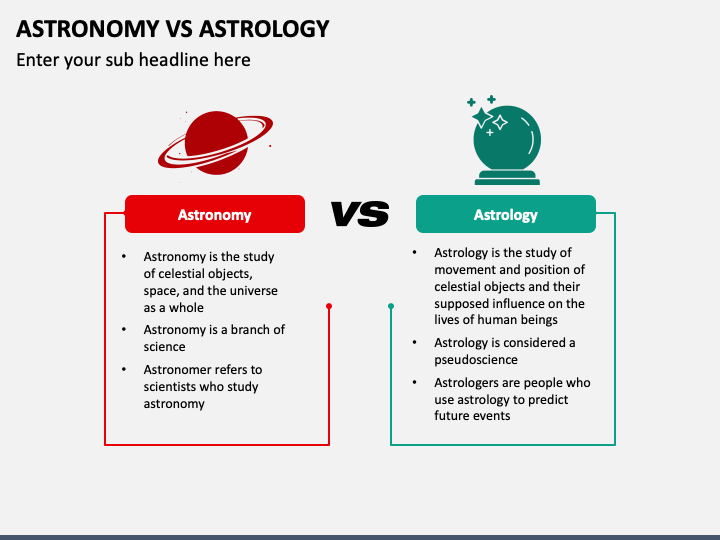
Methodology and Evidence: Science vs. Pseudoscience
- Astronomy: Astronomy is a predictive science. Its theories, like the theory of gravity or the Big Bang model, make verifiable predictions that can be tested through observation and experiment. When new evidence emerges that contradicts an existing theory, the theory is either refined or replaced. This constant evolution based on empirical data is its strength. For instance, astronomers use observed planetary motions to predict future positions with incredible accuracy, enabling space missions and calendar systems.
- Astrology: Astrology, by contrast, is generally considered a pseudoscience because its claims are not falsifiable or have consistently failed scientific tests. Numerous studies attempting to find a correlation between astrological predictions (e.g., personality traits, life events, medical outcomes) and actual outcomes have yielded no statistically significant results beyond chance. When predictions fail, astrological interpretations often rely on subjective framing, ambiguity, or an appeal to complex, untestable influences, rather than revising core tenets based on empirical evidence. The mechanisms by which distant celestial bodies could exert specific, personality-shaping influences on individuals remain entirely unproven by physics or biology.
The Role of Skepticism and Critical Thinking
In a world saturated with information, discerning between credible science and unverified claims is paramount. Digital Security isn’t just about protecting data; it’s also about protecting oneself from misinformation. The proliferation of astrological content online, often presented alongside legitimate scientific news, necessitates a strong emphasis on critical thinking.
Astronomical research encourages skepticism and demands evidence. It challenges assumptions and seeks objective truths. Astrology, while offering comfort and a framework for self-understanding to many, relies on faith in its principles rather than empirical validation. Understanding this distinction empowers individuals to make informed decisions about what information to trust and how to interpret celestial phenomena.
The Economic and Branding Universe: From Exploration to Interpretation
Beyond their core methodologies, astronomy and astrology also engage with society through distinct economic and branding strategies.
The Business of Space: Funding, Innovation, and Careers
Astronomy, as a field of fundamental science, requires substantial investment. This falls under the Money category in a big way. Government agencies (like NASA, ESA) are primary funders, allocating billions to research, mission development, and infrastructure. Private companies are increasingly entering the space sector, driving innovation in areas like satellite communication, space tourism, asteroid mining, and commercial rocket launches. This commercialization of space creates a robust economy around Tech:
- Investment: Venture capital flows into space startups, creating new technologies and services.
- Job Creation: Astronomy and the broader space industry generate high-tech jobs for scientists, engineers, software developers, data analysts, and project managers.
- Spinoff Technologies: Research conducted for space exploration often leads to unexpected technological advancements that benefit everyday life, from improved medical imaging to GPS technology.
- National Branding: A nation’s capacity for space exploration significantly contributes to its Brand on the global stage, symbolizing technological prowess, ambition, and scientific leadership. Institutions like CERN or observatories like ESO also cultivate powerful scientific brands.
Marketing the Mystical: Astrological Brands and Personal Influence
The astrological sphere also has a significant economic footprint, though structured very differently. It thrives on personal connection, niche markets, and the power of Brand:
- Personal Branding: Individual astrologers often build strong personal brands through social media, online courses, and personalized client services. Their unique interpretive styles, communication skills, and ability to connect with an audience are central to their success. This is a classic example of Personal Branding in action.
- Product and Service Diversification: Astrological entrepreneurs offer a wide range of services and products: detailed birth chart analyses, compatibility reports, future predictions, courses on astrological interpretation, specialized software, books, and merchandise (e.g., zodiac-themed jewelry, planners). This constitutes a significant source of Online Income and fosters numerous Side Hustles.
- Marketing and Design: Astrological apps and websites invest heavily in engaging user interfaces, intuitive designs, and effective marketing strategies to attract and retain users. They leverage data analytics to personalize content delivery and identify user preferences, reflecting modern Marketing trends.
- Reputation Management: For both individual astrologers and larger platforms, managing their online Reputation is vital. Positive testimonials, community engagement, and consistent brand messaging are key to maintaining trust and drawing new clients.
Navigating the Stars in a Digital Age: Tools, Trust, and Trends
In the digital era, both astronomy and astrology leverage technology to engage vast audiences, presenting a unique challenge and opportunity for informed discernment.
Tech as an Enabler: Enhancing Engagement with Both Worlds
Technology has democratized access to the cosmos, albeit in different ways:
- Empowering Astronomical Exploration: Stargazing apps, interactive planetarium software, virtual reality tours of the solar system, and online courses bring the wonders of astronomy to anyone with a smartphone or internet connection. Citizen science projects allow amateur astronomers to contribute to real scientific discovery, such as identifying exoplanets or classifying galaxies, fostering a collective appreciation for space science. These Apps and Tutorials enhance scientific literacy and productivity.
- Facilitating Astrological Engagement: Similarly, the ease of accessing personalized astrological content through apps, social media, and online platforms has made astrology more mainstream than ever. Users can instantly generate their birth charts, receive daily horoscopes, and connect with astrological communities globally. This personalization is a key Technology Trend leveraged by the astrology industry.

The Challenge of Credibility and Digital Security
The digital age, while offering immense opportunities, also presents challenges, particularly regarding the distinction between science and pseudoscience. For users engaging with both astronomy and astrology online, Digital Security and critical information assessment are crucial:
- Information Overload: The sheer volume of information available online can make it difficult to distinguish between scientifically verified facts and unsubstantiated claims. Users must critically evaluate sources, look for evidence-based reporting, and understand the difference between scientific consensus and personal belief.
- Data Privacy and Digital Security in Astrology Apps: Many astrology apps require users to input sensitive personal information, including birth date, time, and location. Users should be aware of privacy policies, data collection practices, and the Digital Security measures employed by these apps to protect their personal data from breaches or misuse. This extends to understanding how their data might be used for targeted advertising or shared with third parties, a crucial aspect of personal digital security.
- Ethical Considerations: The marketing of astrological services, particularly those promising definitive life guidance or financial success, raises ethical questions. Consumers must be vigilant about claims that lack scientific backing and understand the speculative nature of such interpretations.
In conclusion, while both astronomy and astrology peer towards the heavens, they do so with fundamentally different gazes. Astronomy, a rigorous science, seeks to objectively understand the universe through observation, data, and testable theories, driven by continuous technological advancement and a significant economic footprint in research and innovation. Astrology, a belief system rooted in ancient traditions, interprets celestial patterns to offer subjective insights into human experience, having found new life and profitability through modern digital platforms and savvy personal branding. Recognizing this distinction is not about devaluing personal beliefs but about empowering individuals to critically navigate the vast cosmos of information and make informed choices in a world increasingly shaped by technology, brand influence, and diverse economic models.
aViewFromTheCave is a participant in the Amazon Services LLC Associates Program, an affiliate advertising program designed to provide a means for sites to earn advertising fees by advertising and linking to Amazon.com. Amazon, the Amazon logo, AmazonSupply, and the AmazonSupply logo are trademarks of Amazon.com, Inc. or its affiliates. As an Amazon Associate we earn affiliate commissions from qualifying purchases.