
The Pythagorean theorem, a fundamental concept in geometry, might seem like it belongs solely to dusty textbooks and high school math classes. However, its elegant simplicity and profound implications extend far beyond the realm of Euclidean geometry, finding surprising and essential applications within the ever-evolving landscape of technology. From the intricate algorithms powering our digital devices to the very infrastructure that enables global communication, the Pythagorean theorem is a silent, yet crucial, architect of the modern tech world. This article delves into the ways this ancient mathematical principle has become an indispensable tool in contemporary technology, exploring its foundational role in areas like graphics, navigation, data analysis, and even the design of the very gadgets we use daily.
The Geometry of Pixels: Visualizing and Rendering in Digital Graphics
The visual interfaces that define our digital experiences, from video games to professional design software, are fundamentally built upon geometric principles. The Pythagorean theorem provides the bedrock for calculating distances and relationships between points, which is essential for rendering accurate and compelling imagery.
Calculating Distances and Screen Coordinates
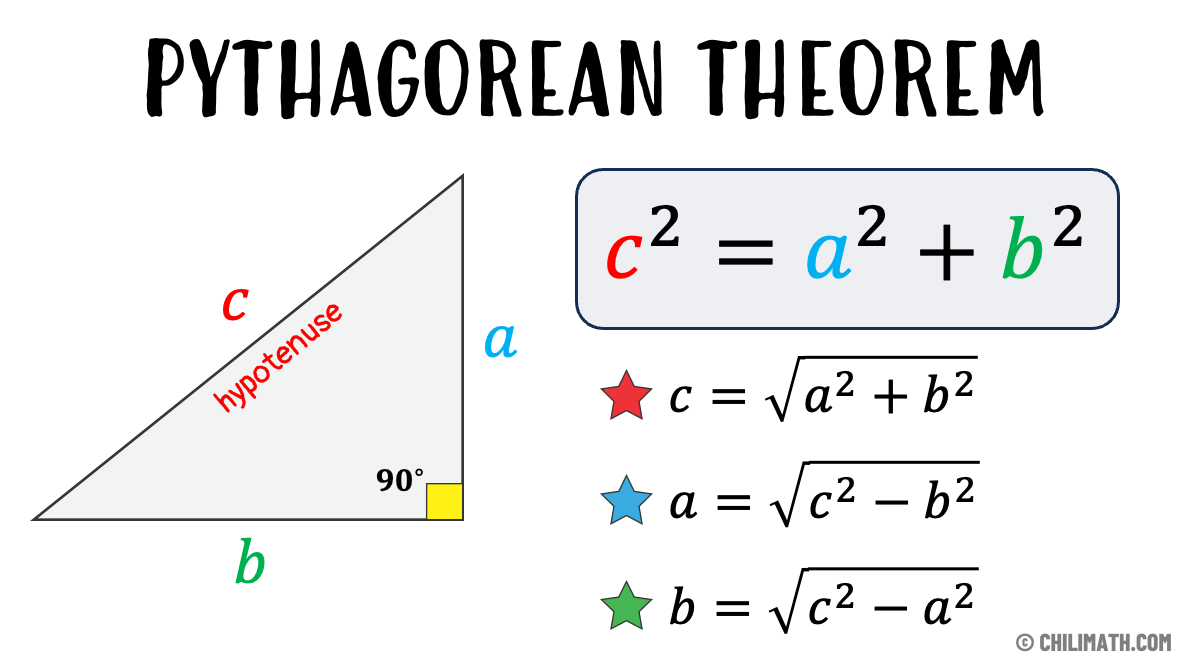
At its core, a digital screen is a grid of pixels. Each pixel has an X and Y coordinate. When we want to draw a line, determine the size of a shape, or understand the spatial relationship between two elements on the screen, we often need to calculate the direct distance between two points. This is precisely where the Pythagorean theorem, $a^2 + b^2 = c^2$, becomes indispensable.
Imagine two points on a screen, Point A at (x1, y1) and Point B at (x2, y2). The horizontal distance between these points is the absolute difference in their X coordinates: $a = |x2 – x1|$. The vertical distance is the absolute difference in their Y coordinates: $b = |y2 – y1|$. The straight-line distance, or hypotenuse, between these two points, denoted as $c$, can then be calculated using the theorem: $c = sqrt{(x2 – x1)^2 + (y2 – y1)^2}$.
This calculation is fundamental to:
- Line Drawing Algorithms: Sophisticated algorithms like Bresenham’s line algorithm, while not directly using the Pythagorean theorem in its simplest form, rely on its underlying principles of distance and slope to efficiently determine which pixels to illuminate for a straight line.
- Collision Detection in Games: In video games, determining if two objects have collided often involves calculating the distance between their centers or their bounding boxes. If this distance is less than the sum of their radii (for circles) or other appropriate metrics, a collision is detected. The Pythagorean theorem is vital for these distance calculations.
- Vector Graphics: Vector graphics, unlike raster graphics (which are pixel-based), are defined by mathematical equations. The theorem helps define curves, shapes, and their relationships, ensuring scalability without loss of quality.
- Image Processing Filters: Many image filters that manipulate pixels based on their proximity to other pixels or specific points utilize distance calculations derived from the Pythagorean theorem. For instance, blur effects or edge detection algorithms often involve measuring distances between neighboring pixels.
3D Modeling and Transformations
In three-dimensional graphics, the Pythagorean theorem is extended to calculate distances in 3D space. For points with coordinates (x1, y1, z1) and (x2, y2, z2), the distance $d$ is given by $d = sqrt{(x2 – x1)^2 + (y2 – y1)^2 + (z2 – z1)^2}$. This is crucial for:
- Ray Tracing: This rendering technique simulates how light rays interact with objects in a 3D scene. Calculating intersections between rays and surfaces, and determining distances to light sources, heavily relies on 3D distance calculations.
- Object Placement and Manipulation: Positioning, rotating, and scaling 3D models accurately in a virtual environment depends on precise spatial calculations that are rooted in geometric principles, including the Pythagorean theorem.
- Camera Movement and Perspective: Simulating camera perspectives, depth of field, and the visual appearance of objects based on their distance from the camera all involve complex geometric calculations where the theorem plays a role.
Navigating the Digital Landscape: Location, Mapping, and GPS
The ability to pinpoint our location, navigate complex environments, and understand spatial relationships is a cornerstone of modern technology, and the Pythagorean theorem is a fundamental component of these systems.
The Heart of GPS and Geolocation
The Global Positioning System (GPS) is perhaps the most pervasive application of the Pythagorean theorem in everyday technology. GPS satellites transmit signals that allow receivers on Earth to determine their position. The core principle behind GPS accuracy involves trilateration (or multilateration), which relies on calculating distances.
A GPS receiver on your smartphone or in your car receives signals from at least four satellites. Each signal contains information about the satellite’s location and the time the signal was sent. By comparing the time the signal was sent with the time it was received, the receiver can calculate the distance to each satellite. This distance calculation is based on the speed of light and the time difference.
Once the distances to multiple satellites are known, the receiver can determine its own position. If we consider the Earth’s surface as a plane for simplified explanation (though in reality, spherical geometry is used for greater accuracy), the Pythagorean theorem is implicitly used in calculating the intersection of spheres (or circles in 2D) representing the possible locations based on each satellite’s distance.
For instance, if you know your distance from two satellites, your possible locations form the intersection of two circles. With a third satellite, you narrow it down to two points. A fourth satellite is often used to resolve ambiguities and correct for clock errors. While the actual GPS algorithms are complex, involving spherical trigonometry and error correction, the underlying concept of calculating distances between points in space, and thus implicitly using variations of the Pythagorean theorem for distance calculations, remains fundamental.
Mapping and Routing Algorithms
Beyond GPS, the theorem is vital for mapping applications like Google Maps or Apple Maps. When you request directions, the system calculates the shortest or most efficient route between two points. This involves:
- Distance Calculations on Maps: The software needs to calculate the straight-line distance between points on a map, even though roads are not always straight. This straight-line distance, often referred to as the “as-the-crow-flies” distance, uses the Pythagorean theorem to determine the direct path between two sets of latitude and longitude coordinates (treated as points on a Cartesian plane for calculation).
- Graph Theory and Pathfinding: While more complex algorithms like Dijkstra’s algorithm or A* search are used for route optimization, these algorithms operate on graphs where nodes represent intersections and edges represent road segments. The “cost” of traversing an edge often involves distance, which is derived from geometric calculations.
- Geospatial Analysis: Urban planning, logistics, and even emergency service dispatch systems rely on accurate geospatial analysis. Understanding distances between locations, calculating service areas, and optimizing resource allocation all leverage principles that are underpinned by geometric distance calculations.
The Foundation of Data Science: Algorithms and Machine Learning
In the realm of data science and machine learning, the Pythagorean theorem emerges in a more abstract yet equally powerful form, contributing to how algorithms understand and process vast datasets.
Measuring Similarity and Distance in Data
Machine learning algorithms often need to quantify the “similarity” or “dissimilarity” between data points. This is crucial for tasks like clustering, classification, and anomaly detection. A common metric used for this purpose is the Euclidean distance.
For a data point with $n$ features (represented as a vector in an $n$-dimensional space), the Euclidean distance between two data points, P = $(p1, p2, …, pn)$ and Q = $(q1, q2, …, qn)$, is calculated as:
$d(P, Q) = sqrt{(q1 – p1)^2 + (q2 – p2)^2 + … + (qn – pn)^2}$
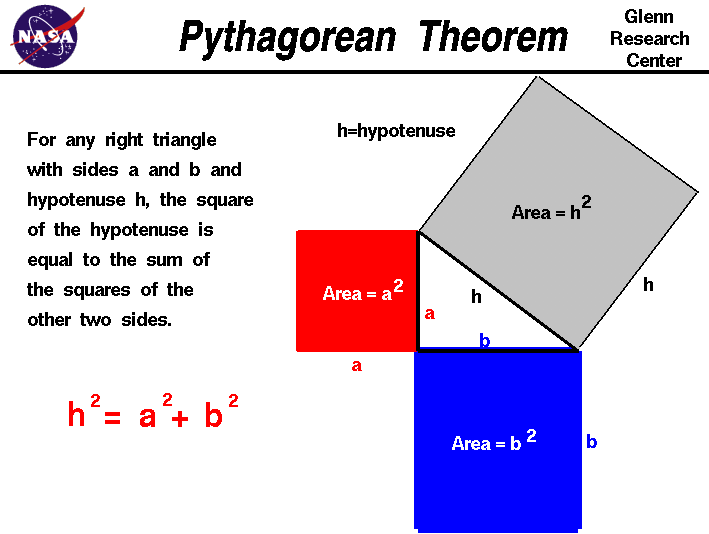
This formula is a direct generalization of the Pythagorean theorem to $n$ dimensions. Each term $(qi – pi)^2$ represents the squared difference along one dimension (or feature). Summing these squared differences and taking the square root gives us the straight-line distance between the two data points in this multi-dimensional feature space.
This metric is fundamental to:
- Clustering Algorithms (e.g., K-Means): K-Means aims to partition data points into $k$ clusters. It works by iteratively assigning data points to the nearest cluster centroid (using Euclidean distance) and then recalculating the centroid based on the assigned points.
- Classification Algorithms (e.g., K-Nearest Neighbors – KNN): The KNN algorithm classifies a new data point based on the majority class of its $k$ nearest neighbors in the training data. The “nearest” is determined by calculating the distance (typically Euclidean) between the new data point and all training data points.
- Dimensionality Reduction Techniques (e.g., Principal Component Analysis – PCA): While PCA is more complex, it fundamentally seeks to find new axes (principal components) that capture the most variance in the data. The distances between data points in the original and transformed spaces are preserved as much as possible, with Euclidean distance being a key consideration.
- Recommender Systems: Many recommender systems, like those used by Netflix or Amazon, calculate the similarity between users or items based on their past interactions. Euclidean distance (or variations) on feature vectors representing user preferences or item attributes is a common approach.
Feature Engineering and Data Transformation
In data science, transforming and engineering features can significantly improve the performance of machine learning models. Techniques often involve scaling features or creating new ones based on existing ones. The Pythagorean theorem’s application in Euclidean distance implicitly guides how these transformations are understood and interpreted in terms of how they affect the “space” in which data points reside. For example, when standardizing features (mean=0, variance=1), the resulting feature space maintains the geometric relationships that Euclidean distance relies upon.
The Ubiquitous Influence on Device Design and Performance
Even in the physical design and performance optimization of the very gadgets we interact with daily, the Pythagorean theorem finds its influence, often in subtle but critical ways.
Circuit Board Design and Signal Integrity
Modern electronic devices, from smartphones to high-performance servers, are packed with intricate circuit boards. The placement of components, the routing of traces (the electrical pathways), and the management of signal integrity all involve considerations that touch upon geometric principles.
- Trace Length and Impedance: The length of a trace on a circuit board can affect its electrical properties, such as impedance. In high-frequency applications, precise control of trace length is crucial to prevent signal reflections and distortions. Calculating the shortest path between two points on a multi-layered circuit board, especially when routing around obstacles, can involve geometric algorithms that are influenced by the Pythagorean theorem.
- Component Placement for Thermal Management: The spatial arrangement of heat-generating components on a circuit board is critical for effective thermal management. Understanding the distances between components helps engineers model heat dissipation and airflow, ensuring that devices do not overheat. This spatial analysis often starts with basic distance calculations.
- Antenna Design: The physical dimensions and shape of antennas are directly related to the wavelengths of the electromagnetic signals they are designed to transmit or receive. The geometric relationships that govern antenna performance are rooted in wave physics, which itself is deeply intertwined with geometry and often involves calculating lengths and distances that can be solved using the theorem.
Mechanical Engineering and Structural Integrity
The physical casing and internal structures of our electronic devices are designed by mechanical engineers. The Pythagorean theorem is a fundamental tool for them in ensuring structural integrity and optimizing material usage.
- Stress and Strain Calculations: When designing load-bearing components, engineers use principles of mechanics that rely on geometric relationships to calculate stresses and strains. The theorem is used in determining lengths of beams, diagonals, and other structural elements, which are critical for calculating how forces are distributed.
- Ergonomics and User Interface Design: The physical dimensions and layout of devices are designed with ergonomics in mind. Understanding the distances between buttons, the curvature of surfaces, and the overall form factor often involves geometric considerations to ensure comfortable and intuitive use.
Data Compression and Signal Processing
While not always directly calculating a hypotenuse, the underlying mathematical principles of signal processing and data compression often rely on Fourier transforms and other spectral analysis techniques. These techniques break down complex signals into simpler sinusoidal components. The coefficients and transformations involved in these analyses can be visualized and understood in terms of distances and relationships in abstract mathematical spaces, where the Pythagorean theorem’s concepts of orthogonality and distance are foundational. This is crucial for efficient storage and transmission of audio, video, and other data.
Conclusion: An Enduring Principle in a Digital Age
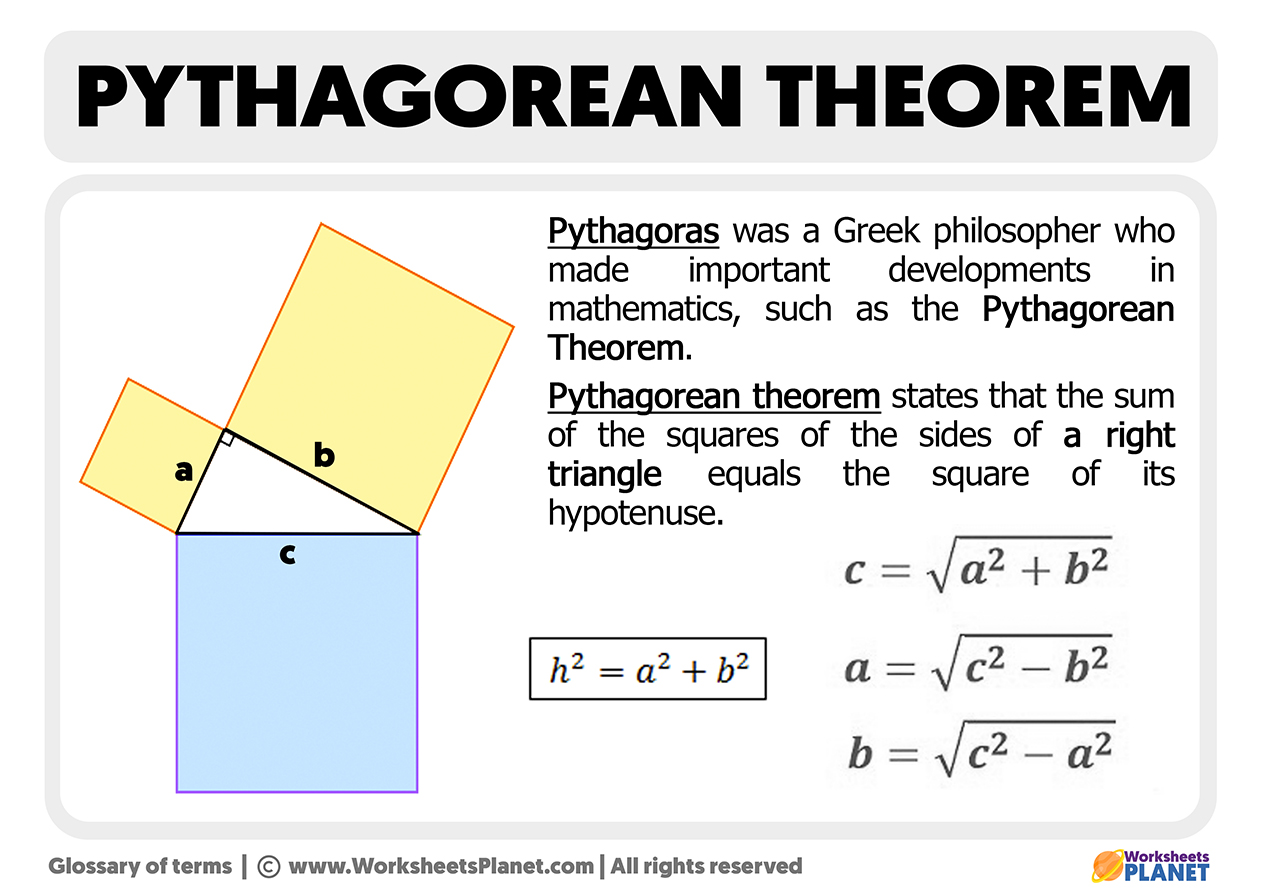
The Pythagorean theorem, originating from ancient Greece, has transcended its geometrical origins to become a foundational pillar of modern technology. Its elegant equation, $a^2 + b^2 = c^2$, provides a simple yet powerful method for calculating distances, a fundamental operation that underpins a vast array of digital applications. From rendering lifelike graphics and enabling precise navigation through GPS to powering sophisticated machine learning algorithms and guiding the intricate design of our electronic devices, the theorem’s influence is pervasive and indispensable. As technology continues to advance, pushing the boundaries of what is possible, the fundamental geometric principles embodied by the Pythagorean theorem will undoubtedly remain a cornerstone, facilitating innovation and shaping the digital future. Understanding this ancient concept is not just an academic exercise; it is a gateway to appreciating the intricate mathematical beauty that powers our interconnected world.
aViewFromTheCave is a participant in the Amazon Services LLC Associates Program, an affiliate advertising program designed to provide a means for sites to earn advertising fees by advertising and linking to Amazon.com. Amazon, the Amazon logo, AmazonSupply, and the AmazonSupply logo are trademarks of Amazon.com, Inc. or its affiliates. As an Amazon Associate we earn affiliate commissions from qualifying purchases.