
For decades, the phrase “how is the market doing?” has almost universally been answered by looking at one specific set of numbers: the S&P 500. While there are thousands of publicly traded companies and numerous indices tracking everything from small-cap tech startups to international shipping conglomerates, the Standard & Poor’s 500 Index remains the undisputed heavyweight champion of financial metrics. It is more than just a list of stocks; it is a barometer of the American economy, a cornerstone of modern retirement planning, and the yardstick by which professional fund managers are judged.

To understand the S&P 500 is to understand the mechanics of the modern financial world. Whether you are a seasoned investor or someone just beginning to explore the world of personal finance, grasping what this index represents—and how it has historically functioned—is essential for building long-term wealth.
The Anatomy of an Index: How the S&P 500 is Constructed
At its core, the S&P 500 is a stock market index that tracks the performance of 500 of the largest companies listed on stock exchanges in the United States. However, it is not a simple “top 500” list by size alone. The index is managed by S&P Dow Jones Indices, and the selection process is governed by a committee that follows strict eligibility criteria.
The Selection Criteria and the Committee
Unlike indices that are strictly rules-based (like the Russell 2000), the S&P 500 involves a level of human oversight. To be included, a company must meet specific requirements regarding its market capitalization (currently billions of dollars), its liquidity (the shares must be easy to trade), and its profitability. A key rule is that a company must have positive reported earnings over the most recent quarter and the sum of the previous four quarters. This “quality filter” is one reason the S&P 500 is often viewed as a more reliable indicator of economic health than other broader indices.
Market Capitalization Weighting
The S&P 500 is a “float-adjusted market-capitalization weighted” index. This means that larger companies have a more significant impact on the index’s performance than smaller ones. If a trillion-dollar company like Apple or Microsoft sees a 5% move in its stock price, it will move the entire index far more than a 5% move from a smaller utility company. This structure reflects the reality of the market: the biggest companies represent the largest portion of the economy’s total value.
Sector Representation
The index is divided into 11 sectors, including Information Technology, Health Care, Financials, Consumer Discretionary, and Energy. While the tech sector has dominated the index’s growth over the last decade, the S&P 500 is designed to represent the breadth of the U.S. economy. As the economy evolves—moving from manufacturing to services to digital software—the index rebalances to reflect those shifts, ensuring it remains relevant across generations.
Historical Performance: The Engine of Wealth Creation
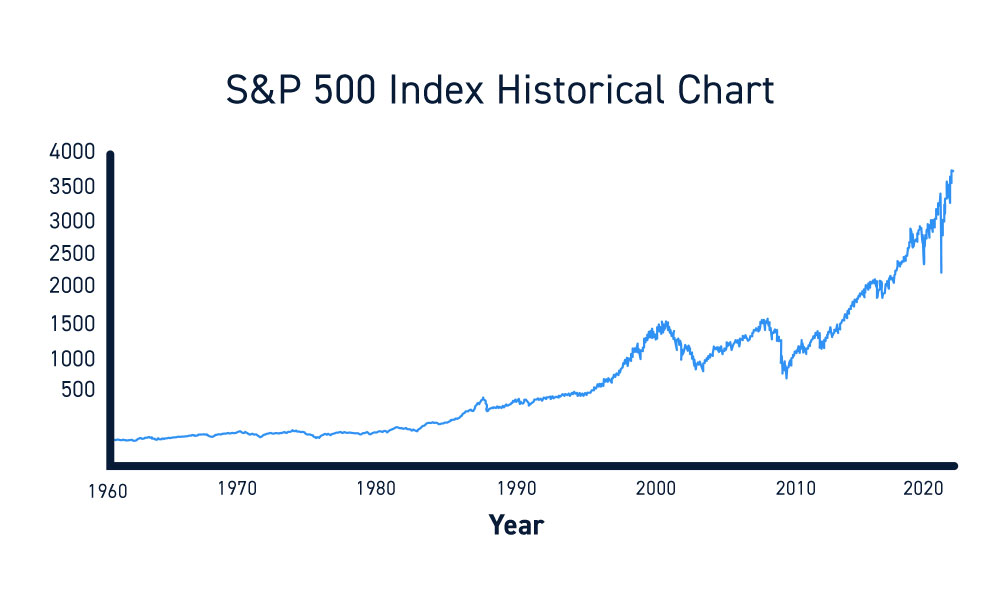
When investors ask “what was the S&P 500” in a historical context, they are usually looking at its track record as a wealth-building tool. Since its expansion to 500 companies in 1957, the index has provided an annualized total return (including dividends) of approximately 10%. While this number fluctuates wildly year to year, the long-term consistency of the index has made it the foundation of personal finance.
The Power of Compound Interest
The primary reason the S&P 500 is celebrated in the “Money” niche is its relationship with compounding. An initial investment in the S&P 500 that grows at an average of 10% will double roughly every seven years. Over a 30-year career, this compounding effect can turn modest monthly contributions into a substantial nest egg. This historical reliability is why the index is the primary recommendation for “set it and forget it” investors.
Surviving Volatility and Bear Markets
History shows that the S&P 500 is not a smooth ride upward. It has weathered the 1970s stagflation, the 1987 “Black Monday” crash, the Dot-com bubble of 2000, the Great Recession of 2008, and the 2020 pandemic. In every single instance, the index has eventually surpassed its previous highs. This resilience is a testament to the “survivorship bias” built into the index: as failing companies shrink and leave the index, they are replaced by the next generation of growing, profitable firms.
Inflation Hedge and Dividend Growth
Beyond price appreciation, the S&P 500 has historically served as a hedge against inflation. Because the index is composed of companies that can raise prices for their goods and services, their earnings tend to keep pace with—or exceed—rising costs. Additionally, many companies within the index pay dividends. Reinvesting these dividends has historically accounted for nearly 40% of the total returns of the index, highlighting the importance of a “total return” mindset in business finance.

The Index Fund Revolution: How to Invest in the S&P 500
For most of the 20th century, individual investors could not easily “buy” the S&P 500. They had to pick individual stocks or pay high fees to active mutual fund managers. That changed with the “Index Fund Revolution,” a movement that democratized investing and shifted the power from Wall Street elites to the average person.
The Legacy of Jack Bogle and Vanguard
In 1975, John “Jack” Bogle, the founder of Vanguard, launched the first retail index fund. His philosophy was simple: if you can’t beat the market, be the market. He argued that after fees and taxes, most active managers fail to outperform the S&P 500. By creating a low-cost fund that simply tracked the index, he allowed everyday people to capture the full growth of the American corporate landscape. This shift fundamentally changed personal finance, moving trillions of dollars into “passive” investment vehicles.
ETFs vs. Mutual Funds
Today, the most popular way to invest in the S&P 500 is through Exchange-Traded Funds (ETFs) like SPY (State Street), IVV (iShares), or VOO (Vanguard). These tools allow investors to buy a “slice” of all 500 companies in a single transaction. ETFs offer high liquidity and incredibly low expense ratios—often less than 0.05%. This means for every $10,000 invested, you might pay only $3 to $5 a year in fees, allowing the vast majority of the “Money” to stay in the investor’s pocket.
Direct Indexing and the Future
As financial technology (FinTech) evolves, we are seeing the rise of “direct indexing.” This allows investors to own the individual stocks within the S&P 500 directly in their accounts rather than through a fund. This offers advanced tax-loss harvesting opportunities, which can further increase net returns. However, for the average person, the traditional S&P 500 ETF remains the most efficient and effective tool for long-term wealth accumulation.
Strategic Importance: Why the S&P 500 is the Ultimate Benchmark
In the world of business finance and portfolio management, the S&P 500 is the standard against which all success is measured. This creates a psychological and tactical framework that influences how trillions of dollars are moved globally.
The “Warren Buffett” Standard
Even the world’s most successful investors pay homage to the S&P 500. Warren Buffett famously won a million-dollar bet against a group of hedge fund managers by proving that a simple S&P 500 index fund would outperform a hand-picked portfolio of hedge funds over a ten-year period. Buffett’s advice for his own heirs is to put 90% of their cash into a low-cost S&P 500 index fund. This endorsement solidifies the index’s status as the “gold standard” for risk-adjusted returns.
Market Sentiment and Economic Health
The S&P 500 is often considered a “leading indicator.” Stock prices reflect the market’s collective expectation of future earnings. When the S&P 500 is rising, it generally indicates confidence in corporate profitability and economic growth. Conversely, a “Bear Market” (a drop of 20% or more) often precedes or accompanies economic recessions. For business owners and financial planners, watching the S&P 500 provides crucial context for making decisions about hiring, expansion, and capital expenditures.
Concentration Risk and Modern Challenges
While the S&P 500 is highly regarded, modern investors must also be aware of its limitations. Because it is market-cap weighted, the index has become increasingly concentrated in a few massive technology companies (often referred to as the “Magnificent Seven”). This means that “the market” is sometimes less diversified than it appears. If a few massive tech firms struggle, the entire S&P 500 can suffer, even if the other 493 companies are performing well. Understanding this concentration is key to modern risk management.
Conclusion: The S&P 500 as the Foundation of Financial Freedom
“What was the S&P 500?” It was, and continues to be, the most successful experiment in collective capitalism. It is a living entity that sheds the weak and embraces the strong, constantly refining itself to represent the most profitable enterprises in the world.
For the individual focused on “Money”—whether that means building a side hustle to fund an investment account or managing a corporate retirement plan—the S&P 500 is the most important tool in the shed. It offers a path to participate in the growth of global giants with minimal effort and cost. By understanding its construction, respecting its history, and utilizing modern investment tools to access it, any individual can harness the power of the 500 most influential companies on earth to secure their own financial future. The S&P 500 isn’t just a list of stocks; it is the heartbeat of the modern financial system.
aViewFromTheCave is a participant in the Amazon Services LLC Associates Program, an affiliate advertising program designed to provide a means for sites to earn advertising fees by advertising and linking to Amazon.com. Amazon, the Amazon logo, AmazonSupply, and the AmazonSupply logo are trademarks of Amazon.com, Inc. or its affiliates. As an Amazon Associate we earn affiliate commissions from qualifying purchases.