
The allure of a well-crafted board game, a tangible experience that brings people together around a shared objective, is timeless. From the simple strategy of checkers to the complex narratives of modern-day epics, board games have captivated human minds for millennia. But as we roll dice, strategize moves, and celebrate victories, a fundamental question often arises: what was the first board game? Unraveling this mystery isn’t just a matter of historical curiosity; it delves into the very origins of human ingenuity, social interaction, and perhaps even the early forms of strategic thinking that would later underpin much of our technological and economic development.
While the concept of a single, definitive “first” board game is elusive due to the nature of archaeological discovery and the gradual evolution of play, we can trace the lineage back to some of the earliest known examples. These ancient games offer a fascinating glimpse into the minds of our ancestors, revealing their understanding of luck, skill, and competition. Their survival, often in fragmented forms, allows us to piece together a narrative that spans continents and cultures, demonstrating a universal human drive to engage in structured play.
The significance of these early board games extends far beyond mere entertainment. They served as powerful tools for social cohesion, education, and even religious or divination practices. The development of these games reflects the growing complexity of societies, the establishment of leisure time, and the desire to transmit knowledge and cultural values across generations. Understanding their origins is, in essence, understanding a foundational aspect of human civilization.
The Dawn of Strategy: Ancient Civilizations and Their Games
The earliest evidence of board games points to their emergence in sophisticated ancient civilizations, where leisure time and the development of abstract thought allowed for the creation of structured play. These were not simple pastimes but often imbued with cultural and social significance, reflecting the values and beliefs of their creators.
Senet: The Game of Passage in Ancient Egypt
Perhaps the most celebrated contender for the title of the “first board game” is Senet, a game that originated in ancient Egypt. Archaeological evidence for Senet dates back as far as 3100 BCE, making it one of the oldest known board games in the world. Hieroglyphs and tomb paintings depict pharaohs, queens, and commoners alike engrossed in playing Senet, underscoring its widespread popularity and cultural importance.
The Mechanics and Symbolism of Senet: While the exact rules of Senet are not definitively known, reconstructions based on fragmented texts and game boards suggest a game of strategy and luck. Played on a board of 30 squares arranged in three rows of ten, players moved their pieces based on the throw of casting sticks, an ancient form of dice. The objective was to move all of one’s pieces off the board, but the squares themselves held symbolic meaning. Certain squares were considered good, offering advantages, while others were perilous, forcing players to backtrack or face penalties.
The game was deeply intertwined with Egyptian religious beliefs, particularly the concept of the afterlife. It was believed that playing Senet successfully could help the deceased navigate the challenges of the underworld and achieve eternal life. The journey across the Senet board mirrored the soul’s journey through the Duat, with the final squares representing the attainment of paradise. This spiritual dimension elevates Senet beyond a mere game, positioning it as a ritualistic practice deeply embedded in Egyptian cosmology.
The Royal Game of Ur: A Mesopotamian Masterpiece
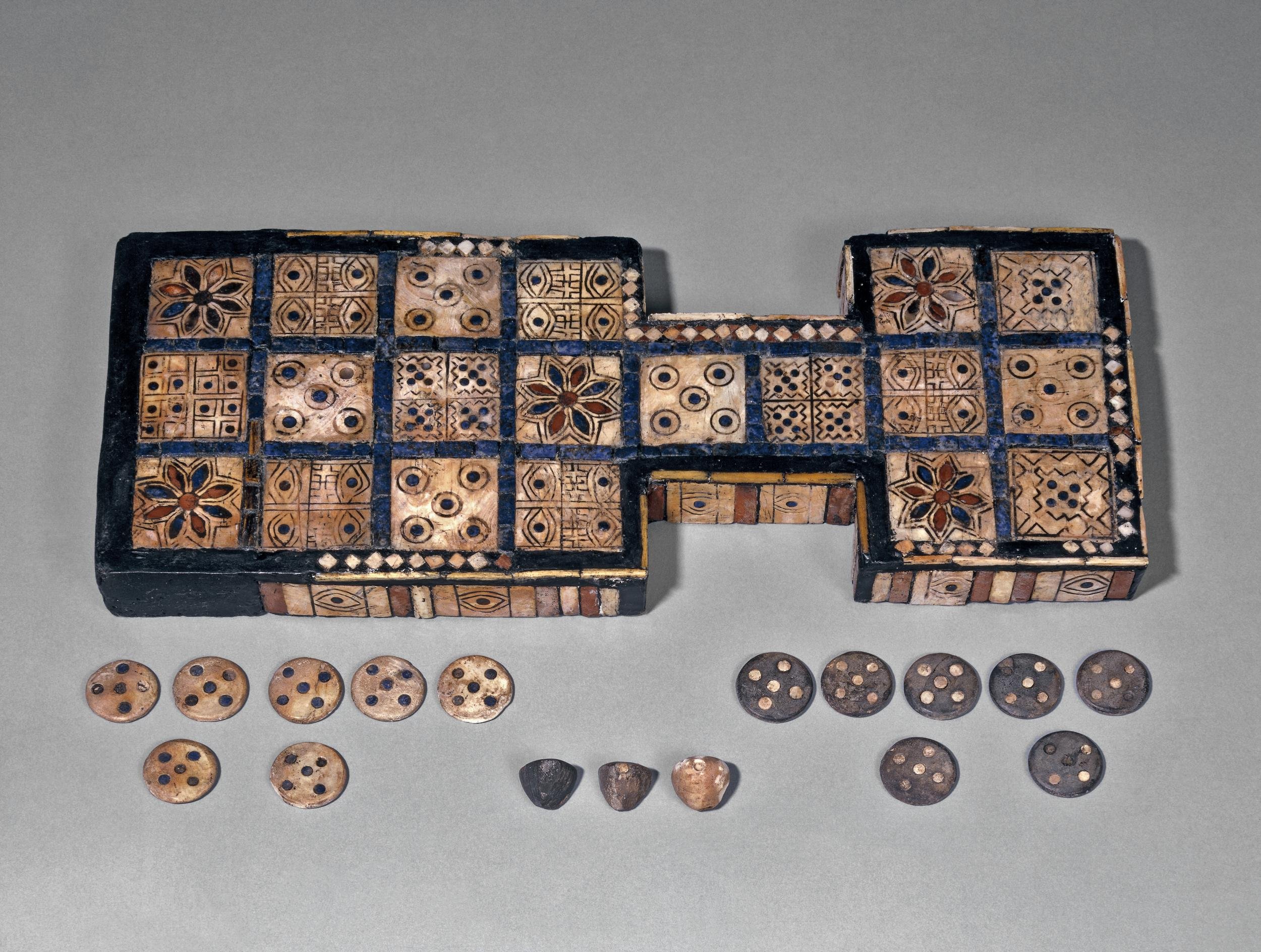
Another strong contender for the earliest board game comes from Mesopotamia, a region known for its early advancements in mathematics, astronomy, and governance. The Royal Game of Ur, unearthed from the Royal Tombs of Ur, dates back to approximately 2600-2400 BCE. This discovery, made by Sir Leonard Woolley, provided not only a remarkably preserved game board but also cuneiform tablets detailing some of its rules, offering invaluable insights into ancient gameplay.
Unearthing the Royal Game: The game board itself is an exquisite piece of craftsmanship, inlaid with shell, lapis lazuli, and red limestone. It features 20 squares and distinctive “rosettes” on certain squares, which played a crucial role in gameplay. Like Senet, the Royal Game of Ur was a race game, where players moved their pieces along a track, aiming to be the first to get all their pawns off the board.
The inclusion of rosettes served a unique purpose. Landing on a rosette square granted the player another turn, introducing an element of strategic advantage and exciting momentum. The game likely involved a combination of dice rolls (tetrahedral dice, which had distinct marks on their faces) and strategic maneuvering of pieces to secure these advantageous positions.
The Royal Game of Ur was not solely a pastime for the elite; evidence suggests it was played by people from various social strata. Its presence in royal tombs indicates its status as a game of prestige, but its widespread discovery implies broader accessibility. The game’s sophisticated mechanics and the detailed nature of its discovery make it a vital piece in the puzzle of early board game evolution.
Beyond the Cradle: Early Board Games Across Continents
As civilizations developed and interacted, the concept of board games began to spread, adapting to new cultural contexts and evolving in complexity. While Senet and the Royal Game of Ur represent some of the earliest known examples, similar games emerged independently or through cultural diffusion in other parts of the world.
Go: The Ancient Strategy of East Asia
Originating in China, Go (known as Weiqi) is one of the oldest continuously played board games in existence. While its precise origins are shrouded in legend, historical records suggest its existence dates back at least 4,000 years, making it a contemporary or even precursor to some of the earliest Western board games. Go is a game of profound strategic depth and abstract reasoning, played on a grid of intersecting lines.
The Philosophy of Go: Unlike race games, Go is a territory-control game. Players place black and white stones on the grid, aiming to surround more territory than their opponent. The simplicity of its rules belies an immense strategic complexity, with the number of possible game positions exceeding the number of atoms in the observable universe. Go has been deeply integrated into East Asian culture, often associated with intellectual prowess, patience, and philosophical contemplation. Its evolution has been remarkably consistent, with the fundamental rules remaining largely unchanged for millennia. The enduring popularity and strategic depth of Go highlight the universal appeal of abstract strategic challenges.
Mancala: The Ancient Art of Seed Counting
Mancala is not a single game but a family of ancient counting games played with seeds, pebbles, or beans. The origins of Mancala are difficult to pinpoint precisely, with evidence suggesting its presence in ancient Africa and the Middle East dating back thousands of years. It is considered by many to be the oldest “count and capture” game.
The Mechanics of Mancala: Mancala games are typically played on a board with rows of pits. Players take turns scooping up seeds from one pit and distributing them one by one into subsequent pits. The objective usually involves capturing a certain number of seeds or emptying one’s own pits before the opponent. The simplicity of the equipment (often just a board and stones) and the accessibility of the gameplay have contributed to Mancala’s vast geographical spread and continuous cultural relevance. It has been played by royalty and commoners alike, serving as a means of education, social interaction, and even simple entertainment.
The Enduring Legacy of Early Board Games
The journey to discover “the first board game” leads us not to a single definitive artifact, but to a rich tapestry of human history, ingenuity, and social evolution. Senet, the Royal Game of Ur, Go, and Mancala, among others, offer compelling evidence of our ancestors’ early capacity for strategic thinking, their desire for structured social interaction, and their use of games as a means of cultural expression and even spiritual exploration.
The impact of these ancient games resonates through the ages. They laid the groundwork for the complex gaming systems we see today, from intricate board games to the vast digital landscapes of video games. The fundamental principles of strategy, resource management, probability, and social deduction that are core to modern gaming all have their roots in these ancient pastimes.
Furthermore, the study of early board games provides invaluable insights into the social structures, belief systems, and cognitive abilities of past civilizations. The very existence and evolution of these games demonstrate a sophisticated level of abstract thought and the capacity for developing complex rule sets. They highlight a fundamental human need for play, competition, and connection, a need that has persisted and transformed, yet remains deeply ingrained in our collective consciousness. As we continue to innovate and develop new forms of digital entertainment, it is crucial to remember the ancient foundations upon which this entire industry is built, acknowledging the profound and lasting legacy of the very first board games.
aViewFromTheCave is a participant in the Amazon Services LLC Associates Program, an affiliate advertising program designed to provide a means for sites to earn advertising fees by advertising and linking to Amazon.com. Amazon, the Amazon logo, AmazonSupply, and the AmazonSupply logo are trademarks of Amazon.com, Inc. or its affiliates. As an Amazon Associate we earn affiliate commissions from qualifying purchases.