
Gravity, the invisible force that keeps our feet planted on the ground, governs the celestial ballet of planets around stars, and shapes the very fabric of the universe, is often perceived as a constant. Yet, like many fundamental forces, its influence is not immutable. While the popular understanding often boils down to mass, a deeper dive reveals a more nuanced picture. Within the realm of technology, understanding and manipulating – or at least accounting for – the factors that influence gravity is paramount. From the precision required in satellite navigation to the development of advanced propulsion systems, the gravitational landscape is a critical consideration for technological advancement. This article will explore the two primary drivers that dictate the strength and effect of gravity, focusing on their implications within the technological sphere.
Mass: The Cornerstone of Gravitational Influence
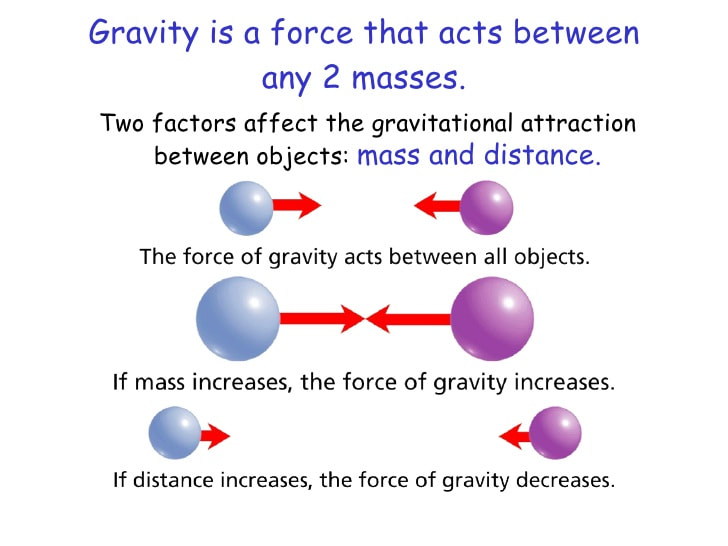
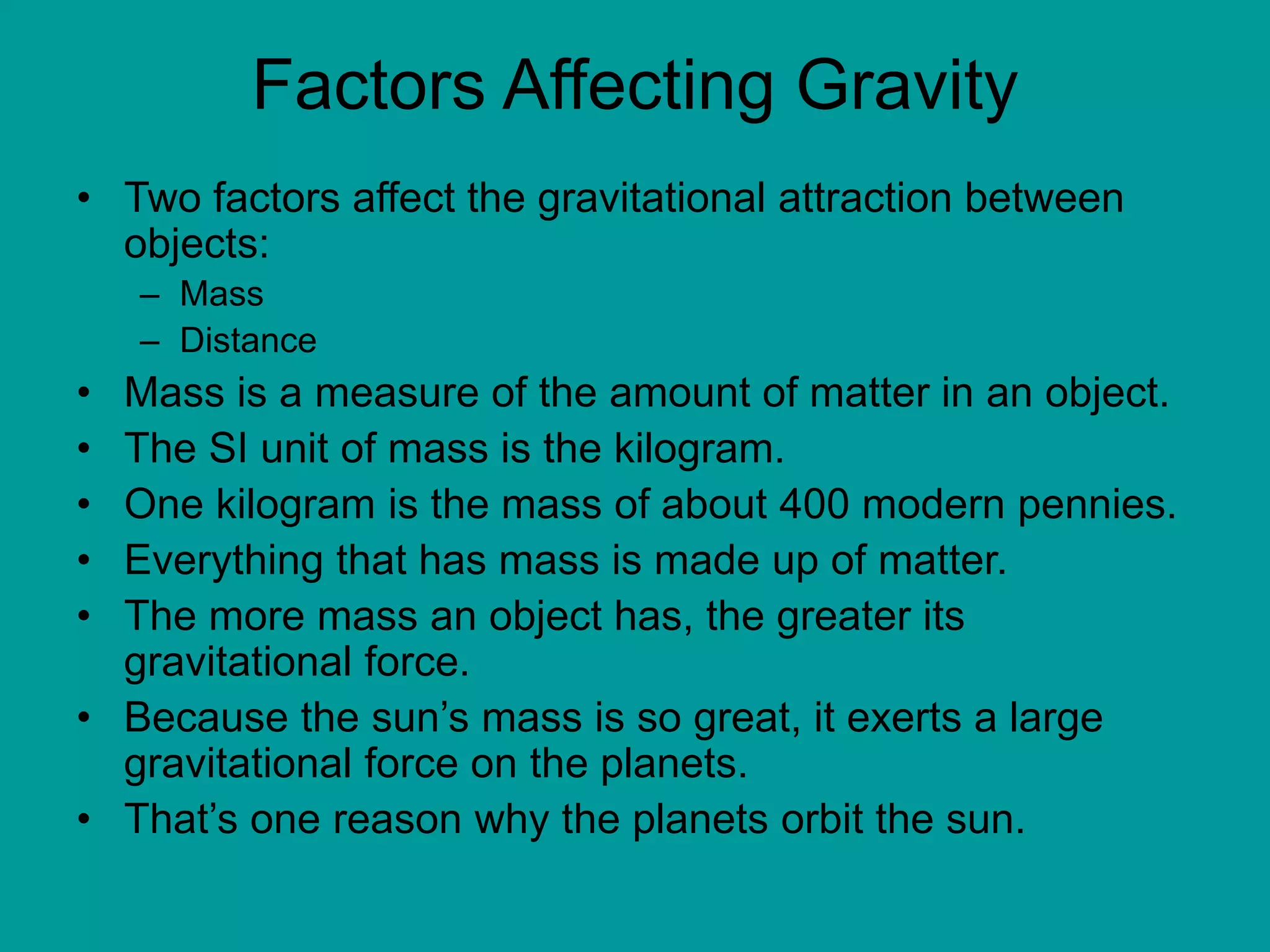
At its most fundamental, gravity is a consequence of mass. Any object possessing mass exerts a gravitational pull on any other object with mass. The more massive an object, the stronger its gravitational field. This principle, first mathematically articulated by Sir Isaac Newton, forms the bedrock of our understanding of gravitation. In the context of technology, understanding mass is not merely an academic exercise; it’s a critical design and operational parameter.
Understanding Gravitational Force and Mass
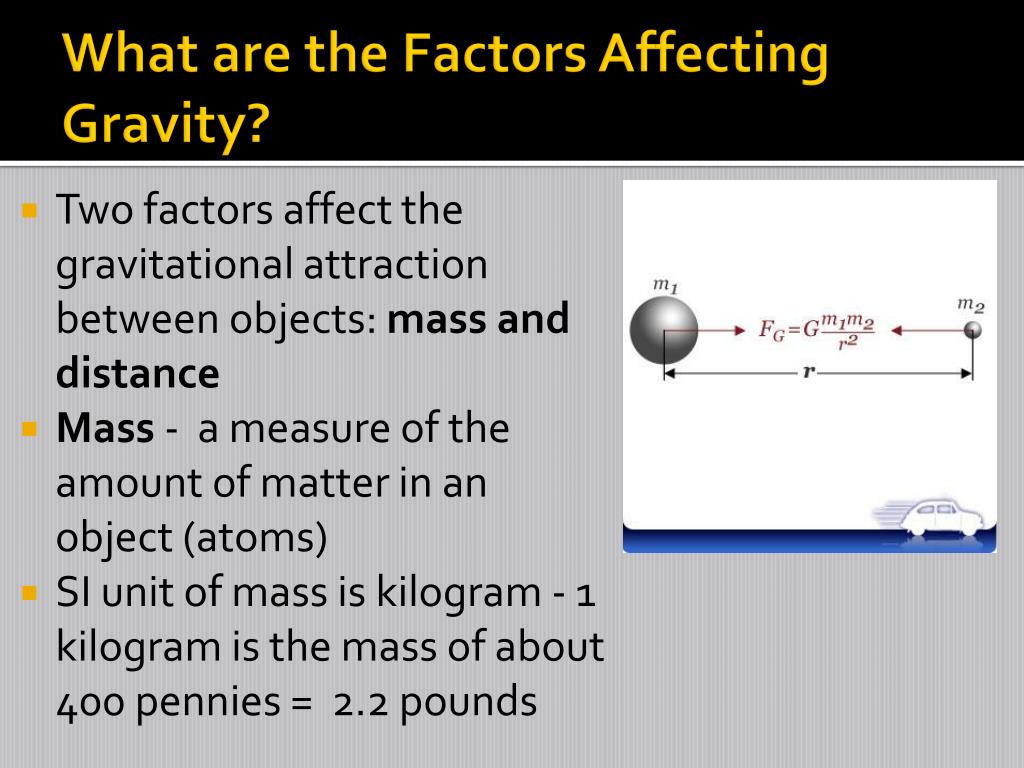
Newton’s Law of Universal Gravitation provides the foundational equation:
$F = G * (m1 * m2) / r^2$
Where:
- F is the gravitational force between two objects.
- G is the gravitational constant (a universal value).
- m1 and m2 are the masses of the two objects.
- r is the distance between the centers of the two objects.
This equation clearly illustrates that gravitational force is directly proportional to the product of the masses of the two objects. For technological applications, this means that the gravitational pull experienced by a satellite is determined by its own mass and the mass of the celestial body it orbits, such as Earth. Similarly, the gravitational force exerted by a rocket’s engine during launch is influenced by the enormous mass of the rocket itself.
Mass in Spacecraft Design and Navigation
The sheer mass of a spacecraft is a primary determinant of its launch requirements and orbital mechanics. Launch vehicles are engineered with immense power to overcome Earth’s gravitational pull on the heavy payload. Once in orbit, the spacecraft’s mass influences its trajectory and the fuel required for maneuvers.
For instance, when designing a satellite, engineers must meticulously calculate its mass budget. Every component, from solar panels to scientific instruments, contributes to the overall mass. This mass directly impacts the acceleration it will experience due to Earth’s gravity and the gravitational fields of other celestial bodies. Precise calculations are crucial for maintaining stable orbits, performing orbital transfers, and executing docking maneuvers with other spacecraft. Any miscalculation in mass can lead to deviations from the intended trajectory, requiring significant fuel expenditure to correct, thereby shortening the mission’s lifespan.
Furthermore, in interplanetary missions, the gravitational influence of planets along the spacecraft’s path is strategically utilized. This technique, known as a gravitational assist or slingshot, leverages the planet’s mass to alter the spacecraft’s speed and direction without expending additional fuel. Understanding the mass of these planets is therefore critical for planning efficient and successful deep-space exploration.
Mass and Advanced Propulsion Systems
The development of advanced propulsion systems, particularly those aimed at interstellar travel or significant speed increases, is intrinsically linked to mass. Traditional rocket propulsion relies on expelling mass (propellant) to generate thrust, inherently demanding the carriage of vast amounts of fuel, which in turn adds to the spacecraft’s mass. This creates a feedback loop where more mass requires more fuel, which adds more mass, and so on.
Emerging propulsion technologies, such as ion thrusters or nuclear propulsion, aim to circumvent this limitation by offering higher exhaust velocities or more efficient energy conversion. However, even these systems are subject to the fundamental principles of mass and gravity. For example, a more massive spacecraft might still require a more powerful engine, even if it’s more efficient, to achieve desired accelerations against gravitational forces. The concept of mass reduction through advanced materials and structural design is also a key area of research, as lowering a spacecraft’s mass directly translates to less fuel needed for propulsion and easier maneuvering within gravitational fields.
Distance: The Inverse Square Law’s Dominion
While mass dictates the potential for gravitational interaction, distance plays an equally crucial role in determining the actual strength of that interaction. The influence of gravity diminishes rapidly as the distance between two objects increases. This inverse square relationship is a fundamental aspect of how gravity operates and has profound implications for technology.
The Inverse Square Law Explained
As seen in Newton’s Law of Universal Gravitation ($F = G * (m1 * m2) / r^2$), the force of gravity is inversely proportional to the square of the distance ($r^2$) between the centers of two masses. This means that if you double the distance between two objects, the gravitational force between them becomes not half, but one-fourth of its original strength. If you triple the distance, the force drops to one-ninth, and so on.
This inverse square relationship is a powerful principle that governs many phenomena, from the intensity of light from a distant star to the signal strength of a radio transmitter. For gravity, it signifies that while massive objects exert a pull across vast cosmic distances, their influence weakens considerably as separation increases.
Gravity and Orbital Mechanics
The inverse square law is the bedrock of orbital mechanics. It’s why planets orbit stars, moons orbit planets, and satellites orbit Earth. For a stable orbit to be maintained, the gravitational pull of the central body must be precisely balanced by the orbital velocity of the orbiting object.
In satellite technology, this principle is applied with extreme precision. Geostationary satellites, for instance, orbit Earth at a specific altitude where their orbital period precisely matches Earth’s rotation. This altitude is determined by the balance between Earth’s gravitational pull at that distance and the satellite’s orbital speed. Any deviation in altitude would alter the gravitational force, requiring adjustments in speed to maintain the geostationary position.
Conversely, for deep-space probes, the weakening gravitational influence of Earth and the Sun as they travel further out becomes a significant factor. While the Sun’s gravitational pull still dominates in our solar system, it becomes less pronounced at the outer reaches, allowing for the exploration of the Kuiper Belt and beyond. Understanding this decline in gravitational force is essential for calculating trajectories, fuel requirements for course corrections, and the feasibility of future missions to distant celestial bodies.
Distance and Signal Integrity in Space Communication
While not a direct manipulation of gravity itself, the principles governing gravity’s decline with distance have strong parallels and implications for technologies that operate in space. The inverse square law also governs the attenuation of electromagnetic signals, which are crucial for communication with spacecraft. As a spacecraft ventures further from Earth, the radio signals it sends and receives become weaker due to the increasing distance.
This necessitates the use of powerful transmitters and highly sensitive receivers, often employing large dishes and sophisticated signal processing techniques. The challenge of maintaining reliable communication over vast distances is directly analogous to the diminishing gravitational influence. Just as gravity’s pull weakens with distance, so too does the strength of a radio signal. Engineers must account for this attenuation, often building in redundancy and employing error correction codes to ensure data integrity. Understanding this principle, derived from the same mathematical framework that describes gravity, is vital for the success of space missions.
Gravity and the Design of Sensitive Instruments
The sensitivity of advanced technological instruments can also be affected by gravitational gradients, particularly over short distances. While the overall gravitational pull of Earth might be constant, subtle variations in gravitational force can occur due to local variations in mass density beneath the surface or the gravitational pull of nearby massive objects.
For incredibly sensitive scientific instruments, such as those used in gravitational wave detection (like LIGO) or precise gravimetry, these subtle variations can be a source of noise or interference. Researchers employ sophisticated techniques to isolate their instruments from local gravitational disturbances. This often involves placing them in deep underground laboratories, where the Earth’s mass shields them from external gravitational fluctuations, or using advanced vibration isolation systems. While not directly altering gravity, understanding how distance and local mass distribution influence gravitational pull is crucial for designing and operating these cutting-edge technologies. The principle here is similar to how the gravitational influence of a nearby mountain would be stronger than that of a distant one, even if their absolute masses were comparable.
In conclusion, while the concept of gravity might seem straightforward, the two fundamental factors that dictate its strength and effect are mass and distance. In the technological landscape, a profound understanding and precise calculation of these two elements are not merely academic pursuits but are indispensable for the design, operation, and advancement of a vast array of technologies. From the fundamental mechanics of satellite orbits and interplanetary trajectories to the engineering of sensitive instruments and the challenges of deep-space communication, the interplay of mass and distance shapes our ability to explore, understand, and utilize the universe around us. As we push the boundaries of technological innovation, our mastery of these gravitational principles will continue to be a cornerstone of our progress.
aViewFromTheCave is a participant in the Amazon Services LLC Associates Program, an affiliate advertising program designed to provide a means for sites to earn advertising fees by advertising and linking to Amazon.com. Amazon, the Amazon logo, AmazonSupply, and the AmazonSupply logo are trademarks of Amazon.com, Inc. or its affiliates. As an Amazon Associate we earn affiliate commissions from qualifying purchases.