
Dubai has transformed from a quiet pearling port into a global powerhouse of commerce, luxury, and innovation. For investors, expatriates, and high-net-worth individuals, understanding the local financial landscape begins with the currency: the United Arab Emirates Dirham (AED). While many global cities experience volatility in their local markets, Dubai offers a unique proposition of stability and growth.
This guide provides an in-depth exploration of the currency used in Dubai, the mechanisms that govern its value, and the practical financial strategies required to navigate one of the world’s most dynamic economic hubs.
Understanding the Dirham (AED): History, Value, and Pegging
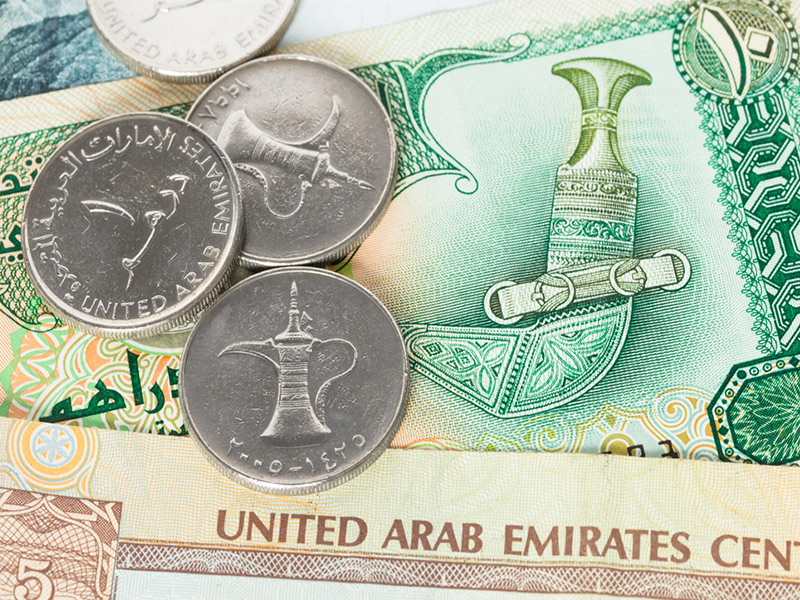
The official currency of Dubai and the entire United Arab Emirates is the UAE Dirham, abbreviated officially as AED, though you will often see it represented as “Dhs” or “DH” in retail environments. To understand the “Money” aspect of Dubai, one must first understand the bedrock upon which its value sits.
The Origins of the Dirham
Before the formation of the UAE in 1971, the region utilized various currencies, including the Gulf Rupee and the Qatar-Dubai Riyal. The UAE Dirham was introduced in 1973, replacing these currencies at par. Since then, it has become one of the most stable currencies in the Middle East. Each Dirham is divided into 100 fils. While the 1 Dirham coin is common, you will also encounter 25-fil and 50-fil coins, which are essential for smaller cash transactions.
Why the Dirham is Pegged to the US Dollar
From a strategic financial perspective, the most critical feature of the AED is its “peg.” Since 1997, the UAE Dirham has been officially pegged to the United States Dollar at a fixed rate of 1 USD = 3.6725 AED.
This peg is a cornerstone of the UAE’s economic policy. Because the nation’s primary exports—oil and gas—are priced in dollars, the peg eliminates exchange rate volatility for the government’s primary revenue stream. For the investor or the resident, this means that the Dirham remains remarkably stable. When the US Dollar strengthens, the Dirham strengthens; when the Dollar fluctuates, the Dirham follows suit. This predictability makes Dubai an attractive destination for foreign direct investment (FDI), as it removes the “currency risk” often associated with emerging markets.
Denominations and Identification
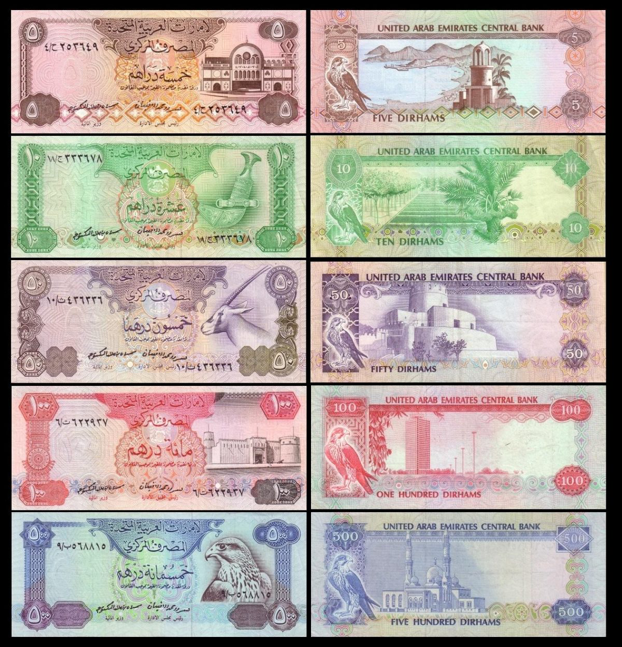
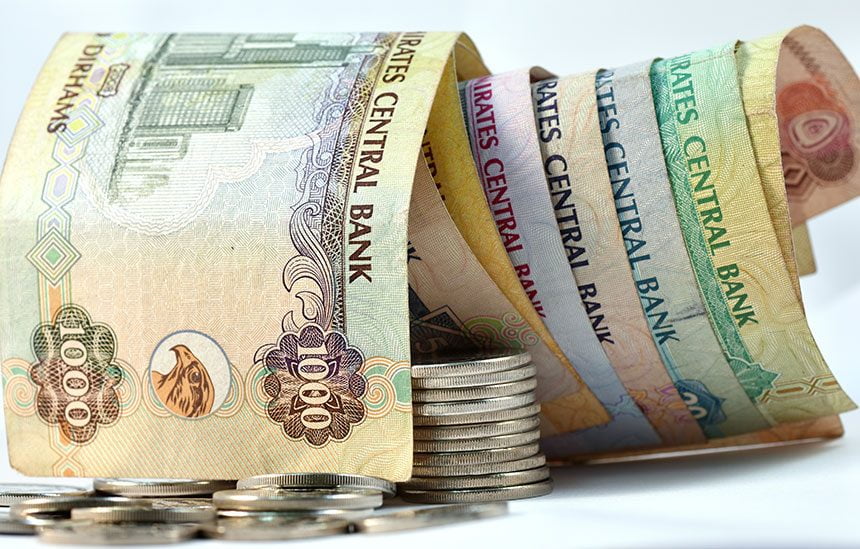
The Central Bank of the UAE issues banknotes in denominations of 5, 10, 20, 50, 100, 200, 500, and 1,000 Dirhams. Each note features distinct cultural landmarks, such as the Blue Souk in Sharjah or the Al Fahidi Fort in Dubai. In recent years, the Central Bank has transitioned several denominations—such as the 5, 10, 20, and 50—to polymer materials. These are more durable and include advanced security features to prevent counterfeiting, reflecting Dubai’s commitment to modernizing its physical financial tools.
Practical Money Management for Travelers and Residents
Whether you are in Dubai for a short-term business project or a long-term residency, managing your liquid assets requires a localized strategy. Dubai is a high-liquidity environment, but the costs of moving money can add up if not handled with professional oversight.
Exchange Rates and Where to Swap Currency
While the peg provides a fixed mid-market rate, retail exchange houses and banks will apply a margin. In Dubai, currency exchange is a highly competitive industry. Unlike many European cities where banks are the primary spot for exchange, Dubai is home to massive exchange houses like Al Ansari Exchange and Al Rostamani International Exchange.
To maximize your value, avoid exchanging large sums at the airport, where margins are typically wider. The exchange houses found within Dubai’s major malls (like the Dubai Mall or Mall of the Emirates) offer much more competitive rates. For major transactions, such as transferring funds for a real estate purchase, utilizing a specialized FX broker can save thousands of Dirhams compared to standard retail bank transfers.
Banking and ATMs in Dubai
The banking sector in Dubai is robust, featuring a mix of local giants (such as Emirates NBD and First Abu Dhabi Bank) and international institutions (such as HSBC, Citibank, and Standard Chartered).
ATMs are ubiquitous, found in every mall, petrol station, and metro station. Most ATMs in Dubai do not charge a local fee for using a foreign card, though your home bank likely will. For residents, opening a bank account is a straightforward process requiring a residency visa and an Emirates ID. Once established, you gain access to some of the world’s most advanced mobile banking apps, which facilitate everything from bill payments to instant international remittances.
Credit Cards vs. Cash: What You Need to Know
Dubai is rapidly becoming a “cash-light” society. Credit and debit cards are accepted almost everywhere, from high-end boutiques to small corner grocery stores. Visa and Mastercard are the dominant players, while American Express is widely accepted in luxury hotels and upscale restaurants.
However, cash is still king in the traditional “Souks” (markets) and for tipping. If you are negotiating the price of a gold necklace in the Deira Gold Souk, having cash in hand can often give you the leverage needed to secure a better discount, as it eliminates the 2–3% processing fee merchants pay to card providers.
The Digital Shift: Fintech and Payment Trends in Dubai
In line with the “Dubai Economic Agenda D33,” the city is positioning itself as a global leader in the digital economy. This has led to a massive influx of financial technology (Fintech) that is changing how money is handled on a daily basis.
The Rise of Contactless and Mobile Wallets
The adoption rate of mobile payments in Dubai is among the highest in the world. Apple Pay, Samsung Pay, and Google Pay are integrated into the majority of Point of Sale (POS) terminals. Furthermore, local digital wallets like e& money and Careem Pay allow users to store funds, pay for transport, and transfer money to friends instantly.
For the tech-savvy individual, physical wallets are becoming secondary. The integration of the “Digital Dubai” initiative means that even government fees, fines, and utility bills are paid through centralized apps like “DubaiNow,” which links directly to your UAE bank account or credit card.
Cryptocurrency Regulation and Adoption
Dubai has made significant strides in becoming a global hub for virtual assets. The establishment of the Virtual Assets Regulatory Authority (VARA) provides a legal framework for cryptocurrency exchanges and blockchain service providers. While you cannot yet walk into a supermarket and pay for milk with Bitcoin, the infrastructure for institutional crypto-investment is vast. Many real estate developers in Dubai now accept cryptocurrency for property purchases through licensed intermediaries, representing a significant shift in how high-value assets are liquidated and traded in the region.
Cost of Living and Budgeting in a Global Hub
Financial literacy in Dubai requires an understanding of the specific costs associated with a tax-free (or low-tax) environment. While there is no personal income tax in the UAE, the “Money” side of Dubai involves navigating other costs that function as indirect taxes.
Hidden Fees and Tipping Etiquette
When dining out or staying at hotels, your bill will often include several additions: a 10% service charge, a 7% municipality fee, and a 5% VAT. While the service charge is included, it is customary in Dubai to tip an additional 10–15% for good service, as this goes directly to the staff. Understanding these “extras” is vital for accurate budgeting in the city’s hospitality-heavy economy.
Value Added Tax (VAT) and Tourist Refunds
The UAE introduced a 5% Value Added Tax (VAT) in 2018. This is a consumption tax applied to most goods and services. However, for tourists and non-residents, there is a “Tax-Free Shopping” scheme.
If you purchase goods worth more than 250 AED, you can request a tax-free tag. Before exiting the country via Dubai International Airport (DXB), you can validate these tags at “Planet Payment” kiosks to receive a refund of the VAT (minus a small administrative fee). For luxury shoppers, this 5% refund can represent a significant saving on high-ticket items like watches or designer handbags.
Future Outlook: Dubai’s Financial Evolution
The United Arab Emirates Dirham remains a symbol of stability in a volatile world. As Dubai continues to diversify its economy away from oil and toward technology, tourism, and finance, the demand for the AED is expected to remain high.
The “Money” story of Dubai is one of calculated growth. By maintaining the dollar peg, the UAE ensures that international trade remains seamless. At the same time, by embracing Fintech and digital transformation, the city is ensuring that its financial systems are ready for the next generation of global commerce.
For anyone looking to engage with this market—whether through investment, employment, or entrepreneurship—the Dirham represents more than just a currency; it represents a gateway to one of the most liquid and ambitious financial ecosystems on the planet. Understanding how to use it, save it, and move it is the first step toward financial success in the City of Gold.
aViewFromTheCave is a participant in the Amazon Services LLC Associates Program, an affiliate advertising program designed to provide a means for sites to earn advertising fees by advertising and linking to Amazon.com. Amazon, the Amazon logo, AmazonSupply, and the AmazonSupply logo are trademarks of Amazon.com, Inc. or its affiliates. As an Amazon Associate we earn affiliate commissions from qualifying purchases.