
In a world increasingly driven by complex algorithms, artificial intelligence, and vast datasets, it might seem counterintuitive to pause and delve into a seemingly simple mathematical identity: “x to the power of 0.” Yet, for anyone navigating the intricate landscape of technology, understanding these foundational principles is not merely an academic exercise; it’s a critical component of building robust systems, designing efficient algorithms, and accurately interpreting data.
This article will demystify the concept of x to the power of 0, moving beyond its basic definition to explore its profound implications and practical applications within the realm of technology. From the logic gates of microprocessors to the intricate layers of neural networks, fundamental mathematical truths underpin every innovation. By examining why x^0 equals 1, we gain insight into the elegant simplicity that forms the bedrock of our digital universe, highlighting the importance of ‘first principles’ thinking in an ever-evolving tech environment.
The Mathematical Foundation: Demystifying Exponents
Before we dive into the technological relevance of x to the power of 0, it’s essential to firmly grasp its mathematical origins. Exponents are a fundamental operation, providing a concise way to express repeated multiplication. Understanding their core rules is the first step towards appreciating the special case we are examining.
A Brief Review of Exponents (X to the Power of N)
At its core, an exponent indicates how many times a base number (x) is multiplied by itself. For instance, in the expression x^n, ‘x’ is the base, and ‘n’ is the exponent.
- x^1 = x (x multiplied by itself once – or simply x)
- x^2 = x * x (x multiplied by itself twice)
- x^3 = x * x * x (x multiplied by itself three times)
This pattern is straightforward and intuitive, representing exponential growth or decay. Whether modeling population dynamics, calculating compound interest, or understanding algorithmic complexity (like O(n^2)), exponents are ubiquitous. However, the rule changes when ‘n’ becomes zero.
The Special Case: X to the Power of 0 Explained
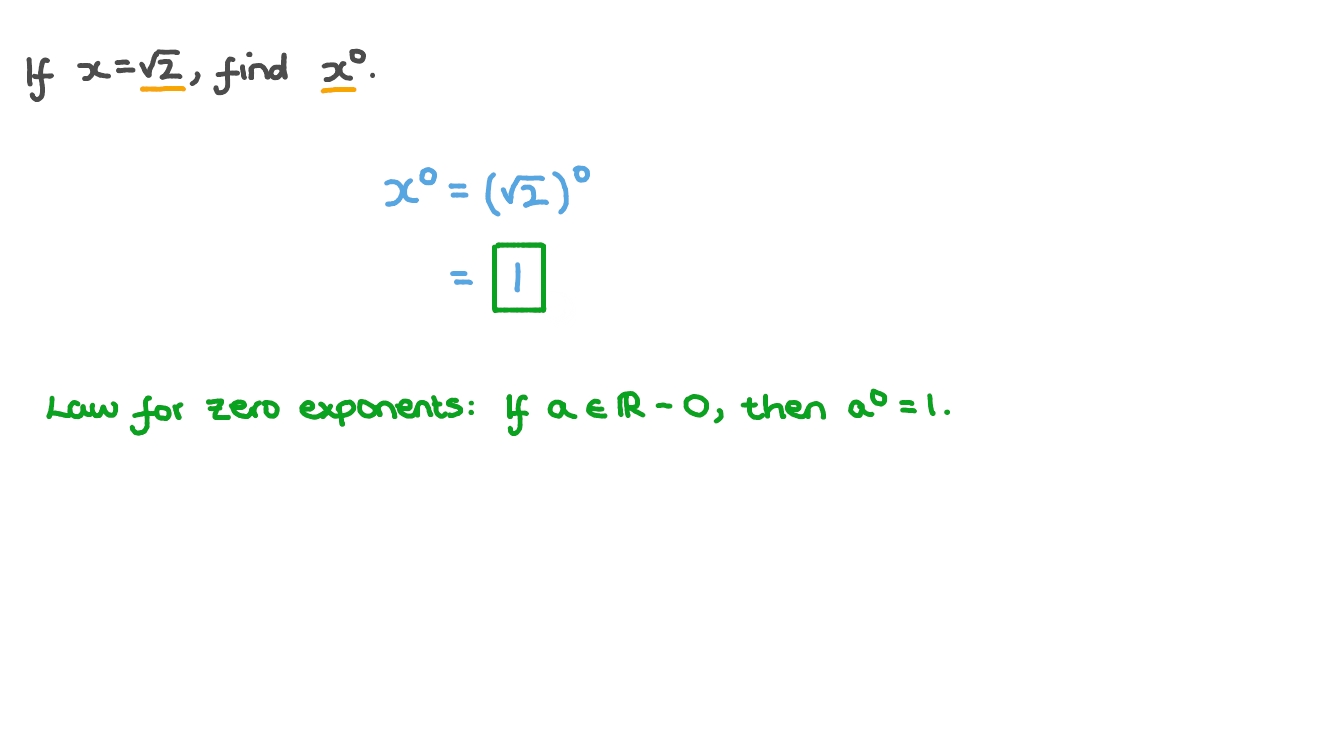
The moment the exponent is zero, the rule shifts, and the result becomes consistently 1, provided the base ‘x’ is not zero. This isn’t an arbitrary rule; it’s a logical extension of the properties of exponents designed to maintain mathematical consistency.
Consider the pattern of decreasing exponents:
- x^4 = x * x * x * x
- x^3 = x * x * x (which is x^4 / x)
- x^2 = x * x (which is x^3 / x)
- x^1 = x (which is x^2 / x)
Following this pattern, to get x^0, we should divide x^1 by x:
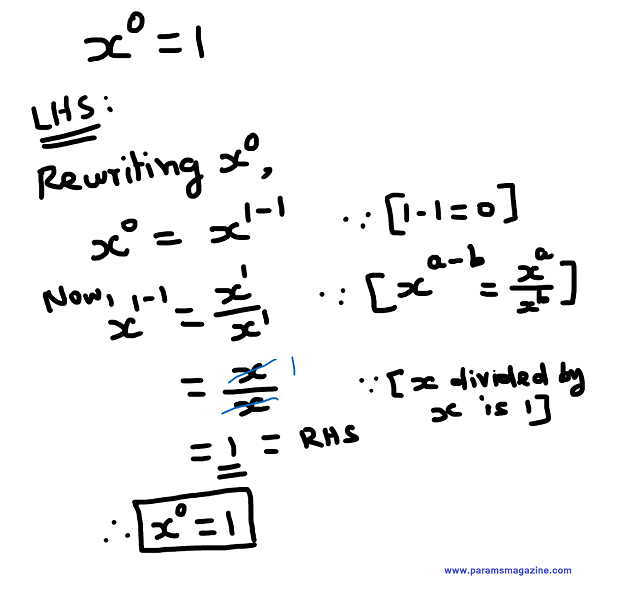
- x^0 = x^1 / x = x / x = 1 (assuming x ≠ 0)
This derivation elegantly demonstrates why any non-zero number raised to the power of 0 must equal 1. It preserves the coherence of exponential operations, ensuring that mathematical relationships remain valid across the spectrum of integers.
Why X to the Power of 0 Equals 1: Maintaining Consistency
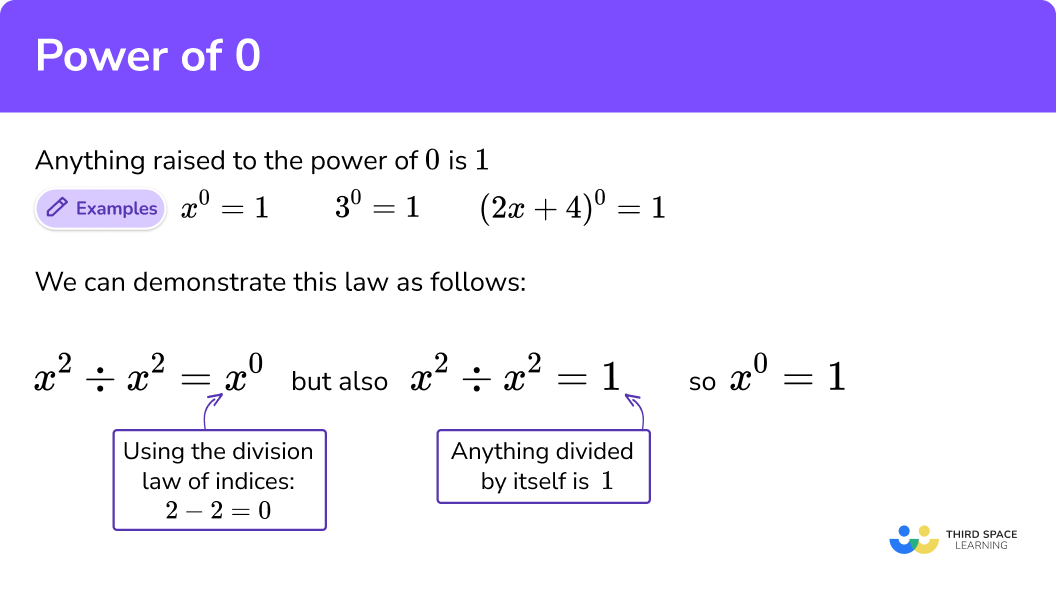
Beyond the intuitive pattern of division, the consistency rule is crucial. One of the fundamental rules of exponents is the quotient rule: x^a / x^b = x^(a-b).
If we apply this rule where a = b:
x^a / x^a = x^(a-a) = x^0.
We also know that any non-zero number divided by itself is 1.
So, x^a / x^a = 1.
Therefore, for consistency, x^0 must equal 1. This mathematical elegance is not just satisfying for mathematicians; it forms a bedrock principle that, as we shall see, has profound implications for how we design and understand digital systems. The one exception is 0^0, which is considered an indeterminate form in calculus, often treated as 1 in combinatorics and computer science contexts for practical purposes, but its mathematical definition is more nuanced. For general practical applications in tech, x^0 = 1 for any non-zero x is the key takeaway.
X^0 in Computing: More Than Just a Math Rule
While it originates in pure mathematics, the concept of x to the power of 0 permeates various aspects of computing, often in subtle yet critical ways. It frequently appears when defining base cases, initializing values, or handling edge conditions in algorithms and data structures, underscoring its role as a fundamental building block.
Base Cases and Initialization in Algorithms
In computer science, many algorithms, especially recursive ones, rely on clearly defined base cases to terminate their execution. A base case is the simplest instance of a problem that can be solved directly without further recursion. Often, x^0 (representing ‘1’) manifests as an initial state or a starting point, particularly when dealing with quantities that grow multiplicatively.
Consider an algorithm that calculates x to the power of n.
- If n = 0, the function should return 1 (the base case).
- If n > 0, the function recursively calls itself for x to the power of (n-1) and multiplies the result by x.
This return 1 for n=0 directly reflects the x^0 = 1 mathematical identity. Without this precise base case, recursive functions could loop infinitely or produce incorrect results. It ensures that even when a process hasn’t started (0 multiplications), there’s a neutral multiplicative identity to build upon.
Data Structures and Indexing
While less direct, the concept of a ‘neutral’ or ‘initial’ state akin to x^0=1 can be seen in how we often handle indexing in data structures. For instance, when calculating memory addresses, offsets, or scaling factors, a starting point of ‘1’ (or a similar initial value) can set the stage before any operations or shifts are applied.
In scenarios where elements are weighted or combined, if an element is present “zero times,” its contribution effectively becomes a neutral factor (like 1 in multiplication, or 0 in addition). While not explicitly x^0, the underlying logic of a neutral multiplicative identity for a ‘zero’ operation count is crucial for maintaining consistency in computations across arrays, lists, or trees.
Binary Systems and Bit Manipulation
In the realm of digital electronics and computer architecture, information is represented in binary (base-2) systems. Each digit, or bit, represents a power of 2.
- … 2^3, 2^2, 2^1, 2^0
Here, 2^0 represents the least significant bit (LSB) and has a value of 1. This is fundamental to how numbers are represented and manipulated in computers.
- For example, the binary number
1011is(1 * 2^3) + (0 * 2^2) + (1 * 2^1) + (1 * 2^0) - Which translates to
(1 * 8) + (0 * 4) + (1 * 2) + (1 * 1) = 8 + 0 + 2 + 1 = 11
Without 2^0 equaling 1, the entire positional numeral system that underpins all digital computation would collapse. Every byte, every integer, every floating-point number relies on the precise mathematical definition of each bit’s weight, with 2^0 being the indispensable ‘unit’ position.
Practical Applications Across Tech Disciplines
The implications of x^0 = 1 ripple through various tech disciplines, influencing how software is written, data is analyzed, and artificial intelligence is designed. It’s a testament to how fundamental mathematical truths manifest in practical engineering solutions.
Software Development and Logical Operations
In software development, particularly in languages that handle mathematical operations, ensuring correct handling of exponents is crucial. For instance, cryptographic algorithms, which rely heavily on modular exponentiation, must correctly implement the base case where the exponent is 0. An error here could lead to critical security vulnerabilities.
Beyond direct mathematical functions, the principle of a neutral identity when “nothing has happened yet” is key to initializing variables or flags. A variable representing a cumulative product might be initialized to 1 (the multiplicative identity), so the first multiplication produces the correct result. Similarly, in state machines or logical conditions, an initial “null” or “empty” state might functionally behave like a base value of 1, awaiting the first operation or input.
Data Science and Statistical Modeling
Data scientists frequently work with statistical models that involve exponents, especially in areas like growth curves, decay functions, and probability distributions. For example, in generalized linear models (GLMs) or certain time-series analyses, parameters raised to a power might be part of the equation. Correctly interpreting and implementing x^0 = 1 ensures that models behave predictably when a given factor has “zero effect” or is at its baseline level.
Furthermore, in data normalization or scaling, understanding the baseline or ‘unit’ transformation is vital. If a transformation involves a power function, knowing how it behaves at the exponent of 0 helps in defining the model’s intercept or initial condition, preventing misinterpretations of coefficients. The fundamental ‘1’ value provides a neutral starting point for scaling operations.
AI and Machine Learning Foundations
At the heart of AI and machine learning, particularly in neural networks, matrix multiplications and activation functions are prevalent. While x^0 might not explicitly appear in every layer, the concept of a “bias” term in neurons can be seen as an additive equivalent to x^0=1. A bias allows a neuron to activate even when all inputs are zero, shifting the activation function.
More directly, in feature engineering, if a feature represents the ‘count’ or ‘occurrence’ of an event, and we want to apply a power transformation to it, knowing that count^0 = 1 provides a sensible baseline for instances where the event has not occurred. This prevents division by zero or other mathematical inconsistencies when handling sparse data or zero-valued features, contributing to the stability and interpretability of complex AI models.
The Power of Fundamental Principles in Innovation
The digital world, for all its complexity and abstraction, is built upon a bedrock of fundamental principles. X to the power of 0 serves as a microcosm of this truth: a simple rule with expansive consequences, reinforcing the idea that even the most advanced technological feats rely on impeccable foundational understanding.
Building Robust Systems from Simple Rules
Every piece of software, every circuit, and every algorithm is a composition of simpler, well-defined rules. The principle that x^0 = 1 is one such rule – a consistent, predictable outcome for a specific operation. When these basic rules are consistently applied and correctly understood, they allow engineers to build incredibly complex and robust systems. Imagine the chaos if this simple rule were inconsistent or ambiguous; calculations would break, algorithms would fail, and software would be riddled with unpredictable errors. The reliability of our digital infrastructure stems from the unwavering nature of these foundational mathematical truths.
Debugging and Understanding Edge Cases
In software development, a significant portion of the effort goes into debugging and handling “edge cases” – situations that fall outside the typical parameters of an algorithm. The exponent of 0 is a classic edge case. Knowing why x^0 = 1 (and why 0^0 is special) helps developers write code that gracefully handles these scenarios.
For example, when validating user input for a calculation involving exponents, a developer might specifically check for an exponent of 0. Understanding its mathematical implication allows for predictable behavior and prevents potential runtime errors or logical flaws. This precision in handling foundational math contributes directly to the stability and security of applications.
The Future of Tech Relies on Foundational Literacy
As technology advances, the abstraction layers grow thicker, and developers work with higher-level tools and frameworks. However, beneath every AI library, every cloud service, and every blockchain ledger, lie mathematical and logical primitives. A strong foundational literacy, which includes understanding concepts like x^0 = 1, enables professionals to:
- Innovate effectively: By truly understanding the underlying mechanics, rather than just memorizing syntax, they can push boundaries and create novel solutions.
- Debug efficiently: When things go wrong, a deep understanding allows for quicker root cause analysis.
- Adapt to change: Fundamental principles are timeless; knowing them makes it easier to learn new technologies built upon the same bedrock.
Beyond the Equation: A Mindset for Tech Professionals
Ultimately, the exploration of “x to the power of 0” offers more than just a mathematical explanation; it provides a lens through which to view the broader ethos of technology. It’s about appreciating precision, understanding first principles, and cultivating a mindset essential for success in the digital realm.
The Importance of First Principles Thinking
Elon Musk often champions “first principles thinking” – boiling things down to their fundamental truths and reasoning up from there, rather than reasoning by analogy. Understanding why x^0 = 1 is a perfect exercise in this. It encourages us to look beyond memorized rules and delve into the underlying logic and consistency. In tech, this means understanding the core computer science concepts, mathematical models, and physical laws that govern our systems, rather than just knowing how to use a specific tool or framework. This deep understanding empowers true innovation and problem-solving.
Embracing Precision and Rigor
The digital world demands absolute precision. A single misplaced bit, an incorrect logical condition, or a misunderstanding of a mathematical rule can have cascading consequences. The exactness of x^0 = 1 underscores the rigor required in tech. Every line of code, every algorithm design, and every data model benefits from an unwavering commitment to accuracy and logical consistency. This attention to detail is what separates robust, reliable systems from those prone to failure.
Continuously Learning the “Why”
In a rapidly evolving field like technology, continuous learning is non-negotiable. But beyond learning what new tools or techniques exist, the lasting value comes from understanding why they work, why certain rules exist, and why certain designs are superior. Delving into the “why” behind concepts like x^0 = 1 cultivates a deeper, more resilient knowledge base that empowers tech professionals to adapt, innovate, and lead. It reminds us that even in the most cutting-edge applications, the bedrock of mathematics and logic remains an indispensable guide.