
For anyone navigating the landscape of personal finance and investing, the terms “S&P 500” and “index fund” frequently surface. Separately, they represent foundational concepts, but together, an S&P 500 index fund offers one of the most popular and often recommended pathways for both novice and seasoned investors alike to gain broad exposure to the U.S. stock market. Far from a mere buzzword, understanding what an S&P 500 index fund is, how it works, and why it’s so highly regarded can be a pivotal step in building a robust financial future.
At its core, an S&P 500 index fund is an investment vehicle designed to replicate the performance of the S&P 500 index. This means that instead of trying to pick individual winning stocks, you are investing in a diversified basket of the largest and most established companies in the United States. It’s a strategy rooted in simplicity, diversification, and the enduring belief in the long-term growth of the American economy. This article will delve into the intricacies of both the S&P 500 index and the index fund concept, exploring their mechanics, benefits, and why they often form the cornerstone of a sound investment portfolio.

Demystifying the S&P 500: More Than Just a Number
Before we can fully grasp the concept of an S&P 500 index fund, it’s crucial to first understand its namesake: the S&P 500 index itself. Often referenced in news reports and financial discussions, the S&P 500 is more than just a random collection of stocks; it’s a carefully curated benchmark that provides a critical pulse on the health and performance of the U.S. economy.
The S&P 500 Index: A Benchmark of American Economic Health
The S&P 500, officially known as the Standard & Poor’s 500, is a stock market index that tracks the stock performance of 500 of the largest publicly traded companies in the United States. Developed and maintained by S&P Dow Jones Indices, it is widely regarded as one of the best gauges of large-cap U.S. equities and a leading indicator for the U.S. stock market. Unlike other indices that might focus on a specific sector or a broader range of companies, the S&P 500 aims to capture the essence of the U.S. market’s largest and most influential players.
Its origins trace back to 1957, building upon earlier, smaller indices. The S&P 500 represents approximately 80% of the total market capitalization of the U.S. stock market, making its movements a strong reflection of overall market sentiment and economic activity. When you hear that “the market is up” or “the market is down,” more often than not, the S&P 500’s performance is being cited.
Criteria for Inclusion: Who Makes the Cut?
Being included in the S&P 500 is a significant achievement for any company, signaling its prominence and financial stability. The selection process is not automatic and involves a committee at S&P Dow Jones Indices that applies specific criteria beyond just market capitalization. While market cap is a primary factor, companies must also meet standards regarding liquidity, public float (the percentage of shares available for public trading), domicile in the U.S., profitability (four consecutive quarters of positive earnings), and sector representation, among others.
This rigorous selection process ensures that the index remains a relevant and accurate representation of the broad U.S. economy, avoiding companies that are too small, illiquid, or not financially sound. Companies can be added or removed from the index, reflecting the dynamic nature of the market and the constant evolution of corporate America. For instance, a company might be removed if it’s acquired, ceases to meet profitability requirements, or its market capitalization significantly declines.
Market-Cap Weighting: Understanding Proportional Influence
A crucial aspect of the S&P 500 is its market-capitalization weighting. This means that companies with larger market values (share price multiplied by the number of outstanding shares) have a greater impact on the index’s overall performance than smaller companies. For example, if Apple (a massive company by market cap) experiences a significant stock price change, it will influence the S&P 500’s movement much more than a company like Ford, which has a smaller market capitalization, even if both experience the same percentage change in their stock price.
This weighting methodology reflects the actual economic impact of these companies and ensures that the index truly represents the aggregate value of its constituents. It also means that investors in an S&P 500 index fund are inherently more exposed to the performance of mega-cap companies, which typically tend to be more stable and established, though not immune to market downturns.
Understanding Index Funds: Investing in the Market, Not Just Stocks
With a clear picture of the S&P 500 index, we can now turn our attention to the “index fund” component. Index funds represent a revolutionary approach to investing, offering a straightforward, low-cost method to participate in the broader market without the complexities and risks associated with active stock picking.
What is an Index Fund? The Philosophy of Passive Investing
An index fund is a type of mutual fund or exchange-traded fund (ETF) that is designed to mimic the performance of a specific market index. Instead of having a team of fund managers actively buying and selling stocks in an attempt to “beat the market” (which is the goal of actively managed funds), an index fund simply buys the stocks that are included in its target index, in the same proportions. If the S&P 500 index holds 1% of its value in Microsoft stock, then an S&P 500 index fund will similarly allocate 1% of its assets to Microsoft.
This strategy is known as “passive investing” because it avoids the constant trading and research costs of active management. The philosophy behind passive investing is often attributed to the efficient market hypothesis, which suggests that it’s extremely difficult for even professional investors to consistently outperform the market over the long term, especially after factoring in fees. Rather than trying to outsmart the market, index funds aim to simply match its performance.
Diversification by Design: Spreading Your Risk Broadly
One of the most compelling advantages of an index fund, particularly an S&P 500 index fund, is the inherent diversification it provides. When you invest in an S&P 500 index fund, you are effectively buying small pieces of 500 different companies across various sectors, including technology, healthcare, finance, consumer discretionary, and industrials.
This level of diversification significantly reduces what’s known as “idiosyncratic risk,” or the risk associated with any single company’s performance. If one company in the S&P 500 performs poorly or even goes bankrupt, its impact on your overall investment is minimal because it’s diluted across 499 other companies. Compare this to investing in just a handful of individual stocks, where the failure of one could devastate your portfolio. This broad diversification offers a powerful layer of protection and stability, making it easier for investors to weather market volatility.
Low Costs, High Efficiency: The Appeal of Passive Management
The passive nature of index funds translates directly into lower operating costs. Since there’s no need for expensive research teams, frequent trading, or highly paid active managers, index funds typically have significantly lower expense ratios (the annual fee charged as a percentage of your investment) compared to actively managed funds.
Over time, these seemingly small differences in fees can have a profound impact on your long-term returns. Even a 1% difference in annual fees, compounded over decades, can amount to tens or hundreds of thousands of dollars in lost gains. The cost-efficiency of index funds is a major reason why they are so appealing, allowing investors to keep more of their hard-earned money working for them. This efficiency, combined with diversification and market-matching performance, makes index funds a highly attractive option for long-term wealth building.
The S&P 500 Index Fund: Your Gateway to Broad Market Exposure

Bringing these two concepts together, an S&P 500 index fund offers an elegant and effective solution for investors seeking broad exposure to the U.S. equity market. It’s an investment that embodies simplicity, low cost, and robust diversification, making it a cornerstone for many financial plans.
How an S&P 500 Index Fund Works: Mirroring the Benchmark
As discussed, an S&P 500 index fund’s primary objective is to track the performance of the S&P 500 index as closely as possible. Fund managers of an S&P 500 index fund do not try to pick winners; instead, they employ a strategy called “indexing” or “replication.” They purchase all 500 stocks in the S&P 500 index in the same market-cap weighted proportions as the index itself.
When a company is added to or removed from the S&P 500 index, the fund will adjust its holdings accordingly. When companies within the index pay dividends, these dividends are typically reinvested back into the fund, buying more shares and contributing to long-term growth. This continuous, automated process ensures that the fund’s composition remains aligned with the index, thereby mirroring its performance before fees. While minor tracking errors can occur due to transaction costs or dividend timing, index funds are remarkably effective at replicating their benchmarks.
Different Forms of S&P 500 Funds: ETFs vs. Mutual Funds
S&P 500 index funds are primarily available in two common structures:
- Mutual Funds: Traditionally, index funds were offered as mutual funds. With a mutual fund, investors buy shares directly from the fund company, and transactions occur once a day after the market closes, based on the fund’s Net Asset Value (NAV). They are often suitable for regular, recurring investments, such as those made through a 401(k) or IRA.
- Exchange-Traded Funds (ETFs): ETFs are a more modern and increasingly popular form of index fund. Unlike mutual funds, ETFs trade on stock exchanges throughout the day, just like individual stocks. This allows for real-time pricing and greater flexibility in trading. Many investors find ETFs convenient for their liquidity and often slightly lower expense ratios compared to their mutual fund counterparts. Both types serve the same purpose of tracking the S&P 500, and the choice between them often comes down to personal preference for trading flexibility and investment habits.
Key Benefits for Investors: Simplicity, Diversification, and Growth Potential
The appeal of an S&P 500 index fund for investors lies in a powerful combination of factors:
- Simplicity: It removes the need for complex research, market timing, or stock analysis. You’re investing in the overall market, not trying to outwit it.
- Diversification: Instantly grants you exposure to 500 leading U.S. companies across diverse sectors, significantly lowering specific company risk.
- Growth Potential: By tracking the S&P 500, you participate in the long-term growth of the U.S. economy and corporate profits, which historically has delivered substantial returns over extended periods. It allows investors to benefit from the innovation and expansion of America’s largest businesses without the daunting task of individual stock selection.
Why Invest in an S&P 500 Index Fund? Compelling Advantages
The arguments for including an S&P 500 index fund in your investment portfolio are numerous and compelling, particularly for long-term investors focused on wealth accumulation. It’s not just a default option but a strategically sound choice for many.
Simplicity and Accessibility: Investing Made Easy
For many, the world of investing seems complex and intimidating. Choosing individual stocks requires significant research, understanding financial statements, and keeping up with market news. Active mutual funds, while managed by professionals, often come with opaque strategies and high fees. The S&P 500 index fund cuts through this complexity. Its strategy is transparent: track the S&P 500. This simplicity makes investing accessible to everyone, from complete beginners to experienced investors who appreciate a straightforward approach. Setting up a recurring investment into an S&P 500 index fund is one of the easiest ways to start building wealth systematically.
Diversification Without Effort: Reducing Idiosyncratic Risk
As previously noted, an S&P 500 index fund provides instant, broad diversification across 500 companies in various industries. This built-in diversification is one of its strongest features. It protects your portfolio from the extreme volatility that can come from owning just a few stocks. Even well-regarded individual companies can face unexpected challenges, but the S&P 500 spreads your risk so effectively that the poor performance of a single company has a minimal impact on your overall returns. This significantly reduces “idiosyncratic risk,” allowing investors to focus on overall market trends rather than company-specific events.
Historically Strong Performance: Riding the Tide of Corporate America
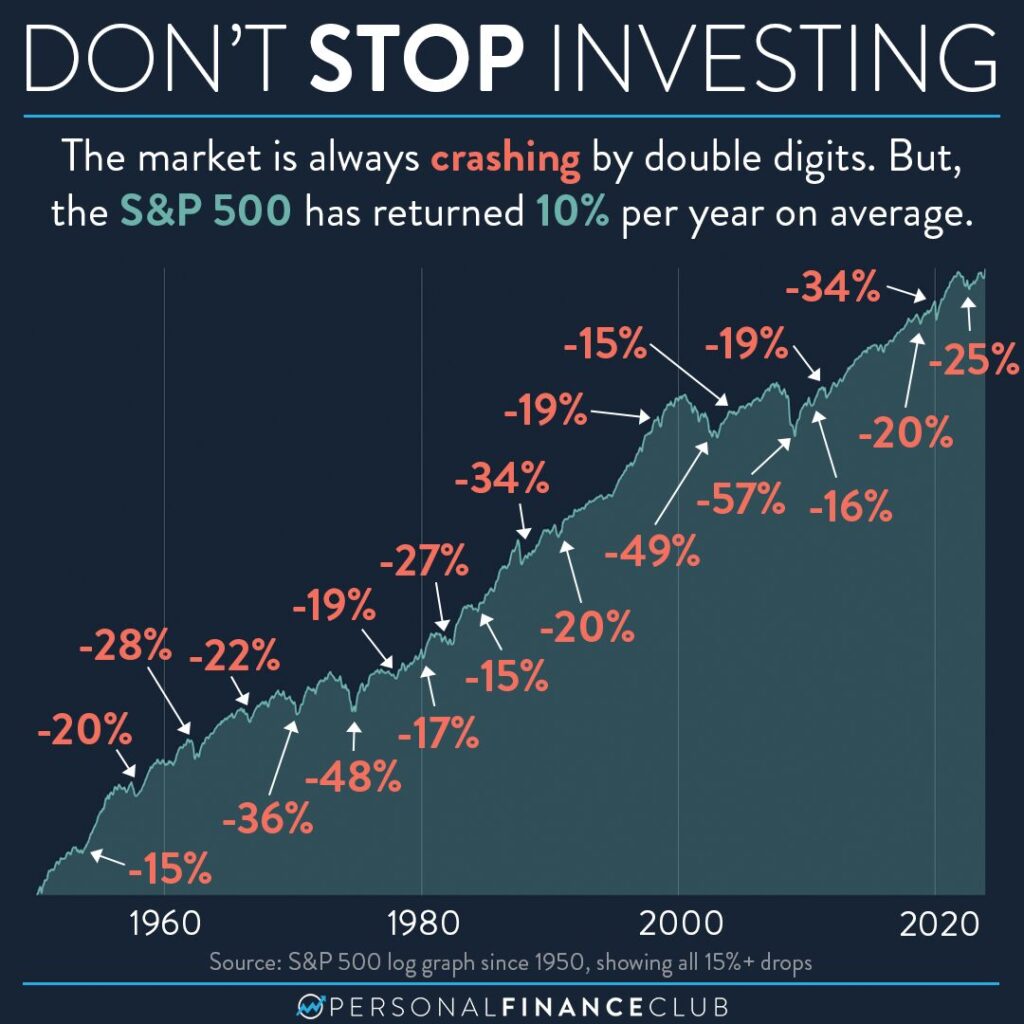
Historically, the S&P 500 has demonstrated robust long-term growth. While past performance is not indicative of future results, the average annual return of the S&P 500 since its inception in 1957 (or looking further back at similar large-cap indices) has been around 10-12% per year. This track record reflects the innovation, resilience, and profitability of American corporations over decades. By investing in an S&P 500 index fund, you are essentially betting on the continued growth and success of the most powerful economic engine in the world. This ride-the-market strategy has proven to be incredibly effective for long-term wealth creation, especially when coupled with regular contributions and reinvested dividends.
Cost-Efficiency: Keeping More of Your Returns
The low expense ratios associated with S&P 500 index funds are a significant advantage. Actively managed funds often charge 1% or more annually, whereas many S&P 500 index funds and ETFs boast expense ratios well under 0.10%. Over the course of several decades, these seemingly small differences in fees can translate into hundreds of thousands of dollars in additional returns for the investor. For example, a 1% annual fee on a $100,000 portfolio reduces your returns by $1,000 each year. If that money compounded, it would be significantly more. The power of compounding means that every dollar saved in fees is a dollar more that can grow exponentially over time.
Considerations Before Investing: What to Keep in Mind
While S&P 500 index funds offer numerous benefits, it’s crucial to approach any investment with a clear understanding of its inherent risks and limitations. No investment is without its downsides, and index funds are no exception.
Market Fluctuations and Risk: No Investment is Without Downsides
Despite their diversification, S&P 500 index funds are not immune to market downturns. Because they track the overall market, when the market (or a significant portion of it) falls, so will the value of your S&P 500 index fund. Economic recessions, geopolitical events, and other broad market shocks can lead to significant drops in value. While history suggests markets tend to recover over time, there’s no guarantee of recovery, and the timeline for recovery can be unpredictable. Investors must be prepared for volatility and understand that their capital is at risk. An S&P 500 index fund is generally considered a long-term investment, best suited for money you won’t need for at least 5-10 years, allowing time to ride out market cycles.
Limited Outperformance: Mirroring, Not Beating, the Market
The fundamental goal of an S&P 500 index fund is to match the performance of the S&P 500 index, not to beat it. This is both its strength and its limitation. While it excels at capturing market returns with low costs, it will never significantly outperform the index itself. Investors seeking to pick individual winners or those who believe they can consistently identify undervalued stocks and beat the market may find this passive approach limiting. For most investors, however, consistently matching market returns over the long run is a highly successful strategy, outperforming the majority of actively managed funds after fees.
Fees and Expense Ratios: Small Costs, Big Impact Over Time
While index funds are celebrated for their low fees, it’s still essential to pay attention to the expense ratio. Even within the category of S&P 500 index funds, there can be variations. Always compare the expense ratios of different providers (e.g., Vanguard, Fidelity, Schwab, iShares) to ensure you’re getting the most cost-effective option. While a 0.03% expense ratio versus a 0.09% might seem negligible initially, these fractional differences compound over decades, eating into your total returns. Furthermore, be aware of any trading fees if you’re frequently buying and selling ETFs, though for long-term investors, these are usually minimal.
In conclusion, an S&P 500 index fund stands as a cornerstone investment for countless individuals building their financial futures. It offers an incredibly efficient, diversified, and low-cost way to participate in the long-term growth of the U.S. stock market. By understanding the S&P 500 index itself, the mechanics of passive investing, and the practical advantages of these funds, investors can make informed decisions that align with their long-term financial goals, ultimately simplifying their investment journey while potentially maximizing their returns over time. While not without risk, its proven track record and straightforward approach make it an indispensable tool in a well-constructed investment portfolio.
aViewFromTheCave is a participant in the Amazon Services LLC Associates Program, an affiliate advertising program designed to provide a means for sites to earn advertising fees by advertising and linking to Amazon.com. Amazon, the Amazon logo, AmazonSupply, and the AmazonSupply logo are trademarks of Amazon.com, Inc. or its affiliates. As an Amazon Associate we earn affiliate commissions from qualifying purchases.