
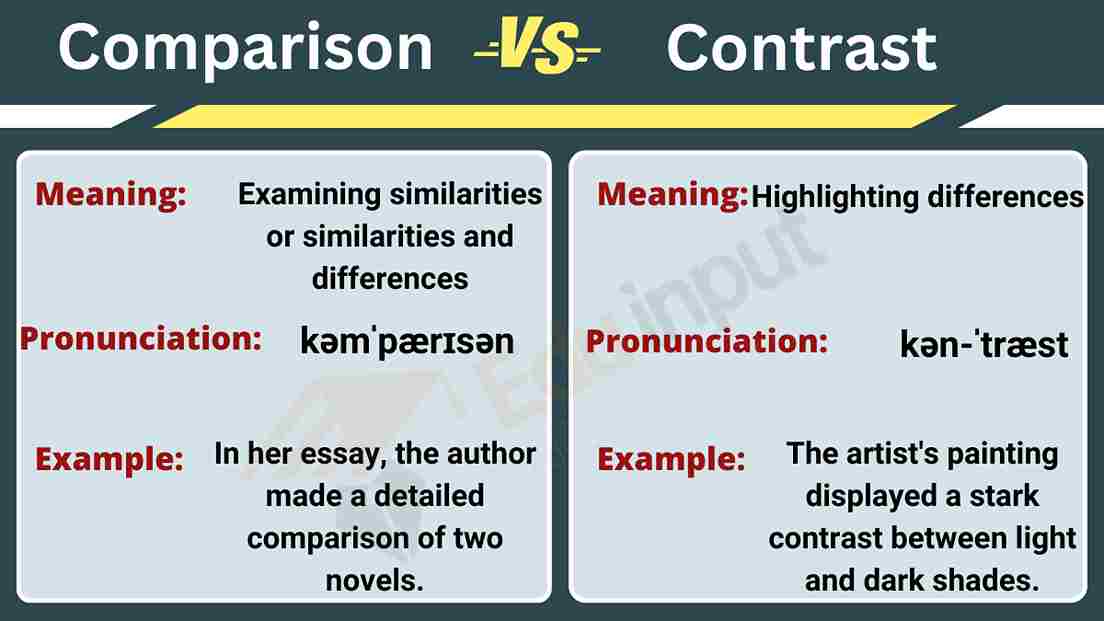
In the rapidly evolving landscape of the 21st century, the ability to “compare and contrast” has transitioned from a basic rhetorical device used in classrooms to a fundamental framework for technological advancement. In the tech sector, this methodology serves as the primary engine for innovation, procurement, and system optimization. To compare is to identify the commonalities between two or more technological entities—such as software architectures, hardware specifications, or digital protocols—while to contrast is to pinpoint the unique divergences that define their specific value propositions.
Understanding the meaning of compare and contrast in a technical context is about more than just listing features; it is about conducting a rigorous audit of performance, scalability, and integration capabilities. Whether a developer is choosing between two programming frameworks or a CTO is deciding on a multi-million dollar cloud migration strategy, the comparative framework provides the empirical evidence required to navigate a crowded and complex market.
1. Decoding the “Compare and Contrast” Framework in Technical Analysis
In technology, “compare and contrast” functions as a systematic lens through which we view product development and software selection. Without a standardized way to measure one tool against another, the industry would lack the benchmarks necessary for progress.
The Analytical Pillar of Software Selection
When businesses look at software solutions, the “compare” phase identifies the baseline requirements. For instance, if a company is evaluating two Project Management tools like Jira and Monday.com, the comparison highlights that both offer task tracking, API integrations, and cloud hosting. These are the shared traits that make both tools viable candidates.
The “contrast” phase, however, is where the decision-making happens. It uncovers that Jira offers deeper integration for agile development teams with robust ticket-tracking for bugs, whereas Monday.com emphasizes visual workflow automation and ease of use for non-technical departments. By contrasting these specificities, stakeholders can determine which tool aligns with their specific operational DNA.
Benchmarking Hardware: Identifying Similarities and Divergent Features
In hardware engineering, comparing and contrasting is often driven by raw data. When we compare two processors, such as an Intel Core i9 and an AMD Ryzen 9, we look at shared architectural concepts: both utilize multi-core processing, have high clock speeds, and require sophisticated cooling systems.
The contrast emerges in the micro-architecture. One might excel in single-threaded performance, making it superior for gaming, while the other offers more threads at a lower price point, making it the better choice for video rendering. This contrast isn’t just a list of differences; it represents a strategic fork in the road for the consumer and the manufacturer alike.
2. Comparing AI Models: The New Frontier of Tech Analysis
The rise of Artificial Intelligence has introduced a new layer of complexity to the meaning of compare and contrast. As Large Language Models (LLMs) proliferate, developers must look beyond simple “input-output” metrics to understand the nuances of machine intelligence.
Large Language Models (LLMs) vs. Specialized Neural Networks
When we compare an LLM like GPT-4 with a specialized neural network designed for medical imaging, we find a shared reliance on deep learning and transformer architectures. Both require massive datasets for training and significant computational power.
However, when we contrast them, we see a massive divergence in utility and “hallucination” risks. An LLM is a “generalist”—it prioritizes linguistic fluidity and creative synthesis. A medical neural network is a “specialist”—it prioritizes precision and cannot afford the creative liberties that an LLM might take. This contrast dictates the safety protocols and ethical frameworks applied to each technology.
Cost-Benefit Analysis: Open-Source vs. Proprietary AI
The tech world is currently divided by the contrast between open-source models (like Meta’s Llama) and proprietary models (like OpenAI’s GPT series). Comparing them reveals that both can achieve high benchmarks in logic and reasoning.
The contrast lies in the “black box” nature of proprietary software. While proprietary models often offer better out-of-the-box performance and support, open-source models offer the contrast of “transparency” and “customization.” For tech organizations, this contrast is the difference between data privacy (keeping weights on-premise) and ease of use (relying on an external API).
3. The Role of Contrast in User Experience (UX) and Interface Design

In the realm of digital design, “contrast” is not just a comparative concept but a literal design principle. It is the tool that developers and designers use to guide user behavior and ensure accessibility.
Visual Contrast: Accessibility and User Retention
In UX design, the meaning of contrast refers to the difference in luminance or color that makes an object distinguishable from another. High contrast is essential for accessibility, ensuring that users with visual impairments can navigate an app. By contrasting the call-to-action (CTA) button against the background, designers leverage the human brain’s natural tendency to notice outliers.
Compare two design philosophies: Skeuomorphism (which mimics real-world textures) and Flat Design. Both aim to create an intuitive interface. The contrast, however, lies in their visual weight. Skeuomorphism uses shadows and gradients to create depth, while Flat Design uses stark colors and typography to prioritize speed and readability on mobile screens.
Functional Contrast: Differentiating Operating Systems
The perennial comparison between iOS and Android is a masterclass in functional contrast. Both are Unix-based mobile operating systems that support millions of apps. They are comparable in their fundamental goal: to manage mobile hardware and provide a user interface.
The contrast defines their market positions. iOS provides a “walled garden,” contrasting with Android’s “open ecosystem.” This contrast influences everything from the software development kits (SDKs) used by programmers to the frequency of security patches. One prioritizes uniformity; the other prioritizes flexibility.
4. Strategic Technical Decision-Making: A Guide for Enterprises
For enterprise-level technology, the meaning of compare and contrast is tied directly to the Total Cost of Ownership (TCO) and long-term scalability.
Scaling Solutions: Cloud vs. On-Premise Comparison
In the modern tech stack, the comparison between Cloud (AWS, Azure, GCP) and On-Premise servers is a standard exercise. Both systems provide storage, compute power, and networking.
The contrast is found in the “CapEx vs. OpEx” (Capital Expenditure vs. Operating Expenditure) models. On-premise requires a heavy upfront investment in hardware (contrast: high control, high initial cost), whereas the cloud offers an elastic, pay-as-you-go model (contrast: low initial cost, variable monthly expenses). Contrasting these two allows a tech leader to align their infrastructure with their company’s financial health and growth trajectory.
Security Protocols: Comparing Encryption and Compliance Standards
In cybersecurity, comparing different encryption standards like AES-256 and RSA is vital for digital security. Both serve the purpose of protecting data at rest and in transit.
The contrast is found in their mathematical foundations. AES is a symmetric algorithm, meaning the same key is used for encryption and decryption. RSA is asymmetric, using a public and private key pair. Contrasting these allows security architects to use the right tool for the right job: AES for fast data encryption and RSA for secure key exchange. This distinction is the bedrock of secure communication on the internet.
5. The Future of Comparative Analysis in a Rapidly Evolving Tech Landscape
As we move toward a future defined by quantum computing and the “Internet of Things” (IoT), the meaning of compare and contrast will only grow in importance. We are entering an era where human-led comparison is being supplemented by AI-driven insights.
Automated Comparison Tools and AI-Driven Insights
We are seeing the rise of “comparative AI”—tools designed specifically to ingest technical documentation and provide a contrastive analysis of different software versions or hardware specs. These tools can compare millions of lines of code in seconds, identifying “code smells” or vulnerabilities that a human might miss.
Furthermore, the “digital twin” technology allows companies to contrast a simulated version of a system with the physical version. By comparing the real-time data from an IoT sensor with the “ideal” data in the digital twin, engineers can contrast the current performance with the expected performance to predict hardware failure before it happens.

Conclusion: The Critical Importance of a Contrastive Mindset
In technology, “compare and contrast” is more than a linguistic exercise; it is a survival skill. It is the process that allows us to filter the signal from the noise in an industry saturated with “next big things.” By identifying the shared foundations of technology and rigorously analyzing their unique differences, we can make informed decisions that lead to more secure, efficient, and innovative digital futures.
Whether you are a consumer choosing between two smartphones or an engineer architecting a global network, the ability to find the meaning in the similarities and the value in the differences is the ultimate technical edge. Progress, after all, does not happen in a vacuum; it happens at the intersection where we compare what we have with the contrast of what is possible.