
In an increasingly connected world, the quality and speed of our internet connection are paramount. Wi-Fi, the ubiquitous wireless technology, has undergone significant evolution to keep pace with the ever-growing demands of digital life. Two of the most prevalent standards today are Wi-Fi 5 and Wi-Fi 6, representing distinct generations of wireless innovation. While both deliver high-speed internet, they differ fundamentally in their underlying technologies, capabilities, and the environments for which they are optimized. Understanding these differences is crucial for consumers and businesses alike when making informed decisions about their networking infrastructure, ensuring they harness the full potential of their connected devices.
The Evolution of Wireless Connectivity: A Brief Overview
The journey of Wi-Fi standards is a testament to continuous technological advancement, driven by the insatiable appetite for faster, more reliable, and more efficient wireless communication. Each new iteration builds upon its predecessors, addressing emerging challenges and introducing groundbreaking features that redefine our digital experience.
From 802.11 Standards to User-Friendly Naming
For years, Wi-Fi standards were known by their technical IEEE 802.11 designations – a series of letters like 802.11b, 802.11g, 802.11n, 802.11ac, and 802.11ax. While precise for engineers, these names often proved confusing for the average user. Recognizing this, the Wi-Fi Alliance, the global industry association, introduced a simplified, generational naming convention. What was formerly 802.11ac became Wi-Fi 5, and 802.11ax was rebranded as Wi-Fi 6. This shift aimed to make it easier for consumers to identify and understand the latest Wi-Fi technology, much like how mobile phone generations are distinguished.
This generational numbering system simplifies comprehension:
- Wi-Fi 1: 802.11b (released 1999)
- Wi-Fi 2: 802.11a (released 1999)
- Wi-Fi 3: 802.11g (released 2003)
- Wi-Fi 4: 802.11n (released 2009)
- Wi-Fi 5: 802.11ac (released 2013)
- Wi-Fi 6: 802.11ax (released 2019)
- Wi-Fi 6E: An extension of Wi-Fi 6 utilizing the 6 GHz band (released 2020)
- Wi-Fi 7: 802.11be (due 2024)
The Core Need for Advancement
Each leap in Wi-Fi technology has been spurred by specific demands. Early Wi-Fi needed to establish wireless networks for basic internet access. Subsequent versions focused on increasing raw speed and range. However, with the proliferation of smart devices, high-bandwidth applications like 4K streaming, online gaming, and virtual reality, the focus shifted beyond mere speed. Modern networks now contend with unprecedented levels of device density and traffic congestion, particularly in homes and offices packed with smartphones, tablets, laptops, smart TVs, IoT sensors, and wearables. This growing complexity necessitated a new approach, moving from simply making connections faster to making them smarter and more efficient—a paradigm shift that Wi-Fi 6 champions.
Diving Deep into Wi-Fi 5 (802.11ac): The Modern Standard
Wi-Fi 5, officially known as 802.11ac, emerged in 2013 as a significant upgrade over its predecessor, Wi-Fi 4 (802.11n). It was designed to cater to the burgeoning demand for higher throughput in single-user scenarios, primarily focusing on faster downloads and smoother streaming experiences.
Key Features and Capabilities
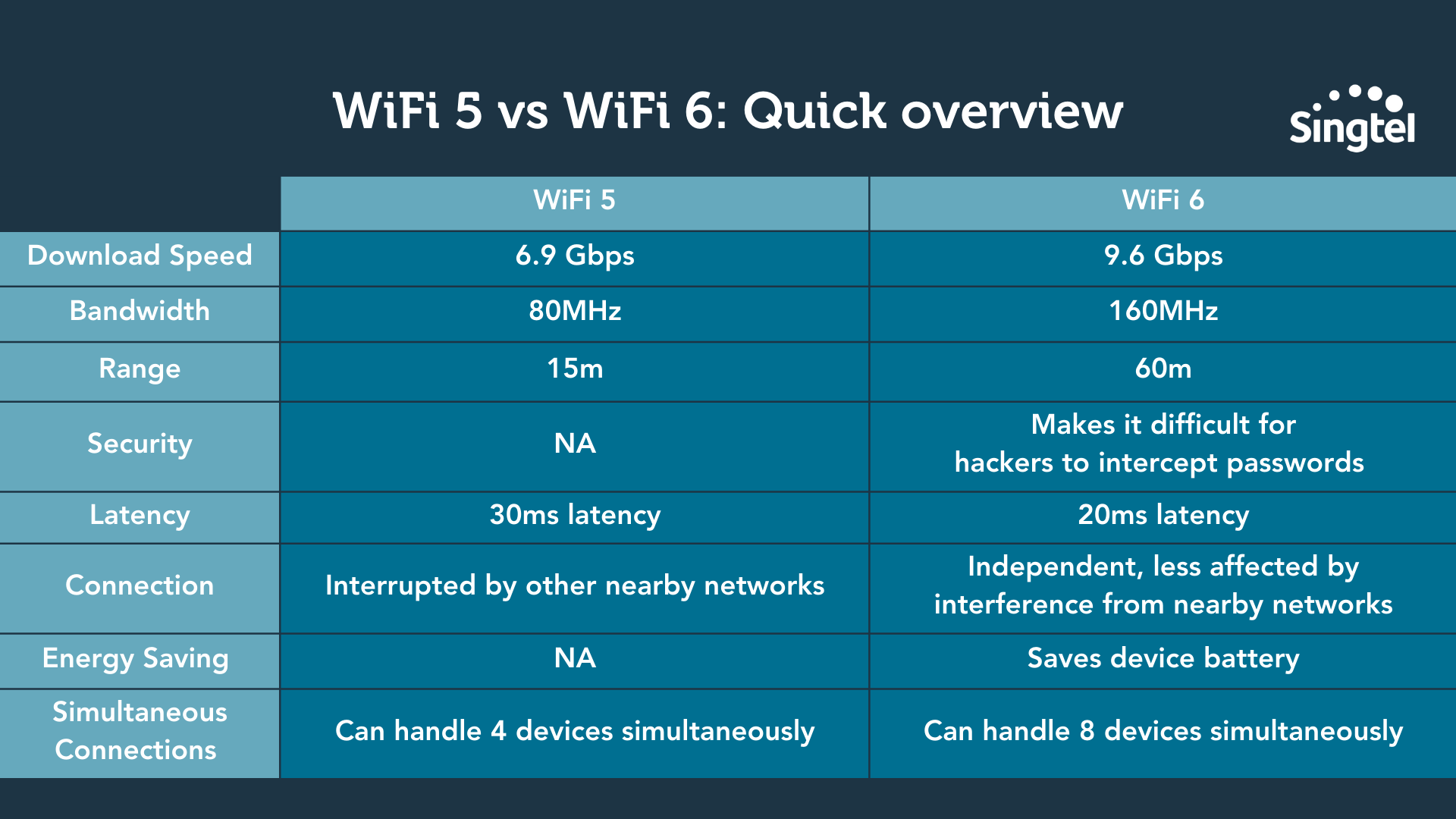
Wi-Fi 5 operates exclusively on the 5 GHz frequency band. This band offers several advantages over the older 2.4 GHz band used by Wi-Fi 4, including less interference from other devices (like microwaves and cordless phones) and the ability to support wider channels, leading to higher data rates. However, its shorter wavelength means it has a more limited range and struggles to penetrate walls as effectively as 2.4 GHz.
Key technologies introduced or enhanced with Wi-Fi 5 include:
- Wider Channels: Wi-Fi 5 supports channel widths up to 160 MHz (compared to 40 MHz in Wi-Fi 4), allowing more data to be transmitted simultaneously.
- Higher-Order Modulation (256-QAM): Quadrature Amplitude Modulation (QAM) is a method for packing more data into each signal. Wi-Fi 5 adopted 256-QAM, significantly increasing the data rate per hertz.
- Increased Spatial Streams: Wi-Fi 5 routers can support up to 8 spatial streams, allowing for multiple simultaneous data transmissions to different devices or multiple antennas on a single device, leveraging Multiple-Input, Multiple-Output (MIMO) technology.
- Multi-User MIMO (MU-MIMO) – Downlink Only: While initially optional and limited, MU-MIMO allowed a router to transmit data to multiple compatible devices simultaneously, rather than sequentially. However, in Wi-Fi 5, this was only for the downlink (router to device).
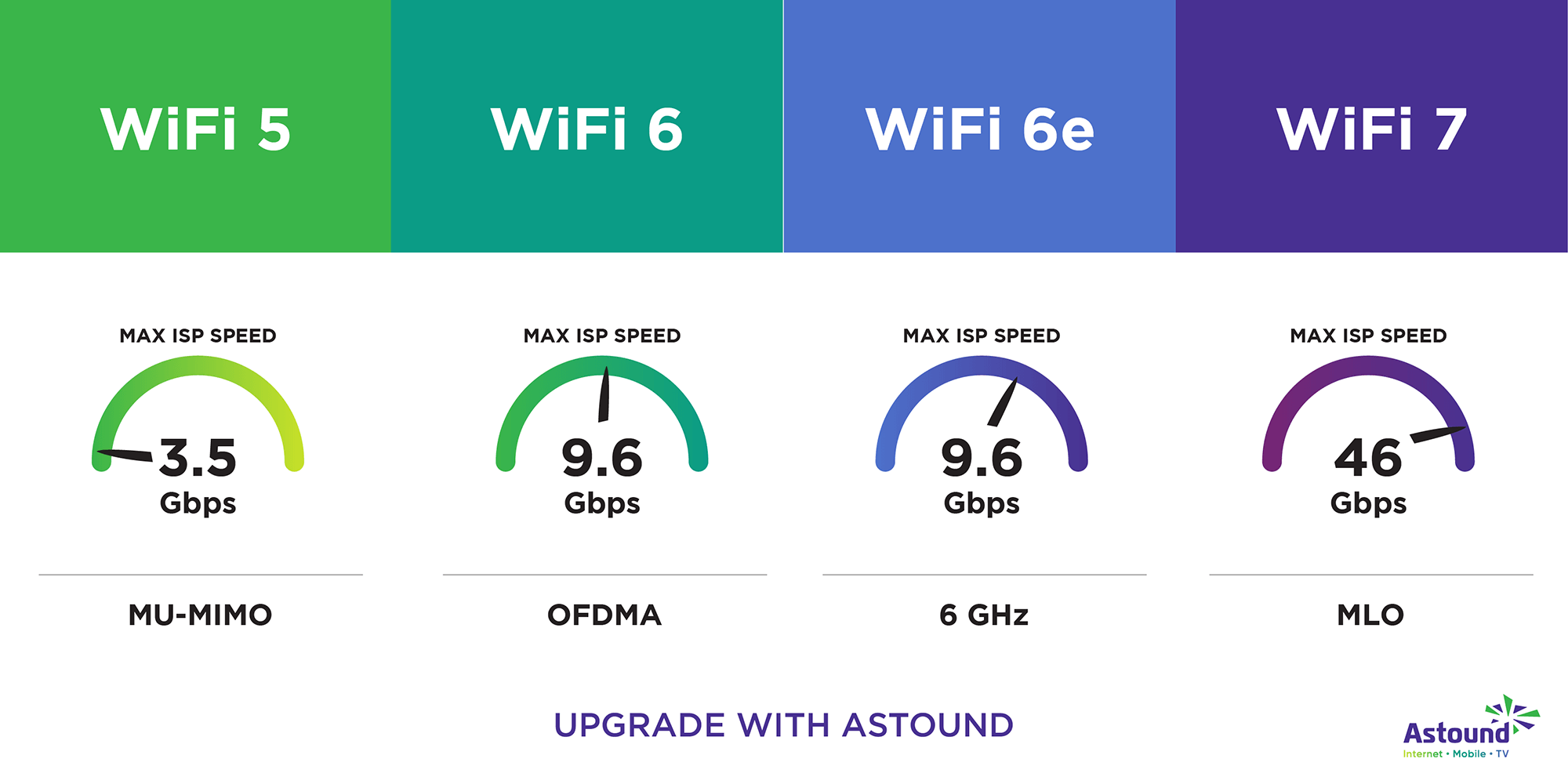
Collectively, these features enabled Wi-Fi 5 to achieve theoretical maximum speeds of up to 6.9 Gbps (though real-world speeds are significantly lower, typically in the hundreds of Mbps to 1 Gbps range), making it ideal for high-definition video streaming, large file transfers, and general internet browsing in homes with a moderate number of devices.
Limitations in Congested Environments
Despite its impressive speed, Wi-Fi 5 was designed primarily for a world where each device largely took turns communicating with the router. It excelled at providing a fast connection to a single device or a few devices that weren’t all simultaneously demanding peak bandwidth.
However, as homes and offices became saturated with dozens of Wi-Fi devices – each vying for bandwidth – the limitations of Wi-Fi 5 became apparent. In crowded network environments, even though the theoretical top speed was high, the actual performance for each device could degrade significantly. This is because Wi-Fi 5 still largely operates on a “first-come, first-served” basis. When multiple devices try to communicate simultaneously, they often have to wait their turn, leading to latency, buffering, and a general feeling of a slow or unreliable connection, even if the internet service provider (ISP) delivers ample bandwidth to the router. This problem, known as network congestion, became the primary challenge that the next generation of Wi-Fi sought to address.
Unveiling Wi-Fi 6 (802.11ax): The Future-Ready Standard
Wi-Fi 6, or 802.11ax, represents a paradigm shift in wireless networking. While it does offer increased raw speed, its primary focus is on efficiency and performance in dense, multi-device environments. Released in 2019, Wi-Fi 6 is engineered to handle the modern digital landscape, where homes and workplaces are brimming with an ever-increasing number of connected devices, from laptops and smartphones to smart home gadgets and IoT sensors.
Enhanced Speed and Throughput
While not its sole focus, Wi-Fi 6 certainly delivers a bump in speed. It offers a theoretical maximum throughput of up to 9.6 Gbps, a roughly 30% increase over Wi-Fi 5’s 6.9 Gbps. This boost comes from a combination of refined technologies, including:
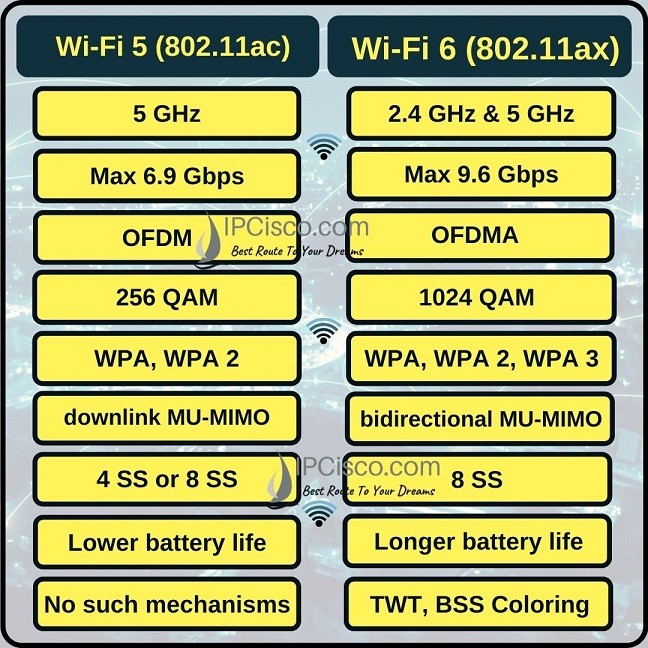
- Both 2.4 GHz and 5 GHz Bands: Unlike Wi-Fi 5 which was 5 GHz exclusive, Wi-Fi 6 operates across both the 2.4 GHz and 5 GHz bands. This allows it to leverage the better range and wall-penetration capabilities of 2.4 GHz, while still capitalizing on the higher speeds of 5 GHz. This dual-band operation provides greater flexibility and compatibility with older devices.
- 1024-QAM: Wi-Fi 6 upgrades the modulation scheme from 256-QAM in Wi-Fi 5 to 1024-QAM. This allows each signal to carry 25% more data, contributing directly to higher throughput.
Superior Performance in Dense Networks
The true strength of Wi-Fi 6 lies in its ability to manage multiple simultaneous connections far more efficiently than its predecessor. It’s not just about peak speed for one device; it’s about delivering consistent, high-performance connectivity to many devices at once, even in crowded network conditions. This makes it ideal for smart homes with numerous IoT devices, busy offices, and public Wi-Fi hotspots. It effectively reduces latency and improves overall network responsiveness, ensuring a smoother experience for everyone.
Improved Efficiency and Battery Life
Beyond speed and density, Wi-Fi 6 also introduces features designed to enhance efficiency and prolong battery life for connected devices. This is particularly beneficial for battery-powered IoT devices and mobile gadgets. By allowing devices to communicate more intelligently with the router about when they need to send or receive data, Wi-Fi 6 minimizes unnecessary power consumption.
Key Technological Innovations Driving Wi-Fi 6
The significant advancements of Wi-Fi 6 stem from several core technological innovations that fundamentally change how Wi-Fi routers and devices communicate. These aren’t just incremental improvements but rather architectural shifts in wireless communication protocols.
OFDMA: Revolutionizing Multi-User Efficiency
Perhaps the most transformative technology in Wi-Fi 6 is Orthogonal Frequency Division Multiple Access (OFDMA). This is a significant upgrade from the Orthogonal Frequency Division Multiplexing (OFDM) used in previous Wi-Fi standards.
- OFDM (Wi-Fi 5 and earlier): In OFDM, the entire channel is dedicated to a single user at any given time. If a device only needs to send a small packet of data, it still occupies the whole channel, meaning other devices have to wait their turn even if the channel isn’t fully utilized. This is analogous to a delivery truck making a trip for a single small package.
- OFDMA (Wi-Fi 6): OFDMA allows a channel to be divided into smaller frequency resource units (RUs), which can then be allocated to multiple users simultaneously. This means a single transmission can carry data for several different devices at once. Think of it like a delivery truck carrying multiple packages for different recipients on a single trip. This drastically improves efficiency, especially for small, frequent data packets, reducing latency and increasing overall network capacity.
MU-MIMO: Expanding Simultaneous Data Streams
Multi-User Multiple-Input, Multiple-Output (MU-MIMO) was introduced in Wi-Fi 5 but was limited to downlink only and often not fully implemented. Wi-Fi 6 significantly enhances MU-MIMO:
- Wi-Fi 5 MU-MIMO: Allowed the router to send data to a few devices simultaneously (downlink).
- Wi-Fi 6 MU-MIMO: Extends MU-MIMO to both downlink (router to devices) and uplink (devices to router). This means multiple devices can send data back to the router at the same time, further reducing contention and improving overall network efficiency, particularly for applications like video conferencing where upstream bandwidth is crucial. Wi-Fi 6 also supports up to 8×8 MU-MIMO configurations, allowing for more spatial streams and connections.
1024-QAM: Boosting Data Density
1024-QAM (Quadrature Amplitude Modulation) is a modulation scheme that allows Wi-Fi 6 to pack more data into each signal symbol.
- Wi-Fi 5 uses 256-QAM: Each symbol carries 8 bits of data (2^8).
- Wi-Fi 6 uses 1024-QAM: Each symbol carries 10 bits of data (2^10).
This 25% increase in data per symbol directly contributes to higher theoretical speeds and overall throughput, making data transmission more efficient.
Target Wake Time (TWT): Conserving Power
Target Wake Time (TWT) is a power-saving feature designed to improve battery life for Wi-Fi 6 devices.
- With TWT, the Wi-Fi 6 router can schedule exact times for devices to wake up, transmit or receive data, and then return to a low-power sleep state.
- Instead of constantly checking for data or contending for access, devices can remain asleep for longer periods, significantly reducing power consumption. This is a game-changer for battery-powered IoT devices like smart sensors, smart doorbells, and security cameras, extending their operational life and reducing maintenance requirements.
Practical Implications and When to Upgrade
Understanding the technological differences between Wi-Fi 5 and Wi-Fi 6 is one thing; appreciating their real-world impact and deciding when to make the upgrade is another. The decision largely depends on your specific needs, current network environment, and the types of devices you use.
Benefits for the Smart Home and IoT
The modern home is increasingly becoming a “smart home,” filled with an array of interconnected devices. From smart thermostats and lighting systems to voice assistants, security cameras, and smart appliances, the number of Wi-Fi-enabled gadgets is rapidly escalating. This surge in device count places significant strain on older Wi-Fi 5 networks, leading to slowdowns, dropped connections, and frustrating latency.
Wi-Fi 6 is tailor-made for this multi-device environment. OFDMA ensures that even dozens of IoT devices, each sending small packets of data, can communicate efficiently without congesting the network. TWT dramatically extends the battery life of these devices, reducing the hassle of frequent battery changes. If your home has more than 10-15 active Wi-Fi devices, especially if you plan to add more smart gadgets, upgrading to Wi-Fi 6 will provide a noticeably more stable, responsive, and reliable smart home experience.
Considerations for Businesses and Public Spaces
For businesses, especially those with open-plan offices, co-working spaces, or public venues like cafes, airports, and stadiums, the benefits of Wi-Fi 6 are even more pronounced. These environments are characterized by very high device density and diverse usage patterns, from casual browsing to bandwidth-intensive video conferencing and cloud application usage.
Wi-Fi 6’s ability to handle high user density with consistent performance translates directly into increased productivity, reduced IT support calls for network issues, and a better experience for customers and employees. Features like uplink MU-MIMO are particularly beneficial for businesses relying heavily on video conferencing or cloud-based collaboration tools. The enhanced security protocols (WPA3 is often paired with Wi-Fi 6) also offer a more robust defense against cyber threats, a critical concern for any organization.
Making the Transition: Routers and Devices
Upgrading to Wi-Fi 6 requires both a Wi-Fi 6 compatible router and Wi-Fi 6 compatible devices to fully realize its benefits.
- Wi-Fi 6 Router: This is the foundational piece. Even if your devices are Wi-Fi 5, a Wi-Fi 6 router will offer some improvements due to its better processing power and efficiency in managing existing Wi-Fi 5 traffic. It also ensures your network is future-proofed.
- Wi-Fi 6 Devices: To experience the full performance and efficiency gains of Wi-Fi 6 (like OFDMA and TWT), your devices (laptops, smartphones, smart TVs, etc.) must also support Wi-Fi 6. Most flagship smartphones and new laptops released since 2019-2020 come with Wi-Fi 6 compatibility.
It’s important to note that Wi-Fi 6 is backward compatible, meaning a Wi-Fi 6 router will still work perfectly with your older Wi-Fi 5 and Wi-Fi 4 devices. However, those older devices will operate at their respective older standards’ speeds and efficiency, not benefiting from the full suite of Wi-Fi 6 features. The best approach is a gradual transition, starting with a Wi-Fi 6 router and then replacing devices over time as needed.
Conclusion: Embracing the Next Generation of Wireless
The difference between Wi-Fi 5 and Wi-Fi 6 is more than just a numerical increment; it represents a fundamental shift in how wireless networks handle the increasing demands of our connected world. While Wi-Fi 5 excelled at delivering high speeds to individual devices, Wi-Fi 6 introduces a suite of advanced technologies like OFDMA, enhanced MU-MIMO, 1024-QAM, and TWT that prioritize efficiency, capacity, and power saving in dense, multi-device environments.
For anyone experiencing network slowdowns with multiple devices, streaming 4K content, engaging in online gaming, or building out a smart home ecosystem, the upgrade to Wi-Fi 6 is not just about future-proofing but about immediately enhancing the quality and reliability of their wireless experience. It’s an investment in a smarter, more efficient, and more robust network that can truly keep pace with the relentless march of technological innovation. As our digital lives become more integrated and dependent on seamless connectivity, Wi-Fi 6 stands ready as the backbone of the next-generation internet experience, delivering not just speed, but intelligent and harmonious connectivity for all.
aViewFromTheCave is a participant in the Amazon Services LLC Associates Program, an affiliate advertising program designed to provide a means for sites to earn advertising fees by advertising and linking to Amazon.com. Amazon, the Amazon logo, AmazonSupply, and the AmazonSupply logo are trademarks of Amazon.com, Inc. or its affiliates. As an Amazon Associate we earn affiliate commissions from qualifying purchases.