
The terms “distilled water” and “purified water” are often used interchangeably in everyday conversation, leading to a common misconception that they are synonymous. While both processes aim to remove impurities from water, the methods employed and the resulting purity levels differ significantly. Understanding these distinctions is crucial, especially within contexts where water quality directly impacts technological processes, product development, or even the efficacy of certain financial investments. This article delves into the nuanced differences between distilled and purified water, focusing on their technological applications and implications.
Understanding Water Purification: The Core Concepts
At its heart, water purification is the process of removing contaminants from water. These contaminants can range from dissolved minerals and salts to microorganisms, organic matter, and even heavy metals. The goal of purification is to render water safe for specific uses, whether it’s for human consumption, industrial applications, or scientific research. The key differentiator between various purification methods lies in the specific contaminants they target and the efficacy with which they are removed.
The Spectrum of Water Impurities
Water in its natural state is rarely pure. It acts as a universal solvent, dissolving and carrying a wide array of substances from its environment. These impurities can be broadly categorized:
- Dissolved Solids: This includes minerals like calcium, magnesium, and potassium, as well as salts such as sodium chloride. While some of these are essential for health in moderate amounts, their presence can interfere with sensitive electronic components, cause scaling in industrial equipment, and affect the performance of certain laboratory reagents.
- Suspended Solids: These are particulate matter, such as silt, sand, and organic debris, that can be seen with the naked eye or under a microscope. They can clog filters, cause turbidity, and interfere with optical or chemical processes.
- Microbiological Contaminants: Bacteria, viruses, protozoa, and other microorganisms are a significant concern for health and can also be problematic in industrial processes requiring sterile environments.
- Chemical Contaminants: This category encompasses a broad range of substances, including pesticides, herbicides, industrial chemicals, heavy metals (like lead, mercury, and arsenic), and disinfection byproducts. These can be toxic and have detrimental effects on both human health and technological systems.
- Gases: Dissolved gases like oxygen and carbon dioxide can contribute to corrosion or affect chemical reactions.
The extent to which these impurities are removed dictates the final purity of the water. Different applications demand varying levels of purity, necessitating specific purification techniques.
Distilled Water: Purity Through Phase Change
Distillation is a physical separation process that relies on the principle of boiling and condensation. It is one of the oldest and most effective methods for removing a broad spectrum of impurities from water. The process involves heating water to its boiling point, where it turns into steam, leaving behind most of the dissolved solids, minerals, salts, and non-volatile contaminants. The steam is then channeled to a separate chamber where it is cooled and condensed back into liquid water, resulting in a highly pure form.
The Distillation Process in Detail
The core steps involved in distillation are as follows:
- Heating: Water is heated in a boiling vessel to its vaporization point.
- Vaporization: As the water boils, it transforms into steam, a gaseous state. Impurities with higher boiling points, such as dissolved salts and minerals, remain in the liquid phase in the boiling vessel.
- Condensation: The steam rises and enters a condenser, a cooling chamber. Here, the steam is cooled, typically by circulating cold water around it. This causes the steam to revert to its liquid state.
- Collection: The condensed, purified water is collected in a separate container.
Advantages and Limitations of Distilled Water
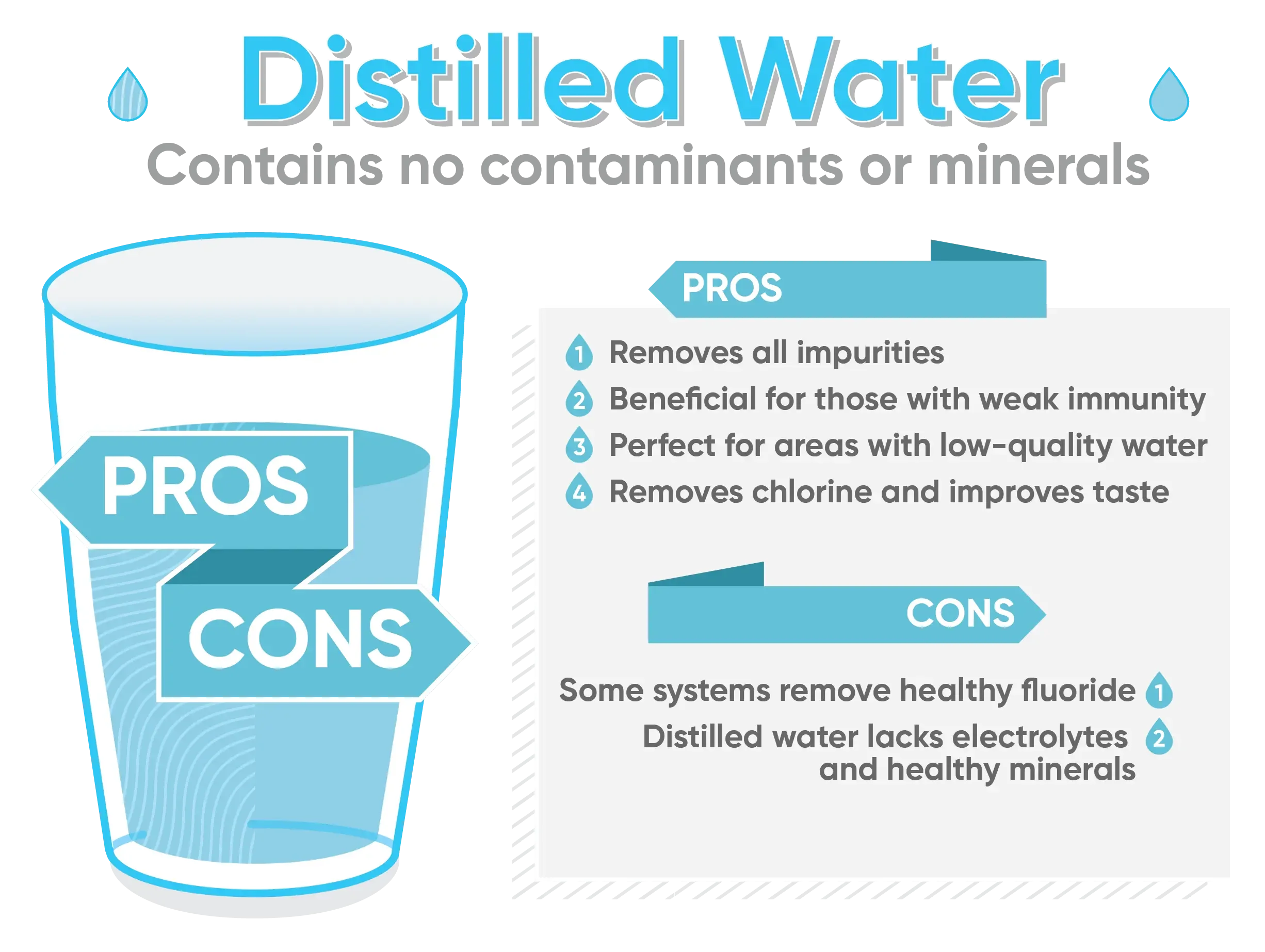
The primary advantage of distilled water is its exceptionally high purity, particularly concerning dissolved solids and inorganic contaminants. This makes it ideal for applications where the presence of even trace amounts of minerals can be detrimental.
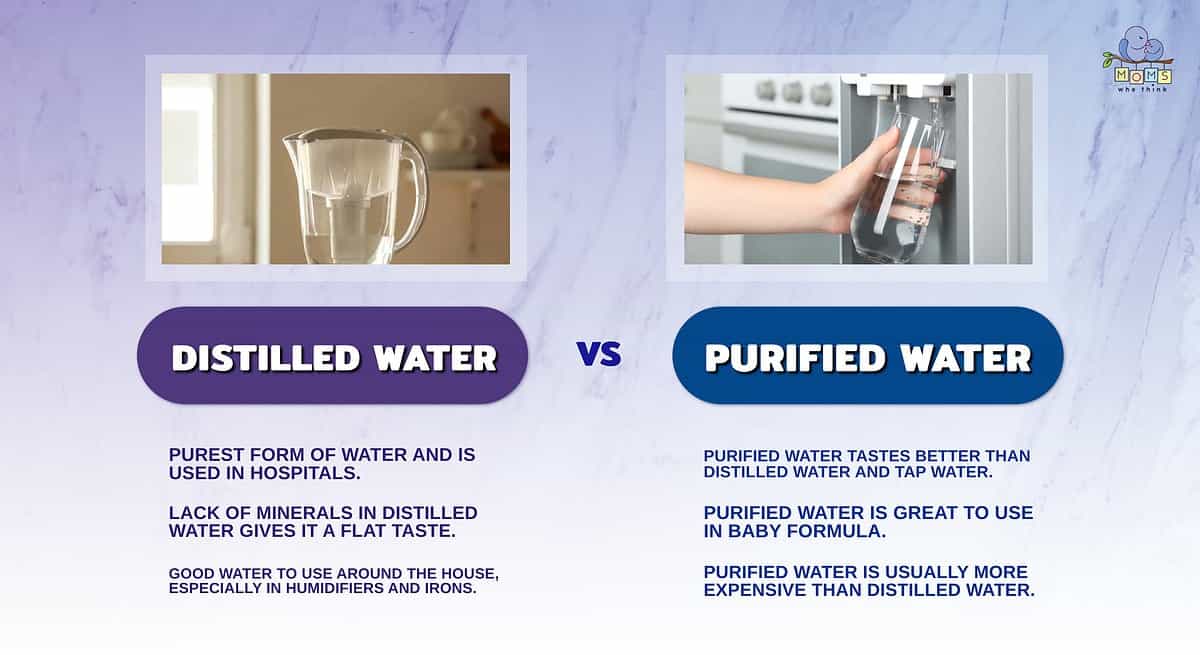
- Applications: Distilled water is widely used in laboratories for experiments where precise chemical reactions are required without interference from mineral ions. It’s essential for car batteries, steam irons (to prevent mineral buildup and clogging), humidifiers, and medical equipment such as CPAP machines. In some manufacturing processes, such as semiconductor fabrication, ultra-pure water, often achieved through distillation and further purification, is critical.
- Limitations: While highly effective at removing non-volatile impurities, distillation is less effective at removing volatile organic compounds (VOCs) that may have boiling points close to or lower than water. It also requires significant energy input due to the heating and cooling cycles, making it a less environmentally friendly and more costly method for large-scale purification compared to some other techniques. Furthermore, distilled water lacks the minerals that contribute to taste, making it taste flat to many people.
Purified Water: A Broader Category of Purity
“Purified water” is a more general term that encompasses any water that has undergone a process to remove impurities. It is not tied to a single specific method but rather to the outcome: water that has been treated to be free from contaminants. While distillation is a method of purification, not all purified water is distilled. Various technologies can be employed to achieve purified water, often in combination, to target different types of contaminants.
Common Technologies for Water Purification
Several advanced techniques are employed to purify water, each with its strengths in removing specific types of impurities:
- Reverse Osmosis (RO): This is a widely used technology that forces water through a semi-permeable membrane under high pressure. The membrane acts as a filter, allowing water molecules to pass through while blocking larger molecules, ions, and contaminants. RO is highly effective at removing dissolved salts, minerals, bacteria, viruses, and many chemicals. It is a cornerstone of desalination plants and is increasingly common in household water filtration systems.
- Pros: Excellent at removing a wide range of contaminants, including dissolved solids.
- Cons: Can be energy-intensive (though less so than distillation), requires regular membrane replacement, and can waste water if not optimized. It may also remove beneficial minerals.

-
Deionization (DI) / Demineralization: This process removes dissolved ionic compounds (salts and minerals) from water. It typically involves passing water through ion-exchange resins, which attract and bind with positive and negative ions, replacing them with hydrogen and hydroxide ions, which then form water.
- Pros: Highly effective at removing all dissolved ionic impurities, producing very high-purity water.
- Cons: Does not remove non-ionic contaminants like bacteria, viruses, or organic molecules. The resins eventually become saturated and need to be regenerated or replaced.
-
Ultraviolet (UV) Purification: UV light is used to inactivate or kill microorganisms like bacteria, viruses, and protozoa. It damages their DNA, preventing them from reproducing and causing illness.
- Pros: Effective at microbiological disinfection, does not add chemicals to the water, and does not alter the taste or odor.
- Cons: It does not remove dissolved solids, chemicals, or particulate matter. It requires clear water to be effective.
-
Ultrafiltration (UF) and Microfiltration (MF): These are membrane filtration processes that use membranes with different pore sizes to remove suspended solids, bacteria, and larger viruses. UF has smaller pores than MF, allowing it to remove a wider range of contaminants.
- Pros: Effective for removing suspended particles and microbes.
- Cons: Do not typically remove dissolved solids or smaller viruses.
-
Activated Carbon Filtration: This method uses activated carbon to adsorb (attract and hold onto the surface) organic compounds, chlorine, and other chemicals that affect taste and odor.
- Pros: Improves taste and odor, removes chlorine and some organic contaminants.
- Cons: Does not remove dissolved solids, minerals, or microorganisms.
Often, these technologies are used in combination. For example, a water purification system might employ activated carbon pre-filtration, followed by reverse osmosis, and then UV disinfection to achieve a high level of purity suitable for various applications.
The Hierarchy of Purity: Where do they stand?
Distilled water generally represents a very high standard of purity, especially concerning dissolved inorganic solids. However, the term “purified water” can encompass levels of purity that are even higher, particularly when referring to applications in fields like semiconductor manufacturing or pharmaceuticals. In these highly specialized industries, water undergoes multi-stage purification processes that often begin with distillation and are followed by deionization, ultrafiltration, and other advanced treatments to achieve “ultrapure water” with parts-per-trillion levels of contaminants.
Conversely, water that has undergone a simpler purification process, such as basic carbon filtration and UV disinfection, might also be classified as “purified water” for drinking purposes. Therefore, while distilled water is a specific type of purified water, not all purified water is necessarily distilled, and the degree of purity can vary widely within the broader “purified water” category.
Technological Implications and Applications
The distinction between distilled and purified water is not merely academic; it has tangible implications in various technological sectors, impacting efficiency, product longevity, and the reliability of sensitive equipment.
Electronics and Semiconductor Manufacturing
The electronics industry, particularly semiconductor manufacturing, demands the highest levels of water purity. Even minuscule amounts of dissolved ions, particles, or organic matter can lead to defects in microchips, drastically reducing yields and product reliability.
- Distilled Water in Electronics: Historically, distilled water was a staple in electronics manufacturing for cleaning and rinsing components. Its ability to remove conductive mineral ions helped prevent short circuits and corrosion.
- The Rise of Ultrapure Water: Modern semiconductor fabrication relies on ultrapure water (UPW), which goes beyond simple distillation. UPW is typically produced through a complex series of processes including reverse osmosis, ion exchange, and various forms of filtration. This water has virtually no measurable contaminants, measured in parts per billion or even parts per trillion. In this context, while distillation might be an initial step, it is insufficient on its own. The ability of RO and DI to remove a wider spectrum of ionic and organic impurities, combined with advanced filtration, is crucial.
Power Generation and Industrial Boilers
In power plants and industrial settings that utilize boilers, water purity is paramount for efficiency and equipment lifespan.
- Preventing Scale and Corrosion: Minerals in feedwater, such as calcium and magnesium, can precipitate out at high temperatures and pressures, forming scale on boiler tubes. This scale acts as an insulator, reducing heat transfer efficiency and potentially leading to overheating and tube failure. Dissolved gases like oxygen and carbon dioxide can cause significant corrosion.
- Distilled and Deionized Water: Distilled water, by removing most dissolved solids, significantly reduces scale formation. However, it may still contain dissolved gases. For critical applications, deionized water is often preferred, as ion exchange resins effectively remove both minerals and dissolved gases. In many high-pressure boiler systems, a combination of RO and DI is used to produce feedwater that is virtually free of scale-forming minerals and corrosive elements. The cost-effectiveness of RO for initial purification, followed by DI for final polishing, makes it a common choice.
Medical and Pharmaceutical Applications
The medical and pharmaceutical industries have stringent requirements for water purity to ensure patient safety and product integrity.
- Medical Devices: Distilled water is commonly used in devices like CPAP machines, humidifiers, and autoclaves. Its purity prevents mineral buildup that can clog tubes and affect device performance.
- Pharmaceutical Manufacturing: Water used in pharmaceutical production, known as Purified Water (USP) and Water For Injection (WFI), must meet rigorous pharmacopoeial standards. WFI, the highest grade, is typically produced through distillation or reverse osmosis followed by electro-deionization, ensuring the absence of pyrogens (fever-inducing substances) and microbial contamination. While distillation is a valid method for achieving a high purity standard, advanced RO and DI systems are often employed for their efficiency and ability to consistently produce water meeting these critical specifications. The energy efficiency of modern RO systems can also be a significant factor in large-scale pharmaceutical operations.
Conclusion: Choosing the Right Purity for the Task
The difference between distilled and purified water lies in the specificity of the purification method and the resulting impurity profile. Distilled water is a product of a specific process – evaporation and condensation – that excels at removing dissolved solids and non-volatile contaminants. Purified water, on the other hand, is a broader category defined by the outcome of removing impurities, achieved through a variety of technologies, often employed in combination.
In the realm of technology, understanding these differences is crucial for selecting the appropriate water for the intended application. From the ultra-high purity required in semiconductor fabrication to the mineral-free water needed for industrial boilers and the sterile conditions demanded in pharmaceuticals, the choice directly impacts operational efficiency, equipment longevity, and product quality. While distillation remains a robust method for achieving a high level of purity, advancements in technologies like reverse osmosis, deionization, and advanced filtration have expanded the toolkit for creating purified water tailored to the increasingly demanding purity requirements of modern technology. Ultimately, selecting the right type of water is an informed decision that hinges on a thorough understanding of the impurities present and the precise purity standards required for optimal performance and reliability.
aViewFromTheCave is a participant in the Amazon Services LLC Associates Program, an affiliate advertising program designed to provide a means for sites to earn advertising fees by advertising and linking to Amazon.com. Amazon, the Amazon logo, AmazonSupply, and the AmazonSupply logo are trademarks of Amazon.com, Inc. or its affiliates. As an Amazon Associate we earn affiliate commissions from qualifying purchases.