
In the rapidly evolving landscape of digital storage, terms like SSD, NVMe, and NAND flash have become household names for tech enthusiasts and professionals alike. However, beneath these broad labels lies a complex hierarchy of technologies that determine how our data is stored, how fast it can be accessed, and how long the hardware will last. At the pinnacle of this hierarchy sits SLC, or Single-Level Cell NAND flash.
While the consumer market is currently dominated by high-capacity, budget-friendly drives, SLC remains the gold standard for mission-critical applications, enterprise environments, and high-performance computing. To understand why SLC is often referred to as the “elite” tier of flash storage, one must delve into the physics of how data is trapped in silicon and the architectural trade-offs that define modern computing.
The Architecture of NAND Flash: Defining the Single-Level Cell
To understand what SLC is, we must first understand the fundamental building block of solid-state storage: the NAND flash cell. Traditional hard drives rely on magnetic platters and mechanical arms, but SSDs use a grid of transistors known as floating-gate cells. These cells store electrons, and the presence or absence of a charge represents the data.
The One-Bit-Per-Cell Philosophy
The defining characteristic of SLC is its simplicity. As the name suggests, a Single-Level Cell stores exactly one bit of data per physical cell. In binary terms, this means the cell is either “0” or “1.” From a technical perspective, the controller only needs to distinguish between two distinct voltage levels: one representing a programmed state and one representing an erased state.
This binary simplicity is the root of all SLC’s advantages. Because the threshold between a “0” and a “1” is so wide, the drive’s controller can quickly and accurately determine the state of the cell. This is a stark contrast to Multi-Level Cell (MLC), Triple-Level Cell (TLC), or Quad-Level Cell (QLC) technologies, which must distinguish between 4, 8, or 16 different voltage levels within the same physical space.
Why Complexity Slows Down Storage
In higher-density flash (like TLC or QLC), the margin for error is razor-thin. The controller must use sophisticated error-correction code (ECC) and take more time to “read” the precise voltage level to ensure it hasn’t misinterpreted a bit. By sticking to a single bit per cell, SLC avoids these complexities. There is no ambiguity; the cell is either charged or it isn’t. This architectural choice results in the lowest possible latency and the highest possible read/write speeds currently available in NAND technology.
Performance and Endurance: The SLC Competitive Advantage
When evaluating storage technology, professional users typically look at three metrics: speed, endurance, and reliability. In all three categories, SLC outperforms its multi-bit counterparts by a significant margin.
Unmatched Data Endurance
Every time a NAND cell is written to or erased, it undergoes a tiny amount of physical degradation. This process is measured in P/E (Program/Erase) cycles. For a standard TLC drive found in most consumer laptops, a cell might survive 3,000 P/E cycles before it can no longer reliably hold a charge.
SLC, by comparison, is incredibly robust. Because the voltage margins are so wide, the cell can sustain significant wear and tear before the data becomes unreadable. A typical SLC chip can handle between 50,000 and 100,000 P/E cycles. This makes SLC-based storage virtually “immortal” in the context of standard computing, and a necessity for industrial applications where data is written and rewritten 24/7.
Reliability in Extreme Environments
Beyond just longevity, SLC offers superior data retention and reliability under stress. High temperatures can cause electrons to “leak” from flash cells—a phenomenon known as data rot. In a QLC drive, a tiny bit of leakage can change the cell’s state from one voltage level to another, corrupting the data. Because SLC only has two states with a massive gap between them, it is much more resistant to temperature fluctuations and electromagnetic interference. This is why SLC is the preferred choice for automotive tech, aerospace systems, and industrial machinery operating in harsh conditions.
SLC vs. MLC, TLC, and QLC: The Trade-off of Density and Cost
The primary reason why every laptop doesn’t come equipped with an SLC drive is not a matter of performance, but of economics and physical density. The history of NAND flash has been a constant struggle between the desire for speed and the demand for higher capacities at lower prices.
The Cost of Premium Performance
Because SLC only stores one bit per cell, it requires significantly more silicon to reach the same capacity as a TLC or QLC drive. For example, to create a 1TB drive using SLC technology, you would need three times as many physical NAND cells as you would for a 1TB TLC drive. This translates directly to manufacturing costs.
As of the current market, SLC is exponentially more expensive per gigabyte than consumer-grade flash. For most home users, the extreme speed and endurance of SLC do not justify a price tag that can be ten times higher than a standard NVMe SSD.
The Shift to “Pseudo-SLC” (pSLC)
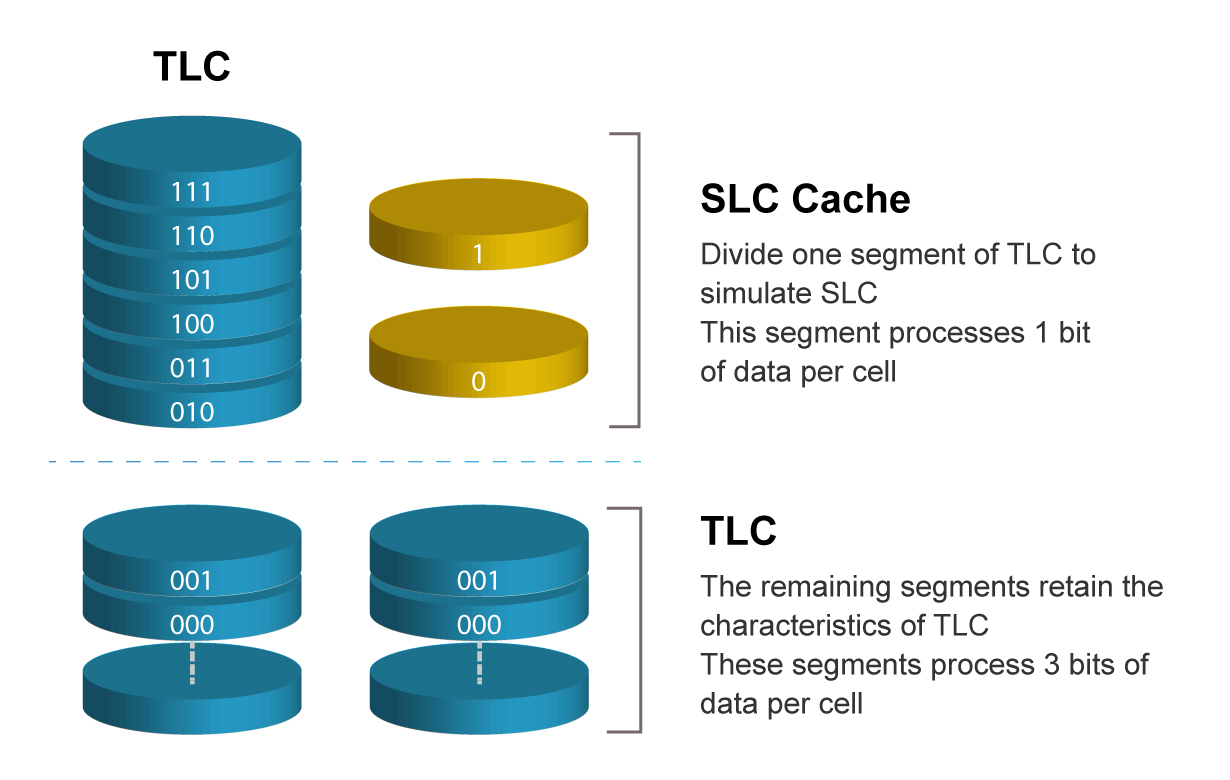
In a clever engineering compromise, many modern consumer drives use a technique called “SLC Caching.” The drive identifies a portion of its TLC or QLC NAND and treats it as if it were SLC, storing only one bit per cell in that specific area. This provides a massive “burst” of speed for small file transfers. However, once that cache is full, the drive slows down significantly as it reverts to its native, slower storage method. While this gives consumers a taste of SLC performance, it does not offer the true endurance or reliability of a native SLC drive.
Practical Applications: Where Does SLC Thrive?
While the average gamer or office worker may never need a pure SLC drive, several sectors of the tech industry rely on it as a cornerstone of their infrastructure.
Enterprise Data Centers and High-Frequency Trading
In the world of high-frequency trading (HFT), milliseconds are worth millions of dollars. The ultra-low latency of SLC flash ensures that transactions are logged and processed with the absolute minimum delay. Similarly, in enterprise data centers, SLC is often used for “write-intensive” workloads, such as database indexing or as a high-speed buffer for larger, slower storage arrays.
Industrial and Embedded Systems
Think of the computer systems inside a high-speed train, a medical MRI machine, or a military drone. These systems often require relatively small amounts of storage (usually under 128GB), but that storage must be 100% reliable for decades under vibration, heat, and constant use. In these scenarios, the cost of the drive is negligible compared to the cost of a system failure. SLC is the only logical choice for embedded systems where “failure is not an option.”
High-End Media Production
Professional cinematography and 8K video recording generate massive amounts of data at incredible speeds. When a camera is recording at a high bitrate, the storage media must be able to sustain a constant, high-speed write without dropping frames. Professional-grade CFexpress cards and external SSDs for cinema cameras often utilize SLC or high-grade pSLC to ensure the footage is captured safely without the risk of thermal throttling or write-speed dips.
The Future of SLC: Evolution in the Age of 3D NAND
As we look toward the future, the role of SLC is evolving. The transition from 2D (planar) NAND to 3D NAND (where cells are stacked vertically like a skyscraper) has allowed manufacturers to increase capacity across all flash types. However, this has not made SLC obsolete; rather, it has refined its purpose.
The Rise of Specialized Storage Tiers
We are moving toward a tiered storage architecture. In this model, “Cold Data” (files you rarely access) sits on cheap QLC drives or even traditional HDDs. “Warm Data” sits on TLC drives. “Hot Data”—the information the CPU needs right this second—is increasingly being handled by specialized SLC or SLC-like technologies like Intel’s Optane (though now discontinued) or Kioxia’s XL-NAND.

Is SLC Still Relevant for Consumers?
For the general tech consumer, the “what is SLC” question is most relevant when looking at the quality of an SSD’s cache or its “TBW” (Total Bytes Written) rating. As software becomes more data-intensive and AI models require faster local caching, the principles behind SLC—simplicity, speed, and durability—continue to drive innovation.
In conclusion, while you might not find a 2TB SLC drive in your next budget laptop, the technology remains the bedrock of the high-performance computing world. It represents the limit of what NAND flash can achieve when we prioritize quality and speed over raw capacity. Whether it’s powering the server that hosts your favorite website or ensuring the safety of an autonomous vehicle, SLC is the silent engine of the high-end tech world.
aViewFromTheCave is a participant in the Amazon Services LLC Associates Program, an affiliate advertising program designed to provide a means for sites to earn advertising fees by advertising and linking to Amazon.com. Amazon, the Amazon logo, AmazonSupply, and the AmazonSupply logo are trademarks of Amazon.com, Inc. or its affiliates. As an Amazon Associate we earn affiliate commissions from qualifying purchases.