
MicroStrategy (NASDAQ: MSTR) has emerged as one of the most intriguing and widely discussed stocks in the financial world, transcending its traditional role as an enterprise software company. For many investors, “MicroStrategy stock” has become synonymous with “Bitcoin proxy,” reflecting its audacious strategy of holding a significant portion of its corporate treasury in Bitcoin. Understanding MSTR stock, therefore, requires a dual lens: one focused on its foundational business intelligence software and another on its pioneering, high-conviction bet on the world’s leading cryptocurrency. This article delves into the multifaceted nature of MicroStrategy stock, exploring its core identity, key valuation drivers, inherent risks, and how investors can approach analyzing this unique investment vehicle.

The Dual Identity of MicroStrategy: Enterprise Software & Bitcoin Powerhouse
MicroStrategy’s journey from a conventional tech company to a major player in the Bitcoin ecosystem is central to comprehending its stock’s current dynamics. Its long-standing business in enterprise software provides a bedrock, while its more recent pivot to Bitcoin has become its primary narrative.
MicroStrategy’s Core Business: Enterprise Software Foundation
Founded in 1989, MicroStrategy built its reputation as a leading provider of enterprise analytics and business intelligence (BI) software. Its suite of products helps organizations analyze vast datasets, uncover trends, and make data-driven decisions. This includes advanced analytics, mobile intelligence, and cloud services, catering to a diverse global client base spanning various industries. The company’s traditional revenue streams are derived from software licenses, subscriptions, and related support and consulting services. This core business represents a steady, albeit mature, operation that generates consistent cash flow and forms the fundamental operational value of the company. While often overshadowed by its Bitcoin strategy, this underlying software business provides a crucial, tangible asset base and ongoing revenue that supports the broader corporate strategy.
The Bitcoin Bet: A Strategic Treasury Shift
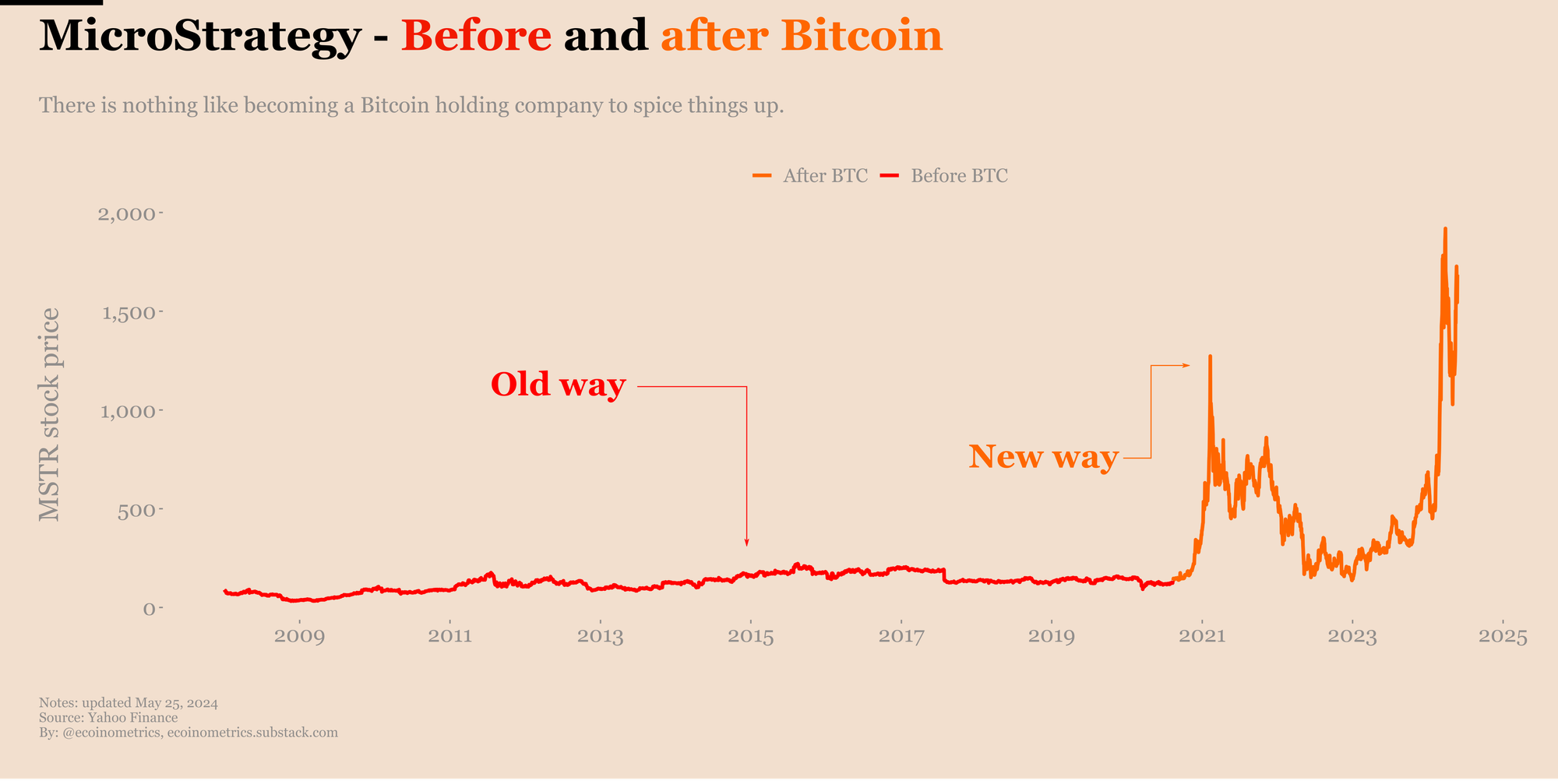
In August 2020, under the leadership of then-CEO Michael Saylor, MicroStrategy embarked on a groundbreaking corporate treasury strategy, adopting Bitcoin as its primary treasury reserve asset. The rationale articulated by Saylor and his team centered on Bitcoin’s perceived superiority as a store of value compared to traditional fiat currencies, which are susceptible to inflation and monetary debasement. The company began accumulating Bitcoin aggressively, using cash from its operations, proceeds from debt offerings (including convertible notes), and even direct equity sales. This move transformed MicroStrategy into the first publicly traded company to make Bitcoin its central treasury asset, effectively turning its stock into a unique vehicle for investors seeking indirect exposure to Bitcoin through a regulated entity. This strategic shift fundamentally altered how the market perceives and values MSTR, linking its performance inextricably to the fortunes of Bitcoin.
Understanding MSTR’s Valuation Drivers
The valuation of MicroStrategy stock is a complex exercise, diverging significantly from traditional software company metrics. Its unique position as a hybrid entity necessitates a specialized approach that balances its software fundamentals with its substantial cryptocurrency holdings.
Bitcoin Holdings: The Primary Catalyst for MSTR’s Price
The most significant driver of MicroStrategy’s stock performance is undoubtedly the price of Bitcoin. With hundreds of thousands of Bitcoin on its balance sheet, movements in the cryptocurrency’s value translate directly into changes in MicroStrategy’s reported assets and, by extension, its market capitalization. For many investors, MSTR acts as a “leveraged Bitcoin play” or a “Bitcoin proxy,” offering a way to invest in Bitcoin without directly owning the cryptocurrency. The company frequently updates its Bitcoin holdings, providing transparency that allows investors to track the intrinsic value derived from its crypto treasury. Consequently, investor sentiment around Bitcoin, regulatory news concerning cryptocurrencies, and broader market trends in the digital asset space all exert a powerful influence on MSTR’s stock price.
The Software Business as a Valuator Component
While Bitcoin dominates the narrative, the underlying software business still contributes to MicroStrategy’s valuation. Analysts often attempt to separate the value of the software segment from the Bitcoin holdings. This involves assessing the traditional metrics of a software company: revenue growth, profitability, operating margins, and market share in the business intelligence space. The software business generates cash flow that can either be reinvested, used to service debt, or, as has often been the case, funneled into additional Bitcoin purchases. Understanding the health and performance of this segment provides a floor to the company’s valuation and ensures there’s an operational enterprise beneath the crypto asset. However, the market often applies a “sum-of-the-parts” valuation, where the software business’s contribution is frequently overshadowed by the volatility and potential upside of the Bitcoin treasury.
Debt and Capital Structure Impact
MicroStrategy’s aggressive Bitcoin accumulation strategy has been significantly financed through various forms of debt, primarily convertible notes. These notes allow the company to raise capital at relatively low interest rates, with the option for investors to convert their debt into equity if the stock price reaches certain thresholds. While this strategy has enabled MicroStrategy to scale its Bitcoin holdings rapidly, it also introduces significant leverage and financial risk. The company’s balance sheet reflects substantial debt, which must be serviced regardless of Bitcoin’s performance. Investors must analyze the company’s debt-to-equity ratios, interest coverage, and maturity schedules of its various convertible notes. The capital structure impacts dilution potential for existing shareholders if conversion occurs and adds a layer of complexity to its risk profile, particularly during periods of high interest rates or Bitcoin price depreciation.
Investment Considerations and Risks
Investing in MicroStrategy stock comes with a unique set of considerations and risks that differ from typical equity investments. Its high correlation with a volatile asset like Bitcoin, coupled with its distinctive management philosophy, demands thorough due diligence.
Volatility and Market Sensitivity
The most pronounced risk associated with MSTR stock is its extreme volatility, mirroring and often amplifying the price swings of Bitcoin. As a highly speculative asset, Bitcoin is known for its dramatic upward and downward movements. Because MicroStrategy’s valuation is so heavily tied to its Bitcoin treasury, its stock price experiences similar, if not greater, fluctuations. Investors in MSTR must therefore have a high tolerance for risk and be prepared for potentially significant drawdowns. Furthermore, broader market sentiment towards risk assets, macroeconomic factors, and regulatory announcements concerning cryptocurrencies can all trigger rapid shifts in MSTR’s valuation, making it susceptible to sudden and unpredictable changes.
Management Strategy and Execution Risk
Michael Saylor, a prominent advocate for Bitcoin, has been the driving force behind MicroStrategy’s strategic pivot. His conviction and unwavering commitment to Bitcoin define the company’s direction. While this single-minded focus has been a catalyst for MSTR’s growth alongside Bitcoin, it also represents a concentration of strategic risk. The company’s fortunes are intrinsically linked to Saylor’s vision and the management team’s continued execution of the Bitcoin strategy. Any change in leadership, a significant shift in the strategic outlook, or a major misstep in managing their substantial Bitcoin holdings could have profound implications for the stock. This concentrated bet contrasts with diversified corporate treasury management typical of most public companies.

Regulatory and Competitive Landscape
The cryptocurrency market operates within an evolving and often uncertain regulatory environment. Potential new regulations impacting Bitcoin and other digital assets could have significant implications for their valuation, which would directly affect MSTR. Geopolitical events, changes in monetary policy, or governmental crackdowns on crypto could all pose substantial risks. Additionally, while MSTR gained a first-mover advantage, the competitive landscape for gaining Bitcoin exposure through traditional markets is evolving. The approval of spot Bitcoin Exchange Traded Funds (ETFs) in various markets, for instance, provides investors with alternative, potentially less complex, and less leveraged ways to gain direct exposure to Bitcoin, which could dilute MSTR’s appeal as the primary proxy.
How to Analyze MicroStrategy Stock
Analyzing MSTR stock requires a blend of traditional financial analysis and an acute understanding of the cryptocurrency market. Traditional metrics alone may not fully capture its unique value proposition or risk profile.
Fundamental Analysis: Beyond Traditional Metrics
Traditional fundamental analysis metrics like Price-to-Earnings (P/E) or Price-to-Sales (P/S) ratios are often insufficient or misleading for MSTR due to the outsized impact of its Bitcoin holdings. A more appropriate approach involves a “sum-of-the-parts” valuation. This entails:
- Valuing the Bitcoin Holdings: Calculate the market value of MicroStrategy’s total Bitcoin treasury. This is the most straightforward part, given the transparency of their holdings.
- Valuing the Software Business: Assess the intrinsic value of the business intelligence software segment, often using discounted cash flow (DCF) analysis or comparable company analysis (CCA) based on traditional software multiples.
- Adjusting for Debt and Other Liabilities: Subtract the net debt and other liabilities from the combined value of Bitcoin and the software business to arrive at an estimated Net Asset Value (NAV) per share.
Comparing the current market capitalization of MSTR to this calculated NAV provides insight into whether the stock is trading at a premium or discount to its underlying assets. This analysis needs to be regularly updated due to Bitcoin’s price fluctuations.
Technical Analysis: Charting the Bitcoin Correlation
Technical analysis for MSTR often involves observing its price action in conjunction with Bitcoin’s chart. Identifying trends, support and resistance levels, and charting patterns can offer insights into short-term price movements and investor sentiment. Due to its high correlation, MSTR’s chart frequently mirrors Bitcoin’s, albeit often with greater volatility. Traders might look for divergences or confirmations between the two assets to inform their decisions. Indicators like Relative Strength Index (RSI) or Moving Average Convergence Divergence (MACD) can also be applied, but always within the context of the underlying Bitcoin movements.
Understanding the Premium/Discount to NAV
A key aspect of MSTR analysis is understanding why its stock might trade at a premium or discount to its calculated Net Asset Value (NAV). Several factors can contribute:
- Leverage: The use of debt to acquire Bitcoin can lead to a premium, as it offers a leveraged exposure to Bitcoin, potentially amplifying returns (and losses).
- Management Premium: Some investors might pay a premium for Michael Saylor’s proven track record, conviction, and strategic leadership in the crypto space.
- Liquidity and Access: For some institutional investors, MSTR might be a more accessible or preferred route to gain Bitcoin exposure compared to direct ownership, especially when Bitcoin ETFs were not widely available.
- Tax Efficiency: Depending on jurisdiction, holding MSTR might offer different tax implications compared to direct Bitcoin ownership.
- Risk Perception: Conversely, concerns about debt, regulatory risks, or the concentrated nature of the treasury strategy could lead to a discount.
Monitoring this premium or discount provides a powerful indicator of market sentiment toward both MicroStrategy’s strategy and the broader Bitcoin market.
The Broader Implications for Investors
MicroStrategy’s bold strategy has far-reaching implications, not just for its own shareholders but for the broader investment landscape and corporate finance.
A Unique Investment Vehicle
MicroStrategy stock represents a truly unique investment vehicle, blurring the lines between a traditional tech company and an investment fund. It offers a publicly traded, regulated avenue for investors to gain exposure to Bitcoin, effectively making it a proxy for the cryptocurrency. This provides an alternative for those who might be hesitant or unable to directly purchase and custody Bitcoin, or for those seeking a leveraged play on Bitcoin’s price movements through an equity wrapper. Its existence has spurred discussions among corporate treasurers globally about alternative asset strategies and inflation hedges.
The Future of Corporate Treasury Management
MicroStrategy’s pioneering adoption of Bitcoin as a primary treasury reserve asset has effectively created a new template for corporate finance. Its success or failure could influence how other publicly traded companies view and manage their cash reserves in an era of inflation and unprecedented monetary policy. Saylor’s aggressive stance and detailed explanations of the strategy have prompted broader consideration of Bitcoin’s role in corporate balance sheets, challenging conventional wisdom about liquidity and asset management. MicroStrategy is a living case study that continues to shape the discourse around the integration of digital assets into mainstream finance, demonstrating how a company can strategically position itself at the forefront of a paradigm shift.
Conclusion
MicroStrategy stock is far more than just shares in an enterprise software company; it is a high-conviction bet on the future of Bitcoin and a powerful case study in innovative corporate treasury management. Investors considering MSTR must look beyond traditional equity analysis and embrace a sophisticated understanding of both its underlying software business and its substantial, market-moving Bitcoin holdings. It offers a unique, albeit volatile, pathway to Bitcoin exposure, driven by a clear strategic vision and significant financial leverage. While the risks are considerable, particularly given Bitcoin’s inherent volatility and the concentrated nature of MicroStrategy’s strategy, the potential for significant returns tied to Bitcoin’s appreciation continues to captivate investors, making MSTR a perennial point of discussion and analysis in the financial markets.
aViewFromTheCave is a participant in the Amazon Services LLC Associates Program, an affiliate advertising program designed to provide a means for sites to earn advertising fees by advertising and linking to Amazon.com. Amazon, the Amazon logo, AmazonSupply, and the AmazonSupply logo are trademarks of Amazon.com, Inc. or its affiliates. As an Amazon Associate we earn affiliate commissions from qualifying purchases.